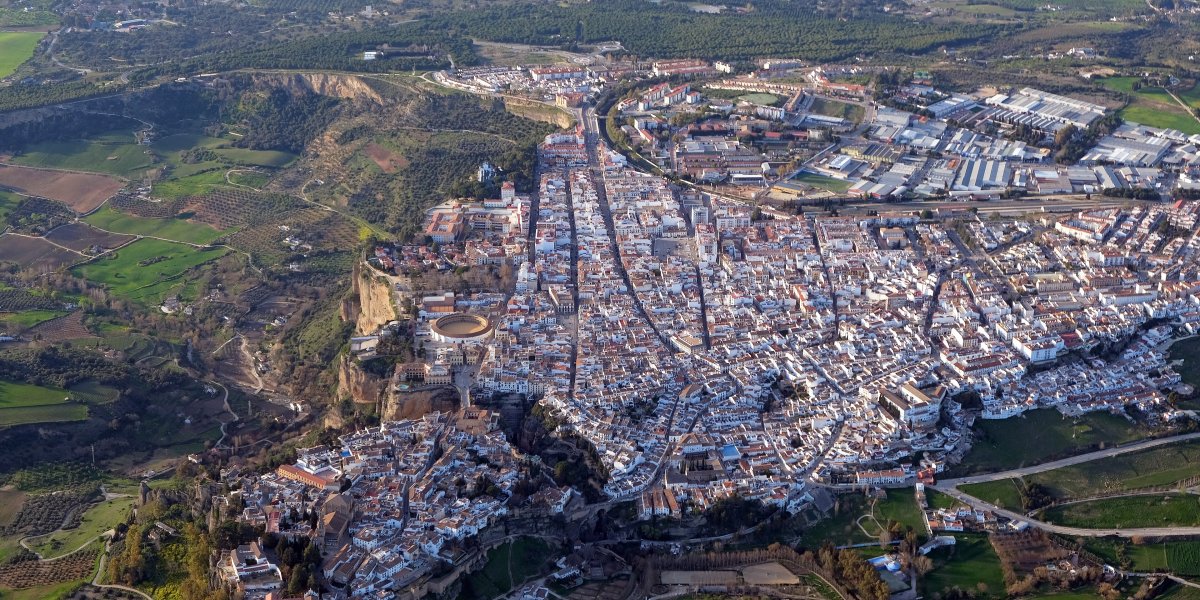
City Guide
Ronda
España · Best time to visit: Mar-Jun, Sep-Oct.
Day-by-day plan
Choose your pace
Duración del viaje
09:00
Landmark
From wherever you arrive in the new town, walk south to Calle Virgen de la Paz and the bullring appears on your right — the sandstone facade glowing in the morning light. Spain's oldest bullring (1785), Neoclassical and perfectly proportioned, and at 09:00 the east face is lit golden while the first tour buses don't roll in until 10:30. We circle the exterior for photos, then slip next door into the Alameda del Tajo — the cliff-edge promenade where 19th-century Rondeños took their evening air. Walk to the far railing and take your first peek over the 150-meter drop: a free preview of the gorge you're about to cross.
Tip: Stand at the iron railing at the northwest corner of Alameda del Tajo — it juts out like the prow of a ship over the valley and gives the cleanest, most vertiginous view of the Serranía de Ronda with no building in frame. The Instagram spot on the south railing always has a queue; this one almost never does.
Open in Google Maps →10:30
Landmark
Exit the Alameda and walk 5 minutes south down Calle Virgen de la Paz — you'll pass the white-walled Parador, and the ground under your feet tightens as the gorge closes in. Then the Puente Nuevo opens up: the 120-meter stone bridge that took 42 years to finish (1759–1793) and cost the life of its architect, who fell from his own basket into the gorge. Cross it into the old town, then follow the signs from Plaza de María Auxiliadora down the cliff path to Mirador de Aldehuela — the classic postcard angle where the bridge rises out of the rock like a cathedral organ. The 11:00 light is still soft and the eastern arches hold a deep shadow, which is the contrast every photographer waits for.
Tip: The real money shot isn't at the top of the path — it's at the unmarked rocky ledge on your left about 80 steps down, where the full triple-arch frames perfectly with the town roofline on top. Wear grippy shoes; the last 20 meters of the descent are smooth limestone and slick if there's morning dew.
Open in Google Maps →12:30
Food
Climb back up to Plaza de España, then 3 minutes north on Calle Santa Cecilia — you'll hear Faustino before you see it: the clatter of plates, a room full of Rondeños on their lunch break, and a chalkboard pinned to the wall with today's tapas in hand-written Spanish. A no-frills vermouth-and-tapas bar with zero concession to tourists and exactly the right energy for a quick, proud midday stop. Order the carrillada ibérica (slow-braised pork cheek on bread, €4.50), a flamenquín (rolled pork loin with jamón, €5), and a small glass of Málaga vermouth on tap (€2). Counter service, standing room, fifteen minutes and you're done right.
Tip: Arrive at 12:30 sharp — by 13:15 the bar is three-deep with locals and the carrillada sells out. Order at the counter, not the table; the bartender tallies chalk marks on the wood in front of you and you pay when you leave. If you want something the tourists miss entirely, ask for the rabo de toro montadito — it's not on the board.
Open in Google Maps →13:30
Neighborhood
Walk 6 minutes south, recross Puente Nuevo, and duck into the old town through the stone arch on the immediate right — cobbled Calle Armiñán is La Ciudad's spine and it empties out the moment tour groups sit down to lunch, which is exactly why we time it for now. Wander south past Iglesia de Santa María la Mayor on Plaza Duquesa de Parcent — exterior only, the whitewashed tower rises on the foundations of Ronda's main mosque and you can still see the minaret profile under the Christian stonework. Continue east on Calle Marqués de Salvatierra to Casa del Rey Moro, where the hanging gardens spill down the cliff — look over the public wall to see them for free, no ticket needed.
Tip: Two blocks south of Santa María, find Plaza del Campillo — it's a tiny cliff-edge square almost no one visits, and it hands you the best side-on view of the old town perched along the gorge, with Puente Nuevo framed on the far right. Most guides don't mention it because it's off the main axis, which is exactly why the light and the silence stay pure in the early afternoon.
Open in Google Maps →15:30
Landmark
From Plaza del Campillo, take Calle Tenorio east and pick up the signed footpath through Jardines de Cuenca — a series of terraced switchbacks down the cliff that drops you onto the valley floor in about 15 minutes. You'll arrive at the Baños Árabes de Ronda, the best-preserved Arab baths in Spain (13th–14th century): we view the exterior — the brick horseshoe arches, the star-shaped skylights cut into the dome, the raised aqueduct still feeding the old cistern. Then cross Puente Viejo (the 16th-century 'old bridge') and spot the tiny Puente Romano just below — a magical water-pooled corner most visitors never find. Climb back up at 17:00 as the afternoon sun turns the limestone cliff honey-gold, which is the color Ronda is actually famous for but almost no one sees because they leave before it happens.
Tip: For the climb back, take the stone staircase of Cuesta de las Imágenes, not the paved road — it's steeper but saves 8 minutes and passes two hidden east-facing balconies where the Sierra de Grazalema glows pink at golden hour. Bring a bottle of water; there are no shops in the valley and the ascent is about 140 meters of vertical over 600 meters of path.
Open in Google Maps →19:30
Food
From the top of the climb, walk south through the old town to Puerta de Almocábar — the horseshoe Moorish gate at La Ciudad's southern edge — and the restaurant is 30 seconds on your left at Calle Ruedo Alameda 5. You'll smell the wood grill before you see the door. A century-old tavern beloved by Rondeños, white-washed walls, hand-painted tiles, low vaulted ceilings, and a chef-owner who still works the line every night. Order the rabo de toro (oxtail stewed until it slides off the bone, €19) with a glass of Descalzos Viejos — a tinto made 2 km away in the Ronda wine valley (€5). For a starter, the revuelto de setas with jamón (wild mushroom scramble, €12) is the dish locals come home for. Budget €35–40 per person with wine. This is the meal you came to Spain for.
Tip: Reserve 19:00 or 19:30 — the 20:30 seating fills with tour groups and the kitchen slows. Ask for a table in the inner vaulted room, not the front terrace, for the real 17th-century atmosphere. Warning: avoid every restaurant ringing Plaza de España with laminated multi-language menus and photos of the food — they charge €25 for frozen paella and microwaved croquetas, and the touts outside the bullring steering you toward 'traditional flamenco dinners' are selling the same food with a €20 show surcharge. Every meal worth eating in Ronda is one or two blocks off the tourist axis, and Almocábar is the proof.
Open in Google Maps →Saltar al día
10:00
Landmark
Most hotels cluster within five minutes of Plaza de España — walk north along Calle Virgen de la Paz and the bullring's ochre façade fills the end of the avenue. Spain's oldest stone arena (1785) and the birthplace of modern bullfighting, the ring also houses the Royal Cavalry Museum with Goya's original Tauromaquia engravings. Step onto the sand floor, look up at the double ring of Tuscan columns, and every photo you've ever seen of Ronda suddenly has a center.
Tip: Buy tickets online the night before and walk straight to turnstile 1 when doors open at 10:00 — by 11:15 the arena floor fills with tour-group selfies. The two details almost nobody notices: the stables behind the ring (horses still train here for the September Corrida Goyesca) and the small chapel where matadors pray before the fight.
Open in Google Maps →12:00
Park
Exit the bullring, cross the street, walk under the plane-tree arcade — two minutes to the park's three cliff-edge balconies. A 19th-century public garden carved out of the cliff-top with cast-iron benches facing a vertical 100-meter drop into the Serranía de Ronda. This is the view Rainer Maria Rilke sat with in 1912 when he called Ronda 'the dream city' — and the line is still accurate.
Tip: The middle of the three balconies juts furthest out — stand at the waist-high parapet for the uninterrupted sierra shot. Morning haze usually burns off by 11:30, so 12:00 gives the cleanest mountain line; by late afternoon the sun is directly behind the peaks and the photo goes flat.
Open in Google Maps →13:00
Food
Walk back past the bullring and cross Plaza de España — six minutes down Calle Nueva brings you to the door. Chef Benito Gómez's tapas bar (he runs the two-Michelin-star Bardal next door) serves the city's best-value serious cooking in a twelve-stool room. Order the pringá taco (€5 — slow-cooked pork, chorizo, and morcilla wrapped in house-made corn tortilla, Gómez's signature) and the oxtail croquetas (€10); full lunch with wine €25-30.
Tip: No reservations at the bar — arrive at 13:00 sharp when doors open and claim a counter stool where you can watch the pass. By 13:45 there's a forty-minute queue down the sidewalk. Skip the dining-room menu (fixed price, less interesting); the real food is the snacks list above the counter.
Open in Google Maps →14:45
Landmark
Three minutes south down Calle Nueva, the street ends at Plaza de España and the bridge is directly in front of you. Finished in 1793 after 42 years of construction (and the death of its architect, who fell from the scaffolding), the three-tiered arch spans the 120-meter El Tajo gorge in three honey-colored stone leaps. Enter the Centro de Interpretación at the north-side staircase — a door in the bridge's inner arch lets you stand inside the structure itself, eye-level with the gorge walls.
Tip: The interpretation center is nearly empty after 15:00 once the Málaga day-trippers leave — perfect timing. Skip the mule-drawn carriages in Plaza de España: €30 for a 15-minute loop that never leaves the tourist strip. The real walk down into the gorge is your next stop.
Open in Google Maps →16:00
Park
Walk back to the new-town side, follow Calle Jerez four minutes west, and descend the signposted terraced path down the cliff face. A small hillside garden named for Ronda's twin city in Castile, with six switchback terraces that carry you halfway down the gorge to the iconic low-angle view of the bridge. Between 16:30 and 18:00 the setting sun hits the east-facing cliff wall head-on and the Puente Nuevo turns copper against the shadow of the gorge — this is when the postcard photograph happens, not at noon.
Tip: The second-lowest terrace has a stone bench angled exactly at the bridge — the vantage every published photograph of Ronda uses. Wear shoes with grip: the worn limestone steps get slick after even a light rain and there's no handrail on the lower switchbacks.
Open in Google Maps →20:00
Food
Climb back up to Calle Virgen de la Paz — seven minutes — and the restaurant's wood-paneled door faces the bullring's back gate. Ronda's classic dining room since 1970, named after the matador who codified modern bullfighting; the walls are a museum of tauromaquia photographs and Pedro Romero's own montera hat in a glass case. Order rabo de toro estofado (oxtail stew, €22 — three hours of slow braise in Rioja and cloves) and perdiz a la rondeña (partridge with wild mushroom, €24).
Tip: Reserve at least 24 hours ahead — walk-ins are turned away every Friday and Saturday night. Avoid the 'menú turístico' boards along the Plaza de España balustrade: those places exist purely for the bridge-view crowd, the gazpacho comes from a carton, and the sangría is cut with lemonade. Locals eat at Pedro Romero, Tragatá, or the San Francisco side streets — nowhere on the plaza itself.
Open in Google Maps →09:30
Landmark
Cross the Puente Nuevo south into the old town, turn immediately left onto Calle Santo Domingo — three minutes to the house's Mudéjar-tile doorway on the right. An 18th-century mansion built atop a Nasrid-era palace, with a hanging garden designed in 1912 by Jean-Claude Forestier (the architect behind Paris's Champ-de-Mars). The real attraction is underground: 236 stone steps cut into the cliff during the 14th century, descending all the way to the river so slaves could haul water in leather buckets during Christian sieges.
Tip: Go first thing — by 11:00 the mine becomes a single-file procession that can take 40 minutes just to descend. Steps are worn smooth with no handrail on the lower half; closed-toe grippy shoes are not optional. You can turn around at the second water-level chamber — the bottom landing is often flooded and the view from the room above is the same.
Open in Google Maps →11:45
Landmark
Climb back up the mine steps, follow Calle Santo Domingo south, then take the signposted switchback path down to the gorge bottom — ten minutes. Built in the 13th-14th centuries on the Arroyo de las Culebras stream, these are the largest and best-preserved hammam ruins in Spain — the horseshoe-arched caldarium ceiling is still pierced with star-shaped skylights that Moorish bathers used to tell the hour. A 12-minute reconstruction film loops inside; unlike most museum videos, this one is actually worth the time.
Tip: Enter at 11:45 rather than right at opening: the Málaga tour bus lands at 11:00 sharp and the vaulted room echoes. Leaving, climb the Cijara ramp (not the way you came in) — it takes you up through the old Jewish quarter and the quietest alleys in Ronda, which nobody else walks.
Open in Google Maps →13:15
Food
From the Arab Baths, take the Cijara ramp up, continue up Cuesta de las Imágenes, then turn right onto Calle Santo Domingo — a twelve-minute uphill walk through the prettiest old-town lane. A 16th-century house cantilevered over the gorge edge, with the city's only private terrace hanging directly above El Tajo. Order tagarninas esparragadas (wild thistle stew with ham and egg, €12 — a Ronda-valley dish you will not find north of the sierra) and solomillo al whisky (pork tenderloin flamed in whisky and garlic, €18).
Tip: Call ahead and specifically request 'terraza con vistas al tajo' — only six gorge-side tables exist and they fill first. If they're full, take the inner patio on the ground floor: original Mudéjar tile work, nearly as atmospheric. Skip the flan and order arrope con nueces — grape-must syrup over walnuts, a Roman-era recipe still made in Ronda and almost nowhere else.
Open in Google Maps →15:30
Museum
A three-minute walk west along Calle Manuel Montero, past the stone fountain in Plaza de Mondragón, to the palace's crenellated gate. Built in 1314 as the residence of Ronda's last Moorish king Abbel Malik, later redesigned for Ferdinand and Isabella after the reconquest — three patios in a row in their original strata: Moorish, Renaissance, Baroque. The back garden opens onto a gorge-edge mirador that tour groups never find.
Tip: The first patio — Mudéjar horseshoe arches with original cedar ceiling — is the one to photograph; head there immediately before the noon light drops behind the west wall. The upstairs prehistory gallery is standard municipal-museum filler, but the Roman tomb reconstruction on the ground floor takes five minutes and is genuinely eerie.
Open in Google Maps →17:00
Religious
A two-minute walk east across Plaza de Mondragón lands you in Plaza Duquesa de Parcent — the church's bell tower dominates the square. Built directly over the city's main mosque after the 1485 reconquest, with the original mihrab (Moorish prayer niche) still visible behind a 16th-century Christian arcade — a rare side-by-side religious palimpsest you can walk through. Climb the bell-tower staircase (included in the €5 ticket) for a 360° panorama over the old-town roofs toward the Sierra de las Nieves.
Tip: Golden hour climb: the tower closes 30 minutes before the church (18:30 summer, 17:30 winter). From the top, face south-west — the sun dropping behind the Sierra Bermeja turns the white-washed roofs pink for about eight minutes. This is the shot nobody has, because everyone is still at the Puente Nuevo watching the sunset from the wrong side.
Open in Google Maps →20:00
Food
Walk north through Plaza Duquesa de Parcent, then down Calle Marqués de Salvatierra toward the bridge — eight minutes to Hotel Montelirio's terrace entrance. The hotel's restaurant cantilevers directly over the gorge, and the Puente Nuevo is lit from below after 21:00 — you eat staring at it. Order carpaccio de presa ibérica (acorn-fed Iberian shoulder, €18) and cordero lechal asado (milk-fed lamb roasted in a wood oven, €28).
Tip: Reserve a terrace table 48 hours ahead and specifically note 'mesa exterior con vistas al puente' — the interior dining room is elegant but defeats the point. Avoid the photo-menu tapas bars along Calle Armiñán and Plaza Teniente Arce: microwaved paella, three-euro wine sold at fifteen, English-German-French-Italian menus out front — those are the old-town tourist traps. Locals eat here for the view, or at Bodega San Francisco past the Puerta de Almocábar for cheap serious tapas.
Open in Google Maps →
Trip builder
Plan this trip around Ronda
Turn this guide into a bookable rail itinerary with FlipEarth.
Keep exploring
Related cities
More in the same country
FAQ
Frequently asked questions
How many days do you need in Ronda?
Most travelers enjoy Ronda in 1 days, with enough time for headline sights and a slower meal or museum stop.
What's the best time to visit Ronda?
The easiest season for most travelers is Mar-Jun, Sep-Oct, especially if you want good weather and manageable crowds.
What's the daily budget for Ronda?
A practical starting point is about €90 per person per day before hotels, then adjust based on museums, dining, and transport.
What are the must-see attractions in Ronda?
A good first shortlist for Ronda includes Plaza de Toros de Ronda & Alameda del Tajo, Puente Nuevo & Mirador de Aldehuela, Arab Baths & Puente Viejo Descent.