City Guide
Opatija
Croacia · Best time to visit: May-Oct.
Day-by-day plan
Choose your pace
Duración del viaje
09:00
Neighborhood
Take the 08:30 bus 32 from Opatija's Slatina stop south to Lovran (15 min, €1.66), getting off at 'Lovran' — the old town climbs immediately uphill from the bus stop. This is a coiled knot of stone alleys above a working harbor, mostly silent before the day-trippers descend at 10:30; the Romanesque church of St. George (Crkva Sv. Jurja) sits at the top with a 16th-century loggia where laurel wreaths once crowned local poets. Lovran (whose name comes from the laurel tree) was a Roman crossroads centuries before Opatija was invented, and at this hour you have it almost to yourself — the kind of opening scene that resets your sense of the coast.
Tip: Catch bus 32 at exactly 08:30 — the next bus is 09:00 and lands you in Lovran with the first cruise-coach crowd. Skip the seafront cafés on the Riva; the best espresso is at Bar Knapić one street back from the harbor (€1.80, no English sign), where the fishermen still take their morning glass of rakija. If you're here in April, the cherry trees lining the Riva turn the whole seafront pink — Lovran's annual Marunada festival (sweet chestnuts) takes over in late October.
Open in Google Maps →10:30
Park
From Lovran's harbor, walk down to the water and pick up the paved promenade heading north — the Lungomare starts where the cobblestones meet the sea and never leaves the shore for the next 6 km. This is Franz Joseph's coastal walk, carved between 1885 and 1911 so Habsburg ladies could stroll between villages without their hems touching dust; you'll pass Ika's tiny chapel-on-the-rock, Ičići's marina, century-old villas swallowed by bougainvillea, and clean swim coves the locals use before work. Walk it now, before noon — half this stretch has no shade, the morning sun lights the bay from the east, and the Učka mountain on your left looks freshly washed in this light.
Tip: Don't try to walk this in mid-afternoon summer — the limestone seawall radiates heat and there's no escape between Ika and Ičići. Distance markers are carved into the wall every kilometer; pace yourself for roughly 18 minutes per km with photo stops. The single best swim cove is at Ika village (2 km in) — a flat rock platform with the water dropping to clean blue; pack a small towel and you can be in and out in 15 minutes.
Open in Google Maps →13:00
Food
As the promenade enters central Opatija at Slatina beach, cut one block uphill onto Bože Milanovića street — Istranka is the small green-awning terrace, a 2-minute climb from the water. This is what an Istrian grandmother's kitchen would look like if she ran it for a living: low-ceilinged single room, chalkboard menu, dry fuži pasta in baskets in the window. Order the fuži with Buzet truffle and prosciutto (€18, real shavings not oil) and a bowl of maneštra (Istrian bean-and-corn soup, €9) — pair with a glass of local Malvazija for €4 and you'll walk away properly fed for under €25.
Tip: Arrive at 13:00 sharp — by 13:30 the four outdoor tables are gone and the wait stretches to 45 minutes; no reservations for lunch. Skip every fish dish on the menu (you're saving seafood for Volosko tonight) and resist the temptation to order three courses — portions are heroic. Ask the owner to hand-grate the truffle tableside; he sources from a single supplier in Buzet and will tell you exactly which forest it came from that week.
Open in Google Maps →14:00
Park
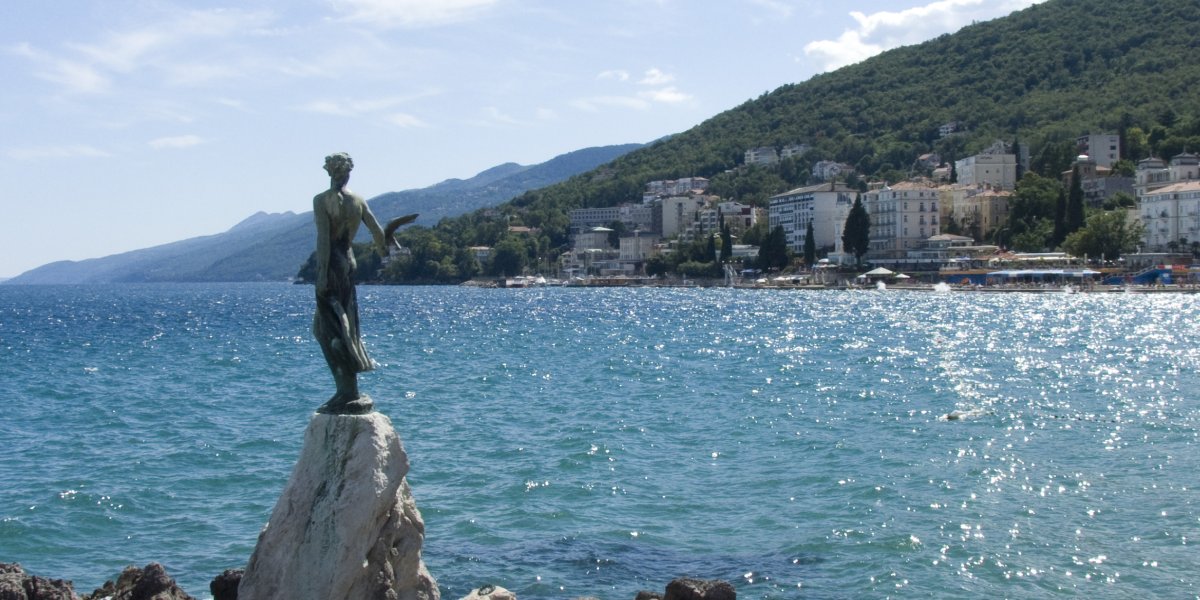
Two minutes downhill from Istranka, back to the seafront — the park's iron gate is on Maršala Tita street, beside Hotel Imperial. Park Angiolina is where Opatija was invented: in 1844 the merchant Iginio Scarpa built the first villa here for his late wife Angiolina and planted the camellias she'd loved in Genoa, and within a generation the entire resort had been built around her garden. Wander beneath sequoias from California, magnolias from Japan, palms from the Canaries — 150 species, every one brought here by ship — then step out to the seafront and meet the Maiden with the Seagull, the 1956 bronze on the rock who has been Opatija's emblem ever since (she replaced an earlier Madonna del Mare swept off in a storm). Behind her stands the grand façade of Hotel Kvarner, the first proper hotel on the eastern Adriatic, opened 1884.
Tip: Enter from the Maršala Tita gate and exit toward the seafront — that direction walks the camellia avenue first (still in flower Feb-April) and delivers you at the Maiden statue with the afternoon sun behind you, the only angle where the bronze and the sea both render in a photo. Don't pay to enter the Croatian Tourism Museum inside Villa Angiolina — Scarpa's original 1844 villa exterior IS the artifact, and every plaque is readable from the garden path. Step into Hotel Kvarner's lobby (free, two minutes) to see the Crystal Hall where the first Habsburg balls happened in 1885 — most visitors never realize you can just walk in.
Open in Google Maps →16:30
Neighborhood
Pick up the Lungomare again from the Maiden's seafront and continue north for 3 km — the path narrows, the grand hotels give way to private villas, and around the final headland you'll suddenly see a tight-packed cluster of stone houses ringing a square harbor. Volosko is what was here before Opatija was Opatija — a working fishing village the Habsburg developers somehow forgot to redesign — and the alley climbing behind the harbor (Andrije Štangera) is one stone room wide, rising past laundry lines, clay bread ovens, and front doors unchanged since the 18th century. Time it for 17:30 to watch the boats unload the night's catch on the harbor; it's almost certainly going onto your dinner plate two hours later.
Tip: The street to climb is Andrije Štangera — up, not along the harbor; from the top you get the only postcard angle of the village rooftops with the bay behind. Ignore the 'best gelato in Opatija' signs along the harbor — those are tourist traps; the actual locals' favorite is back at Slatki Kutak in central Opatija (you've already walked past it). The small chapel of St. Anne (Crkva Sv. Ane) at the village's high point opens for evening mass at 18:00 and is the only chance you'll get to see inside.
Open in Google Maps →19:30
Food
Two minutes downhill from the top of Andrije Štangera, back to the harbor — the restaurant's blue façade is at the water's edge, with terrace tables almost touching the moored boats. Plavi Podrum (the 'Blue Cellar') has been serving this village since 1888 — same family for four generations, a wine cellar Wine Spectator-rated for two decades running, and a daily catch list the chef writes by hand each afternoon. Order the scampi buzara (€32) — Kvarner gulf scampi in white wine, garlic, and tomato, served whole so you crack them with your fingers — and split a whole sea bass baked in salt (€38) for the table; pair with the house Malvazija (€8 a glass) from a vineyard 20 km up the coast. Expect €70-90 per person with wine, and worth every cent for what is genuinely the finest seafood meal on this stretch of the Adriatic.
Tip: Reserve at least 48 hours ahead and specify 'harbor-side terrace, not interior' — the four water-edge tables are the entire reason to come and they go to whoever asks first. Arrive at 19:30 (Croatians dine at 21:00, so the terrace is nearly empty for your first hour, then the local crowd fills in for atmosphere). Pitfall warning: avoid any Opatija restaurant displaying fresh fish on ice without per-kilo prices marked — the standard scam is to weigh the fish in front of you and bill at €100+/kg tourist rates; Plavi Podrum prints prices openly on the menu, which is exactly why locals have trusted it for 130 years. Skip dessert and walk back along the harbor for a €4 grappa at one of the locals' bars — the night view of Opatija's lit-up grand hotels across the bay is the real finale.
Open in Google Maps →
Trip builder
Plan this trip around Opatija
Turn this guide into a bookable rail itinerary with FlipEarth.
Keep exploring
Related cities
More in the same country
FAQ
Frequently asked questions
How many days do you need in Opatija?
Most travelers enjoy Opatija in 1 days, with enough time for headline sights and a slower meal or museum stop.
What's the best time to visit Opatija?
The easiest season for most travelers is May-Oct, especially if you want good weather and manageable crowds.
What's the daily budget for Opatija?
A practical starting point is about €120 per person per day before hotels, then adjust based on museums, dining, and transport.
What are the must-see attractions in Opatija?
A good first shortlist for Opatija includes Lovran Old Town (Stari Grad Lovran), Lungomare Coastal Promenade (Šetalište Franza Josipa I.), Konoba Istranka.