City Guide
Mechelen
Bélgica · Best time to visit: Apr-Oct.
Day-by-day plan
Choose your pace
Duración del viaje
09:00
Landmark
Begin where merchants and pilgrims entered Mechelen 700 years ago — Brusselpoort is the city's only surviving medieval gate, twin round towers wrapped in 13th-century brick. At 09:00 the southeast sun lights the brickwork warm-amber and the cobbles in front are still empty of cars. Cross to the moat side for the framing shot, then walk under the arch — every step from here pulls you deeper into the old city.
Tip: Stand on the small footbridge over the moat just outside the gate — you get both round towers in one frame. After 10:00 delivery vans block this lane and the symmetry is gone.
Open in Google Maps →09:45
Landmark
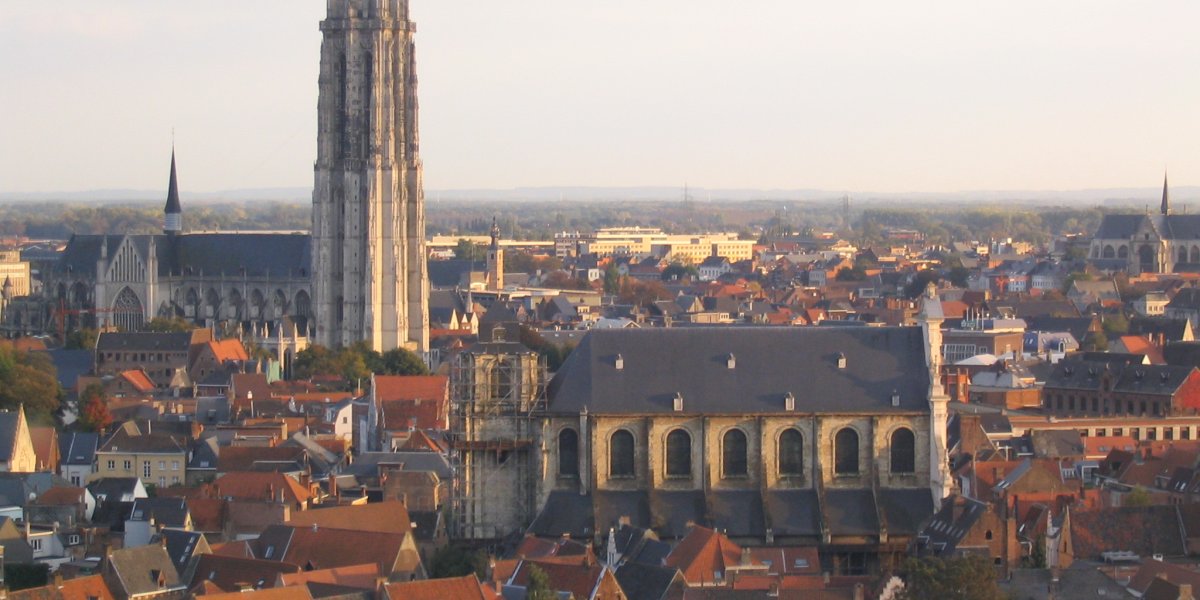
Walk down Hoogstraat for 12 minutes — Renaissance gables, a chocolatier on the corner, the spire growing in your view — and emerge onto Grote Markt facing the unfinished giant. The builders ran out of money in 1520, leaving the tower stunted at 97m, which is why locals call it 'the most beautiful stump in Europe.' Climb the 538 worn stone steps to the open sky walk; on a clear day you can spot Brussels' Atomium and Antwerp's cathedral from one platform. The 49-bell carillon plays every quarter hour and you will feel the lowest bells through the stone floor.
Tip: Buy your ticket the moment it opens at 10:00 — the first school group reaches the staircase around 10:45 and the spiral becomes a slow human conveyor belt for the rest of the day. The bell chamber on level 6 has a working 1840 clock mechanism most tours rush past; spend two minutes there. Tower is closed Mondays.
Open in Google Maps →12:30
Food
Descend the tower (it takes longer than the climb) and walk south down Bruul, Mechelen's pedestrian shopping street, for 5 minutes. Wittouck is the 1936 chocolatier-bakery where construction workers and Court of Appeal judges queue at the same marble counter. Order the broodje filet américain (Belgian raw-beef sandwich, €6.50) or the hot chicken-curry roll (€7), then a slice of frangipane tart. The staff slice, dress, and wrap in under three minutes — you eat standing at the counter or on a bench across the square.
Tip: Skip the croque-monsieur — it's microwaved. The curry filling sells out by 13:30, so don't browse the pastries first. Their housemade ham is the giveaway dish; ask for it on a kaiserbroodje.
Open in Google Maps →13:30
Landmark
Walk back toward Grote Markt and turn left onto IJzerenleen — the 'iron street' named for its 16th-century wrought-iron railings. Four minutes later the lane opens onto Haverwerf, where three of the most photographed façades in Flanders line the Dijle: Het Paradijs with its carved Adam and Eve, De Duiveltjes hiding little wooden devils in the cornice, and the white Renaissance Sint-Jozef. Cross the Grootbrug for the postcard shot, then follow the riverside path past Vismarkt's beer terraces — the moored barges below you carried Mechelen beer for centuries.
Tip: Shoot from the middle of Grootbrug between 14:00 and 15:00 — the western sun rakes across the carvings and the devils on De Duiveltjes finally cast shadows you can see. By 17:00 the whole row drops into shade and the photo is flat.
Open in Google Maps →15:30
Neighborhood
Continue north along the river, then cut east through Wollemarkt — a 7-minute walk drops you through a low brick archway into the Great Beguinage, UNESCO-listed since 1998. This is a car-free village inside the city, where lay religious women lived independently for four hundred years. Wander the silent inner courtyards, find the baroque St. Catherine's Church at the heart, then walk Twaalf Apostelenstraat — twelve identical white-trimmed doors on a single cobbled lane, the prettiest stretch of brick in Belgium. End at Hof van Busleyden's Renaissance courtyard, whose exterior alone justifies the detour.
Tip: Enter via Schrijnstraat, not the main Nokerstraat gate — you arrive at Twaalf Apostelenstraat from the empty end and have its full length to yourself for ten minutes before the tour-loop crowd circles back.
Open in Google Maps →18:30
Food
Exit the Begijnhof at its northern edge onto Guido Gezellelaan — Het Anker brewery is two minutes away and you will smell the malt before you see the brick chimney. The brewery has run continuously since the 14th century and still operates in the same vaulted hall where the beguines once brewed their own ration. Order the Vlaamse stoverij — Flemish beef stew braised in Gouden Carolus Classic, served with hand-cut frites (€22) — and the konijn met pruimen, rabbit slow-cooked with prunes (€26). The signature Gouden Carolus Tripel arrives in its bell-shaped glass; sniff before sipping, the malt aroma is half the drink.
Tip: Reserve the 18:30 slot — by 19:30 it's a 45-minute wait. Open with the four-beer tasting flight (€14) before committing; locals always start with the Cuvée van de Keizer Imperial Dark. Pitfall warning: do NOT eat dinner on Grote Markt — every terrace there reheats frozen stoverij at double the price and pours mass-market Stella instead of the local Gouden Carolus that's brewed 400m away.
Open in Google Maps →
Trip builder
Plan this trip around Mechelen
Turn this guide into a bookable rail itinerary with FlipEarth.
Keep exploring
Related cities
More in the same country
FAQ
Frequently asked questions
How many days do you need in Mechelen?
Most travelers enjoy Mechelen in 1 days, with enough time for headline sights and a slower meal or museum stop.
What's the best time to visit Mechelen?
The easiest season for most travelers is Apr-Oct, especially if you want good weather and manageable crowds.
What's the daily budget for Mechelen?
A practical starting point is about €120 per person per day before hotels, then adjust based on museums, dining, and transport.
What are the must-see attractions in Mechelen?
A good first shortlist for Mechelen includes Brusselpoort, St. Rumbold's Cathedral & Tower Climb, Haverwerf & Dijle Riverwalk.