City Guide
Lugano
Suiza · Best time to visit: May-Sep.
Day-by-day plan
Choose your pace
Duración del viaje
09:00
Landmark
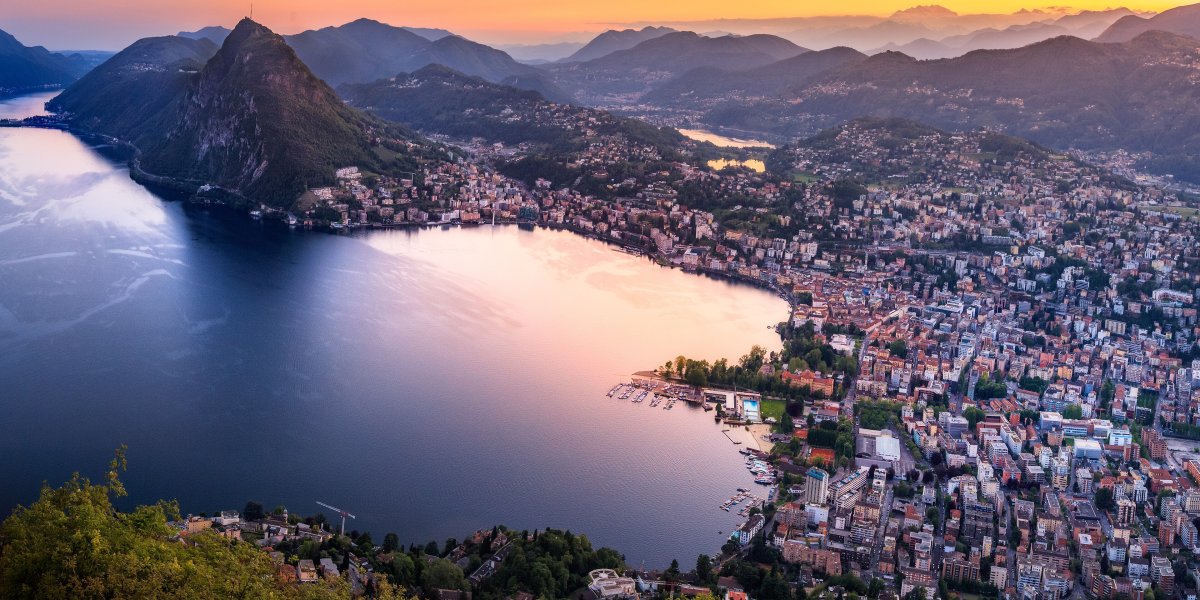
Walk five minutes from any lakefront hotel to the Paradiso funicular base, then catch the 08:30 first car — a two-stage cable railway climbing 600 vertical meters through chestnut forest to a 912 m granite summit. The terrace delivers Lugano's signature postcard: the lake forking south into Italy, the Bernese Alps rising north, Como's mountains silhouetted southwest. Skip the funicular descent and walk down the marked trail to Paradiso — 4.5 km through cool woods with hidden lake balconies the cable car never sees, ending you back at the lakefront with the day's hardest effort already done.
Tip: Take the very first 08:30 funicular — a Como bus tour arrives at the summit around 10:30 and floods the terrace, and the lake haze starts rising by 11:00 which softens the long-distance Alpine views. Buy a one-way up + walking-down ticket at the kiosk (saves CHF 11 versus return); the trail is well-marked, dry, and takes 45 minutes at a steady pace.
Open in Google Maps →12:15
Religious
From the Paradiso funicular base, follow Lungolago Riva Caccia north for fifteen minutes — palm trees line the promenade, Monte Brè reflects across glass-flat water, and the route feels more Lake Como than Switzerland. The walk ends at a small piazza fronting an unassuming whitewashed Franciscan church that hides Italian Switzerland's most extraordinary fresco. Step inside for ten minutes: Bernardino Luini's 1529 Passion cycle covers the entire dividing wall in 22 panels — often called the Sistine Chapel of Ticino — and admission is free.
Tip: Stand in the exact center of the nave and look at the fresco's painted Roman arch — Luini designed the perspective so the architecture appears three-dimensional only from this single spot; step left or right and the illusion collapses. Photos without flash are allowed; the side door on the left often closes by 18:00, so go now.
Open in Google Maps →13:15
Food
Walk five minutes north past LAC's bronze cultural-center facade, cross Piazza Bernardino Luini onto the pedestrianized Via Pessina — the smell of cured ham reaches you before the shopfront does. This 1937 deli is where Luganese have bought their prosciutto for four generations: marble counters, hanging salami, wine on tap from a ceramic spigot. Order a panino al prosciutto crudo di Parma (CHF 9), a tagliere misto board with mortadella, salame nostrano, and aged grana (CHF 18), and a glass of local Merlot (CHF 6). Eat standing at the high counter or grab a stool in the back courtyard.
Tip: Ignore the white-tablecloth restaurant next door called Ristorante Gabbani — same name, different operation, triple the price. Order at the meat counter (not the till), point at what you want, the staff slices and assembles in two minutes; cash and card both work, but the line moves twice as fast at the meat counter than at the till.
Open in Google Maps →14:15
Neighborhood
Step out of Gabbani into Piazza Cioccaro, then climb the cobbled Via Cattedrale for two minutes — the cathedral's pink-marble Renaissance portal appears suddenly between two narrow Lombard buildings. From there, descend slowly through the heart of the old town: Piazza della Riforma's neoclassical town hall and its open-air cafes, Via Nassa's arcaded luxury shopfronts running parallel to the lake, the hidden Piazza Sant'Antonio with its baroque church and morning produce market. Every alley reveals a different century stacked on the last — Romanesque arches, Lombard frescoes, Belle Époque grand hotels — and the whole quarter is fully pedestrianized.
Tip: Return to the cathedral terrace at 16:00 — late afternoon sun hits the three Renaissance rose windows head-on for about twenty minutes, briefly turning the pink marble facade glowing rose; this exact angle disappears before 16:30 and is the only time of day photos come out without harsh shadow across the portal. The terrace also gives the best free panorama of the lake and old-town rooftops in the entire city.
Open in Google Maps →17:30
Park
From Piazza della Riforma walk east along the lakefront for ten minutes — the promenade widens into a tree-lined avenue, sailboats moor along the quay, and the park gates open under twin century-old magnolia trees. Lugano's grandest public garden wraps around a 19th-century neoclassical villa and reaches the lake's edge with cypress walks, a swan pond, and benches angled directly at Monte Brè across the water. The far point where the Cassarate river meets the lake is the city's best sunset perch — the water turns copper, the eastern peaks blush pink, and almost no tourists make it past the main lawn.
Tip: Walk all the way to the river mouth at the park's far northeast corner — past the villa, past the rose garden, past the playground — locals come here with takeaway aperitivi from the Manor supermarket nearby (CHF 6 for a small bottle of Prosecco and plastic cups); the sunset light is twenty minutes stronger here than at the main promenade, and the angle catches both the lake and the mountains in one frame.
Open in Google Maps →19:30
Food
Walk back along the lakefront for ten minutes, then turn into a vaulted side alley behind the old post office — the small wooden sign hangs above a stone basement door with no menu board outside. This 1960s grotto is where Lugano's older generation actually eats: brick-vaulted cellar, paper tablecloths, house Merlot poured from ceramic boccalini, no English menu, no online reservations, cash strongly preferred. Order the risotto con luganighe (CHF 22, saffron rice with house Ticinese sausage) and the brasato al Merlot con polenta (CHF 28, wine-braised beef with stone-ground yellow polenta) — this is Ticinese soul food, eaten the same way for sixty years.
Tip: Arrive at exactly 19:00 before the local rush at 19:45, or wait until after 21:00 when the first seating clears — they take no reservations and tables go first-come; cash is twice as fast as card so withdraw CHF 80 beforehand. Tourist trap warning for the whole old town: avoid every restaurant on Piazza della Riforma and along Lungolago with menus in five languages and waiters waving from the doorway — they charge double for half the quality of any back-alley grotto, and no local has eaten at one of them since 1995.
Open in Google Maps →Saltar al día
09:00
Landmark
Begin where Lugano itself begins — the broad neoclassical piazza opening directly onto the lake, lined with pale pink and yellow palazzi. At nine the espresso machines hiss to life and shopkeepers roll out canvas awnings; you have the square almost to yourself before the cruise crowds arrive at eleven. Stand by the lake-facing edge and look back toward the mountains — this is the postcard you came for.
Tip: Order an espresso standing at the counter inside Bar Manor (CHF 2.50) instead of seated outside (CHF 5.50) — same coffee, half the price, and you will people-watch exactly like a local commuter.
Open in Google Maps →10:00
Religious
Leave the piazza at the northwest corner and climb stepped Via Cattedrale for five minutes — the alley narrows, the pastel walls close in, and Lugano shrinks behind you. The early-Renaissance facade was carved in white Carrara marble and the morning sun strikes it head-on between ten and eleven, lighting every angel and Corinthian capital. Step inside for the dim, silent frescoes — a deliberate contrast you will feel in your chest.
Tip: The flagstone terrace immediately right of the entrance is the highest free viewpoint over old-town rooftops to the lake — better than any paid lookout in town, and ninety percent of visitors walk straight past the gate.
Open in Google Maps →11:30
Religious
Walk back down to the lake and turn right along the palm-lined promenade for eight minutes — gleaming water, the gentle clack of stationary halyards, the LAC museum looming on your right. The little church is plain outside, but step in and you face Bernardino Luini's 1529 Passion fresco — twenty meters of figures frozen mid-gesture, the single greatest Renaissance work in Swiss Italy. Half-past eleven is the moment the south windows slant natural light directly across its surface.
Tip: Slip a CHF 2 coin into the illumination box on the left interior wall — the side chapels and the Last Supper panel only become visible when lit, and most visitors miss them entirely in the gloom.
Open in Google Maps →12:45
Food
Three minutes north into the warren of pedestrian alleys — Via dei Gorini, an address locals have guarded for fifty years. Down a half-flight of stone steps into a vaulted cellar with checkered tablecloths, Italian-only blackboards, and grandmothers' recipes that have not changed in decades. Order the risotto ai funghi porcini (CHF 24) and the polenta with brasato (CHF 26), with a small carafe of Merlot del Ticino (CHF 14) — budget CHF 45-55 per person.
Tip: No reservations are taken — arrive at 12:45 sharp and ask for the second room past the wine racks; the front room fills with office workers by 13:00 and the kitchen stops seating at 13:30. Cash strongly preferred.
Open in Google Maps →14:30
Landmark
From La Tinèra walk south fifteen minutes along the lakefront promenade — palms, ferries, the lake visibly widening — to the Paradiso funicular station. Two cars haul you up a sixty-percent gradient in twelve minutes to 912 m, where the entire Lago di Lugano unfurls south into Italy with the Valais Alps stacked behind you. Stay until the 19:00 sunset — light turns peach over the Italian shore in a way photographs never capture.
Tip: Climb the metal staircase onto the small chapel roof at the summit (free) for a true 360° view — most visitors stop at the terrace below and miss the highest accessible point. Last return funicular runs every 30 minutes until 23:00 in midsummer.
Open in Google Maps →19:30
Food
Funicular back down and a twenty-minute lakefront walk east past the public lido to the old fishing harbor at Foce — you will see the yellow lanterns from a hundred meters off. This is where Lugano locals come for lake fish: order the filetti di persico in burro e salvia (perch fillets in sage butter, CHF 38) and the cured beef carpaccio (CHF 22) to start. Budget CHF 70-85 per person with a glass of Bianco Ticinese.
Tip: Reserve a day ahead and specifically request 'tavolo sul lago' — the back tables are pleasant but miss the water entirely. Pitfall warning: skip every lakefront restaurant between Piazza della Riforma and here that displays 'fish of the day' boards without listed prices — they quote in Swiss francs after the tourist orders and CHF 95 perch is common.
Open in Google Maps →09:00
Park
Begin where most visitors end — Lugano's grand lakeside park at its quietest hour. From the old town walk east along the promenade for ten minutes; the lake is glass at nine, swans drift past the boathouse, and Villa Ciani's pink baroque facade glows in the cross-light. Loop the full perimeter to the little headland behind the LAC — the angle here gives you Monte San Salvatore framed by a single weeping willow, the cleanest postcard of the trip.
Tip: The drinking fountain beside the central rose garden runs cold filtered mountain water — fill your bottle here once and you will never pay CHF 5 for a kiosk Evian again. The little wooden pier at the park's east tip is the unmarked best swimming spot in town in summer.
Open in Google Maps →11:00
Museum
Loop back along the lake for five minutes to the LAC's pale travertine flank — Lugano's modernist showpiece, opened in 2015. MASI's strength is Swiss-Italian 20th-century art and a serious rotating photography programme; ninety minutes is exactly the right dose. Arrive at 11:00 sharp — the museum opens at eleven and the first hour is blissfully empty before the cruise-boat tour groups arrive at noon.
Tip: Ride the elevator straight to the top floor and work downward, opposite the crowd flow — the strongest temporary shows are always installed upstairs. The combined ticket includes the satellite Palazzo Reali across the river but skip it unless you have a third day; the main building holds the highlights.
Open in Google Maps →12:45
Food
Three blocks north into the old town — Via Magatti, a stone alley behind Piazza della Riforma where wine bottles climb floor to ceiling. The owner knows every Ticino grower personally and the daily handwritten menu is a love letter to the region: the gnocchetti al gorgonzola (CHF 22) and the tagliata di manzo (CHF 36) are non-negotiable. Budget CHF 50-65 per person with a glass of Merlot from the slate hills above Mendrisio.
Tip: Ignore the printed menu and ask 'cosa consiglia oggi?' — the daily specials are always the kitchen's pride and rarely make it onto paper. Walk-ins are accepted but the bar seats fill first; arrive by 12:45 to claim them.
Open in Google Maps →14:30
Neighborhood
From Bottegone walk eight minutes south to the Lugano Centrale boat dock and board the 14:30 ASNL ferry to Gandria — a thirty-minute ride along the wooded eastern shore with Monte Brè climbing on your left. Gandria is a single car-free fishing village clinging vertically to the cliff — wander its three lanes, drink at the lakeside terrace of Antico Hotel Gandria, then walk the Sentiero dell'Olivo back to Castagnola (3.5 km, gentle downhill, 75 minutes through working olive groves with sweeping lake views). This is the loveliest hour of the entire weekend.
Tip: Take the boat outbound and walk back — never the reverse; the trail is graded and signed in one direction only, and the lake light is on your camera side this way. Buy a one-way ticket (CHF 14.40) at the dock rather than the round-trip — you will not be retracing by boat.
Open in Google Maps →17:30
Landmark
The olive trail delivers you to Castagnola, where the Brè funicular lower station is a four-minute walk inland. A two-section funicular climbs to 925 m on the eastern peak — and here is the trick most guidebooks miss: while everyone rides up San Salvatore for sunset, Monte Brè faces directly west and watches Lugano itself catch fire in the golden hour. The city, the lake, and yesterday's peak across the water — all aglow at once.
Tip: Confirm the last descent time at the lower station before riding up — it runs to 18:45 in shoulder season and 21:15 only from mid-June to mid-September. The signed footpath down through Brè Village (the painters' hamlet, with eight fresco-clad wayside chapels) takes 90 minutes and is the most rewarding descent in the city when daylight permits.
Open in Google Maps →19:30
Food
From the Brè funicular base a six-minute taxi or twenty-five-minute walk west into Massagno — a residential quarter most tourists never see. Grotto della Salute has poured its own Merlot since 1928 in a stone-vaulted dining room with checked tablecloths and zero pretense. Order the polenta e mazza (CHF 32) — house polenta with assorted braised meats — and finish with torta di pane served warm (CHF 9); budget CHF 55-70 with a glass of the house red.
Tip: Phone the morning of your visit — 'vorrei un tavolo per due alle sette e mezza' is enough Italian. The gravel terrace under the chestnut tree is first-come, first-served and the most beautiful seat — arrive at 19:20 and wait one out. Pitfall warning: avoid every lakefront-promenade restaurant displaying a 'menu turistico' board in four languages; they cycle frozen perch and charge CHF 60 for what costs CHF 35 anywhere a local actually eats.
Open in Google Maps →
Trip builder
Plan this trip around Lugano
Turn this guide into a bookable rail itinerary with FlipEarth.
Keep exploring
Related cities
More in the same country

FAQ
Frequently asked questions
How many days do you need in Lugano?
Most travelers enjoy Lugano in 1 days, with enough time for headline sights and a slower meal or museum stop.
What's the best time to visit Lugano?
The easiest season for most travelers is May-Sep, especially if you want good weather and manageable crowds.
What's the daily budget for Lugano?
A practical starting point is about €140 per person per day before hotels, then adjust based on museums, dining, and transport.
What are the must-see attractions in Lugano?
A good first shortlist for Lugano includes Monte San Salvatore.