City Guide
Kefalonia
Grecia · Best time to visit: May-Oct.
Day-by-day plan
Choose your pace
Duración del viaje
09:00
Landmark
Arrive just before the 9:00 opening — the wooden steps down to the cave platform are still cool in shadow, and you'll catch one of the first rowboats with no queue. The collapsed limestone ceiling lets sunlight pour straight onto the lake, turning the brackish water a luminous blue no camera quite captures. Stay quiet near the back chamber — the boatman sings briefly to demonstrate the natural acoustics, and the sound hangs in the air for seconds.
Tip: Pay only for the boat (10€); skip the audio guide. Ask for the bow seat for unobstructed reflections, and request a brief pause in the back chamber where the blue glow is strongest. Tour buses arrive after 10:30, so leaving by 10:15 keeps the cave nearly private.
Open in Google Maps →12:00
Landmark
From Melissani's parking, the cliff road north climbs above Agia Efimia bay until the final ridge — and Myrtos suddenly opens below in a perfect white-and-turquoise crescent, the most photographed view in Greece. A small cliffside platform some 200 m above the beach catches the geometry of the bay just as the midday sun turns the shallow water electric. Walk the path along the cliff edge to the southern viewpoint for the iconic postcard angle.
Tip: Do not drive down to the beach — it's a 7 km switchback descent that eats an hour, and the sand has no shade or facilities. The upper viewpoint is where the photograph lives. Park at the topmost platform (free) rather than the lower paid lot (3€) halfway down the cliff.
Open in Google Maps →13:30
Food
A 12-minute drive north drops you into Assos — leave the car at the village entrance and walk down the cobbled slope to the harbor square, where Platanos Taverna spreads its tables under a 200-year-old plane tree. Order at the counter to keep it fast: kreatopita (Kefalonian meat pie, 9€) and a Greek salad with island mizithra cheese arrive in ten minutes. Pair with a small glass of Robola, the dry white grown only on this island's chalky slopes.
Tip: Sit on the harbor side of the plane tree — the inland tables face a parking lot. If Platanos is full, the corner bakery sells fresh spanakopita and bougatsa for 3€ each, which you can eat on the harbor wall while small fishing boats unload their morning catch.
Open in Google Maps →14:30
Landmark
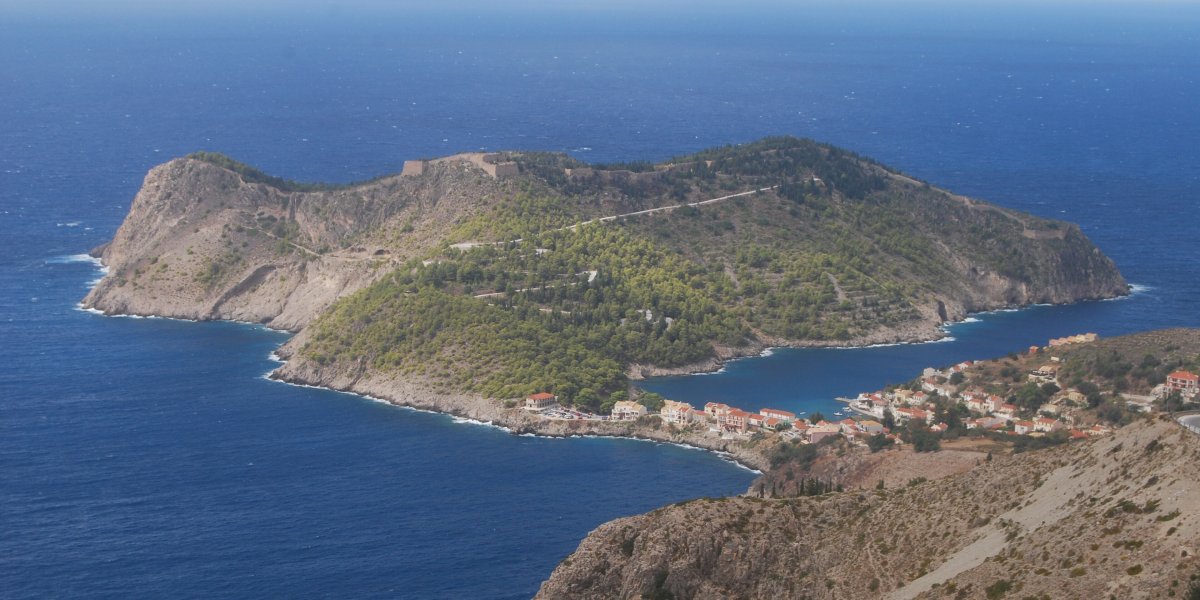
From the taverna, follow the signed path up through the village to the Castle of Assos — a 30-minute climb up stone switchbacks through pine forest, the harbor shrinking behind you at every turn. The 16th-century Venetian walls now enclose only goats and wildflowers, but the bastions look down on the whole isthmus, with Myrtos's white pebble curve to the south and open Ionian on both sides. Bring water — no fountain runs at the top.
Tip: The path forks halfway up — take the left branch signed 'Kastro' for the shorter ascent, then return on the right ('Pano') through old olive groves for a 4 km loop. Avoid the climb between 14:00 and 16:00 in July or August: the south-facing slope has no shade and bakes the stones to oven heat.
Open in Google Maps →18:30
Landmark
A one-hour drive south along the inland road lands you in Argostoli at golden hour — park near De Bosset Bridge, the 700 m stone causeway built by a Swiss governor in 1813, and walk its full span as the sun lowers over the Lassi peninsula. Halfway across, look down: loggerhead sea turtles circle the shallows, drawn by the fishermen who clean their evening catch at the quay by the obelisk. The light at this hour turns the water bronze and the turtles' shells the same.
Tip: Stand on the bridge's east side at 19:00 sharp — the fishermen at the small quay south of the bridge (near Drapanos boatyard) gut their daily catch then, and the discarded scraps draw the turtles right to the surface. Do not feed them yourself — there is a 500€ fine, and bread harms their wild behavior.
Open in Google Maps →20:00
Food
From the obelisk end of the bridge, walk 250 m along the seafront promenade to Kiani Akti, a fish taverna built on stilts above the harbor that locals quietly consider Argostoli's best. Order the charcoal-grilled octopus (14€), bakaliaros with skordalia (12€), and a half-kilo of whatever was hauled in that morning from the chalkboard (around 25€). The whitewashed terrace catches the last harbor light and the sound of water against the pilings — the perfect close to a long, bright day.
Tip: Reserve the day before by phone for a terrace table — the indoor room has no view. Avoid the tourist strip along Ioannou Metaxa avenue: prices are double for half the freshness, and any menu translated into eight languages is a sign no locals eat there. Likewise skip any 'fresh fish' board that omits price per kilo — the bill is calibrated to what the waiter thinks you'll pay.
Open in Google Maps →Saltar al día
09:00
Landmark
Drive in along the cliff-hugging western road — the first glimpse of Myrtos comes around a bend locals call 'the gasp corner.' Park at the upper viewpoint for ten minutes of photos, then take the switchback road down to the white-pebble cove. Arriving at 9 buys you a full hour of empty beach and crystal water before the first tour vans appear at 10:30; the cliffs face east, so morning light pours down them like a spotlight while the afternoon turns them into harsh silhouette.
Tip: The famous postcard angle is not the marked lookout — it's the second hairpin bend 200 m further up the road. Park on the gravel shoulder and walk back; the view is twice as wide and you'll be alone.
Open in Google Maps →12:00
Neighborhood
A 25-minute drive north along the same coast road; park in Assos upper village and walk down the cobblestone lane through painted ochre and rose houses to the harbor — this descent is the entrance every postcard photographer chooses. From the harbor follow the wooded path 30 minutes up the peninsula to the ruined 16th-century Venetian fortress, where at noon the sun lights both bays at once and you can see all the way back to Myrtos.
Tip: Wear shoes with grip — the castle path is loose limestone. There is no water or shade on the climb; fill a bottle at the stone fountain in the village square before you start.
Open in Google Maps →13:30
Food
Descend the castle path 15 minutes back to the harbor square — you'll pass the bougainvillea-draped pink house everyone photographs. Platanos sits under a vast plane tree (its name) in the square and is run by the same family for three generations. Order the moussaka (€11) and grilled octopus (€16) — the octopus is caught that morning by the owner's brother-in-law in Assos bay. House Robola white from the village is €5 a half-litre.
Tip: Be in your seat by 13:30 — by 14:00 the four shaded tables under the plane tree are gone and the rest is in full sun. Skip the seafront tavernas at the harbor: same menu, double the price, no tree.
Open in Google Maps →15:30
Neighborhood
A 25-minute drive further north brings you to Fiskardo — the only Kefalonian village spared by the 1953 earthquake, so the Venetian pastel facades are original, not reconstructed. Park at the entrance roundabout and walk the horseshoe harbor counter-clockwise; follow the wooded coastal path past the old lighthouse to the Roman cemetery ruins on the headland. At 17:00 the light turns every moored yacht sail amber and the cypress shadows lengthen across the water.
Tip: Duck into the back lane behind the harbor for Petros Galleries — local watercolours at honest prices; the harbour-front 'galleries' are mostly Athens import wholesale.
Open in Google Maps →17:45
Park
A 5-minute drive south of Fiskardo on a single-lane road ends in a tiny cove where ancient cypresses and olive trees grow right to the water's edge — Foki means 'seals,' and monk seals still occasionally rest here in spring. Float in the glassy water as the late sun filters through the cypress canopy; the pebbles slope gently, the seabed glows turquoise. By 18:00 the day-trippers have left and you'll likely share the beach with two or three locals.
Tip: There is one tiny seasonal kiosk with the only freshwater rinse on the cove — €1 to use; bring small change. The pebbles are smooth, no water shoes needed, but the dirt road in is rough on low cars — drive slowly.
Open in Google Maps →19:45
Food
Five-minute drive back to Fiskardo harbor and a 3-minute walk to the navy-blue awning at the far north end of the waterfront. Chef Tassia Dendrinou wrote the definitive Kefalonian cookbook and the kitchen is still hers. Order the cuttlefish-ink risotto (€22) and the kreatopita — the island's traditional Sunday meat pie with rice, herbs and lamb (€18). Both are family recipes from her grandmother in Vassilikades.
Tip: Phone before noon to reserve a harbor-edge table — they go only to bookings, walk-ins get the inner row. Pitfall: the 'fish by weight' tavernas on either side list sea bream at €60/kg but bring it unweighed; if a place won't show you a labeled scale, walk away.
Open in Google Maps →09:00
Landmark
Drive inland from Sami — the cave entrance sits in a pine forest 5 minutes off the main road. Arrive at opening: the 150-step descent is single-file and tour buses start dumping at 10:30. The 'Sala Apotheosis' chamber is the size of a basketball court, hung with 150-million-year-old stalactites the colour of caramel and lit theatrically from below — its acoustics are so pure that Maria Callas once gave a private recital here in 1959.
Tip: It is a steady 18°C inside even in August — bring a light layer. Buy the combined Drogarati + Melissani ticket at this entrance booth, not at Melissani; it saves €3 and skips the second queue.
Open in Google Maps →10:30
Landmark
Four-minute drive on country roads — Melissani sits in a hidden basin signposted from Karavomylos village. You enter through a stone tunnel, then board a small wooden rowboat onto an underground lake. The cave roof collapsed in antiquity, leaving an open oculus to the sky; arriving between 11:00 and 13:00 puts the sun directly overhead and the water glows an electric, almost radioactive blue. An hour earlier or later and it is just a dim pool — the timing is the whole point.
Tip: Boatmen rush each load through in 8 minutes — quietly ask 'one more moment under the light?' as you reach the centre and most will pause for you. Phone cameras handle the contrast better than DSLRs; turn off HDR.
Open in Google Maps →12:45
Food
Ten-minute drive down the hill to Sami harbor — Karnagio is the wooden-shuttered taverna at the south end of the waterfront, run by the same family since 1962 in the building that used to be the boatyard ('karnagio' means shipyard). Order the bourdeto — Ionian spicy fish stew with kefalonian feta (€18) — and the bianco, a local white-wine and garlic fish dish that exists nowhere else in Greece (€16). House Robola rosé is €4 a glass.
Tip: Ask for the upper terrace, not the sea-level deck — the Ithaca ferry's exhaust drifts low across the harbor. Skip the 'seafood platter for two' (€60): it is frozen calamari and farmed prawns, not the day's catch.
Open in Google Maps →15:00
Park
A 10-minute drive over the green headland east of Sami drops you into an amphitheatre of cypress-covered hills meeting white pebbles — this is where Captain Corelli's Mandolin was filmed in 2001, and the view has not changed since. Walk to the north (right) end of the bay where the cypress shade reaches the water by 16:00 and the seabed shelves into impossible clarity. The wind dies in the afternoon, the bay turns to glass.
Tip: The two beach bars charge €5 per sun bed — but walk 200 m past the second bar and the public stretch is empty and free. The pebbles can be sharp; if you didn't bring water shoes, the kiosk sells reasonable ones for €8.
Open in Google Maps →18:30
Landmark
A 45-minute drive west across the island to the capital. Park near the Lithostroto pedestrian street and walk to the lagoon — the De Bosset Bridge is a 689-metre stone causeway built by the Swiss engineer Charles de Bosset in 1813, the longest stone bridge over a sea inlet in the world. Walk to the obelisk at its midpoint as the sun goes down; loggerhead turtles surface in the lagoon below and local fishermen feed scraps to them at the fish market quay around 19:00.
Tip: The best sunset shot is from the obelisk looking BACK toward Argostoli with the mountains behind, not facing the open sea — the colour catches the town. Ignore the 'sunset cruise' touts at the marina; €40 for what you can see free standing still.
Open in Google Maps →20:00
Food
A 7-minute walk inland from the waterfront, through the Lithostroto's marble pedestrian lane to a hidden courtyard on Stavrou Metaxa. Casa Grec is run by a Greek-Italian couple who married in Argostoli twenty years ago; try the saffron risotto with kefalonian feta (€19) and the pork slow-cooked in Mavrodaphne wine (€21). The wine list is the most serious on the island for local Robola — ask for the Gentilini Robola of Cephalonia (€18 a half-bottle), grown in vineyards you can see from the bridge.
Tip: Reserve the courtyard, not the indoor room — patio heaters keep it warm into late October. Final island pitfall: avoid the gyros and souvlaki shops on Vallianou Square that target cruise day-trippers — they charge €12 for a €4 wrap, while the locals' favourite Halaris Gyros on Diadochou Konstantinou street, two blocks inland, is half the price and twice the size.
Open in Google Maps →
Trip builder
Plan this trip around Kefalonia
Turn this guide into a bookable rail itinerary with FlipEarth.
Keep exploring
Related cities
More in the same country
FAQ
Frequently asked questions
How many days do you need in Kefalonia?
Most travelers enjoy Kefalonia in 1 days, with enough time for headline sights and a slower meal or museum stop.
What's the best time to visit Kefalonia?
The easiest season for most travelers is May-Oct, especially if you want good weather and manageable crowds.
What's the daily budget for Kefalonia?
A practical starting point is about €110 per person per day before hotels, then adjust based on museums, dining, and transport.
What are the must-see attractions in Kefalonia?
A good first shortlist for Kefalonia includes Melissani Cave, Myrtos Beach Cliffside Viewpoint, Castle of Assos.