City Guide
Bremen
Alemania · Best time to visit: May-Sep.
Day-by-day plan
Choose your pace
Duración del viaje
09:00
Landmark
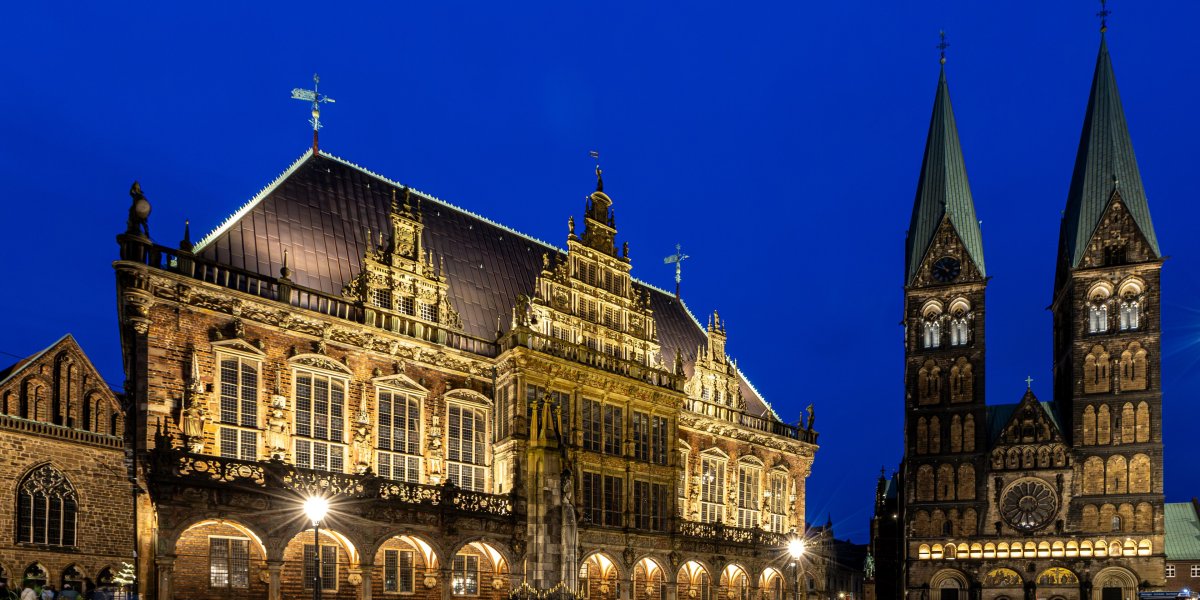
From Hauptbahnhof, walk straight down Bahnhofstraße and continue along Sögestraße — 12 minutes through the pedestrian shopping lane, past the bronze pig herder fountain that everyone rubs for luck. You step out into Northern Germany's most photographed square: the UNESCO Renaissance Town Hall on the north side, the 1404 stone Roland statue (10 meters tall, sword unsheathed) staring him down across the cobbles. Walk around to the western side of the Town Hall and there they are — the Bremen Town Musicians stacked donkey-dog-cat-rooster in bronze, polished to gold where a million hands have touched.
Tip: Grasp BOTH front legs of the donkey with both hands — touching only one leg is local folklore for 'half a wish'. By 11:00 a queue of tour buses forms around the statue; at 09:15 you'll have it to yourself. For the best Town Hall facade shot, stand at the southeast corner near the Dom — morning light hits the Renaissance gables head-on, and you get the cathedral spire in the same frame.
Open in Google Maps →10:30
Landmark
Cross the square south, slip through the narrow arched passage beside the Schütting (the old merchants' guild house) — 90 seconds and you've entered a different century. Böttcherstraße is 110 meters of 1920s Expressionist brick built by coffee magnate Ludwig Roselius: Bernhard Hoetger's gilded 'Lichtbringer' relief above the entrance, the Paula Modersohn-Becker House halfway down (Europe's first museum dedicated to a female painter — exterior alone is worth the photo), and at the south end the famous Glockenspiel of 30 Meissen porcelain bells. Linger by the small courtyards; each one is its own sculptural surprise.
Tip: The Glockenspiel chimes at 12:00 sharp (May-Sep also 15:00 and 18:00). As the bells play, three carved wooden panels on the adjacent tower rotate to show transatlantic pioneers — Columbus, Lindbergh, Zeppelin. Position yourself at the corner of Hinter dem Schütting by 11:55 with phone in landscape mode — that angle catches both the rotating panels and the bells in one frame.
Open in Google Maps →12:15
Food
Step out the south end of Böttcherstraße and the Weser is right there — turn left along the Schlachte promenade for 4 minutes. The Admiral Nelson is an old three-masted sailing ship permanently moored at the quay, its galleys converted into a casual pancake restaurant. Order the 'Bauernpannekoek' (farmer's pancake with bacon, onion and mushroom, €13.50) or the savory 'Räucherlachs-Pannekoek' with smoked salmon and dill cream (€14.90). Average spend €18-22 with a Beck's vom Fass.
Tip: Walk in at 12:15 — by 12:45 the Schlachte office crowd fills every deck table. In warm months the upper open deck is the prize seat (Weser breeze, container barges drifting past); in cold months ask for a port-side window in the glassed lower deck. No reservation needed at lunch; service is fast — pancakes hit the table in 12 minutes.
Open in Google Maps →13:30
Neighborhood
Continue west along the Schlachte — cobbles polished by 600 years of Hanseatic trade, old iron port cranes still standing, brick warehouses converted into wine bars. Walk to the Teerhof footbridge and cross to the south bank of the Weser. From that midpoint on the bridge you get the only frame that fits the entire old-town skyline in one shot: Cathedral towers, Town Hall gables, Böttcherstraße roofs, ships moored at the quay, all in a single horizontal sweep.
Tip: Cross the bridge, take the postcard photo from the exact center of the span, then double back — don't be tempted to walk further down the south bank. The far side is residential and you'll burn 40 minutes for no payoff. Afternoon light (13:30-14:30) hits the old town facades from the southwest — the brick glows red-orange, peak photo window.
Open in Google Maps →14:30
Neighborhood
Walk back east along the river, then cut inland through Stavendamm — 8 minutes — into the medieval fishermen's quarter that escaped the wartime bombs. The Schnoor ('string') is a tangle of crooked 15th-century half-timbered houses on lanes so narrow you can touch both walls. Goldsmiths, dollhouse-scale galleries, hand-bound book workshops. Mid-afternoon, stop at Café Tölke (Schnoor 23) for a slice of 'Bremer Klaben' — the dense fruit-and-marzipan cake the city has baked since the 1300s, €4.50 with a coffee.
Tip: Walk the main lane 'Schnoor' first heading east, then loop back along the parallel 'Lange Wieren' — that direction keeps the afternoon sun behind your shoulder for every photo. Skip the small 'doll museum' on the corner (€6, six rooms, ten minutes max) — the alleyway itself is the open-air museum. The amber jewelers here are real Baltic amber and 30% below Lübeck prices.
Open in Google Maps →17:30
Food
100 meters inside the Schnoor on Hinter der Holzpforte — a crooked dining room with nine tables, low wooden beams, sailors' lithographs on the walls. This is where Bremen locals bring out-of-town family. Order 'Bremer Knipp' (oat-and-pork specialty with crisp roast potatoes, gherkins and apple sauce, €18) — it's the dish you cannot eat anywhere else on earth — and 'Labskaus' (the salty sailors' beetroot-and-corned-beef hash with a fried egg, €19.50). One Beck's vom Fass €3.80. Average €40 per person.
Tip: Reserve 24 hours ahead in summer or walk in at 17:30 sharp when doors open — by 19:00 every table is gone. WARNING for the Schnoor: ignore any restaurant with menus printed in five languages and 'Bremen Specialty Set Menu €28' signs near the quarter entrance — those are pure tourist mills serving microwaved schnitzel. The authentic kitchens (Kleiner Olymp, Beck's in'n Snoor, Schröter's Leib & Seele) are tucked deeper inside on the small inner lanes and have German-only chalkboards.
Open in Google Maps →Saltar al día
09:00
Landmark
Begin in the heart of the Hanseatic city at this UNESCO-listed square. The 9.5-metre Roland of 1404 — the tallest free-standing medieval statue in Germany — has stared down emperors and kings for six centuries, his sword promising the city's freedom. At 09:00 the low northeastern light strikes the gold-leafed Renaissance facade of the Town Hall head-on, while the square is still empty enough to walk around Roland in slow circles.
Tip: Stand at the southwest corner of the square (in front of the Schütting guild house) facing northeast — from this single spot you frame Roland, the Town Hall, and the cathedral spires in one shot. Arrive before 09:30; the first coach groups appear at 10:00 sharp.
Open in Google Maps →10:00
Landmark
Walk 2 minutes around the west side of the Town Hall, looking up at the medieval brick to catch the carved sandstone window frames you missed from the square. The bronze pyramid of donkey, dog, cat, and rooster (Gerhard Marcks, 1953) is smaller than first-timers expect — just under 2 metres — and that intimacy is the whole point: you can crouch right up to the donkey's polished hooves.
Tip: The Bremen legend is exact: grasp both of the donkey's front hooves with both of your hands simultaneously — one-handed wishes don't count, because in the Grimm tale the animals only succeed by working together. The brass is mirror-bright from millions of palms; the rest of the statue is matte green-brown.
Open in Google Maps →11:00
Landmark
Re-enter from the main Marktplatz facade — a 1-minute walk back around the building. Bremen's Rathaus has been continuously administering the city since 1405; the German tour at 11:00 is the only way inside the Upper Hall, where 15th-century wooden ship models hang from a painted ceiling and the Renaissance Güldenkammer glitters like a jewel box. The 11:00 slot still has soft northern light pouring through the leaded windows.
Tip: Buy the 6 € ticket at the Tourist Info booth on Liebfrauenkirchhof (north side of the Town Hall) 30 minutes before the tour — they cap groups at 25 and weekend slots sell out. The English tour runs only Saturday 12:00; on other days, take the German tour and read the printed English handout — the architecture speaks for itself.
Open in Google Maps →13:00
Food
Three-minute walk south from the Town Hall through the narrow Wachtstraße — you pass the Schütting (merchants' guild house) and slip into a lane locals still call the brewers' alley. This is Bremen's last city-centre brewery, with copper kettles visible from the long wooden tables. Try Bremer Knipp (oat-and-pork grits sausage with fried potato and pickle, ~14 €) — the city's signature winter dish served year-round here — or the Wirtshaus-Pfanne mixed grill (~18 €). Budget 18-25 € per person with one house beer.
Tip: Ask for the unfiltered "Schüttinger Zwickel" — brewed in the tanks 4 metres from your table and sold nowhere else in Bremen. Walk in before 12:45 and you'll skip the queue; after 13:15 expect a 20-minute wait. The back room with the brewing tanks is louder but always has a free table when the front is full.
Open in Google Maps →14:45
Landmark
Five-minute walk south across the corner of Marktplatz — the gilded "Bringer of Light" relief above the entrance is the photo to take before you even step in. This 110-metre brick-Expressionist alley was financed in the 1920s by Kaffee-HAG founder Ludwig Roselius, who handed seven architects free rein. The Paula Modersohn-Becker Museum inside (the world's first museum dedicated to a single female painter) is the secret stop. Arrive by 14:55 to stand under the carillon for the 15:00 show — the rotating wooden panels of Atlantic explorers only turn on the three full-hour performances (12:00, 15:00, 18:00).
Tip: Position yourself directly under the carillon facing the porcelain bells at 14:58 — the rotating panels are visible from only a 2-metre arc on the east side of the alley. Save the Modersohn-Becker Museum (8 €) for 16:30 — the last tour groups leave and you'll have her Self-Portrait with Amber Necklace to yourself for ten minutes.
Open in Google Maps →19:00
Food
Eight-minute walk back north through Böttcherstraße and diagonally across the now-floodlit Marktplatz — the Town Hall facade turns honey-gold after dark, worth a pause. Enter the Ratskeller down the side stairs that descend under the building; the temperature drops 5 °C as the barrel vaults open up. Founded 1405, this is the oldest wine cellar in Germany, stocking 650 German wines (and, by 600-year-old statute, nothing foreign). Try Bremer Labskaus (corned-beef hash with fried egg and herring, ~22 €) or the Senatsbraten roast (~32 €) — budget 35-45 € with a Riesling.
Tip: Reserve 48 hours ahead for one of the candlelit "Ratsherrenkabinen" — wooden booths along the wall, free of charge but bookable by name only. Ask the sommelier for the Senate's house Riesling, bottled exclusively for this cellar since 1700. Pitfall warning: avoid the tourist-trap restaurants on Sögestraße north of the Marktplatz — they sell cold supermarket-grade Knipp at double the price; real Bremen food only lives inside the Altstadt cellars or in the Schnoor.
Open in Google Maps →09:00
Neighborhood
Enter the Schnoor at its eastern gate on Wüstestätte and walk west along Schnoor lane itself — the alley is 2 metres wide in places, threading between 14th- and 15th-century fishermen's cottages painted ochre, mint, and slate-blue. The name means "string" because the houses are strung in a single thread along the lane. At 09:00 the shopkeepers are still sweeping their stone steps and you'll smell coffee from kitchens above — by 10:30 the alley is shoulder-to-shoulder with day-trippers.
Tip: Detour into the Insel Bremen passage off Schnoor 24 — most tourists walk past it; it's the most photogenic micro-courtyard in the quarter, and at 09:00 you'll have it entirely to yourself. The narrowest squeeze in town is at Schnoor 15 (shoulder-width) — set your camera on the floor for a perfect symmetric shot.
Open in Google Maps →11:00
Museum
Exit the Schnoor at its north end, cross Tiefer street, and walk five minutes north along the leafy Wallanlagen ramparts — the old city moat, now a curving park where the historic Bremer Mühle windmill appears on your left. The white Neoclassical Kunsthalle is just beyond. Founded in 1849 by Bremen citizens (not the state), the collection is one of Germany's finest civic museums: Monet, Manet, Cézanne, Beckmann, and the largest Paula Modersohn-Becker holdings anywhere.
Tip: Head directly upstairs to Room 11 first — Paula Modersohn-Becker's Reclining Mother and Child (1906) is the masterpiece most visitors miss because they linger downstairs with Monet. The museum is closed Mondays; Tuesday evenings 18:00-21:00 are half-price, but Tuesday mornings are the quietest of all.
Open in Google Maps →13:00
Food
Walk 8 minutes south back into the Schnoor along the same Wallanlagen path you came in on — re-entering the medieval alley after the bright museum is its own pleasure. Kleiner Olymp occupies one of the lowest-ceilinged 16th-century houses in the quarter (mind your head). The kitchen serves a 200-year-old Bremen Senate recipe almost no one else cooks: Bremer Kükenragout (creamed chicken-and-veal ragout with asparagus tips, ~17 €), and a textbook Pannfisch (pan-fried fish in mustard cream sauce on roasted potatoes, ~21 €). Budget 22-28 €.
Tip: Reserve a window table 2 days ahead — they only have four, and the view is straight onto the cobbled crook of Hinter der Holzpforte. Order the Kükenragout: it's the Bremen dish that's vanished almost everywhere else in the city, and this kitchen has cooked it continuously since 1953.
Open in Google Maps →15:00
Entertainment
Walk 20 minutes west along the Schlachte promenade and then south across the Wilhelm-Kaisen-Brücke — the brewery's tall red-brick chimneys are visible the whole way, so the walk has a destination. Beck's has brewed at this riverside site since 1873 and remains Germany's most exported beer; the tour takes you past the original 19th-century brick brewhouse, into the modern bottling line, and ends in the historic Beck's-Haus tap room with a 4-glass tasting.
Tip: Book the English-language tour at becks.de a week ahead — Thursday and Saturday 15:00 are the only English slots and they sell out 48 hours before. At the tasting, request the unfiltered "Brauerei-Spezial" — only poured on site, never bottled, and the brewmaster keeps the cask behind the bar; you have to ask by name.
Open in Google Maps →17:30
Neighborhood
Leave Beck's and recross the Wilhelm-Kaisen-Brücke — 15 minutes — then turn right and walk east along the Weser. The Schlachte is Bremen's medieval harbour, where Hanseatic cogs once unloaded Lübeck salt and Rhine wine; today restored cog ships are moored along the bank as floating restaurants. Late-afternoon light at 18:00 hits the cog masts and turns the river copper; the walk ends at the Teerhof footbridge where the Weser bends and the old town's silhouette stacks against the sky.
Tip: Cross to the Teerhof spit at 18:30 (a footbridge 200 m east of where you arrive) for the unblocked sunset photo of the Altstadt skyline reflected in the river — the cathedral and Town Hall silhouettes line up only from this one sandbar.
Open in Google Maps →19:30
Food
Eight-minute stroll east back along the Schlachte from the sunset spot — the promenade lamps flick on around 20:00 and the river-view terraces fill in 15 minutes. The Ständige Vertretung is the Berlin-import political-cabaret pub whose Bremen branch took over a 19th-century warehouse on the eastern (locals') end of the promenade. The kitchen does serious Rhenish and North German food: Currywurst with hand-cut fries (~14 €), Bremer Knipp (~16 €), and crisp Kölsch on tap (~3 €) — one of the only places in Bremen pouring it. Budget 30-40 €.
Tip: Outdoor terrace tables are first-come, first-served — arrive by 19:15 in summer or you'll wait 40 minutes. Order the Currywurst with a Kölsch (the unusual Bremen-Cologne pairing is the in-joke). Pitfall warning: skip the loud Beck's-branded "Hanseatic" pubs on the western half of Schlachte (numbers 1-20) — they look authentic but reheat frozen bratwurst at tourist prices; the eastern half (30-45) is where Bremen locals actually drink.
Open in Google Maps →
Trip builder
Plan this trip around Bremen
Turn this guide into a bookable rail itinerary with FlipEarth.
Keep exploring
Related cities
More in the same country
FAQ
Frequently asked questions
How many days do you need in Bremen?
Most travelers enjoy Bremen in 1 days, with enough time for headline sights and a slower meal or museum stop.
What's the best time to visit Bremen?
The easiest season for most travelers is May-Sep, especially if you want good weather and manageable crowds.
What's the daily budget for Bremen?
A practical starting point is about €95 per person per day before hotels, then adjust based on museums, dining, and transport.
What are the must-see attractions in Bremen?
A good first shortlist for Bremen includes Bremen Marktplatz — Town Hall, Roland Statue & Town Musicians, Böttcherstraße.