City Guide
Akureyri
Islandia · Best time to visit: Jun-Aug, Sep-Mar.
Day-by-day plan
Choose your pace
Duración del viaje
09:00
Landmark
Start your day at the foot of the 112-stone staircase climbing up from the harbor — the white basalt-inspired Lutheran landmark designed by Guðjón Samúelsson (the same architect behind Reykjavík's Hallgrímskirkja) emerges against the cold morning sky like a frozen waterfall. At 09:00 the low eastern sun strikes the western facade head-on, washing the church in a clean, shadowless glow that flatters every frame. Circle the base counter-clockwise for the postcard angle that drops the fjord directly behind the spire.
Tip: Skip going inside — the magic is the exterior between 09:00 and 09:45 before the first cruise tenders unload. For the iconic shot, descend ten steps down the staircase and frame the church symmetrically between the two flanking iron lampposts; this is the angle every Iceland postcard uses.
Open in Google Maps →10:15
Park
Descend the church staircase, cross Eyrarlandsvegur and walk three minutes south along the leafy residential edge — the unassuming garden gate sits behind a low stone wall on the right. Founded in 1912, this is the world's northernmost public botanical garden, coaxing more than 7,000 plant species into bloom at 65°N — a defiant patchwork of Alpine poppies, Arctic thyme, and rhubarb beds that simply shouldn't exist this far north. Wander the gravel paths to the pond, then warm up in the timber greenhouse café before climbing back uphill.
Tip: Take the western loop first to catch the rock garden in full sun before Akureyri's signature noon clouds roll over Súlur. Order a slice of skyr cake at greenhouse Café Björk (1,200 ISK / ~8 EUR) — it's the locals' Sunday treat and the warmest seat in town before you head back into the wind.
Open in Google Maps →12:00
Food
Walk north along Hafnarstræti for twelve minutes, descending past pastel timber houses toward the harbor — your destination is a red-roofed warehouse where fishing boats still tie up at the quay. This is line-caught Icelandic cod, beer-battered to order in a light tempura crust, served in a paper cone with house tartar and skin-on chips that taste faintly of the sea air outside. The fish hits the fryer within hours of hitting the dock; locals call it 'Fiski' and never bother with anywhere else for a fast lunch.
Tip: Order the cod (2,290 ISK / ~15 EUR) over haddock — the flake is meatier and holds the batter longer. Arrive before 12:15 to beat the cruise-ship surge; one shared extra cone of chips (790 ISK / ~5 EUR) feeds two people, and the malt-vinegar bottle on the counter is the move.
Open in Google Maps →13:15
Neighborhood
From the fish shack, retrace your steps four minutes south along the harbor sidewalk — Hafnarstræti opens up as Akureyri's pedestrian spine, a gentle slope of pastel timber houses, second-hand vinyl shops, and Icelandic wool boutiques. The town's famous heart-shaped red traffic lights at the Kaupvangsstræti junction were installed in 2008 as a national morale lift after the financial crash, and they remain Akureyri's quietest love letter to itself. Drift north through the antique stores, the candy shop Nammi, and Brynja — the original 1939 ice-cream parlor — soaking in the slow rhythm of small-town Iceland.
Tip: For the heart-light photo, stand on the southeast corner of Kaupvangsstræti and Hafnarstræti and shoot the instant the signal flips red — line it up so the church spire sits directly above the heart. Brynja's hand-churned vanilla soft-serve dipped in chocolate (690 ISK / ~5 EUR) has run on the same recipe since 1939; order 'lítill með dýfu' (small with dip).
Open in Google Maps →15:30
Landmark
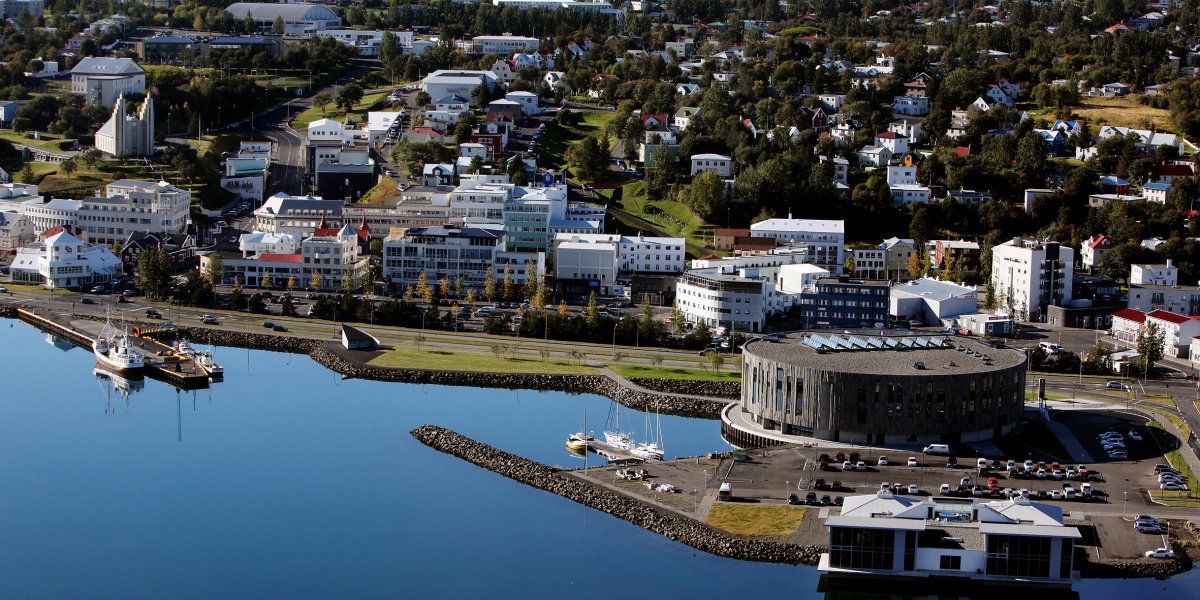
From Hafnarstræti walk six minutes north along Strandgata to pick up the paved Pollurinn shore path hugging the inner bay — Iceland's longest fjord, Eyjafjörður, unfurls in slow arcs with the snow-veined Súlur and Kaldbakur peaks rising on the opposite shore. Loop counter-clockwise past the old herring sheds and the seaplane jetty, then circle back toward the glass-and-basalt cylinder of Hof Cultural Center, whose drum-shaped facade frames the fjord like a giant camera lens. By 17:30 the low Arctic sun rakes across the water in deep gold — this is your sunset slot, and the only stretch of the day where you truly feel how this town sits inside its mountain corridor.
Tip: The flat 5 km Pollurinn loop is the only way to feel Akureyri's geography — locals walk it in 70 minutes after work; pace yourself slower for photos at the wooden viewing platform halfway around. From the bench on Hof's south terrace, the church on the hill aligns perfectly with the spire of its own reflection on the water at 17:45 in summer.
Open in Google Maps →19:00
Food
From Hof walk south along Skipagata for four minutes — Strikið sits one floor up at Skipagata 14, glass-walled terrace facing the fjord and the church on the hill you climbed this morning. This is Akureyri's reservation-only sunset table: Arctic char from Eyjafjörður (4,990 ISK / ~33 EUR), pan-seared lamb fillet from the Mývatn highlands (5,890 ISK / ~39 EUR), and a wine list that punches far above what a 19,000-person town has any right to. Book the window two-top a week ahead through strikid.is — this is the meal where the whole day quietly clicks into place.
Tip: Request 'borð við gluggann' (window table) in the booking notes — at 21:30 in summer the last light catches the church spire and the fjord turns rose-gold; that is the photograph you'll keep. Order the langoustine soup starter (small bowl, 2,490 ISK) over the lava-bread plate. Pitfall warning: skip the Viking-themed restaurants north of Hof on Skipagata (horned helmets at the door, mediocre food at 40% markup) and walk past the cruise-pier puffin-meat tasting kiosks — Iceland's puffin population is in steep decline and Akureyri's serious kitchens, including Strikið, no longer serve it.
Open in Google Maps →Saltar al día
09:00
Park
Begin at the world's northernmost public botanical garden, 65.7°N — over 7,000 plant species somehow thrive here at the edge of the Arctic. Pre-9 AM it is silent except for arctic terns; the alpine garden is still dewy and Cafe Laut has not yet opened. The greenhouse, where subtropicals grow under a near-Arctic sun, feels physically impossible.
Tip: Free entry. Walk to the small pond by the rock garden — its reflection of the Eyjafjordur mountains is the best photo in the park. The garden is officially open Jun-Sep but the gates are unlocked year-round; in winter you walk it under snow.
Open in Google Maps →10:30
Religious
Exit the garden's main gate and walk 10 minutes downhill along Eyrarlandsvegur — the white twin-towered church rises above the rooftops the whole way. Architect Gudjon Samuelsson, who also designed Reykjavik's Hallgrimskirkja, modeled the facade on Iceland's basalt columns. Doors open at 10:00 sharp; inside, find the stained-glass window above the altar — salvaged from Coventry Cathedral after the 1940 Nazi bombing.
Tip: Free. Look up — the model ship suspended from the ceiling is an old Icelandic tradition of sailors' prayers for safe return. For the iconic photo, walk to the bottom of the 112-step staircase on Kaupvangsstraeti; the long flight gives the church its monumental scale.
Open in Google Maps →12:00
Food
Descend the church steps to Hafnarstraeti and walk 3 minutes north on the pedestrian street — you cannot miss the cobalt-blue gables of this 1898 timber house, the most photographed cafe in northern Iceland. Order the Icelandic lamb soup, kjotsupa (~€15), thick with root vegetables and slow-cooked lamb. Grab a window seat upstairs for views of the heart-shaped traffic lights below.
Tip: Average €18-25. The 'happy lights' — traffic lights repainted as red hearts after Iceland's 2008 financial collapse as a city-wide gesture of kindness — flash directly outside the window. Wait for a red light, then shoot from the upstairs window for the perfect frame.
Open in Google Maps →13:30
Neighborhood
Walk south along Adalstraeti for 12 minutes — the road hugs the fjord and the houses shift from concrete to colorful 19th-century timber as you go. This is Akureyri's oldest quarter, where the town began in the 1860s. Pass Laxdalshus (1795 — the oldest house in town) and enter Nonnahus, the childhood home of Iceland's most beloved children's author Jon Sveinsson, with the tiny attic where he wrote intact.
Tip: Nonnahus €8, open 10:00-17:00 (Jun-Aug; off-season by appointment only). After the museum, walk 5 more minutes south to the gravel beach at Pollurinn — eider ducks paddle just offshore and the fjord view is the local detour tourists never make.
Open in Google Maps →16:00
Landmark
Walk 18 minutes back north along the waterfront via Drottningarbraut — the harbor opens up on your right with cruise ships and fishing boats. Hof's circular drum of pale Icelandic basalt is the north's main concert hall; the soaring interior atrium is free to enter, and Kaffi Ilmur in the foyer is where locals stop for an afternoon coffee. Outside, walk the harbor promenade and slip into Strandgata's small Icelandic wool and design shops.
Tip: Free entry to Hof; check the foyer screen for any free lobby concerts that evening. The Geysir wool shop on Hafnarstraeti has lopapeysa sweaters knitted by Icelandic grandmothers — the price tag names the knitter.
Open in Google Maps →19:00
Food
Walk 5 minutes south to Skipagata 14 and ride the elevator to the sixth floor — the windows wrap the entire dining room with sweeping views over Eyjafjordur. This is the locals' choice for a celebration dinner; the kitchen sources from Eyjafjordur farms and boats. Order the Arctic char tartare (~€22) and the slow-roasted reindeer with juniper (~€48).
Tip: Reserve via their website at least 24 hours ahead — window tables sell out a week ahead in summer. Arrive 15 minutes early; in June the sunset over the fjord arrives around 23:00, so target the longest daylight window. Pitfall warning: skip the harborfront restaurants on Hafnarstraeti with menu boards in five languages — they overcharge cruise-ship traffic for frozen seafood.
Open in Google Maps →08:00
Landmark
Leave Akureyri at 07:15 and drive 45 minutes east on Ring Road 1 — Godafoss is signposted just before the bridge. Arriving at 08:00 means a handful of cars, not the tour-bus wave that lands at 10:00. In the year 1000, the lawspeaker Thorgeir threw the pagan idols into this 12-meter horseshoe as Iceland adopted Christianity — hence the name.
Tip: Free. Take the path on the EAST side of the river, not the more popular west — fewer people, and the wide-angle shot from above is unobstructed. In winter the spray freezes the surrounding rocks an electric blue.
Open in Google Maps →10:00
Landmark
Continue 50 minutes east on Route 1 to Lake Myvatn's eastern shore, then park at Dimmuborgir's main lot. 'Dark fortresses' — a labyrinth of 2,300-year-old lava pillars formed when molten basalt flowed over a shallow lake and cooled around steam vents. Take the Kirkjan (Church) loop, 2.3 km in about 1 hour; the path threads through arches and chambers locals say are the home of the Yule Lads' troll family.
Tip: Free. Stay on marked paths — getting genuinely lost in the formations is easy. The chamber called Kirkjan is also where Game of Thrones filmed scenes beyond the Wall; it is on the marked loop, not a detour.
Open in Google Maps →12:30
Food
Drive 8 minutes north toward Reykjahlid village — Vogafjos is a working dairy farm with large interior windows that look directly into the milking barn. Order the smoked Arctic char on geyser-baked rye bread (~€18) and the lamb soup made from animals raised 50 meters away (~€22). The skyr is from milk that left the cow that morning.
Tip: Average €25-35, no reservation needed if you arrive before 13:00. Milking happens at 12:30 and 19:30 — time your visit to watch the cows file in while you eat. Don't skip the geyser-baked rye on the side board: it bakes 24 hours underground in volcanic heat.
Open in Google Maps →14:00
Landmark
Drive 10 minutes east on Route 1 over the Namafjall ridge — the sulfur smell arrives before the view does. An ochre-and-rust Mars-scape of boiling mud pots, hissing fumaroles, and yellow sulfur crystals stretches across the basin. Follow the marked paths between the steaming vents; the ground temperature exceeds 200°C just below the crust.
Tip: Free. Check the wind direction before approaching the largest mud pot — stand upwind for the photo, or you'll be eating sulfur. Wear shoes you can air out: the smell stays in fabric for a day.
Open in Google Maps →15:30
Entertainment
Drive 8 minutes back west — the milky-blue lagoon is set into the lava ridge above Lake Myvatn. This is Iceland's quieter answer to the Blue Lagoon: the same mineral-rich silica water, half the price, with a sweeping view of Myvatn rather than a fence. The water is naturally 36-40°C from a geothermal borehole 2.5 km below; soak until the light changes color.
Tip: Around €45 entry — book online for the 16:00-18:00 slot. Most tour buses board out by 17:00, so the lagoon empties around the time the evening light turns gold. Bring conditioner in your bag: the silica leaves hair dried-out and tangled if you don't rinse and condition immediately after.
Open in Google Maps →20:00
Food
Drive 1.5 hours west back to Akureyri on Route 1 — in summer the sun is still up; in winter the road is well-lit to Akureyri. Rub23 is Akureyri's signature seafood and sushi house; the namesake 'rub' is a house spice mix you apply at the table. Order the Arctic char with mango-chili rub (~€38) and start with the fjord scallop sashimi (~€22).
Tip: Average €50-70. Reserve by phone the day before — Saturday tables are fully booked by Friday lunch. Pitfall warning: don't be tempted by the N1 gas-station hot dogs on the drive back — they're a famous Icelandic snack but you've earned a real meal after 250 km of lava and steam.
Open in Google Maps →
Trip builder
Plan this trip around Akureyri
Turn this guide into a bookable rail itinerary with FlipEarth.
Keep exploring
Related cities
More in the same country
FAQ
Frequently asked questions
How many days do you need in Akureyri?
Most travelers enjoy Akureyri in 1 days, with enough time for headline sights and a slower meal or museum stop.
What's the best time to visit Akureyri?
The easiest season for most travelers is Jun-Aug, Sep-Mar, especially if you want good weather and manageable crowds.
What's the daily budget for Akureyri?
A practical starting point is about €120 per person per day before hotels, then adjust based on museums, dining, and transport.
What are the must-see attractions in Akureyri?
A good first shortlist for Akureyri includes Akureyrarkirkja (Akureyri Church), Pollurinn Shoreline Loop & Hof Cultural Center.