City Guide
Oviedo
Spain · Best time to visit: May-Sep.
Day-by-day plan
Choose your pace
Trip length
09:00
Landmark
Start in Campo de San Francisco park and follow Avenida de los Monumentos uphill, leaving the city through stands of eucalyptus and pine — a 50-minute climb that is already half the experience. Then it appears alone on a green shelf above the valley: a 9th-century stone hall built by King Ramiro I as his summer palace (not a church), with twin arcaded loggias unlike anything else in Europe. From the upper terrace the whole basin of Oviedo unfolds, and the morning sun rakes the south-facing carvings into hard shadow.
Tip: Arrive before 09:45 to catch the eastern facade in raking sun — by 11:30 the angle flattens and the carved corbels lose their depth. Walk to the back fence by the cypress on the north side for the shot every guidebook uses, and you will have it to yourself before the 10:30 tour bus arrives.
Open in Google Maps →10:30
Religious
Follow the meadow lane 300 meters north — three minutes and the smaller of the two UNESCO churches appears in profile against the Cantabrian Mountains. Only the front third survives (the rest collapsed in the 12th century), but the carved stone doorjambs depict Roman circus scenes, lions, and consuls — some of the oldest figurative sculpture in northern Spain. The hilltop here is a working pasture, with cows grazing meters from a building that predates the Crusades.
Tip: Stand at the wooden gate and frame the facade with the lone cypress on the right — that is the angle locals shoot for postcards. Skip the paid interior visit; the carved doorjambs you came to see are on the exterior, and the rest of the inside is bare stone walls.
Open in Google Maps →13:00
Food
Descend the mountain on the same road (35 minutes downhill, much faster) and dive into Calle Carpio in the old town. El Fartuquín has been pouring cider since the 1980s in a tile-and-wood dining room that locals still book for Sunday lunch — the kind of place where the owner walks the floor and remembers the regulars. Order the cachopo (a breaded veal cutlet stuffed with Serrano ham and Cabrales cheese — €18) or the fabada asturiana (the iconic white bean and chorizo stew — €14); either one is a full meal on its own.
Tip: Skip the menu del día (slow kitchen rotation) and order à la carte at the bar to turn the table faster. Ask for a single copa of cider rather than a full bottle — a bottle requires four people to finish before it loses fizz, and you have miles still to walk.
Open in Google Maps →14:30
Religious
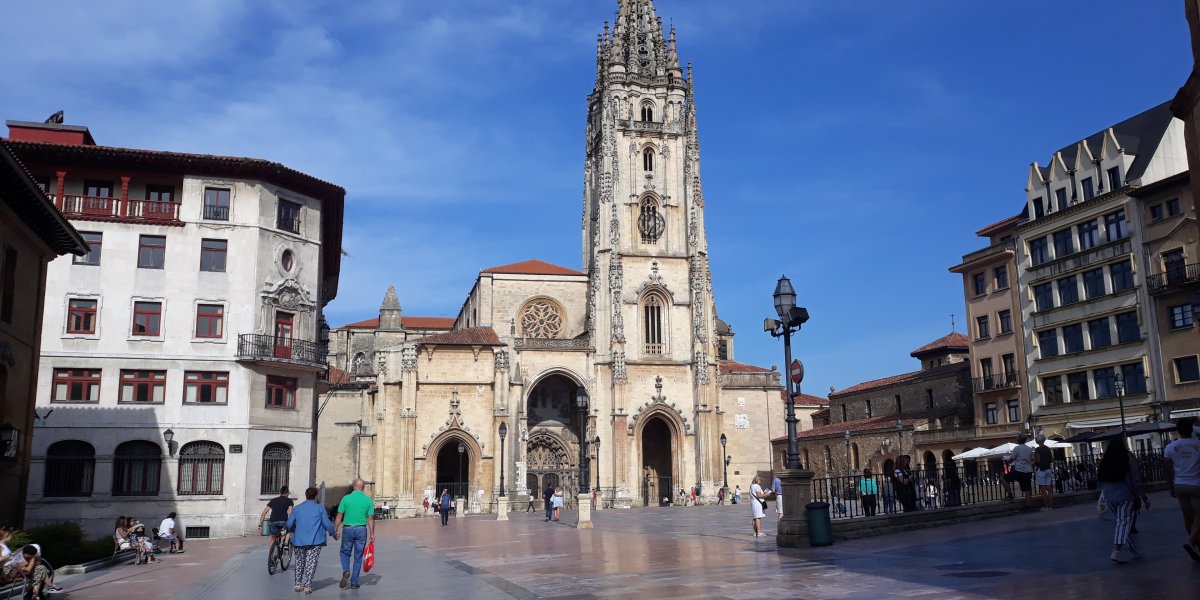
Walk 400 meters east through Plaza del Fontán and emerge onto Plaza Alfonso II el Casto, face to face with the cathedral's famously lopsided silhouette. The Gothic tower on the left rises 80 meters; the right side stops short — the matching tower was abandoned mid-build in 1587 and never completed, giving the facade its strange, off-balance grace. The bronze marker embedded in the south wall flagstones is the official Kilometer Zero of the Camino Primitivo, the original 9th-century Camino de Santiago route from which all others branched.
Tip: Shoot the exterior from the corner of Calle Schultz looking up at a 45-degree angle — it stretches the tower against the sky and hides the unfinished stub. The Cámara Santa interior houses the Holy Shroud relic, but the queue eats an hour you don't have; the postcard is the asymmetric facade, the plaza, and the Pelayo statue out front.
Open in Google Maps →16:00
Neighborhood
Drift west off the cathedral square into the cobbled grid: Calle Cimadevilla, Plaza Trascorrales with its bronze fishwives, and the arcaded Plaza del Fontán with its 18th-century covered market. On Calle de las Milicias Nacionales, the life-sized bronze of Woody Allen mid-stride commemorates his 2002 speech in which he called Oviedo "a delicious, exotic, beautiful, clean, pleasant, tranquil and pedestrianized city." Loop back via the La Regenta statue in front of the cathedral — the tragic heroine of Asturias's most famous novel, standing eternally in the square where her story is set.
Tip: Time your arrival at Plaza del Fontán for 17:30–18:00 — that is when locals emerge for the paseo and the arcaded square fills with conversation that you simply do not get at midday. The Mercado El Fontán closes its produce stalls at 14:00, so come for the iron-and-glass architecture, not the food shopping.
Open in Google Maps →19:30
Food
Walk five minutes north from Plaza del Fontán onto Calle Gascona — Oviedo's Bulevar de la Sidra, twelve sidrerías packed shoulder to shoulder. Tierra Astur Gascona is the most theatrical: waiters hold the bottle overhead at arm's length and pour a thin stream of natural cider into a glass held at hip level, breaking the surface to release the apple aromatics. Order the tabla de quesos asturianos (a board of Cabrales, Gamonéu, and Afuega'l Pitu — €19), the chorizo a la sidra (chorizo poached in cider — €11), and a bottle of natural cider (€4) to share.
Tip: Reserve for 19:30 — by 21:00 every table on Gascona is full and the wait stretches past an hour. Drink each escanciado pour within 20 seconds of it landing in the glass; the carbonation dies fast and warm cider is wasted cider. Pitfall: cafés on Calle Gascona without the green "Sidra de Asturias DOP" decal often serve industrial bottled cider at sidrería prices — sit only at places with visible wooden barrels and a llagar (cider-press) license on the wall.
Open in Google Maps →Jump to day
09:30
Neighborhood
Start in the heart of the old town inside this 19th-century iron-and-glass hall where Asturian farmers have sold cabrales cheese, sidra and chorizo since dawn. Arrive at 9:30 to catch vendors arranging the morning's catch — the smell of smoked fabada beans and fresh-pressed cider sets the tone for the city. Step out afterwards into the arcaded Plaza del Fontán to photograph the pastel facades that inspired generations of Asturian writers.
Tip: Skip the front cafés on the plaza — they're priced for tourists. Instead grab a 1.50€ café con leche at the back corner of the market hall where market workers take their break, and ask for a slice of bollo preñao (chorizo-stuffed bread, 2€) to take with you.
Open in Google Maps →10:30
Religious
Walk two minutes east through Calle Cimadevilla — Oviedo's oldest street, lined with 18th-century stone palaces — and the Gothic cathedral's single tower rises above the rooftops. Head straight upstairs to the Cámara Santa: this 9th-century pre-Romanesque chamber holds the Holy Shroud of Oviedo, said to have wrapped Christ's face, and the Cross of the Angels that appears on the city's coat of arms. The morning crowd thins after 11:00 once the bus groups move on to the cider houses.
Tip: Buy the 7€ combined ticket that includes the cloister, museum and bell tower. Most visitors skip the 117-step climb, but the rooftop view of Old Town's terracotta roofs framed by Mount Naranco is the postcard shot of Oviedo — and you'll often have it to yourself.
Open in Google Maps →13:00
Food
Five minutes northeast along Calle Mon brings you to Calle Gascona — Oviedo's official Boulevard of Cider — where waiters pour sidra from a bottle held overhead into a glass at waist height, aerating the cider in flight. Tierra Astur is the busiest of the strip for a reason: their cachopo (two veal fillets stuffed with serrano and cabrales cheese, breaded and fried, 18€) is the city's defining dish, large enough for two. Order the menu sidrería (24€) which includes cabrales croquettes, fabada beans, the cachopo, and an unlimited bottle of natural cider.
Tip: Arrive at 13:00 sharp — by 14:00 the queue stretches down the street. Order one cachopo between two people: portions are enormous and Asturians laugh kindly at anyone ordering one each. Let the waiter pour your cider escanciar-style; refusing the ritual is the surest way to mark yourself as a tourist.
Open in Google Maps →15:30
Museum
From Calle Gascona walk south for 6 minutes through Plaza de Trascorrales — pause at the bronze fishmonger sculptures — to the museum housed in three connected palaces facing the cathedral. The collection is small enough to see in ninety minutes but holds an El Greco, a Goya, and Picasso's portrait of Josette, alongside the most complete collection of Asturian painting anywhere. The Velázquez room is best on a sunny afternoon when natural light pours through the courtyard skylight.
Tip: Entry is free, but the temporary exhibition in Palacio de Velarde is often more rewarding than the permanent collection. Check what's on at the information desk before deciding your route, and start in the Palacio de Velarde — its top floor closes 30 minutes earlier than the rest.
Open in Google Maps →17:30
Park
Cross the street into Campo de San Francisco, Oviedo's central park where peacocks roam beneath chestnut trees planted in the 17th century. Pick up the Ruta de las Esculturas — over 100 bronze statues are scattered through the surrounding streets, including the famous Woody Allen on Calle de las Milicias Nacionales (Allen called Oviedo a fairytale city after filming Vicky Cristina Barcelona). The late afternoon light slants through the park's central avenue around 18:30 — photographers' golden hour.
Tip: The Woody Allen statue is the most photographed in Spain — but three blocks south on Calle Pelayo, the statue of La Maternidad gives you the same bronze drama without a single other camera. Pitfall warning: never accept 'free' rosemary from women near the cathedral — it's a classic distraction scam for pickpockets, and a tight-knit network operates daily on Plaza Alfonso II.
Open in Google Maps →20:30
Food
Walk five minutes west along Calle San Francisco to Casa Fermín, Oviedo's most celebrated restaurant since 1924 — three generations of the Fernández family have shaped it into the gold standard of refined Asturian cooking. Order the merluza a la sidra (hake in cider sauce, 26€) and the arroz con pitu de caleya (free-range chicken rice, 24€) — both showcase the kitchen's mastery of cider as a culinary ingredient rather than a drink. The dining room of dark wood and white linen feels like 1950s Madrid; reserve at least 48 hours ahead through their website.
Tip: The 75€ tasting menu is the better value than ordering à la carte if you're staying late — it ends with a tabla de quesos featuring nine Asturian cheeses including the volcanic-blue Cabrales aged in mountain caves, served with quince paste and house bread baked twice daily.
Open in Google Maps →09:30
Landmark
Take bus #10 from Calle Uría at 9:00 (1.40€, 15 minutes) up Mount Naranco — the morning shadows on the limestone facade are perfect at 9:30, before tour groups arrive. This is not a church but a 9th-century royal palace built by King Ramiro I and later converted — one of the most important pre-Romanesque buildings in Europe and a UNESCO World Heritage Site. Inside, look up at the original 1,200-year-old wooden ceiling beams that have never been replaced.
Tip: Buy the 4€ combined ticket at the booth between the two churches — it includes a 15-minute Spanish-only guided talk every 30 minutes. Even without the language, ask the guide to point out the medallions on the columns: the carvings of warriors with shields are among the oldest sculptures in northern Spain.
Open in Google Maps →10:45
Religious
A 300-metre uphill walk through the meadow above Santa María brings you to San Miguel de Lillo, the sister palace-chapel of the same king. Only one-third of the original 9th-century structure survives — the rest collapsed centuries ago — but what remains contains the most famous carved doorjambs in all of pre-Romanesque art, depicting a Byzantine consular diptych. Stand outside at 11:00 sharp when the sun clears the eastern ridge and the carved limestone glows honey-coloured.
Tip: The interior is smaller than Santa María and the visit feels rushed — but climb the dirt path five minutes behind the church for the only angle that frames both buildings together with the Asturian valley spreading below. This is the postcard most travellers never find because they board the descending bus immediately after.
Open in Google Maps →12:30
Religious
Catch the descending bus #10 back into town (15 minutes) and walk 8 minutes east from the stop to San Julián de los Prados, locally called Santullano. This is the third pre-Romanesque UNESCO church of the day — older than the Naranco pair (built 812–842) and the largest pre-Romanesque building still standing in Europe. The surprise inside is the frescoes: over 1,200 m² of geometric and architectural paintings completed twelve centuries ago, the most extensive early-medieval mural cycle in Western Europe.
Tip: Visit Monday to Friday only — weekends have masses and the frescoes are hidden behind worshippers. The 3€ ticket includes a small interpretive room where you can see what the original painted columns would have looked like before they faded; spend ten minutes there before entering the nave to recognise what you're seeing.
Open in Google Maps →14:00
Food
Walk 12 minutes west along Calle Marqués de Pidal back into the old town to El Raitán on Plaza Trascorrales — a 200-year-old former fishmonger's house turned traditional Asturian restaurant. The menú astur (22€) is the city's best educational lunch: seven small courses of regional classics — fabes con almejas (white beans with clams), tortos de maíz, cabrales — each explained one by one. The menus are printed in Spanish only, but the waiters are patient with international guests.
Tip: Skip the cider here — order an Asturian dry white from the Cangas DOC region instead, an obscure mountain wine the rest of Spain barely knows. Bottles start at 18€ and pair far better than sidra with the bean stews. Ask specifically for a Vidular Albarín if available.
Open in Google Maps →16:00
Landmark
Stroll 3 minutes south to the Antigua Universidad, founded in 1574 — its sun-drenched two-storey arcaded courtyard is one of the most photogenic spots in northern Spain and rarely contains more than five tourists at any time. From there walk Calle San Francisco where the city's Belle Époque cafés (Café Peñalba opened in 1898, La Mallorquina in 1881) still serve carbayones — almond pastries created for Oviedo's bourgeoisie in 1924. End at Plaza Porlier where the marble Pelayo statue marks the spot where the Asturian king launched the Reconquista.
Tip: Order a carbayón (2.80€) at Café Peñalba's marble counter rather than a table — table service adds 50%. The shop sells a box of six to take home for 16€; they last a week and survive a flight in checked luggage. Ask for them 'sin envolver' if you want to eat the first one immediately on the cobblestones outside.
Open in Google Maps →20:30
Food
Walk 6 minutes east to Ca Beleño on Calle Martínez Vigil — a small wood-panelled restaurant of just nine tables where chef David Suárez is rewriting modern Asturian cuisine. The 9-course tasting menu (58€) moves from a tartare of locally caught sea bass to suckling pig confit with cider reduction, ending with a hot rice pudding flamed at the table with Asturian aguardiente. This is the meal that lingers in your memory long after the cathedral has faded.
Tip: Reserve at least one week ahead via Instagram DM — they don't take online bookings and only respond to messages. Request 'la mesa del rincón' (the corner table) for the kitchen-pass view. Pitfall warning: avoid the touristy seafood restaurants along Calle Mon at night — they're 40% pricier than the same plates served on Gascona and often serve frozen octopus marked as fresh.
Open in Google Maps →
Trip builder
Plan this trip around Oviedo
Turn this guide into a bookable rail itinerary with FlipEarth.
Keep exploring
Related cities
More in the same country
FAQ
Frequently asked questions
How many days do you need in Oviedo?
Most travelers enjoy Oviedo in 1 days, with enough time for headline sights and a slower meal or museum stop.
What's the best time to visit Oviedo?
The easiest season for most travelers is May-Sep, especially if you want good weather and manageable crowds.
What's the daily budget for Oviedo?
A practical starting point is about €80 per person per day before hotels, then adjust based on museums, dining, and transport.
What are the must-see attractions in Oviedo?
A good first shortlist for Oviedo includes Santa María del Naranco.