City Guide
Cardiff
Vereinigtes Königreich · Best time to visit: May-Sep.
Day-by-day plan
Choose your pace
Reisedauer
09:00
Landmark
Begin at the south gate on Castle Street — the moment you turn the corner from Queen Street, the Norman keep on its grass motte and the gothic clock tower come into view together, two thousand years of Welsh history in a single frame. Skip the £15 interior tour today; the 2000-year-old Roman wall, the Norman shell keep, and William Burges's wildly ornate Victorian clock tower read clearly from outside. Walk west along Castle Street to find the Animal Wall — fifteen carved stone creatures (lion, seal, anteater, vulture, beaver) crouched along the parapet since 1890.
Tip: The Animal Wall is the freebie most tourists walk straight past — it's on the south pavement of Castle Street, 30 metres west of the main castle entrance. Best photographed at 09:30 with morning sun raking across the carved faces; the seal at the western end is the local favourite. The clock tower's gold-leafed numerals catch fire at this angle too.
Open in Google Maps →10:45
Landmark
Exit the castle south gate, cross Castle Street, and walk five minutes down Westgate Street — the Principality Stadium rises above the Victorian rooftops like a steel spaceship docked in the city centre. Walk the full west flank along the Millennium Walkway beside the river Taff to see the retractable roof's gantry mechanism and the only angle that captures all 74,500 seats in one shot. This is Welsh rugby's cathedral; on a non-match day the riverside path is yours alone.
Tip: The river Taff west bank is the single public vantage that fits the full stadium in one frame — the east side has buildings in the way. Avoid weekends from February to March (Six Nations) unless you have a ticket: the entire city centre closes to traffic and queues choke every street within 500 m. Check fixtures at principalitystadium.wales before you travel.
Open in Google Maps →12:15
Food
From the stadium's east flank, walk three minutes through Quay Street into the Victorian arcade district — the St Mary Street entrance to Cardiff Central Market is the cast-iron arch on your left. Head straight upstairs to the wrought-iron gallery for the panoramic photograph of the 1891 hall, then back down for lunch: Bakestones for Welsh cakes straight off the griddle (90p each), Ashton's traditional faggot-and-peas plate (£6), or NSP for fish and chips (£8). This is what Cardiff actually eats — fast, regional, and a fraction of the price of the chains on The Hayes.
Tip: Open 08:00–17:30 Monday to Saturday, closed Sundays — do not arrive on a Sunday and expect anything. Bakestones (ground floor, near the St Mary Street entrance) takes cash only and the queue moves fast; eat the Welsh cakes on the gallery upstairs for the view. Skip Costa, Starbucks, and the Hayes café row outside — they're slower, double the price, and have nothing local.
Open in Google Maps →13:45
Landmark
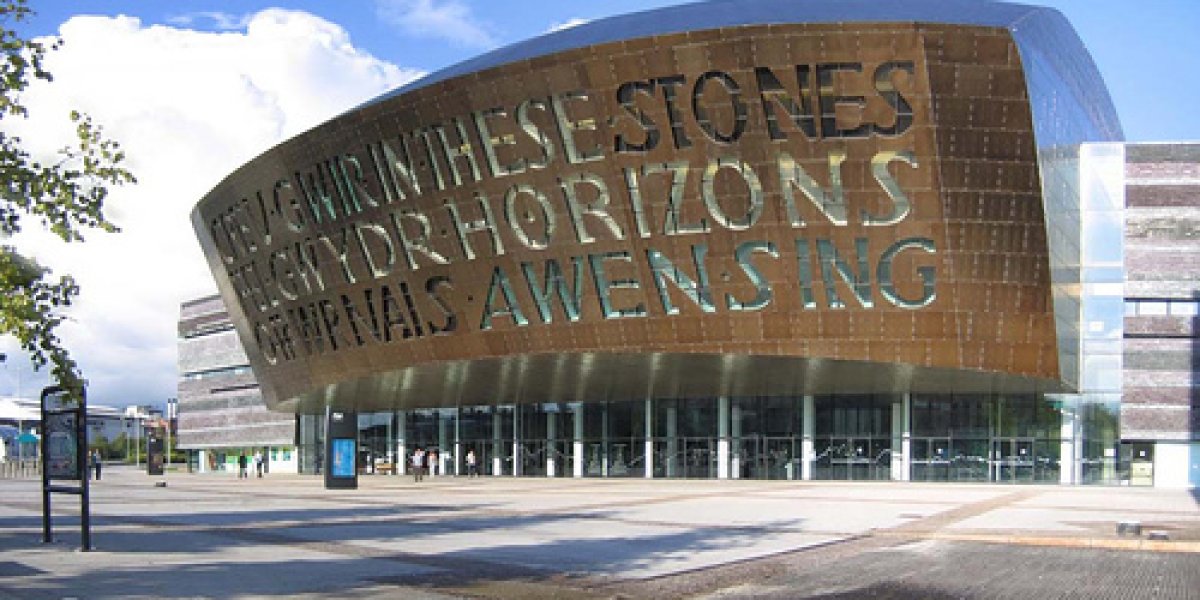
Exit the market onto Hayes Place, cross to Lloyd George Avenue, and walk the regenerated 1.8 km boulevard south to Cardiff Bay — 25 minutes flat, art installations along the way, and the bronze facade of the Millennium Centre gradually filling the horizon. Read the giant Welsh-and-English inscription cut through the copper — 'Creating Truth Like Glass From Inspiration's Furnace / In These Stones Horizons Sing' — best photographed from the centre of Roald Dahl Plass at 14:30 when the sun lights the patina. Walk through the foyer (free entry) for the slate columns and the Glanfa Stage.
Tip: If energy is low after the morning, the Baycar bus 6 runs every 10 minutes from Westgate Street to Cardiff Bay for £2.20 — journey 8 minutes versus 25 walking. The Millennium Centre foyer is free and most tourists assume it's ticketed; the slate columns are quarried from Welsh slate fields you'd otherwise need to drive to Snowdonia to see. The bronze letters are the photograph — frame them with the dome of the Pierhead Building in the background.
Open in Google Maps →16:00
Neighborhood
Walk south from Roald Dahl Plass for five minutes — the red-brick Pierhead Building (1897, Welsh-Gothic, terracotta clock) is on your right, the Senedd parliament's glass-and-slate roof beside it. Continue around the Inner Harbour curve to the Norwegian Church Arts Centre, a small white wooden chapel where Roald Dahl was baptised in 1916. From there, walk 1.2 km east along the boardwalk to the Cardiff Bay Barrage — the 1990s lock system that turned brown tidal mudflats into the freshwater bay you've been circling — and out to the lighthouse at the far end for views across to Penarth and the Bristol Channel beyond.
Tip: The Norwegian Church serves the best flat white in the Bay (£3.20) and is a working arts centre, not a paid attraction — most visitors stop at the Millennium Centre and turn back, missing it entirely. Best photograph: from the south-east boardwalk with the white timber reflected in the still bay water, around 17:00 in summer. The Pierhead Building is free to enter and houses a small museum of Welsh political history — 20 minutes is enough.
Open in Google Maps →19:00
Food
From the Barrage lighthouse, walk 25 minutes back along the boardwalk to Mermaid Quay — Bosphorus is the wooden pavilion on stilts jutting out over the bay water, the only restaurant in Cardiff actually built on the harbour. Reserve a deck table facing west: in summer the sun drops behind the Barrage at 20:30 and the bay turns molten gold beneath your plate. Order the mixed mezze (£14, easily shares between two) and the Iskender kebab (£18) — thin-sliced lamb on toasted bread with yogurt and tomato butter, the dish the restaurant is known for across South Wales.
Tip: Book a west-facing deck table online (bosphorus.co.uk) at least 24 hours ahead — locals fight for them in summer. Pitfall warning: the chain restaurants along the inner Mermaid Quay strip (Wahaca, Bills, Cosy Club, Las Iguanas) are £25-per-head tourist traps with mediocre pub food and no view of the water; the staff push you towards them as you arrive at the Bay. Bosphorus is the only place on the quay genuinely over the water, and the food is twice as good for the same money.
Open in Google Maps →Zu Tag springen
09:00
Landmark
Arrive at the gate the moment the portcullis lifts — this is two thousand years of layered history compressed into a single courtyard, from Roman wall fragments to a Norman keep on a grass motte to William Burges's unhinged Victorian apartments dripping in gold leaf. By 10:30 the timed slots for the Burges interiors choke up, so climb the Apartments staircase first: the Arab Room's honeycomb ceiling and the Winter Smoking Room's astrological frescoes are the most extravagant rooms in Wales. Save the Norman Keep climb for last — the wind off the Bristol Channel hits the top platform and the city centre rooftops unfold below in one clean panorama.
Tip: Buy the 'Castle Plus' ticket online — it includes the Burges apartments which sell out by 11:00. The Wartime Shelters tour at 09:30 is a hidden gem most visitors skip; the tunnels under the castle walls held 1,800 Cardiffians during the Blitz.
Open in Google Maps →11:30
Museum
Exit the castle through the east gate onto Boulevard de Nantes — Cathays Park unfolds before you, a Beaux-Arts civic square of pale Portland stone, with the museum's columned portico straight ahead, an 8-minute walk through formal gardens. Go directly up the central staircase to the first-floor Impressionist galleries: the Davies sisters bequeathed Wales a Monet water-lilies canvas, three Cézannes and a Van Gogh that would draw queues in Paris but here have entire rooms to themselves. The high north-facing windows pour soft midday light straight onto the canvases — the single best hour to see them is the one you've just walked into.
Tip: Closed Mondays. Free entry but drop £5 in the donation box — this collection is genuinely world-class and locally funded. Skip the dinosaur gallery on the ground floor; it's mediocre and eats time you should be spending with the Welsh portraits by Gwen John on Floor 1.
Open in Google Maps →13:45
Food
Retrace your route south down Boulevard de Nantes, cross at the castle wall and duck through the cast-iron entrance of Castle Arcade opposite the keep — 10 minutes total, with the Edwardian glass roof of the arcade opening above you as you enter. Order the Glamorgan sausages (£12.50 — leek, Caerphilly cheese and breadcrumbs, the Welsh meatless classic) and a bowl of cawl (£9.50 — slow-cooked lamb and leek stew that ends every Welsh winter). Ask for the small upper gallery — you eat looking down through the wrought-iron tracery onto shoppers crossing the arcade below, the most photographable Cardiff lunch view there is.
Tip: Budget £20-28 per person. No reservations — arrive by 13:30 to beat the Cathedral Road professionals, otherwise the upper gallery is gone. If both galleries are full, the cheese shop downstairs sells the same cawl in a takeaway pot; eat it on the bench outside the castle.
Open in Google Maps →15:30
Landmark
Cut south through Castle Arcade onto High Street, then west along Quay Street and Westgate Street — the stadium's silver retractable roof looms over the River Taff in under 8 minutes. Pause on the Millennium Footbridge for the classic Cardiff postcard angle. Wales's cathedral of rugby drops you onto the pitch where the Six Nations is decided every February: through the home dressing room (red leather, motivational mosaics), the deliberately bleak away room, the players' tunnel, and out onto the turf itself, where even non-fans stop breathing for a moment when they look up at 74,000 empty seats curving towards the sky.
Tip: Book online — walk-up is £18, online £15, and the 15:30 slot has the late-afternoon sun pouring through the open roof, which makes for far better photos than the morning tour. Tours don't run on event days; check the fixture list before booking weekends in February-March (Six Nations) or August (concerts).
Open in Google Maps →17:30
Shopping
Walk back across the Millennium Footbridge into Working Street — Royal Arcade, the city's oldest (1858), is the entrance two doors down, 5 minutes from the stadium. Cardiff has more covered Victorian arcades per square mile than anywhere else in Britain, and the four-arcade loop (Royal → Morgan → High Street → Castle) is a 45-minute walk through independent bookshops, vinyl crates and the wonderful Spillers in Morgan Arcade — the world's oldest record shop, trading continuously since 1894. The late-afternoon light angling sideways through the curved glass roofs is the photograph every visitor misses because they look at shop windows instead of up.
Tip: Start at Spillers in Morgan Arcade — they close at 17:30 sharp and the staff are the unofficial historians of Welsh music. Penylan Pantry in Royal Arcade does a take-away Welsh cheeseboard if you're peckish before dinner.
Open in Google Maps →19:30
Food
Exit Castle Arcade onto High Street, walk south past the castle wall and turn west onto Quay Street — Asador 44 is the warmly-lit corner restaurant on the right, 6 minutes from the arcade. Cardiff's serious dinner reservation: a Basque asador where suckling pig (£42 for two to share) is roasted in a wood-fired oven imported plank-by-plank from Pamplona. Order the pluma ibérica (£28, the secret cut of acorn-fed Iberico pork) with smoked piquillo peppers and a glass of Rioja Reserva — the same family runs Bar 44 next door, which is where Cardiff's chefs eat on their nights off.
Tip: Budget £50-70 per person with wine. Reserve 7-10 days ahead for Friday-Saturday; weeknights you can often walk in at 19:30. Ask for a table in the front room near the wood-fire — the rear dining room lacks the drama. Pitfall warning: avoid the chain restaurants fanning out along Mill Lane and the lower end of St Mary Street — those blocks are built for stag parties not eaters, and you'll pay London prices for microwaved food.
Open in Google Maps →09:30
Landmark
Take the four-minute train from Cardiff Queen Street to Cardiff Bay (every 12 minutes, £2.20 single) — or walk down Bute Street through the redeveloped Tiger Bay docklands (35 minutes). Arrive when the foyer doors open: the building's huge bilingual bronze inscription — 'Creating Truth Like Glass From the Furnace of Inspiration' — is at its deepest copper hue between 09:00 and 10:00 when low sun strikes the letters sideways; by midday it flattens. Inside, the slate-clad atrium climbs four storeys towards a curved timber ceiling; the resident Welsh National Opera chorus often warms up in the public foyers before the daytime crowds arrive.
Tip: Free entry to all public foyers. Check the box office for same-day returns on evening performances — the auditorium acoustic is one of the finest in Europe and the WNO regularly performs world-class productions for £25. The Glanfa Stage in the foyer often has free lunchtime music at 13:00.
Open in Google Maps →11:15
Landmark
Walk 60 seconds across the plaza — the Senedd is the glass-walled building with the wavy timber roof directly opposite the Millennium Centre, designed by Richard Rogers. Wales's parliament invites the public in for free, with no booking required: climb to the visitor gallery above the debating chamber and watch the architecture's argument unfold — every voter looks down on every politician, never the other way round. The undulating cedar ceiling, harvested from a single sustainable Welsh forest, is the most beautiful interior of 21st-century British civic architecture.
Tip: Free, no booking weekdays — security is airport-style, allow 5 minutes. Plenary sessions run Tuesday and Wednesday afternoons (13:30 onwards); if you're here on a sitting day, the gallery is electric and you'll hear Wales debated in both Welsh and English with live translation headsets. Photography permitted everywhere except during live chamber debate.
Open in Google Maps →12:30
Food
Walk 4 minutes north along the curved boardwalk — Mermaid Quay opens up on your right, all timber decking and bay views, with Bayside Brasserie occupying the prime corner table over the water. Order the pan-roasted Welsh sea bass with leek and laverbread butter (£21 — laverbread is the Welsh seaweed paste Richard Burton called 'Welshman's caviar') and a bowl of mussels in cider and Caerphilly cream (£14.50). Ask for the outdoor terrace tables; you eat looking across the inland bay water at the Pierhead clock tower glowing red brick in the noon sun.
Tip: Budget £25-35 per person. Outdoor tables are first-come — arrive by 12:30 to claim one or reserve a window seat online. The £18 two-course lunch menu is served until 14:00 and is the best value at Mermaid Quay; skip the laminated dinner menu at lunchtime.
Open in Google Maps →14:15
Museum
Walk 3 minutes east along the boardwalk back past the Senedd — the Pierhead is the unmistakable Victorian Gothic red-brick clock tower right on the water's edge, looking like a small French chateau washed up at sea. Built in 1897 as the headquarters of the Bute Dock Company when Cardiff exported more coal than any port on earth, it's now a free museum to Welsh democracy and industrial history. The ground-floor exhibition is small and well-edited — 45 minutes is enough — but the timber-panelled boardroom upstairs is where Cardiff's coal barons signed deals that built half the world's railways.
Tip: Free, no booking. The clock on the tower — known locally as 'the Baby Big Ben' — runs to a slightly different tune than the chimes you know; listen for the 15:00 strike. Closed Mondays from October to March, so check ahead in winter.
Open in Google Maps →15:30
Park
Exit the Pierhead and walk 3 minutes east along the waterfront path — the small white wooden church on the bay's edge is the Norwegian Church Arts Centre, originally built in 1868 for Scandinavian sailors and the place where Roald Dahl was christened. Pause for a free look inside (and a Welsh cake from the café, £2.50), then continue south along the Bay Trail across the Barrage — a 2-kilometre walk over the engineering marvel that turned a tidal mudflat into Europe's largest freshwater bay. Time the walk so you're at the Barrage's seaward locks by 17:00 when the late sun lights the lighthouse and the Bristol Channel opens up towards the English coast.
Tip: The Barrage walk is exposed — even in summer the channel wind cuts; bring a layer. The viewing platform at the far end (Penarth side) is the city's best free panoramic photo spot. Walk back the same way; the alternative is a £15 Uber from Penarth at sunset which doubles in price during demand surges.
Open in Google Maps →19:30
Food
Walk 8 minutes north along the bay path back to Mermaid Quay — Bosphorus is the white-painted floating restaurant moored on its own private pontoon jutting into the water, reached by a short gangway. Cardiff Bay's most theatrical dinner table: a fully working Turkish restaurant inside a moored ship, lights doubling on the black water, with the Millennium Centre's bronze inscription glowing across the bay. Order the mixed mezze starter (£18 for two — hummus, cacik, sigara börek, dolma) and the iskender kebab (£21 — lamb on yufta bread with hot yoghurt and tomato butter). Finish with Turkish coffee on deck.
Tip: Budget £40-55 per person. Reserve a window table on the lower deck for the water-level view — upper deck has bay views but no waves below. Pitfall warning: avoid the chain pubs lining the south side of Mermaid Quay — Las Iguanas, Bills and the rest charge London prices for chain food, and Bosphorus next door is genuinely cheaper for a better meal. Last train back to Queen Street is 23:42; cabs from the quay add £12 to the centre.
Open in Google Maps →
Trip builder
Plan this trip around Cardiff
Turn this guide into a bookable rail itinerary with FlipEarth.
Keep exploring
Related cities
More in the same country


FAQ
Frequently asked questions
How many days do you need in Cardiff?
Most travelers enjoy Cardiff in 1 days, with enough time for headline sights and a slower meal or museum stop.
What's the best time to visit Cardiff?
The easiest season for most travelers is May-Sep, especially if you want good weather and manageable crowds.
What's the daily budget for Cardiff?
A practical starting point is about €75 per person per day before hotels, then adjust based on museums, dining, and transport.
What are the must-see attractions in Cardiff?
A good first shortlist for Cardiff includes Cardiff Castle (Exterior & Animal Wall), Principality Stadium (Exterior & Millennium Walkway), Wales Millennium Centre & Roald Dahl Plass.