City Guide
Aberdeen
Vereinigtes Königreich · Best time to visit: May-Sep.
Day-by-day plan
Choose your pace
Reisedauer
09:00
Neighborhood
From Aberdeen rail station, walk 35 minutes north up the Spital — a quiet granite-tenement climb almost no tourist takes — until the cobblestones of High Street appear, framed by the 16th-century crown spire of King's College Chapel. Wander the cobbled medieval university quarter, then continue ten minutes north on College Bounds and Don Street to St Machar's Cathedral, whose twin sandstone spires guard a 1520 heraldic ceiling — 48 painted shields of European royals, the only ceiling of its kind in Britain.
Tip: Arrive at 09:00 when the chapel courtyard is empty and the low sun catches the mica flecks in the granite — this is the moment you actually see why locals call this 'The Silver City.' Enter King's Chapel via the side door on College Bounds (the main gate stays locked until 10:30). Inside St Machar's, look up at the painted ceiling: it's a propaganda map of who-mattered-when in 1520 European politics, and nothing like it survives anywhere else in Britain.
Open in Google Maps →11:30
Landmark
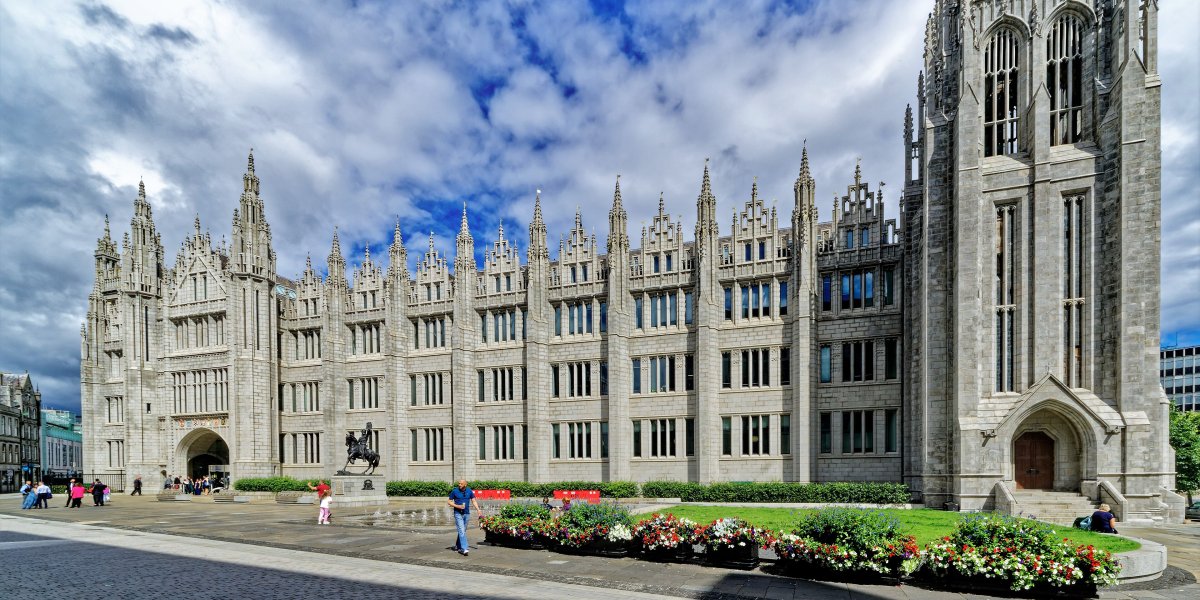
Walk south from St Machar's down the Spital — about 30 minutes through working-class granite terraces and Spital Cemetery, the route few visitors take but where you'll see Aberdeen as locals actually live it. You arrive at Broad Street and stop dead: Marischal College, the second-largest granite building on Earth (after El Escorial in Spain), a wedding-cake fantasia of pinnacles and tracery carved entirely from local stone between 1837 and 1906. It now houses Aberdeen City Council — yes, this is the town hall.
Tip: Stand on the east pavement of Broad Street to frame the whole facade in one shot — that's the only angle where the late-morning sun lights every pinnacle at once. After 14:00 the building falls into its own shadow and the photo dies, which is exactly why you're here before lunch. The inner quad is open during office hours and almost always empty — walk in for the full vertical scale.
Open in Google Maps →12:30
Food
Five minutes south from Marischal: down Broad Street, across Union Street (pause to take in the unbroken granite uniformity — the only major British high street built in a single stone), and down onto The Green, a medieval marketplace tucked one storey below modern Union Street. Cafe 52 occupies a stone-vaulted former merchant cellar at number 52, chalkboard menu changing daily. The smoked haddock chowder lives on it permanently because regulars revolt without it.
Tip: Order the smoked haddock chowder (£8) — it's a rougher, brinier cousin to the refined Cullen skink you'll have at dinner, and tasting both in one day is the proper Aberdeen rite of passage. Pair with a stovies plate (£10) — the leftover-roast-and-tatties Sunday-supper staple. Arrive by 12:15 to claim a vaulted-stone nook before the 12:45 lunch rush; they don't take weekday lunch bookings.
Open in Google Maps →13:45
Landmark
Climb the steps from The Green back up to Union Street and walk east along it — this is the 'Granite Mile,' a 1.2-km Georgian processional carved through the medieval city in 1801 and the most ambitious single piece of urban surgery ever performed in Scotland. End at Castlegate, the original marketplace, where the Mercat Cross (1686), the Salvation Army Citadel (a Scots-Baronial fairy-tale castle), and Provost Skene's House cluster around the spot Aberdeen has gathered for 800 years — to crown kings, hang witches, and trade fish.
Tip: Walk the south pavement of Union Street — the north side stays in shadow most of the day and you'll miss the granite glint that's the whole reason to walk it. At Castlegate, climb the steps of the Mercat Cross for the only elevated view back down Union Street: a kilometre of identical silver-grey storefronts terminating at the Citadel's turrets — the most overlooked composition in the city, and the photo every postcard misses.
Open in Google Maps →15:30
Neighborhood
From Castlegate, walk east down Castle Terrace and along the harbour for 25 minutes — past the supply ships that service the North Sea oil rigs, the only public pavement in Britain where you can watch live offshore industry at arm's length. You arrive at Footdee (pronounced 'Fittie'), a planned 1809 fishermen's village of single-storey granite cottages arranged in three tight squares facing inward against the storms. After exploring its postage-stamp lanes, walk north onto the Aberdeen Beach Esplanade — a 3-km crescent of sand with the North Sea on one side and the granite skyline on the other.
Tip: Step into the inner squares of South Square and Middle Row — every cottage has been decorated by its owner with shells, anchors, painted driftwood, and tiny walled gardens; locals call these their 'tarry sheds.' Photographer's secret: the side-light hits North Square at about 16:30, raking every weathered door. On the Esplanade, walk as far as the 1899 disused outdoor swimming pool ruins and turn back — beyond that it's all car parks and nothing to see.
Open in Google Maps →19:00
Food
Two minutes from Footdee's South Square along Pocra Quay — past the harbour pilots' station, out to the very tip of the north breakwater. The Silver Darling occupies an 1880s former harbourmaster's lookout, glass walls on three sides, the North Sea breaking five metres below your table. The name is the local nickname for herring — the silvery fish that built this city long before oil was ever drilled.
Tip: Order the Cullen skink starter (£12) — smoked haddock, leek, Maris Piper potatoes from Aberdeenshire, cream — the proper, refined version of what you tasted at lunch. Follow with whatever day-boat fish is on the chalkboard (usually £28). Reserve at least 48 hours ahead and explicitly request a sunset table on the seaward side (ask for table 7 or 8). Pitfall warning: skip the 'genuine Scottish fish & chips' kiosks lining the Beach Esplanade — frozen, £14 a portion — and avoid the chain pubs ringing Castlegate, which inflate menus 30% for the view; the real Aberdeen seafood is right here at Pocra Quay.
Open in Google Maps →Zu Tag springen
09:00
Landmark
Begin at Broad Street, where the world's second-largest granite building catches the morning sun — a fairy-tale facade of pinnacles and spires once called 'the most fantastic stone-cut building in the world.' East-facing light at 09:00 strikes the silver-flecked granite at exactly the angle that makes the whole facade shimmer; an hour later the sun is too high. Take it in slowly: this single building is the reason Aberdeen earned its nickname.
Tip: Stand directly opposite the main entrance on Broad Street for the best symmetrical shot. The interior houses council offices and is not open to the public — the exterior is the entire experience. Be there before 09:30, before the tour groups from cruise ships at the harbour arrive.
Open in Google Maps →10:00
Museum
A 3-minute walk south down Broad Street, then along the curving medieval Shiprow, brings you to the museum tucked inside Provost Ross's House — Aberdeen's oldest dwelling, dating to 1593. Be at the door for the 10:00 opening: this is the only museum in the UK dedicated to the offshore oil industry and the North Sea, and the three-storey Murchison oil platform model rising through the atrium is genuinely jaw-dropping. In the first hour after opening, the harbour-view gallery is almost yours alone.
Tip: Free entry, but closed Sundays and Mondays — check the day before you go. The top-floor café has the best view of the working harbour in the city and is rarely full. Don't skip the small clipper ship room on the second floor — it tells how Aberdeen yards built the legendary Thermopylae, fastest tea clipper of her age.
Open in Google Maps →12:00
Food
Walk 3 minutes west along The Green — the sunken medieval heart of Aberdeen, sitting a full storey below modern Union Street — to a converted granite workshop with bare-brick walls, zinc tables and an open kitchen. Order the Cullen skink (£8, the smoked-haddock-and-potato chowder that defines the northeast coast — here made with house-smoked Buchan haddock) and follow with the Aberdeen Angus beef cheek braised in stout (£18). Budget £20-30. Locals book ahead for weekends; on weekdays arrive at 12:00 to walk straight in.
Tip: Ask for a window seat overlooking The Green — you watch the city pass on cobblestones below Union Street, a view of layered Aberdeen no guidebook explains. Skip the wine list and order a Fierce Beer pale ale or a BrewDog Punk IPA — both breweries were born in Aberdeenshire.
Open in Google Maps →13:30
Museum
Walk 7 minutes north up Belmont Street to Schoolhill, where the gallery sits behind a granite Italianate facade. The interior — re-opened in 2019 after a £35 million renovation — is one of the most beautiful museum spaces in Scotland: a single light-flooded atrium ringed by three storeys of galleries. The natural rooflight is at its best in early afternoon, and the Scottish room (Raeburn, McTaggart, the Glasgow Boys) plus a small but real French Impressionist holding (Monet, Pissarro, Sisley) are all free.
Tip: Head straight to the rooftop terrace on the third floor — almost no one finds it, and the view across the city's granite rooftops to the sea is the best in Aberdeen. Closed Mondays. The gift shop carries small prints of the Joan Eardley fishing-village paintings that are otherwise impossible to find.
Open in Google Maps →15:30
Neighborhood
Walk east along Union Street and Castle Street, then down Regent Quay along the harbour edge (20 minutes, or take the No. 13 bus 8 minutes) to where the harbour meets the North Sea. Footdee — locals call it 'Fittie' — is a 19th-century fishermen's village of cottages built in tight inward-facing squares to shelter from North Sea gales; each tar-painted shed is now a folk-art canvas of shells, anchors and ship figureheads. From the North Pier the long sweep of Aberdeen Beach Esplanade curves north, and dolphins regularly play at the harbour mouth on a rising tide between 15:00 and 17:00.
Tip: The North Pier here is officially the best dolphin-watching site in mainland Britain — bring a windproof jacket even in July, the sea wind is the real thing. Walk the four Footdee Squares slowly but remember people still live in these cottages — admire the sheds, don't peer through windows.
Open in Google Maps →19:00
Food
Stay where you are — the restaurant occupies a converted 19th-century customs house perched directly on the North Pier at Footdee, with floor-to-ceiling windows over the harbour entrance. Aberdeen's signature seafood destination since 1986: order the North Sea hand-dived scallops with black pudding (£18 starter) and the catch of the day (£28-36, often turbot or halibut landed that morning at the fish market 400 m away). Budget £55-80 per person with wine. Reserve at least a week ahead, and request a window table for the 19:30 sunset.
Tip: When booking, ask specifically for table 4 or 5 — these face straight down the harbour entrance and you watch the lighthouse beam sweep over fishing boats coming in. Pitfall warning: avoid the chain seafood restaurants in Union Square on the city-centre side of the harbour — they're tourist-priced and serve frozen fish; this peninsula side is where Aberdonians actually celebrate.
Open in Google Maps →09:30
Landmark
Begin in Old Aberdeen, 2 miles north of the centre (a 15-minute ride on the No. 1, 2 or 19 bus up King Street, or a 35-minute walk). The chapel, founded in 1495, anchors the University of Aberdeen — Scotland's third-oldest university. Inside, the original 16th-century carved oak choir stalls and painted ceiling survived the Reformation untouched — the only such interior left in Scotland. Morning light through the west window between 09:30 and 10:30 lays gold bars across the carved oak.
Tip: Free entry, generally open from 09:30 weekdays. Look up before you leave: the Crown Tower above the chapel carries a unique carved stone crown commemorating James IV — the only one of its kind in Britain. The cobbled High Street outside is itself one of Scotland's most beautiful campus walks.
Open in Google Maps →11:00
Religious
Walk 5 minutes north up the High Street — past granite cottages with garden roses spilling over walls and the Cruickshank Botanic Garden on your right — to the twin sandstone spires of St Machar's. Founded in 580 AD on the spot where St Machar planted his crozier, the current building dates from the 14th-15th century. Look up the moment you enter: the heraldic ceiling of 1520 carries 48 painted shields of every European monarch of the day, one of only three such ceilings to survive in Europe.
Tip: Free entry, generally open 09:30-16:30. The interior takes only 30-40 minutes — give the rest of the hour to the kirkyard outside, where, according to tradition, William Wallace's quartered left arm was buried after his execution in 1305; the stone marker is on the west side near the path.
Open in Google Maps →12:30
Food
Walk 2 minutes back down the High Street to the most beloved pub in Old Aberdeen — a granite-fronted bar that has served students, professors and locals for over a century. Order the Cullen skink (£7, smoked haddock and potato chowder) and the haggis, neeps and tatties (£12, the Scottish national dish done properly with peppered turnip and a dram of whisky on the side). Budget £15-25. No reservations — arrive by 12:30 for a quiet seat before the 13:00 student rush.
Tip: The back snug past the main bar is where the academics drink — eavesdropping on a divinity professor and a marine biologist arguing about whisky is part of the experience. Ales are local: try the Fierce Beer pale ale, brewed 4 miles away in Dyce.
Open in Google Maps →14:00
Landmark
Walk 8 minutes north through the Chanonry — the medieval walled lane of the old canons' houses — to where the cobbled road opens onto the oldest standing bridge in Scotland. Built around 1320 under Robert the Bruce, the steep gothic single arch leaps the River Don 14 metres below in one dramatic curve. Afternoon sun between 14:00 and 15:30 lights the upstream face perfectly — cross slowly, then descend the riverside path on the north bank for the iconic shot from below.
Tip: Lord Byron played here as a boy and worked the bridge's foreboding rhyme — 'Brig of Balgownie, black's your wa'' — into Don Juan. Wear sturdy shoes: the path down to the riverbank is mossy and steep. The bridge is still open to cars but rarely sees more than two an hour.
Open in Google Maps →15:30
Park
Cross back over the Brig and follow the south-bank path along the Don for 5 minutes, then through the gates into Seaton Park — Aberdeen's loveliest formal park, laid out around the ruins of Seaton House. The Cathedral Walk frames St Machar's twin spires perfectly between rows of clipped beech; in May the cathedral floats above a riot of azaleas, in August the rose garden by the south entrance hits its peak. Late afternoon light here is gentle and gold and the park is almost entirely locals.
Tip: The 'Don View' lookout at the park's northeast corner gives the best panorama over the Don curving toward the sea — most visitors miss it because it's signposted only once. Free public toilets are inside the park lodge, useful before the walk back south.
Open in Google Maps →19:00
Food
Walk 15 minutes south down King Street, leaving Old Aberdeen behind, to a granite-fronted former weavers' inn now run as a proper Scottish gastropub on the edge of the city centre. Order the Aberdeen Angus steak pie braised in local ale (£16, the dish locals come back for) and the sticky toffee pudding with Drambuie cream (£7). Budget £25-40. No need to book before 19:30 on weekdays; the front bar room with the original 19th-century granite fireplace is the one to ask for.
Tip: Pitfall warning for an Aberdeen night out: do not be drawn into the cluster of late-night bars on Belmont Street in the city centre — they're aimed at the student stag/hen weekend crowd and drink prices double after 22:00. For a real Aberdeen pub experience stay in places like this, or finish the night at The Prince of Wales on St Nicholas Lane — Aberdeen's classic granite-floored ale house since 1850.
Open in Google Maps →
Trip builder
Plan this trip around Aberdeen
Turn this guide into a bookable rail itinerary with FlipEarth.
Keep exploring
Related cities
More in the same country
FAQ
Frequently asked questions
How many days do you need in Aberdeen?
Most travelers enjoy Aberdeen in 1 days, with enough time for headline sights and a slower meal or museum stop.
What's the best time to visit Aberdeen?
The easiest season for most travelers is May-Sep, especially if you want good weather and manageable crowds.
What's the daily budget for Aberdeen?
A practical starting point is about €110 per person per day before hotels, then adjust based on museums, dining, and transport.
What are the must-see attractions in Aberdeen?
A good first shortlist for Aberdeen includes Marischal College, Castlegate & The Granite Mile.