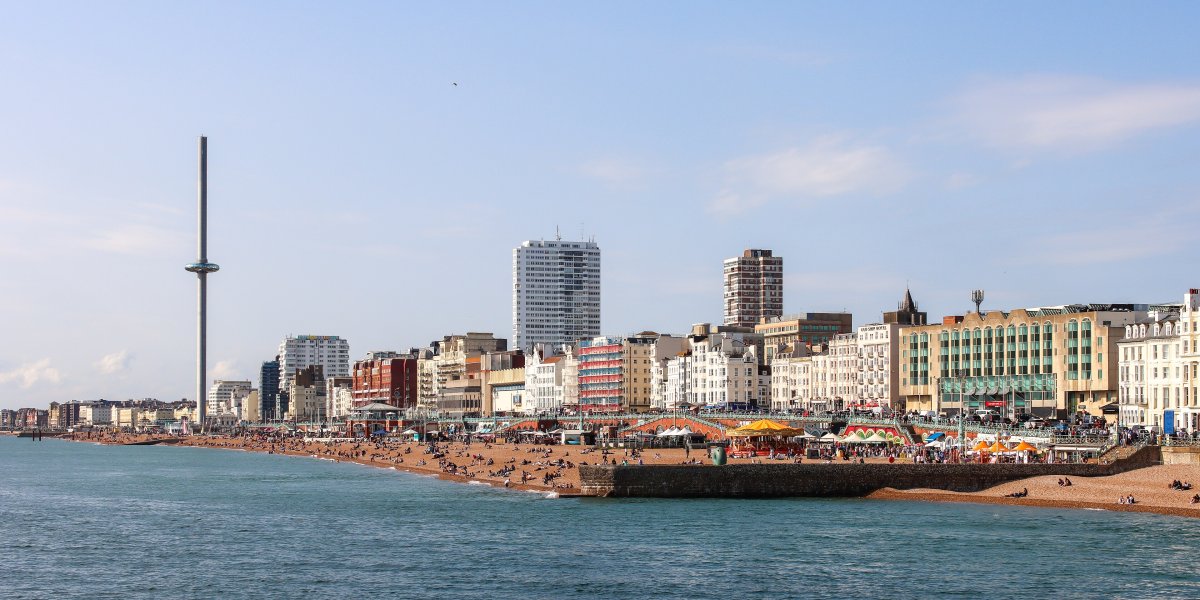
City Guide
Brighton
Vereinigtes Königreich · Best time to visit: May-Sep.
Day-by-day plan
Choose your pace
Reisedauer
10:00
Landmark
Step out of Brighton station, turn right down Queen's Road and follow the slope toward the sea — a 10-minute downhill walk brings the Royal Pavilion's Indo-Saracenic onion domes into view, George IV's outrageous seaside fantasy in white stucco. Arriving before the 11am coach crowds, you'll have the back lawn almost to yourself. The east-side morning light rakes across every minaret and pinnacle — the only hour the domes photograph cleanly against sky instead of being flattened by midday glare.
Tip: Skip paid entry — the lawn loop around the rear is free and the south-east corner behind the lily pond gives the full-domes shot the postcards use. Walk the whole perimeter; avoid the North Gate cafe (£5 for filter coffee).
Open in Google Maps →10:45
Neighborhood
Exit the Pavilion gardens through the south gate and cross North Street — 3 minutes west drops you into The Lanes, Brighton's maze of 17th-century fishermen's alleys now lined with antique jewellers, vinyl shops, and slanting bow-window boutiques. You want to arrive by 11:00, when shutters are up but the daytripper crowds haven't yet clogged Meeting House Lane. The narrow 'twittens' — the local word for these alleys — are barely shoulder-width; walk slowly, duck into the smaller courts, and notice the knapped-flint 'catseye' paving underfoot.
Tip: For real antiques hit Prinny's Antiques on Meeting House Lane and the estate jewellers on Duke's Lane — these are where Brighton locals buy vintage rings. East Street is tourist tat; don't waste time there.
Open in Google Maps →12:00
Food
Weave north out of The Lanes via Meeting House Lane, turn right onto Church Street — 4 minutes brings you to Pompoko, a twelve-seat Japanese canteen tucked behind the Theatre Royal that every Brightonian knows by name. There are no tables to linger at and no reservations — you order at the counter, grab a bowl when it's called, and eat elbow-to-elbow with students and shop owners. Arrive at 12:00 sharp: by 12:30 the queue snakes down Church Street.
Tip: Order the Chicken Katsu Donburi (£7) or the Yasai Tofu Donburi (£6.50) — both are house legends, with miso soup +£1. Cash preferred; there's a £5 card minimum. Green tea refills are free.
Open in Google Maps →12:45
Entertainment
From Pompoko walk south down New Road, cut through the Pavilion Gardens, and cross the seafront at the Aquarium roundabout — 12 minutes brings you to the Palace Pier's painted gates, Brighton's 525-metre Victorian boardwalk jutting into the Channel. Midday sun directly overhead lights the candy-striped helter-skelter and the red-and-white railings in postcard colour — the hour when Brighton looks most like itself. Walk to the very end for the full view back at the seafront; on the return leg, the amusement arcade's neon reads strongest against the dimming afternoon light.
Tip: Entry is free; rides are £3-5 each and only the helter-skelter slide at the pier's end is worth it (best view on the way down). Do not eat on the pier — the fish & chips here are £14 for what's £8 on the mainland.
Open in Google Maps →14:30
Landmark
Step off the Palace Pier onto the lower promenade and turn right (west) along Kings Road Arches — the pebble beach on your left, painted cast-iron railings on your right, and a 1.5-km seafront stretch that ends at the skeletal ruins of the West Pier. Opened in 1866 and burnt twice in 2003, the twisted ironwork standing in shallow water is now the most photographed ghost on the English coast. Keep walking past the ruins to the Victorian Brighton Bandstand, then on to the pastel beach huts at Hove Lawns, and turn back as the afternoon light begins to turn the Channel pink. This is the hour Brighton was made for.
Tip: Shoot the West Pier silhouette from the pebble beach directly south of the ruin, not from the promenade — the low angle doubles the drama against open sky. In Oct-Mar the starling murmuration above the ruins at dusk is worth timing the walk for.
Open in Google Maps →17:45
Food
Walk just 2 minutes back east along Kings Road from the West Pier ruins — The Regency sits directly opposite the seafront, a white-fronted seafood institution open since 1932 and still run by the Savvas family. The window tables look straight out at the sea and the pier skeleton, lit gold as the sun drops; ask for one the moment you step in. The menu hasn't changed in decades because it doesn't need to — this is where Brighton fishermen's families still eat on Sundays, and where you want to end your day before the last train back to London.
Tip: Order the grilled whole Dover Sole (£28, priced to weight) or the house fish soup (£8) with a side of chips — the two dishes locals drive in from Hove for. Arrive by 18:00 to skip the queue; reservations only for parties of 4+. Avoid the glass-fronted tourist bistros clustered around the i360 tower plaza — frozen product, double the prices, and waiters who won't tell you which fish is farmed.
Open in Google Maps →Zu Tag springen
09:45
Landmark
George IV's 1815 seaside fantasy — all onion domes outside, Chinese-dragon chandeliers and palm-tree kitchen pillars inside. Arrive right at the 09:45 summer opening to stand alone in the Banqueting Room under the six-ton crystal chandelier. The included audio guide unlocks George IV's private apartments upstairs, which most tour groups skip entirely.
Tip: Book online at brightonmuseums.org.uk the night before — a few pounds cheaper and you walk straight past the printed-ticket queue. No photos allowed in the state rooms on the ground floor (staff are strict), but the upstairs bedrooms and the Great Kitchen are photo-allowed without flash. Skip the gift shop on the way in and visit it on the way out when your arms are free.
Open in Google Maps →12:00
Museum
Exit the Pavilion's east door and cross the lawn of Pavilion Gardens — the museum sits two minutes away in the Pavilion's converted 1902 stables. Compact and sharp: Regency fashion beside 1980s Vivienne Westwood, Brighton's Mods-and-Rockers history, and one of England's most honest LGBTQ+ social-history galleries.
Tip: Show your same-day Royal Pavilion ticket at reception for a 50% discount on museum entry — the combined saving makes the morning much cheaper than buying separately. Head straight upstairs to the Fashion Gallery; if you only have 40 minutes, that room is the one locals tell visitors not to miss. The museum café in the foyer does the cheapest proper espresso in this quarter (£3).
Open in Google Maps →13:15
Food
Exit the museum onto Church Street and walk three minutes west to the corner of New Road, opposite the Theatre Royal — a tiny glass-fronted counter with chalked kanji and a queue that moves fast. Brighton students and market traders have been eating here for 15 years. Order the chicken katsu donburi (£7.50) or the salmon teriyaki donburi (£9); both arrive in six minutes with miso soup included and fill you until dinner.
Tip: Cash preferred — bring £10 notes to skip the card-machine wait. Arrive before 13:00 or after 14:00 to avoid a 20-minute queue out the door. Shared tables only; don't expect conversation space, expect brilliant food. No reservations ever, no exceptions.
Open in Google Maps →14:30
Neighborhood
From Pompoko walk two minutes south down Bond Street — you are already inside The Lanes, the old fishermen's alleys of 1800s Brighton, crooked and cramped and lined with jewellers and antique silver. After an hour, cross North Street to the very different North Laine: wider, bohemian, vegan, vinyl, graffiti. Together they are Brighton's two hearts.
Tip: The 'Lanes' (narrow, antique, historic) and 'North Laine' (wide, boho, independent) are two distinct areas constantly confused — start at Brighton Square, follow Meeting House Lane to The Cricketers pub, then drift north over North Street. Real antique dealers cluster on Union Street and Prince Albert Street west end — the touristy 'antique' shops at Prince Albert's east end sell mass-produced replicas at triple price. Snoopers Paradise on Kensington Gardens (North Laine) is the vintage cathedral every local sends visitors to.
Open in Google Maps →17:00
Entertainment
Leave North Laine south down Gardner Street, cross Old Steine at the war memorial and aim for the seafront arch — twelve minutes, and the pier reveals itself across the traffic with the sea glinting behind. Open since 1899, this is the last surviving Victorian pleasure pier in England. Walk it end-to-end for the classic view back at the city's white stucco; the late-afternoon sun turns the wrought iron the colour of honey.
Tip: Entry is free — you only pay for rides and the 2p pusher machines (feed in a pound, lose it cheerfully, that is the tradition). The best photograph of the pier is from the pebble beach 50 metres west, aligned with the sunset reflecting off wet shingle. Do not eat the fish and chips sold on the pier itself — overpriced and mediocre; the good appetite belongs to dinner.
Open in Google Maps →19:00
Food
Walk back from the pier up East Street and into Meeting House Lane — eight minutes, and the white-tiled window of the city's premier oyster bar glows on your right. No bookings, no tablecloths, no nonsense: marble counters, white subway tiles, a queue at the door with a glass of fizz in hand. Order half a dozen Jersey Rock oysters (£17) and the whole Dover sole à la meunière (£34) and you understand why locals celebrate birthdays here.
Tip: Arrive at 19:00 on the dot or after 21:30 to skip the worst queue; between 20:00 and 21:15 the wait hits 40 minutes on weekends. Ask for the daily whole fish off the chalkboard — it came in from Newhaven harbour that morning and doesn't appear on the printed menu. Avoid the 'Italian' and 'seafood' places clustered on East Street below the clock tower — menus in six languages are the universal red flag, the seafood is frozen, and prices run double what Riddle & Finns charges for the real thing.
Open in Google Maps →09:00
Park
Walk west along Kings Road seafront from central Brighton — about 25 minutes with the morning sun on your back, or bus 1 or 6 in ten. Between Hove Lawns and the shingle stand 400 numbered beach huts in every imaginable pastel — lemon, coral, mint, rose. Privately owned since the 1950s and still used; you'll pass retirees opening theirs for a thermos and The Times.
Tip: Huts numbered 260–320 (just west of Hove Lawns Café) have the most consistent pastel palette for photos — and the only stretch where the colours don't clash. Walk the boardwalk side, not the road side: the low morning sun aligns with the hut doors only from that angle. Before 10:00 is the only window where owners aren't yet sitting on their deckchairs blocking the shot. Hove Lawns Café does a proper £3 flat white for the cold fingers.
Open in Google Maps →10:45
Landmark
Keep walking east along the promenade fifteen minutes — the haunting skeletal ironwork rises from the sea 600 metres past the bandstand. The West Pier opened in 1866 as the most elegant pleasure pier in Britain and burned in two mysterious fires in 2003; its rusted skeleton has become the city's most photographed ruin. Behind it, Regency Square preserves one of England's finest Georgian terraces — white stucco, wrought balconies, almost unchanged since 1828.
Tip: Stand on the shingle directly in line with the ruin for the symmetrical shot every postcard uses — the angle only works from the beach, not the promenade above. Do not pay for the i360 viewing pod beside the ruin: it has been closed since late 2024 pending new ownership and the access points are fenced. If you return here at dusk in autumn, a cloud of 40,000 starlings murmurates around the skeleton — one of Britain's great free spectacles.
Open in Google Maps →12:30
Food
Walk north from the seafront up West Street, cross North Street and continue up to London Road — about fifteen minutes through the rising streets of central Brighton. The dough proves for 72 hours, the wood-fired oven hits 450°C, the pizza lands on your table in 60 seconds. Prosciutto e Burrata (£14) is the benchmark; Margherita DOP (£10) proves all pizza is really about three ingredients.
Tip: No lunch bookings for tables under six — walk in at 12:15 or after 14:00 and you're seated in ten minutes. Order a Negroni Sbagliato (£9) at the counter while you wait; they stir one of the best in Brighton. Avoid the 'authentic Italian' restaurants on Preston Street between here and the sea — most are UK chain brands wearing Mediterranean wallpaper, and prices are 40% above what you'll pay here for better pizza.
Open in Google Maps →14:00
Entertainment
From lunch walk south down New Road to the seafront, then east along the promenade past Brighton Palace Pier to the small green-and-cream Aquarium station — ten minutes, and the toy-sized Victorian carriages sit waiting. Opened in 1883, this is the oldest operating electric railway in the world, still riding its original rails at a dignified 12 mph. The 15-minute run east to Black Rock at Brighton Marina hums along the edge of the shingle, the sea on one side and the crumbling cast-iron Madeira Terrace on the other.
Tip: Buy a single ticket (£3), not a return — walk back along the seafront and you'll pass beneath Madeira Terrace's 1890 cast-iron arches up close, which is the actual point of the journey. Sit on the left (seaward) side of the carriage on the outward run for the clear sea view. The railway only runs Easter through end-September; check volks-railway.co.uk for the day's timetable, as tides occasionally cancel services.
Open in Google Maps →16:00
Neighborhood
From Black Rock terminus climb the steps up to Marine Parade and walk left (west) five minutes to St George's Road — the spine of Kemptown village. Brighton's LGBTQ+ heart and the city's most bohemian quarter: independent bookshops, vintage clothing above tiny galleries, a rainbow crossing at the Camelford Street junction, small pubs flying pride flags that pre-date every other in England. The Georgian squares immediately behind hide Lewis Carroll's former lodgings and are almost unchanged since 1825.
Tip: Detour into Lewes Crescent — one of the largest Georgian crescents in Britain, wider than Bath's Royal Crescent, and almost entirely undiscovered by tourists. The tunnel at its centre still leads down to a private residents' beach; the tunnel entrance alone is worth the walk. Antiques in Kemptown's shops run roughly 30% cheaper than identical pieces in The Lanes, because the coach tours never reach this far east.
Open in Google Maps →19:00
Food
From St George's Road walk three minutes south down College Place — a small Victorian corner pub with a green awning and the smell of roasted bones drifting out the door. The Kemptown branch of Brighton's legendary Ginger group, holder of a Michelin Bib Gourmand. The slow-cooked ox cheek (£22) is the signature; the Sussex rare-breed pork belly with braised red cabbage (£20) is the alternative worth arguing over. Ask for the back room — quieter, and you can see the open kitchen.
Tip: Book three days ahead for any Friday or Saturday via thegingerdogbrighton.com — walk-ins only work at 18:00 sharp or after 21:00. Ask the server for today's fish special; it comes off the Newhaven boats that morning and never appears on the printed menu. One warning for the evening walk back: avoid the bars on Marine Parade between Kemptown and the Palace Pier — drinks run 40% above Brighton average, the clientele is dense with hen parties, and the pavement scams involving 'free photos' and then demanded payment are a known local nuisance. Walk back through the inland streets (Edward Street) instead — shorter, quieter, entirely free of hassle.
Open in Google Maps →
Trip builder
Plan this trip around Brighton
Turn this guide into a bookable rail itinerary with FlipEarth.
Keep exploring
Related cities
More in the same country
FAQ
Frequently asked questions
How many days do you need in Brighton?
Most travelers enjoy Brighton in 1 days, with enough time for headline sights and a slower meal or museum stop.
What's the best time to visit Brighton?
The easiest season for most travelers is May-Sep, especially if you want good weather and manageable crowds.
What's the daily budget for Brighton?
A practical starting point is about €95 per person per day before hotels, then adjust based on museums, dining, and transport.
What are the must-see attractions in Brighton?
A good first shortlist for Brighton includes Royal Pavilion (exterior), West Pier Ruins & Seafront Promenade.