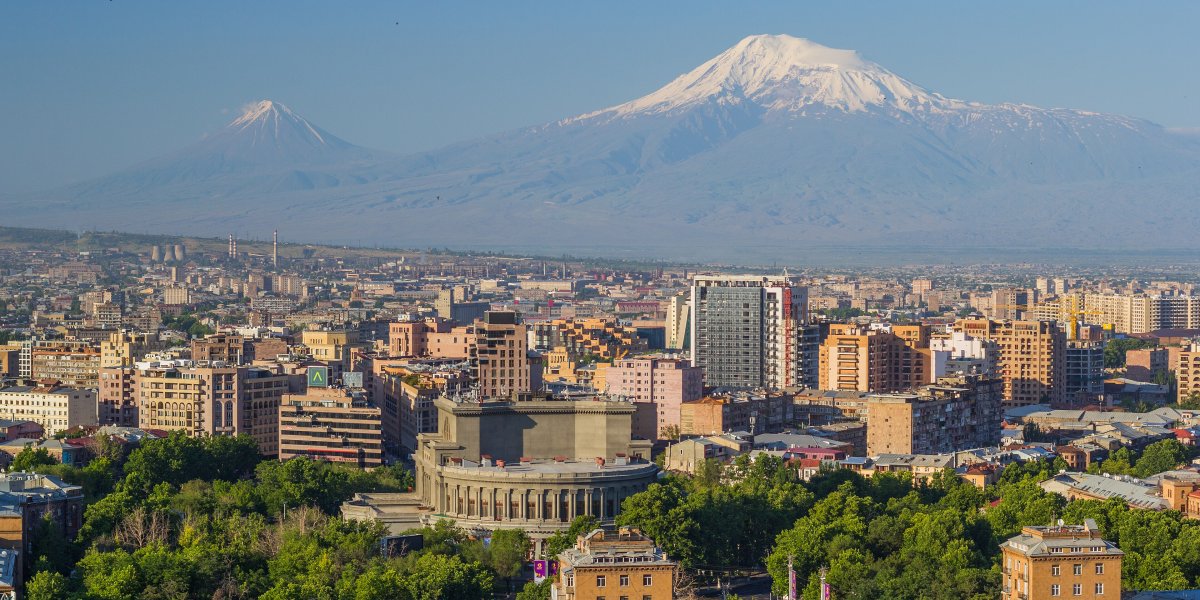
City Guide
Yerevan
Arménie · Best time to visit: May-Jun, Sep.
Day-by-day plan
Choose your pace
Durée du voyage
09:00
Landmark
Start at the top of the city. The Matenadaran sits at the northern crown of Mashtots Avenue like a basalt fortress, guarding 23,000 ancient manuscripts that survived empires, invasions, and a genocide. You are not going inside — you are here for the building itself: monumental staircases, carved khachkar reliefs, and the seated statue of Mashtots, the 5th-century monk who invented the 36-letter Armenian alphabet still in use today.
Tip: Stand at the base of the staircase and frame your shot with the alphabet relief in the foreground and Mashtots' statue above — the morning light hits this façade dead-on between 9:00 and 10:00, before the building casts its own shadow over the inscriptions. The terrace also offers your first unobstructed look south down Mashtots Avenue toward Mount Ararat.
Open in Google Maps →10:30
Landmark
Exit the Matenadaran terrace, turn left and walk 8 minutes east along the ridge — you arrive at the rear top of the Cascade, where Ararat suddenly fills the entire southern horizon. The Cascade is 572 limestone steps cascading down five terraces, lined with Botero, Lynn Chadwick, and Fernando Botero sculptures, and dropping into Tamanyan Park. Descend slowly, terrace by terrace; each level reframes Ararat against a different foreground.
Tip: Do not climb up from the bottom — that's the tourist trap. Enter the Cafesjian Center side door at the base and take the free indoor escalator (the only one in a public monument anywhere in the Caucasus) straight to the top, then descend on foot for the photos. Ararat is sharpest before 11:30 — by noon the summer haze swallows the snowcap. The east-facing terrace at level 3 is the cleanest Ararat composition; the west-facing terrace catches the city skyline.
Open in Google Maps →13:00
Food
Walk south through Tamanyan Park, past Botero's bronze 'Smoking Woman', and continue 4 minutes down Tamanyan Street — Karas sits on the right with a glass-walled khorovats grill facing the sidewalk. This is the chain locals actually use for a fast Armenian lunch: lavash flatbread wrapped around skewer-grilled meat, pickled vegetables, fresh tarragon, and tan (salted yogurt drink). No reservations, no fuss, six minutes from order to table.
Tip: Order the 'mtsvadi' (pork khorovats) wrap, 2,400 AMD — the smoke from the live-coal grill lingers in the lavash and the pickled red cabbage cuts straight through it. Add a glass of cold tan (300 AMD) — sour, salty, unlike anything you've drunk before. Avoid sitting on Saryan Street next door for lunch (the wine bars there charge 40-50% more at midday; come back after dark instead).
Open in Google Maps →14:30
Landmark
Backtrack one block north on Tumanyan Street — the curved travertine colonnade of the Alexander Spendiaryan Opera and Ballet Theatre rises above a small lily pond known locally as Swan Lake. Walk a full loop around the rotunda. The front (north) faces Freedom Square, the civic heart where Armenians gathered for the 1988 Karabakh rallies and the 2018 Velvet Revolution; the rear holds the seated bronze of composer Aram Khachaturian, where pensioners play backgammon under the trees.
Tip: The rotunda's best angle is from the southwest corner, where the colonnade curves away and a single tall Caucasian pine breaks the line — every postcard of the Opera is shot from this exact spot. Sit on the Khachaturian-side benches for 10 minutes: an elderly chess crowd plays here from 14:00 daily, and one of them will almost certainly wave you over to watch.
Open in Google Maps →16:30
Neighborhood
Cross Sayat-Nova Avenue south of the Opera onto Northern Avenue — a 450-metre pedestrian boulevard of cream travertine, sloping gently downhill toward Republic Square. This is Yerevan's evening ritual: ice cream vendors, buskers, families on the promenade. The avenue opens dramatically onto Republic Square (Hraparak) — an oval ringed by five pink tuff buildings of Stalin-era Armenian neoclassicism, with the singing fountains at the centre and the History Museum closing the southern arc.
Tip: Arrive at Republic Square between 18:30 and 19:15 (May-Sept) — the pink tuff facades shift from coral to fire-red under the setting sun, a 20-minute transformation no photograph can quite hold. Stand on the History Museum's front steps for the only angle that frames all four government buildings plus the fountains in a single shot. Stay for the choreographed musical fountain show at 21:00 (May-October) — Armenian folk, Queen, and Khachaturian's 'Sabre Dance' in rotation.
Open in Google Maps →19:30
Food
From Republic Square, walk 4 minutes west on Amiryan Street — Sherep occupies the corner of Amiryan 1, recognisable by the giant copper cauldrons simmering in the front window. Run by the Tumanyan Brothers (the same team behind Lavash next door), Sherep reinterprets Armenian village cooking inside an open-kitchen showroom: skewers turning over coals, dolma being rolled by hand, fresh lavash slapped against a clay tonir oven in the centre of the room.
Tip: Reserve for 19:30 a day ahead (sherep.am) — walk-ins after 20:00 wait 40+ minutes. Must-orders: the khorovats sampler with three meats and grilled vegetables (5,900 AMD), and the dolma in grape leaves with matzoon-garlic sauce (2,800 AMD). Pair with a glass of Areni Noir — Armenia is the world's oldest wine-producing country and Areni is the indigenous grape. Pitfall warning: ignore the unmarked taxis loitering on Northern Avenue offering 'Garni and Geghard right now, half price' — they are routinely double-priced and uninsured; book through gg.am or a licensed agency (35-45 EUR for a full half-day, fixed). Also skip the cafes ringing Republic Square itself — they carry a 50%+ tourist markup compared to identical menus one block away.
Open in Google Maps →Aller au jour
09:00
Landmark
Start your morning at the southwest corner of Republic Square near the Marriott — Alexander Tamanyan's pink-and-rose tuff-stone forum is the symbolic heart of Soviet-Armenian Yerevan. Morning light at 9 AM is when the eastern History Museum facade glows its warmest rose, before midday whitewash and before the tour buses arrive. Walk the colonnade clockwise to read the bilingual basalt plaques — the singing fountains in the central pool are dry by day but mark them for tonight.
Tip: The synchronized 'singing fountains' play 21:00-22:00 May-October — note the timing and return after dinner. Stand at the eastern edge near the Government House for the classical-music finale at 21:55, not in the middle where the speakers blast directly into your ears.
Open in Google Maps →10:30
Museum
Walk 18 minutes straight up Mashtots Avenue — past the open-air book stalls where pensioners sell Soviet-era novels for a few coins — until you face the towering basalt statue of Mesrop Mashtots, inventor of the Armenian alphabet. Inside, 23,000 ancient manuscripts make this the largest collection of Armenian, Persian, and Arabic codices on earth. Enter right at the 10:00 opening when the English guided tour begins and morning light hits the illuminated Gospel of Mughni without glass reflection.
Tip: Book the 11:00 English guided tour (3,500 AMD) immediately on arrival — without it, you'll skim past treasures whose stories you'd never decode. Don't miss the 5.6 kg 'Homilies of Mush' on the second floor: half-saved by two women carrying each half out of a 1915 massacre.
Open in Google Maps →13:00
Food
Walk 12 minutes south along Aram Street to Lavash, a contemporary Armenian kitchen where women slap dough onto the clay tonir oven wall directly in front of the dining room. Order the khorovats pork skewers (4,500 AMD) and spas yogurt-and-grain soup (2,200 AMD) with herb-loaded lavash pulled hot off the wall. Walk in by 12:45 without booking; arrive after 13:30 on a Saturday and you'll queue 25 minutes.
Tip: Order the 'gata' walnut pastry for dessert (1,200 AMD), sweetened with caramelized walnut — the perfect snack to pocket for the Cascade climb. The wine list features Armenian Areni Noir from 5,000-year-old vineyards near Areni village; try a single glass before you switch back to water.
Open in Google Maps →15:00
Landmark
Walk 12 minutes east along Moskovyan Street and cross Tamanyan Park where Botero's fat bronze cat sprawls in the sun. The Cascade is a 572-step travertine waterfall-staircase rising 118 meters above the park, its terraces studded with sculpture by Botero, Lynn Chadwick and Barry Flanagan. Climb in the afternoon when sun lights the western face — at 16:30 the air clears enough to see Mount Ararat's twin peaks floating above the southwestern skyline.
Tip: Skip the unfinished dome at the very top — it's a concrete platform with chain-link fencing and no view. The unbeatable Ararat photo is from the 5th terrace landing where the railings disappear from the foreground; time your ascent to reach this level at exactly 17:30 for the softest lowering light.
Open in Google Maps →18:00
Neighborhood
Walk 8 minutes south down Tamanyan Street and spill onto Northern Avenue, Yerevan's pedestrianized promenade linking the Cascade to Republic Square. This is where locals actually walk on weekend evenings — fashion students, jazz buskers, families pushing strollers with mulberry ice cream. By 18:30 the street lamps glow against the granite facades and the chestnut trees turn silhouette as you drift back toward the square.
Tip: Don't eat on Northern Avenue itself — the cafe terraces are tourist traps charging triple for the same dishes you'll find a block off. Walk through, photograph the architecture, and stop at Grand Candy at the southern end for a 700-AMD 'Ponchik', the cream-filled doughnut every Yerevan child grows up on.
Open in Google Maps →19:30
Food
Walk 4 minutes east from Northern Avenue to Sherep on Amiryan Street, a modern Armenian kitchen that elevates village cooking into theater with five open stations visible from every table. Order khash-pa pork dumplings in broth (3,800 AMD) and the eggplant 'imam' with walnut-pomegranate stuffing (3,400 AMD), then watch the chef toss pomegranate seeds across a grilled trout. Reserve by 18:30 — Saturday night without reservation means a 40-minute wait at the bar.
Tip: Order the 'tan' yogurt-mint drink (800 AMD) over water — it cuts the rich Armenian fats like nothing else. PITFALL: along Abovyan Street and Northern Avenue, avoid the 'Caucasus-theme' restaurants with costumed greeters and laminated picture menus — they charge 3x for microwaved versions of the same dishes. If a man in a felt papakhi hat is waving you in from the doorway, walk past.
Open in Google Maps →09:30
Landmark
Your driver leaves Yerevan at 08:45; the 35-minute descent on the Yerevan-Sevan highway drops into the Hrazdan Gorge with the snow-capped Geghama range glinting on the left horizon. The 1st-century AD Garni Temple sits on a triangular promontory above a 300-meter chasm — the only Greco-Roman colonnaded temple to survive the entire former USSR, pagan and dedicated to Mithra the sun god. Arrive at 09:30 right at opening, before the Tbilisi tour buses roll in, when the Ionic columns cast 6-meter shadows across the basalt platform.
Tip: Walk to the cliff edge BEHIND the temple — almost no tour group does — where the river bends through the gorge and the basalt 'organ pipes' you'll visit next become visible far below. Hire a single English-speaking driver for the whole day at 35,000 AMD (~80 EUR); the Garni-Geghard combo via tour bus is double the price and burns 45 minutes at a souvenir bazaar you don't want.
Open in Google Maps →11:30
Landmark
Your driver descends 4 minutes by car from Garni into the Azat Gorge; the road ends at a riverbed framed by walls of hexagonal basalt columns hanging like a frozen pipe organ. These cliffs formed 2 million years ago from cooling lava — perfectly geometrical, 50 meters tall, locally called 'Krunki Tap' (Crane's Knee). No barriers, no entry fee, no signage — just raw earth, the sound of the river, and almost no tourists this side of midday.
Tip: Wear non-slip shoes — the riverbed cobbles are wet most mornings even in summer. The best photo angle is from the small wooden footbridge 80 meters past where most cars park; cross it and look back UP at the columns from the south bank — the geometry only resolves from that direction.
Open in Google Maps →13:30
Food
Drive 7 minutes back up to Garni village to a family home that hosts a traditional lavash workshop — your driver knows the spot; ask for 'Gohar's tonir' near the village church. The grandmother bakes lavash by slapping dough against the wall of an underground clay tonir while apricot trees shade the long courtyard table. The 8,000-AMD set menu includes the bread you helped bake, dolma in grape leaves, apricot-wood khorovats, and a small glass of homemade mulberry vodka.
Tip: Try slapping a lavash sheet onto the tonir wall yourself — the grandmother always offers but most tourists shy away. You'll burn your knuckles slightly and that's exactly the experience. Take a vacuum-sealed lavash home (1,000 AMD) — it keeps six months in your luggage and reheats over a stove flame in 30 seconds.
Open in Google Maps →15:30
Religious
Drive 15 minutes east up the Goght River canyon — the road dead-ends at a sheer basalt cliff into which the 4th-century Geghard monastic complex is carved. The freestanding 13th-century main chapel hides two cave chambers chiselled directly into the rock, each with a sky-light oculus and uncanny acoustic perfection. UNESCO-listed since 2000, the name means 'spear' — the relic of the Roman lance that pierced Christ was once kept here.
Tip: Enter the right-hand rock-cut chamber and stand directly under the oculus — clap once. The 4-second reverb is the most haunting sound in Armenia. If a monk is chanting when you arrive, freeze and listen with your phone in your pocket — recording it cheapens what no microphone can capture anyway.
Open in Google Maps →17:30
Landmark
Drive 35 minutes back toward Yerevan and stop on the hilltop west of the city at Tsitsernakaberd. A 44-meter basalt stele points skyward beside a circular eternal flame surrounded by 12 inward-leaning slabs — one for each lost western Armenian province. At 18:00 the western light catches the stele as the city below begins to glow; the silence here is louder than any monument in Europe.
Tip: The museum closes at 17:00 — come for the outdoor memorial only, which is always accessible. Walk the alley of foreign-leader-planted trees on the eastern side; each small plaque marks a country that has officially recognized the genocide, and the gap where your own country's name should be is part of the experience.
Open in Google Maps →19:30
Food
Drive 15 minutes back into the city center to Dolmama on Pushkin Street, the grande dame of upscale Armenian dining where presidents — and yes, the Kardashians — come to taste pre-Soviet recipes inside a restored 19th-century stone house. Order the namesake dolma in grape leaves (5,800 AMD) and the lamb-and-quince stew (8,500 AMD); the courtyard tables under the apricot trees are gone by 20:00. Reserve 48 hours ahead — Saturday seating sells out before noon Friday.
Tip: Order the apricot vodka digestif (1,200 AMD) — Armenia's true national spirit and the only one made from native trees. PITFALL: avoid the taxi mafia loitering on Pushkin Street outside the restaurant who quote 5,000 AMD for a 1,200-AMD ride — open the GG taxi app on your phone, or ask Dolmama's host to call one for you (they keep an honest driver list at the front desk).
Open in Google Maps →Aller au jour
10:00
Museum
Take Mesrop Mashtots Avenue north on foot from Republic Square — 15 uphill minutes through pink tuff facades glowing in the morning sun. The 23,000-manuscript collection holds the 28-kg Homilies of Mush (the largest Armenian manuscript) and a 4-gram miniature New Testament; arrive at opening because by 11:30 the cruise groups fill the small halls. Mashtots, inventor of the alphabet, sits in stone before the entrance.
Tip: Closed Sunday and Monday. Buy the 2,500 AMD English audio guide at the desk — without it the manuscripts are beautiful but mute. The second-floor permanent halls are the soul; skip the upper-floor rotating exhibits if short on time.
Open in Google Maps →12:30
Food
Walk back down Mashtots Avenue for 12 minutes — easier with the slope, plenty of cafés to peek into along the way. Sherep ('ladle' in Armenian) is the most polished modern Armenian kitchen; open hearths line the walls so you watch lavash slapped onto the tonir oven in real time. Order the pork khorovats (4,500 AMD) and spas, a tart yogurt-and-wheat soup (1,800 AMD) — average 10,000 AMD per head.
Tip: Reserve via Instagram DM (@sherep_restaurant) for a window seat — walk-ins after 13:00 face a 30-minute wait. Skip the laminated 'tourist set menu' near the door; the regular menu is half the price for identical dishes.
Open in Google Maps →14:30
Landmark
Cross Saryan Street east to Tamanyan Park — Botero's giant black cat marks the base of the limestone pyramid. Take the indoor escalators (free, on the right behind the Cafesjian sculptures) and step out at each landing to admire Lichtenstein, Plensa, and contemporary Armenian works. From the top platform, Mount Ararat dominates the southern horizon and the snow cap turns gold against the afternoon haze.
Tip: Escalators end at level 5 — the actual summit needs a 15-minute outdoor climb up the western side stairs, which most visitors miss. Walk five minutes further to the unfinished Soviet Monument behind the Cascade for the cleanest Ararat photo with no power lines in frame.
Open in Google Maps →17:30
Neighborhood
Descend the Cascade's western staircase and walk south through the leafy Tamanyan walkway — 8 minutes — straight onto the pedestrianized Northern Avenue running down to Republic Square. Locals call it 'the catwalk' for the after-work parade of suited bankers and well-dressed grandmothers. Buskers set up around 18:00 and the Republic Square singing fountains start at sundown.
Tip: Skip the Italian gelato chains lining the avenue — overpriced and frozen. Duck into Grand Candy at #1 for a 600 AMD ponchik (Armenian custard donut), the chain's signature since 2000.
Open in Google Maps →19:30
Food
Walk up Tumanyan Street six minutes from Northern Avenue — the restaurant's wood-paneled facade sits on the corner with Abovyan. Lavash is a designer reinvention of the village tonir house; every table gets a basket of warm fresh-baked flatbread to wrap around the dolma (1,900 AMD). The signature ghapama — pumpkin stuffed with rice, dried fruit, walnuts (3,200 AMD) — is the dish from the famous Armenian folk song; budget around 12,000 AMD per head.
Tip: Book in advance — this fills nightly with locals and visiting diaspora. Pitfall: the cluster of restaurants on Saryan Street one block west copies Lavash's menu and decor but charges 40% more; Lavash is the original.
Open in Google Maps →09:30
Religious
Leave Yerevan at 08:30 by GG taxi or hired driver (12,000 AMD round trip with waiting); the road climbs east through apricot orchards into the Azat River gorge — 40 km, one hour. Geghard ('spear' — once held the lance that pierced Christ) is half-built, half-carved into the basalt cliff. Arrive by 09:30 to enter the rock-cut Avazan chapel before the 11:00 tour buses, when a soloist's sharakan hymn under the dome turns the acoustic into something otherworldly.
Tip: UNESCO World Heritage site. Tip the singer 1,000 AMD — they sing for tips, not salary, and the 90-second performance is the spiritual peak of the trip. Around 10:30, light beams pour through the upper rock chapel's central oculus onto the carved khachkars.
Open in Google Maps →12:30
Food
Drive 15 minutes back down the gorge to Garni village — ask your driver for a registered family kitchen, not a tour-bus canteen. The set lunch (5,000 AMD per head) covers fresh tonir lavash baked in the courtyard before your eyes, khorovats, jingyalov hats (herb-stuffed flatbread), homemade tan yogurt drink, and an apricot vodka tasting. Every ingredient comes from the family's garden or animals.
Tip: Ask the driver for 'Garni Tonratoun' or 'Hov Anapat Tonir Tun' — both are real family operations, not the plastic-chair tour stops. Press the host to let you slap a lavash sheet onto the hot tonir wall yourself — this is the photo of the trip.
Open in Google Maps →14:30
Landmark
A five-minute walk from the village square brings you onto the Garni plateau. The 1st-century Greco-Roman sun temple to Mihr — Armenia's only surviving pagan structure and the only such temple in the entire former Soviet Union — perches on a basalt promontory above the gorge; toppled by a 1679 earthquake, it was rebuilt in the 1970s from its own numbered stones. The unfaded grey blocks are the originals; the lighter ones are 20th-century replacements.
Tip: Walk to the cliff edge behind the temple before entering — the angle from the southwest aligns the columns against the gorge with no fence in frame. In the Roman bath ruins to the left, look down for an intact mosaic inscribed 'We worked, but received nothing' — easy to miss.
Open in Google Maps →16:00
Landmark
From the Garni Temple parking lot, ask the driver to descend the gorge road for 10 minutes — a rough track ending at the Azat riverbank. Basalt columns hang from the cliff like a frozen pipe organ, formed by lava cooling 500,000 years ago. The late-afternoon sun strikes them sideways and turns the columns rust-orange against the river.
Tip: Wear shoes with grip — the riverbank is loose stone. By 16:00 the tour groups have left and you may have it to yourself; photograph the columns looking straight up from directly below the central cluster.
Open in Google Maps →20:00
Food
Return to Yerevan by 19:00 (the unlit gorge road must be finished before sunset) and walk five minutes from Republic Square to Pushkin Street. Tsirani — 'apricot,' Armenia's sacred fruit — fills a restored 19th-century townhouse with candlelit booths and a small upstairs balcony. Try the apricot-glazed lamb chops (6,500 AMD) and the matsun-and-walnut cold soup (2,200 AMD); budget around 11,000 AMD per head.
Tip: Reserve the upstairs balcony — three tables only, overlooking a fig-tree courtyard. Pitfall: drivers offering 'cheap day tour' at Republic Square in the morning often skip Symphony of Stones to save fuel; agree on all three stops in writing before leaving.
Open in Google Maps →11:00
Museum
Walk south through the morning quiet of Abovyan Street for 10 minutes — chestnut trees shade the route — until the pink-tuff arc of Republic Square opens before you. The museum occupies the square's central building; its collection runs from the 7,000-year-old leather shoe of the Areni Cave (the oldest in the world) to a 5,500-year-old wine press from the same dig. Urartian bronze cauldrons from Erebuni's founding fill the upper floor.
Tip: Closed Mondays. The Areni shoe sits in a small case in the right corner of the prehistory hall (level 2) — easy to walk past. Photo permit is 1,000 AMD at the desk; without it, attendants will stop you.
Open in Google Maps →13:00
Food
Exit the museum, cross the square diagonally and walk seven minutes north up Amiryan Street. Pandok Yerevan — the tavern Yerevanis bring out-of-town relatives to — fills a basement done up like a 19th-century stone caravanserai. Order the Lake Sevan trout (4,200 AMD) and harissa, a slow-cooked wheat-and-chicken porridge (2,000 AMD); the homemade tarkhuna lemonade arrives in a copper jug — budget around 7,500 AMD per head.
Tip: Lunch is calmer than dinner — by 14:00 the lawyers from the nearby courthouse fill every booth. Pitfall: the English menu prices run higher than the Armenian column; the bill should match the Armenian — point this out politely and they will correct it.
Open in Google Maps →15:00
Shopping
Walk south back across Republic Square — 6 minutes — to the long park strip behind the National Gallery. Vernissage stretches three blocks: hand-knotted Karabakh carpets, hammered copper jezve coffee pots, Soviet-era cameras and military badges, obsidian jewelry, hand-carved nardi backgammon boards. Weekends bring full force; weekdays only the front section opens.
Tip: Bargain to 60% of asking price on textiles, 70% on jewelry. The serious carpet section sits at the far southern end — most visitors stop at the souvenir tables and never reach it. Cash only; the nearest ATM is at the Marriott on Republic Square.
Open in Google Maps →16:45
Religious
Walk west along Aram Street for 8 minutes to Mesrop Mashtots Avenue — the turquoise dome rises behind a garden wall. Built in 1765 by the Persian khan and restored by Iran in the 1990s, this is Armenia's only working mosque; the inner tiles came from Isfahan. The pomegranate-shaded courtyard is the quietest contemplative pause in central Yerevan.
Tip: Closes at 18:00 — the late-afternoon sun lights the inner courtyard wall in a way photographers miss at midday. Cover shoulders and knees; head covering for women is provided at the entrance.
Open in Google Maps →19:30
Food
Walk east along Sayat-Nova Avenue for 12 minutes through the cooling evening to Pushkin Street. Dolmama, in a 19th-century courtyard house with a wisteria-draped patio, is where Armenian state dinners and visiting dignitaries dine — Hillary Clinton and Anthony Bourdain both ate here. Order the lamb dolma in vine leaves (the namesake — 6,800 AMD) and the trout-and-walnut salad (3,500 AMD); the wine list draws on Vayots Dzor's revived 6,000-year-old vineyards — budget around 18,000 AMD per head.
Tip: Reserve the patio at least three days ahead through their website — indoor is elegant but the patio is the experience. Pitfall: skip the unmarked taxis circling Republic Square after dinner — they triple the price; use Yandex or GG, both work in cyrillic-only mode and run 1,200 AMD anywhere central.
Open in Google Maps →
Trip builder
Plan this trip around Yerevan
Turn this guide into a bookable rail itinerary with FlipEarth.
Keep exploring
Related cities
FAQ
Frequently asked questions
How many days do you need in Yerevan?
Most travelers enjoy Yerevan in 1 days, with enough time for headline sights and a slower meal or museum stop.
What's the best time to visit Yerevan?
The easiest season for most travelers is May-Jun, Sep, especially if you want good weather and manageable crowds.
What's the daily budget for Yerevan?
A practical starting point is about €80 per person per day before hotels, then adjust based on museums, dining, and transport.
What are the must-see attractions in Yerevan?
A good first shortlist for Yerevan includes Matenadaran — Mesrop Mashtots Institute of Ancient Manuscripts, Cascade Complex & Cafesjian Sculpture Garden, Yerevan Opera Theatre & Freedom Square.