City Guide
Würzburg
Allemagne · Best time to visit: Apr-Oct.
Day-by-day plan
Choose your pace
Durée du voyage
09:00
Landmark
Begin at the UNESCO palace just as the Hofgarten gates open — the crowds won't arrive until the Tiepolo staircase tours start at 10. Walk the full length of the east-facing facade first: the soft morning light rakes across Balthasar Neumann's sandstone flourishes and turns the whole thing gold. Then loop behind into the Hofgarten, where clipped yews and rococo putti frame a symmetrical view back at the palace that almost nobody photographs.
Tip: Enter through the Rennweger Ring side gate rather than the main courtyard — you'll come out behind the palace and see the Orangerie parterre before the tour buses arrive. The gardens are free; skip the interior on a day trip (you'd burn 90 minutes and miss the fortress light).
Open in Google Maps →11:00
Religious
Leave the Residenz through the main gate and walk west down Hofstraße — 10 minutes past 18th-century townhouses and the green-domed Neumünster on your right. You emerge directly onto Marktplatz, where the late-Gothic red sandstone of the Marienkapelle glows almost pink against the rococo stucco of the Falkenhaus next door. This is the most photographed corner in Franconia for a reason.
Tip: Shoot the Marienkapelle from the southwest corner of the square — the Falkenhaus's white rococo facade frames the red church in the same frame, a contrast you won't get from any other angle. Step inside briefly for Riemenschneider's stone apostles along the portal; the church closes for lunch at 12:30.
Open in Google Maps →12:00
Food
Cut north from Marktplatz along Schönbornstraße for 3 minutes to Theaterstraße — the Bürgerspital's cloistered courtyard hides behind an unassuming stone arch. This 700-year-old almshouse-turned-winery still funds elderly care from wine sales, and the Weinstube serves Franconian classics fast enough for a day-tripper. Sit in the chestnut-shaded courtyard, not the formal interior.
Tip: Order Blaue Zipfel (white sausages poached in wine-vinegar broth with onions, €9) and a Schoppen of the house Silvaner (€4.80) — this is the grape Würzburg's terroir was literally built on. Arrive right at 12:00 to skip the Uni lunch rush at 12:30; ask for 'die Karte für den Mittagstisch' and you'll be out in 60 minutes.
Open in Google Maps →13:30
Landmark
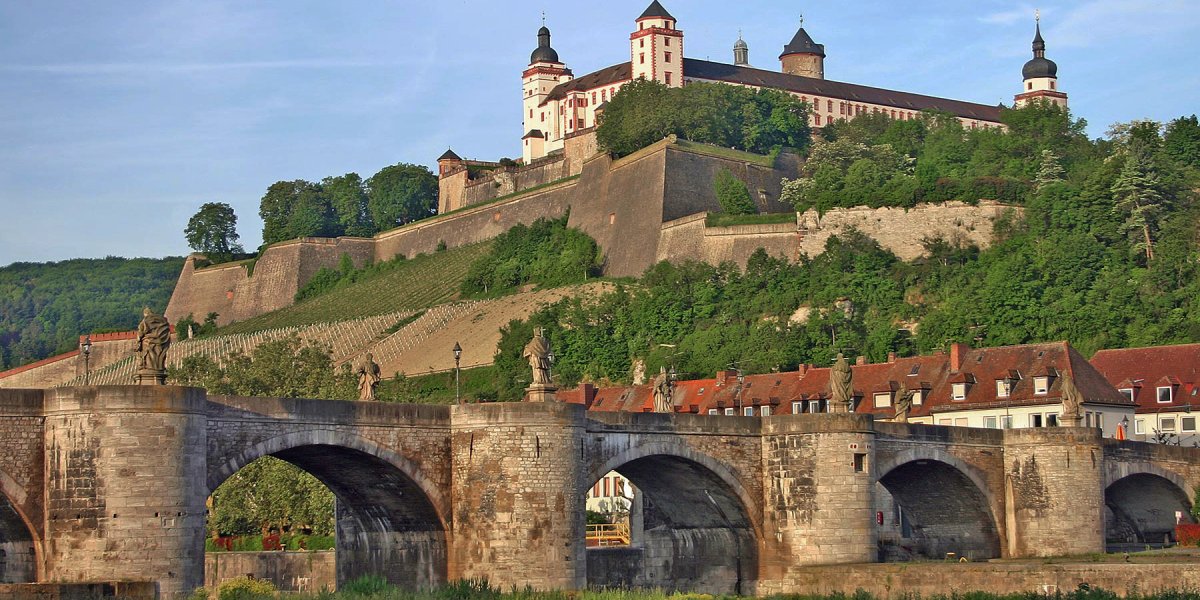
From Bürgerspital, cut south through Marienstraße to the river — 5 minutes along the promenade and the twelve baroque saints come into view, lined up across the span like a stone welcoming committee. Buy a Schoppen at the east end and walk it slowly across: this is Brücken-Schoppen, the unofficial Würzburg ritual, and in summer every local office empties onto the bridge after 4pm. You're here early enough to get the photograph empty.
Tip: Buy a €5 glass (€3 deposit refunded) from the Alte Mainmühle kiosk at the east end — the Müller-Thurgau is the crisp afternoon pour. Stand at the third saint from the west side (St. Kilian with the sword) — from there the fortress's Marienturm aligns perfectly with his halo for a single-frame photograph.
Open in Google Maps →14:30
Landmark
Cross to the west bank and take the Tellsteige path up through the Würzburger Stein vineyards — 15 minutes of steady switchback climb, and the red-tiled city unfolds behind you with every turn. Skip the museums at the top (this is a day trip) and walk straight through the main courtyard to the Fürstengarten on the north side, where the terrace juts out over the Main bend. From up here you can see why the bishop-princes ruled for 500 years: the entire old town, the Residenz, and the river all fit in one glance.
Tip: Go to the Fürstengarten first, not the Bastion — it's smaller, almost always empty, and offers the classic postcard angle with the Alte Mainbrücke in the foreground and Residenz on the far right. Golden hour lights the fortress walls from the east side around 17:30 in shoulder season, 20:00 in high summer; descend via the Neutorstraße zigzag (gentler than Tellsteige) to save your knees.
Open in Google Maps →19:00
Food
Descend from the fortress via Neutorstraße and cross back over the Alte Mainbrücke — the Alte Mainmühle's terrace overhangs the river directly below the bridge, with the fortress floodlit on the hill you just came down. This is where the day earns its sit-down: Franconian heartland cooking, local Silvaner by the jug, and a view worth lingering over.
Tip: Reserve the terrace 2+ days ahead and specifically request 'Terrasse flussseitig' (river-facing side). Order Schäufele (slow-roasted pork shoulder with crackling and potato dumpling, €21) or, in season Sep-Apr, Spiegelkarpfen aus dem Main (€23). Pitfall: avoid the Weinstuben along Domstraße with laminated 8-language menus — they charge Munich prices for frozen Franconian imitations. The real wine country sits by the river, not on the cathedral strip.
Open in Google Maps →Aller au jour
09:00
Museum
Start at Residenzplatz — the scale hits you before you even reach the gate. Enter the moment the doors open at 9:00, when the Treppenhaus is empty and the morning light through the south windows falls evenly across Tiepolo's ceiling. At 677 m² it is still the largest single-panel fresco on earth, painted in 1752-53 in thirteen months without a correction. Continue through the gilded Weißer Saal and the Kaisersaal — this is what peak Baroque looked like before it knew it was peak.
Tip: Buy tickets online the night before to skip the counter. Pause halfway up the Treppenhaus on the landing — that is Tiepolo's intended sightline, where the 'Four Continents' open like a sky above you. Tripods are forbidden, but a phone on the stone banister gives the full ceiling in one frame.
Open in Google Maps →11:30
Park
Leave the Residenz through the south doors — the Hofgarten opens directly behind the palace with no road to cross. Take the eastern axis first through the clipped yews and rose parterres to the orangery; at this hour few people are here and the Baroque geometry is at its clearest. Sandstone putti and urns line every path. This is the decompression chamber after the sensory overload inside.
Tip: Walk back along the bastion path on the eastern wall — the view of the Residenz's south façade framed by the pleached lime avenue is the photo no one takes but should. Skip the south-gate exit; return through the palace's inner courtyard instead, where you can peek at the royal stables.
Open in Google Maps →12:30
Food
8-minute walk from the Hofgarten along Theaterstraße, past the Staatliches Hofkellerei wine shop. Founded in 1319 as a charitable foundation for the elderly, Bürgerspital still funds its care home through one of Germany's great vineyards. Order the Blaue Zipfel — sour boiled bratwurst in onion-vinegar broth, 12.50 EUR — with a glass of their Stein-Hagemann Silvaner, the grape Würzburg invented. Finish with Fränkisches Zwetschgenkompott, plums poached in their own wine.
Tip: Walk in — don't reserve. The atmospheric stone-vaulted Weinstube is walk-in only; reservations are sent to the blander back dining room. Ask for a 'Schoppen' (0.25 L) rather than a glass; that's how Franconians drink Silvaner and the pour is more generous.
Open in Google Maps →14:30
Religious
5-minute walk west down Domstraße — the twin sandstone towers of the Dom rise at the end of the street. Two churches sit back-to-back: the colossal Romanesque Dom St. Kilian (Germany's fourth-largest Romanesque cathedral, started 1040) and the rose-pink Baroque Neumünster, where the Irish missionary-martyr Kilian — Würzburg's patron, beheaded here in 689 — is buried in the crypt. Step from 11th-century austerity into 18th-century theatre in thirty seconds.
Tip: Enter the Dom through the north side portal, not the west door — you come out directly at Balthasar Neumann's Schönborn funeral chapel, a masterpiece that tour groups walk past without ever seeing. In the Neumünster, go downstairs to the crypt: St. Kilian's skull is on display in a golden reliquary, free of charge.
Open in Google Maps →16:00
Landmark
3-minute walk north up Schönbornstraße — the square opens suddenly in front of you. The red sandstone façade of the late-Gothic Marienkapelle (1377-1480) glows at this hour, when low western light ignites the stone. The portal sculptures of Adam and Eve, carved around 1500, are the first fully nude figures in German Gothic art. Opposite, the pink-stucco Falkenhaus is Bavaria's most flamboyant Rococo façade.
Tip: The Adam and Eve on the church are 19th-century copies — the originals by Tilman Riemenschneider are in the Museum für Franken (tomorrow). The red Winzer-Bratwurst stand on the north side of the square sells a grilled sausage in a crusty roll for 4.50 EUR — best in town, but it closes at 17:00 sharp.
Open in Google Maps →19:30
Food
4-minute walk south down Ursulinergasse into the old town's quietest lane. Tucked behind a 400-year-old courtyard, Backöfele is seven candlelit dining rooms wrapped around an inner well. Order the Schäufele — slow-roasted pork shoulder with crackling skin, dark beer gravy and a semmelknödel (24.80 EUR) — with a half-liter of Franconian Müller-Thurgau served in the squat Bocksbeutel bottle unique to this region.
Tip: Reserve the courtyard 3 days ahead; without a booking, arrive at 19:00 sharp for a walk-in seat in the front Weinstube. Avoid every restaurant with a tourist menu in English facing the Marktplatz — they charge double for Schäufele and serve it pre-sliced from a bain-marie. And never pay for 'table water' here: Leitungswasser is free if you ask.
Open in Google Maps →09:00
Landmark
Step onto the east end of the bridge just after 9:00 — at this hour the sun is still low in the east and hits the fortress across the river head-on, turning the sandstone amber. Twelve larger-than-life statues of saints (added 1730) line both parapets, looking exactly the way their Baroque sculptors intended: backlit, monumental, slightly smug. By evening the bridge becomes Würzburg's open-air wine bar; right now you have it almost to yourself.
Tip: Stop at St. Johannes Nepomuk (south parapet, looking downriver) — Würzburg students rub his polished finger before exams. The best photograph is not from either end but from the third bay north: fortress, river bend, and three saints all align in one frame.
Open in Google Maps →09:45
Museum
Cross to the west bank and turn left up the Tellsteige — a 15-minute climb on stone switchbacks through the Leiste vineyard, planted continuously since the 12th century. You arrive at the fortress the way pilgrims and attackers both came for 700 years, not by car. Inside the Fürstenbaumuseum are the prince-bishops' apartments; in the Museum für Franken upstairs are Tilman Riemenschneider's original Adam and Eve — the ones whose copies you saw yesterday on the Marienkapelle. Stand close enough to see tool marks in the 500-year-old limewood.
Tip: Climb up via the Tellsteige vineyard path and descend via the Maschikuliturm bastion road — you see the fortress from two completely different angles. Inside the museum, skip the paintings on the second floor and spend your time on the first-floor Riemenschneider gallery; that is what you came for. The fortress inner courtyard has a free viewing terrace with the best panorama of Würzburg — don't miss it before you enter the museums.
Open in Google Maps →13:00
Food
Come down the Maschikuliturm road and cross back over the Alte Mainbrücke — the restaurant sits directly on the bridge's east abutment, an 18th-century mill over the Main's side channel. Ask for a table on the upper river terrace: fortress on your right, bridge saints on your left, river beneath your glass. Order Meefischli (tiny Main-river fish fried whole with a wedge of lemon, 14.50 EUR, the quintessential Würzburg dish) and a Schoppen of Randersacker Silvaner.
Tip: Arrive by 12:50 for the terrace — after 13:15 every outdoor table is taken and you'll be seated indoors with no river view. Meefischli are eaten whole, heads and all; the tiny bones are the point. If you want the full experience, finish with a Bocksbeutel-glass of sweeter Spätlese to wash down the salt.
Open in Google Maps →15:00
Religious
15-minute walk south along the west bank promenade, then up the Stations of the Cross — 14 sandstone chapels climbing the Nikolausberg, each a perfect small scene carved in the 18th century. The Käppele itself, the twin-towered pink pilgrimage church at the top, is Balthasar Neumann's last masterpiece (1747-50): a pocket-sized Baroque interior with frescoes, gilded columns, and a miraculous wooden Madonna above the altar. The view from the forecourt back across the river at Würzburg is the postcard nobody has shown you yet.
Tip: Enter quietly — locals still come here to pray, this is not a tourist stop. On the way up, count the Stations: the seventh (Jesus falls for the second time) has the finest facial carving. Free, but drop a euro in the votive-candle box as courtesy to a working sanctuary.
Open in Google Maps →17:00
Neighborhood
Descend from Käppele, walk back along the river and re-cross the Alte Mainbrücke, then head 20 minutes north along the east bank to the foot of the Stein vineyard — the terroir that put Würzburg on the European wine map in the 1500s (Goethe ordered 900 liters a year of 'Steinwein'). Climb the vineyard path at the Ludwig-Knoll winery: pink sandstone walls, gnarled old Silvaner vines, and at sunset the whole city — Dom, Residenz, fortress — lines up beneath you in amber light. Finish in the cellar tasting room with three glasses for 9 EUR.
Tip: Go up the vineyard first, taste after — reverse order and you'll rush the light. The bench at the 'Steinwein-Pfad' sign halfway up is the correct sunset seat; arrive at 17:30 in April-May, 18:30 in July-August. Ask the tasting room for 'Stein-Harfe GG' if they have it open — it is Ludwig Knoll's top parcel, and outside the cellar you cannot easily buy it by the glass.
Open in Google Maps →19:30
Food
15-minute walk south back into the old town along Juliuspromenade — the cobbled alley Gressengasse opens onto the ivy-draped courtyard of Zum Stachel, in business since 1413, the oldest wine tavern in the city. The peasants of the 1525 Bauernkrieg met in this room to draft their demands. Order the Fränkischer Sauerbraten (braised beef in gingerbread-red-wine sauce with Klöße, 23 EUR) and, because this is your last meal in Würzburg, a Bocksbeutel of Stachel's own Silvaner trocken.
Tip: Reserve a table in the inner courtyard two days in advance — it's the most atmospheric dining room in the city and seats only 30. On the way home, walk once more across the Alte Mainbrücke: after 21:00 it becomes Brücken-Schoppen — locals buy a 3 EUR glass of Silvaner from Alte Mainmühle or Alter Kranen and drink it leaning against the parapet. That is Würzburg's real nightlife, and you will never see it in a guidebook. Pitfall warning: the 'wine' stands right at the bridge heads charge tourists 7-8 EUR a glass for industrial wine; always buy from the Alte Mainmühle window on the east side — proper Franconian estate wine at local price.
Open in Google Maps →
Trip builder
Plan this trip around Würzburg
Turn this guide into a bookable rail itinerary with FlipEarth.
Keep exploring
Related cities
More in the same country




FAQ
Frequently asked questions
How many days do you need in Würzburg?
Most travelers enjoy Würzburg in 1 days, with enough time for headline sights and a slower meal or museum stop.
What's the best time to visit Würzburg?
The easiest season for most travelers is Apr-Oct, especially if you want good weather and manageable crowds.
What's the daily budget for Würzburg?
A practical starting point is about €110 per person per day before hotels, then adjust based on museums, dining, and transport.
What are the must-see attractions in Würzburg?
A good first shortlist for Würzburg includes Würzburg Residenz & Hofgarten, Alte Mainbrücke, Festung Marienberg.