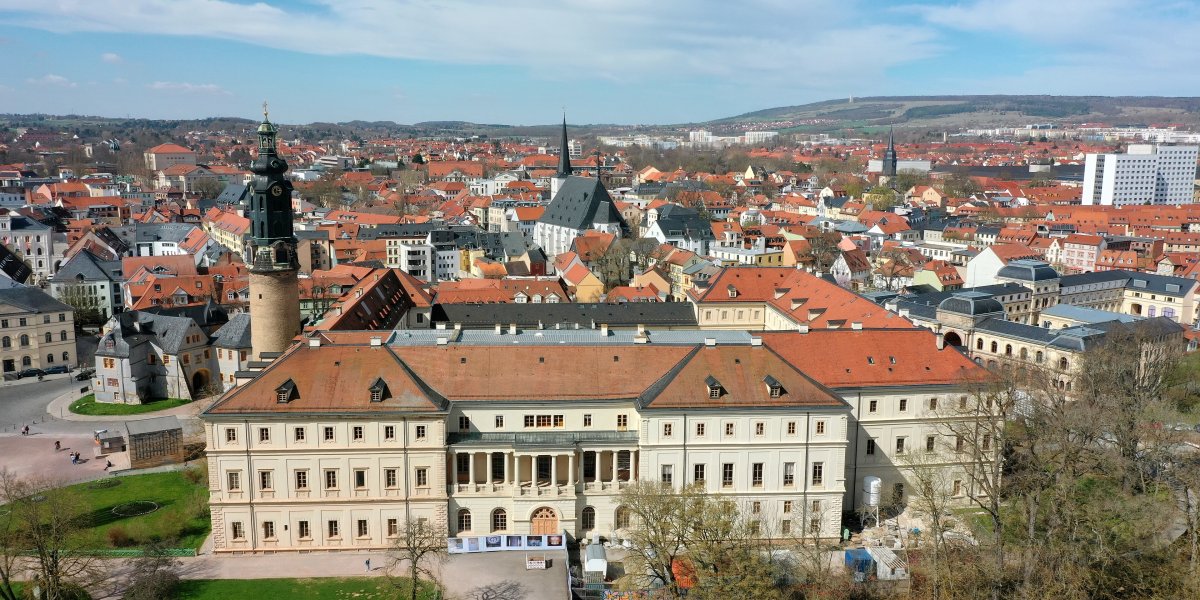
City Guide
Weimar
Allemagne · Best time to visit: May-Sep.
Day-by-day plan
Choose your pace
Durée du voyage
09:00
Landmark
From the Hauptbahnhof, take the 5-minute bus to Goetheplatz, then walk two minutes east up Wielandstraße — the square opens suddenly and the bronze poets stop you in your tracks. Schiller and Goethe stand shoulder to shoulder, sharing a single laurel wreath; behind them rises the cream-pillared Deutsches Nationaltheater, the building where Germany's first democratic constitution was drafted in 1919. Morning sun pours in from the east and lights the bronze head-on — by noon the monument is in flat shadow.
Tip: Stand 8 meters back, slightly left of the monument facing east — the theater's columned façade frames both heads with no lens distortion. Arrive before 09:30; the first school groups roll in by 10:00 and the wreath becomes ungettable without strangers in frame.
Open in Google Maps →10:30
Neighborhood
Exit Theaterplatz south down Schillerstraße — a six-minute walk past the canary-yellow Schillerhaus on your right (photograph from across the street; we are skipping interiors today). The lane opens into a slanted, cobblestoned market square ringed by gabled façades: the neo-Gothic Rathaus to the west, the rust-red Cranachhaus on the north side where Lucas Cranach the Elder lived his final years, and the dignified ochre Hotel Elephant where Thomas Mann and Tolstoy both slept. This is the densest stretch of Renaissance architecture you will see all day.
Tip: The cleanest wide-angle is from the southeastern corner near the fountain, looking northwest — it catches the Cranachhaus, Stadthaus and Rathaus in one frame. Come on a Wednesday or Saturday and the farmers' market fills the square with flower stalls; the foreground color is gift-wrapped for you.
Open in Google Maps →12:30
Food
Don't leave the square — the green-awning bratwurst stand at the southwest corner has been pulling at your nose for the last hour. Thüringer Rostbratwurst is a UNESCO-recognized regional specialty: pork, marjoram, charcoal grill, slid into a small Brötchen with the sausage hanging four fingers out either end. Order 'Eine Bratwurst mit scharfem Senf' — 4 EUR, cash only, eat standing at the wooden barrel tables while watching the square unfold. Budget 5-7 EUR per person.
Tip: Specify 'scharfen Senf' (hot mustard) — the default sweet Bavarian mustard is wrong for this sausage. Locals eat the meat first, then the bread separately; the bun is a delivery vehicle, not the point. Ketchup is a tourist tell — mustard only is the regional code.
Open in Google Maps →14:00
Landmark
Exit the Markt south down Frauentorstraße for three minutes — the lane narrows, cobblestones smooth out, and you arrive at the small triangular Frauenplan square. The ochre-yellow Goethehaus fills the eastern side: Goethe lived here for fifty years, wrote the bulk of Faust upstairs, and died in the back-room armchair in 1832. A proper interior visit takes four hours and isn't on today's plan — but the exterior, the small fountain in front, and the stable courtyard around the back tell the whole story.
Tip: The afternoon light hits the yellow façade head-on from the southwest corner of Frauenplan — that's your shot. Then duck around to Seifengasse behind the house: Goethe's actual garden gate is there, with a worn iron handle most tour groups never find. Touch it; he touched it every morning for half a century.
Open in Google Maps →15:30
Landmark
From Frauenplan walk east through Marstallgasse for four minutes — the lane spills out onto Platz der Demokratie, the broad pale square facing the Stadtschloss. The honey-stone, green-shuttered building on the north side is the Herzogin Anna Amalia Bibliothek — its Rococo Hall is among the most beautiful rooms on Earth and is sold out for weeks (book three months ahead if it matters), but the exterior with its sundial and the statue of Anna Amalia herself is enough to feel the weight of the place. From here, descend the stone stairs southeast into Park an der Ilm — Goethe's own designed landscape garden. Follow the gravel path along the river for forty minutes to Goethe's thatched Gartenhaus, then cross the wooden footbridge to the small Roman House on the far bank.
Tip: Between 16:30 and 17:30 in summer the low sun turns the Ilm copper — stand on the footbridge below the Roman House for the only shot of Weimar most tour buses never see. Skip the uphill detour to the Liszt-Haus unless you are a piano pilgrim; the riverside loop is the soul of this park.
Open in Google Maps →19:00
Food
Climb back up out of the park via the Stern entrance — six minutes uphill returns you to Frauenplan, where the cream-and-green corner house directly opposite Goethehaus is Zum Weißen Schwan. Goethe drank here every week for forty years; the dining room still wears its 1827 oak paneling and his regular table is marked with a small brass plaque. Order Thüringer Rouladen — beef rolls in red wine gravy with potato Klöße (22 EUR) — and a glass of Saale-Unstrut Silvaner, the bone-dry local white from Europe's northernmost wine valley that almost nobody outside Thüringen has tasted. Budget 35-50 EUR per person.
Tip: Reserve table 7 in the rear room via their website 48 hours ahead — that's Goethe's actual booth. Walk-ins should arrive at 19:00 sharp; Germans dine at 19:30, so you get the prime window slot. Pitfall warning: skip the cluster of 'Goethe-themed' cafés ringing Marktplatz and the Hotel Elephant terrace — the food is reheated and the bill runs 40% above local norm. Real Weimar eats one street back, never on the main square.
Open in Google Maps →Aller au jour
09:30
Museum
Begin at Frauenplan, the leafy little square Goethe stared down at for fifty years from his canary-yellow townhouse. Arrive at 09:15 for the 09:30 opening — the bare oak floors are quietest in the first hour, and the death chamber where he uttered 'mehr Licht' is the room you want to stand alone in. This is Day 1 by design: if anything in your trip is unmissable, it's the writing desk where Faust took shape.
Tip: Buy the WeimarCard (32€/48h) — it bundles every museum on this two-day plan plus the bus to Buchenwald. The English audio guide is essential; almost nothing in the house has wall labels because the family layout is preserved as Goethe left it.
Open in Google Maps →12:00
Food
Step out of Goethe's front door, turn right — his favorite tavern stands literally 20 seconds away on the same square, and he ate here for half a century. The wood-paneled corner room with the window onto Frauenplan is the one he used; the kitchen still cooks the dish named after him. The continuity feels like cheating: you eat his lunch, then walk out and see his house.
Tip: Order Goethe-Tafelspitz (22€) — boiled beef with horseradish, the dish on his real household menu — or the Thüringer Rostbratwurst plate (14€). Reserve a day ahead and ask for the Goethe-Ecke (Goethe corner table by the window); walk-ins at noon get the back room without the view.
Open in Google Maps →14:00
Museum
Walk west along Schillerstraße eight minutes — the pastel-yellow façade ahead is where Friedrich Schiller wrote Wilhelm Tell before dying at 45, broke and exhausted. Early afternoon is right for the top-floor writing room: south-facing windows let the light slant across his original quill and unfinished manuscripts in a way the morning sun won't. After Goethe's grandeur, the modesty here lands hard.
Tip: Go downstairs to the family kitchen and laundry — most visitors stay upstairs and miss it. The basement is where you grasp how poorly Germany's national poet actually lived; the contrast with Goethe's wine cellar two streets away is the whole story of 18th-century Weimar in one minute.
Open in Google Maps →15:45
Landmark
From Schillerhaus, head east through the Markt past the green Stadthaus to Platz der Demokratie, seven minutes. The oval gilded Rococo Hall, restored after the 2004 fire, is widely called the most beautiful library room in the world. At 15:45 the late-afternoon light pours through the upper windows and grazes the white-and-gold balconies — this exact 60 minutes is why you came to Weimar.
Tip: Rococo Hall is timed-entry, 50 people per hour, and tickets vanish 2-3 weeks ahead — book at klassik-stiftung.de the moment your dates are fixed (a separate ticket from general library entry). No tripods, no flash. Walk the upper gallery clockwise: the bust of Goethe by Pierre-Jean David d'Angers in the north oval is the best photograph in the room.
Open in Google Maps →17:15
Park
Exit the library and cross the small bridge over the Ilm — you've just walked into the 48-hectare English landscape garden Goethe helped design over five decades. Follow the gravel path south along the river for ten minutes to a small ochre cottage on the meadow: his first Weimar home, gifted by Duke Carl August, where he lived alone before fame. Golden hour over the meadow with the cottage's reflection in the Ilm is the day's quiet payoff.
Tip: The Gartenhaus closes at 18:00 in summer (16:00 Nov–Mar) — be inside by 17:30. After the cottage, cross the wooden footbridge and climb 10 minutes uphill to the Roman House (Römisches Haus) on the opposite ridge — it gives you the only postcard view of Weimar's skyline framed by the park.
Open in Google Maps →19:30
Food
From the park's north exit, walk ten minutes through the old town past Theaterplatz — the restaurant is a freestanding 1900 Jugendstil pavilion in its own garden, original wrought iron and stained glass intact. Inside it feels like a Mucha poster; the conservatory facing the garden is where you want to sit. The kitchen does the best regional cooking in town without slipping into hunting-lodge cliché.
Tip: Reserve 2-3 days ahead and request a conservatory table; walk-ins almost never get one. Order the wild boar ragout (28€) or Thuringian river trout (24€), pair with a Saale-Unstrut Silvaner. PITFALL: the 'Goethe-Menü' prix-fixe boards displayed on Markt square are aimed at coach tours — 35€ for reheated Klöße and tourist-grade Bratwurst. Locals never eat on Markt; they walk one alley deeper.
Open in Google Maps →09:00
Landmark
Catch bus line 6 from Goetheplatz at 08:30 — fifteen minutes uphill through beech forest to the camp gate, where the inscription 'Jedem das Seine' was forged backwards to be read by prisoners standing inside. Morning is the only right time: the appellplatz is least crowded, the flat overcast light has no romance to it, and you need the afternoon to recover. This sits on Day 2 because Day 1 must not end here — and because no first or last day of a trip should carry this weight.
Tip: Entry is free; the 5€ covers your roundtrip on bus 6 (included with WeimarCard). Pick up the English audio guide at the visitor center — the empty foundations mean nothing without it. Budget exactly: 1h appellplatz and crematorium, 1h permanent exhibition, 30 min memorial bell tower. Do not bring children under 12. There is no café on site by design; eat a real lunch back in Weimar.
Open in Google Maps →13:00
Food
Bus 6 back to Goetheplatz, then four minutes east to Grüner Markt. The Residenz has been Weimar's social parlor since 1839 — Goethe, Liszt, Wagner, and Richard Strauss all sat in this stucco-ceilinged room. After Buchenwald you need a long warm meal in a place with three centuries of soul; this is it, and the kitchen still cooks proper Thuringian.
Tip: Order Thüringer Klöße mit Rouladen (19€) — beef rolls with potato dumplings, the regional dish — and finish with their Bienenstich, the best in town. Ask for the back room with the original stucco ceiling; the Markt-facing front room fills with passing tourists and the acoustics are punishing.
Open in Google Maps →14:45
Museum
From Residenz-Café walk eight minutes north via Theaterplatz to Stéphane-Hessel-Platz. The blunt concrete cube ahead opened in 2019 to house the world's oldest Bauhaus collection — Walter Gropius founded the school four blocks from this spot in 1919, and everything modernist design later became started here. Mid-afternoon is the sweet spot: school groups gone, top-floor sunlight clean on Peter Keler's original 1922 cradle.
Tip: Skip the audio guide — every wall text is bilingual and richer than the recording. Work upward from ground floor (origins) to top (icons): the Keler cradle, the Marianne Brandt teapot, the Wagenfeld lamp. The museum shop sells the only licensed Bauhaus chess set reproductions in the city — 95€ but worth carrying home.
Open in Google Maps →16:30
Landmark
Exit the museum, walk fifteen minutes southeast through Park an der Ilm — a soft greenway along the river. On a small rise sits a stark white cube: the 1923 Bauhaus prototype house, the school's first complete building, UNESCO World Heritage. Late afternoon east light catches the original Marcel Breuer tile patterns in the kitchen; you'll likely have the rooms to yourself at this hour.
Tip: Last entry 17:30, closes 18:00 — don't arrive later than 16:45. Sit on the bench inside the Damenzimmer (lady's room) on the right and look at the built-in cabinetry for a full minute: every storage decision is twenty years ahead of 1923. Combination ticket with the Bauhaus Museum saves 3€ if bought together at the museum desk.
Open in Google Maps →17:45
Landmark
Walk twelve minutes back northwest through the park to Theaterplatz. The bronze pair — Goethe handing a laurel wreath to Schiller — is Germany's most photographed monument, standing in front of the Nationaltheater where the 1919 Weimar Constitution was drafted and where, fourteen years later, Hitler gave a speech. 18:00 side-light catches the laurel without harsh shadow; the tour buses have left for dinner. The two stories that frame the day, on one square.
Tip: Stand at the southeast corner of the square, looking toward the theatre's columned façade — that angle is the postcard shot, with the columns aligned behind the figures. Walk a slow half-circle to read both faces of the plinth.
Open in Google Maps →19:30
Food
From Theaterplatz, walk five minutes east via Geleitstraße and turn into Scherfgasse, a dim cobblestone alley off the Markt. The black-painted half-timbered facade is the flagship pub of Köstritzer black beer, brewed by monks since 1543 and the brewery Goethe wrote letters defending. Inside is low-beamed and noisy with locals; this is where Weimar comes off duty.
Tip: Order the Schwarzbierbraten (21€) — pork braised in the house dark beer — and the Thuringian Bratwurst three-way platter (18€) to share, washed with a 0.5L Köstritzer Schwarzbier (4.50€). PITFALL: the 'Original Thüringer Bratwurst' stands clustered on Markt square sell mass-produced versions to tourists at 5€; the real charcoal-grilled hut is on Schillerstraße, look for the small queue of locals. Tipping is 5-10% rounded up to the nearest euro, not American 18-20% — overtipping reads as confused, not generous.
Open in Google Maps →
Trip builder
Plan this trip around Weimar
Turn this guide into a bookable rail itinerary with FlipEarth.
Keep exploring
Related cities
More in the same country
FAQ
Frequently asked questions
How many days do you need in Weimar?
Most travelers enjoy Weimar in 1 days, with enough time for headline sights and a slower meal or museum stop.
What's the best time to visit Weimar?
The easiest season for most travelers is May-Sep, especially if you want good weather and manageable crowds.
What's the daily budget for Weimar?
A practical starting point is about €65 per person per day before hotels, then adjust based on museums, dining, and transport.
What are the must-see attractions in Weimar?
A good first shortlist for Weimar includes Goethe-Schiller Monument at Theaterplatz, Goethehaus Exterior at Frauenplan, Anna Amalia Library Exterior & Park an der Ilm.