City Guide
Tirana
Albanie · Best time to visit: Apr-Jun, Sep-Oct.
Day-by-day plan
Choose your pace
Durée du voyage
09:00
Neighborhood
Start here before the crowds: the bazaar wakes up at eight, and by nine the fruit stalls are stacked in pyramids of blood oranges and figs while the surrounding pastel-painted buildings — peach, mint, lemon — still catch the low morning sun. The renovated square is ringed with bakeries pulling trays of burek from wood ovens, and old men already arguing over backgammon. This is Tirana without filter: loud, fragrant, unposed. Walk the four radiating lanes slowly, grab a coffee at one of the covered stalls, and watch the city decide what to cook tonight.
Tip: The covered market stalls on the east side sell byrek me spinaq (spinach burek) straight from the oven for 50-80 lekë (~0.60€) — the best under-a-euro breakfast in the Balkans. Skip the sit-down cafés on the square; locals stand and eat.
Open in Google Maps →10:30
Landmark
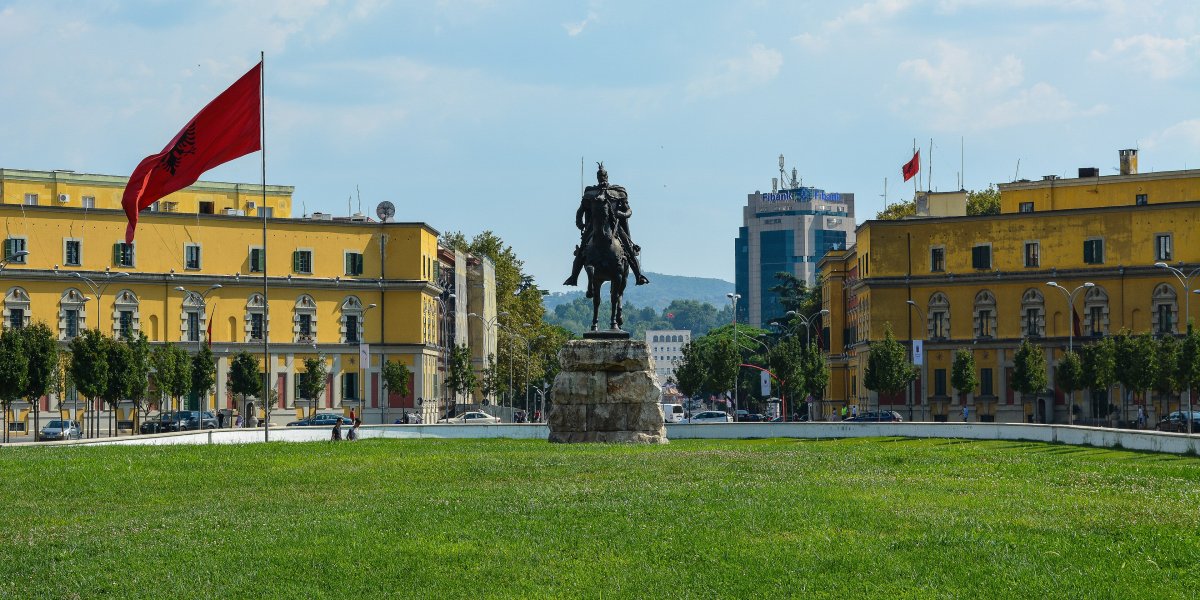
From Pazari i Ri, walk 8 minutes west down Rruga Luigj Gurakuqi — you'll pass Ottoman-era shopfronts that suddenly open onto Albania's largest plaza. Skanderbeg Square is enormous, paved with stones quarried from every region of the country, and the equestrian statue of Skanderbeg himself is angled so the morning light hits his raised sword from behind. Circle the square counter-clockwise: the 18th-century Et'hem Bey Mosque (free to enter outside prayer time, shoes off, headscarf for women) has painted interiors of trees, waterfalls and bridges — rare religious imagery for Ottoman architecture. Next to it, the 35-meter Clock Tower marks the Ottoman skyline that once defined Tirana. Finish at the National History Museum's façade to photograph 'The Albanians' — the 1981 mosaic of workers and partisans charging forward, still the most cinematic piece of socialist realism in Europe.
Tip: Shoot the mosaic from the far southwest corner of the square around 11:00 — the sun is high enough that the tiles glint but not so overhead that the figures lose depth. Midday flattens it completely.
Open in Google Maps →12:30
Food
A 4-minute walk northeast from Skanderbeg, up Rruga Luigj Gurakuqi and into a quiet courtyard — you'll know you've found it when you see the wooden beams and embroidered kilims through the window. Oda is the restaurant every Tirana family sends visiting cousins to: two tiny rooms, hand-carved stools, grandmothers in the kitchen. Order the tavë kosi (baked lamb with yogurt and rice, 550 lekë / ~5.50€) — it's the Albanian national dish and Oda's version is richer than anyone else's in the center — plus a plate of fërgesë (slow-cooked peppers, tomato and cottage cheese, 400 lekë / ~4€) to share. Budget 12-15€ per person with a glass of Kallmet red. Don't reserve; arrive at 12:30 sharp and you'll get the last two-top. After 13:00 you'll wait 30 minutes on the sidewalk.
Tip: The menu is in Albanian only and the waiters speak limited English — just point at neighboring tables or say 'tavë kosi' and 'fërgesë' and you'll eat like a local. Cash preferred (lekë or euros both accepted).
Open in Google Maps →14:00
Landmark
From Oda, walk 12 minutes south down Boulevard Dëshmorët e Kombit — the city's grand north-south axis, lined with government ministries painted in mustard yellow and rust red. The Pyramid appears on your right: built in 1988 as a museum to communist dictator Enver Hoxha, abandoned, graffitied, nearly demolished, and finally reborn in 2023 as a white cascade of staircases and cubes. You climb it — that's the point. The zigzagging external steps take you to the apex in ten minutes, past kids on skateboards and teens filming TikToks in the cube studios below. From the top you get the best 360° view of Tirana: Skanderbeg Square to the north, Mount Dajti rising to the east, the red-roofed sprawl of Blloku to the south. Afternoon is correct — the concrete reflects the morning sun blindingly, but by 14:30 the angles turn cinematic.
Tip: Climb the southeast staircase (facing Blloku) rather than the north face — the steps are wider, less crowded, and you'll summit with the city laid out in front of you instead of behind. The wind at the top is real; secure hats and phones.
Open in Google Maps →16:00
Neighborhood
Descend the Pyramid's south side and cross the boulevard — you're in Blloku in 5 minutes. Until 1991 this neighborhood of villas was sealed off to ordinary Albanians and reserved for the Politburo; today it's the most caffeinated square kilometer in the country. Start at Enver Hoxha's former residence (Rruga Ismail Qemali 31, exterior only — still unmarked, no plaque, very deliberately so) then wander south through the cafés. Commit to the Blloku ritual: order a macchiato (80 lekë, under 1€) at Komiteti, a bar themed around communist nostalgia where the walls are covered in vintage radios and red stars; then drift two blocks to Radio Bar for an aperitivo as the sky turns. The streets here form a loose grid — don't navigate, just let one café lead to the next. By 18:30 the neighborhood has quietly flipped from afternoon coffee to evening raki, and you're already seated for dinner.
Tip: The 'colorful communist blocks' painted by mayor Edi Rama are mostly north of Blloku along Rruga Myslym Shyri and around Rruga Qemal Stafa — detour 10 minutes west to Sheshi Willson for the tallest stripe-patterned tower. Pitfall: avoid the cafés directly on Rruga Pjetër Bogdani with English-only menus and photo-food displays — prices are 3x what a local pays two streets over, and the espresso comes from a capsule machine. If the menu has no lekë-only pricing, walk away.
Open in Google Maps →19:30
Food
Two minutes' walk from Radio Bar, on Rruga Ismail Qemali — look for the warm yellow light spilling onto the sidewalk and a line of Vespas parked outside. Era has been the Blloku sit-down for twenty years: wood-fired oven at the back, red-checked tablecloths, Albanian families and off-duty diplomats at adjacent tables. Order the qofte të fërguara (pan-fried meatballs with mint and feta, 600 lekë / ~6€) and the tavë dheu (clay-pot veal with rice and cheese, 850 lekë / ~8.50€) — these are the two dishes Era built its name on. Share a carafe of house Shesh i Bardhë white (600 lekë / ~6€). Budget 18-22€ per person with wine. Reservations only needed on weekends; weeknights, arrive at 19:30 and you'll beat the 20:30 rush by exactly the right margin.
Tip: Ask for the terrace if the weather holds — the back garden is quieter than the street-facing section and the wood-fire smell hits you the moment you sit down. Finish with a shot of raki rrushi (grape raki, usually on the house with the bill); refusing is considered impolite and it's genuinely the best one in the neighborhood.
Open in Google Maps →Aller au jour
09:00
Landmark
Start your Tirana here because morning light floods the newly repaved limestone plaza before the tour buses roll in around 10:00. At nearly 40,000 square meters it is one of the largest squares in the Balkans, ringed by the Opera House, the mosaic facade of the National History Museum, and the equestrian statue of Skanderbeg, Albania's 15th-century national hero. Stand at the center for a moment and feel how Ottoman, Fascist-era, and Communist buildings somehow make peace with each other.
Tip: The best photo angle is from the northeast corner near the Clock Tower, with Skanderbeg's statue silhouetted against the distant Dajti Mountains — shoot before 09:30 while the air is still clear and the plaza is nearly empty.
Open in Google Maps →09:45
Religious
A 90-second walk northeast from the square toward the Clock Tower — the mosque sits directly at its base. Built between 1789 and 1823 and reopened after decades of communist-era closure, its interior holds Albania's most beautiful mosque frescoes: hand-painted trees, waterfalls, and bridges, a rarity in Islamic art. Morning is near-empty outside prayer hours, so the painted dome feels like a private chamber.
Tip: Remove your shoes at the entrance; scarves are provided free at the door for women. Photography without flash is allowed, and natural light through the small dome windows between 10:00 and 10:30 hits the frescoes at their best angle.
Open in Google Maps →10:45
Museum
Cross the square diagonally west — the famous socialist-realist mosaic 'The Albanians' rising above the entrance is your destination; pause to take it in before entering. Albania's largest museum walks you through Illyrian antiquity, Ottoman resistance, and the brutal Hoxha dictatorship, with the upper-floor Pavilion of Communist Terror telling stories guidebooks rarely print. Two hours is enough to catch the essential rooms without fatigue.
Tip: Head directly upstairs to the Pavilion of Communist Terror first while it is still empty — school groups fill the ground floor by noon. The museum is closed on Mondays, so plan accordingly if shifting the itinerary.
Open in Google Maps →13:00
Food
A 10-minute walk northeast along Rruga Luigj Gurakuqi, down a quiet side lane into an old Tirana courtyard hung with copper pots and woven kilims. This is where locals take visiting relatives — family-run, no concessions to tourism. Order the tavë kosi (baked lamb with yogurt, around 700 lek) and the fërgesë (baked peppers with tomato and cottage cheese, around 500 lek) — two dishes that define Albanian home cooking.
Tip: Arrive at 13:00 sharp — Oda has only about 30 seats and does not take reservations. Pair the meal with a shot of homemade raki (plum brandy, 150 lek) — refusing it is considered rude, and accepting will earn you a second one on the house.
Open in Google Maps →15:00
Museum
A 12-minute walk south down Rruga Murat Toptani — a pedestrian lane that hugs the old Ottoman city walls and is itself a highlight. This underground bunker, built for the communist Ministry of Interior, now tells the story of Albania's secret police through 24 rooms of surveillance files, interrogation cells, and confiscated photographs. Afternoon is ideal because the concrete corridors stay a constant 16°C regardless of the Tirana heat outside.
Tip: This is the 'political' bunker; tomorrow's Bunk'Art 1 at Dajti is the 'military' bunker and a completely different story — do not skip one assuming you've seen the other. The last entry is 18:00 and the exhibits are in English and Albanian only.
Open in Google Maps →19:30
Food
A 20-minute evening stroll south down Rruga e Kavajës into Blloku; the walk itself is part of the reward as the neon-lit cafes of the once-forbidden communist quarter come alive. Era is Tirana's most-loved modern restaurant, serving traditional Albanian recipes refreshed with seasonal produce in a converted villa garden. The lamb qofte (grilled meatballs, 650 lek), slow-baked pasha qofte (900 lek), and spinach byrek (350 lek) are non-negotiable.
Tip: Reserve a day ahead via phone or Instagram — Era Vila fills with Tirana's returning diaspora on weekends. Avoid the touristy 'traditional Albanian' restaurants along Rruga Murat Toptani near Skanderbeg Square that post aggressive waiters on the street; their menus run double the price with half the quality, and the 'free shot of raki' they push is always added to the bill.
Open in Google Maps →09:00
Museum
Take city bus number 1 or a short taxi northeast into the foothills of Mount Dajti — about 20 minutes from the center. This is the big one: five underground floors with 106 rooms, built as the communist government's Cold War refuge in case of nuclear war, now an art and history museum. Arrive exactly at opening because the motion-sensor lights come on only as visitors enter, and walking first through the empty concrete halls is genuinely unsettling in the best way.
Tip: Wear a light jacket — the bunker holds steady at 12°C year-round. The most haunting room is Enver Hoxha's personal quarters on Floor 3; his preserved desk feels as if he just stepped out for a meeting. Entry 500 lek, English signage throughout.
Open in Google Maps →11:30
Landmark
Exit Bunk'Art 1 and walk 10 minutes along Rruga Dajti to the cable car base — signage is clear and the route goes slightly uphill through pine scrub. The 15-minute ride is Albania's only cable car, climbing 800 meters to the Dajti summit with widening views over Tirana's red-tiled sprawl and, on clear days, all the way to the Adriatic coast. Go at 11:30 rather than earlier because the morning haze over the valley usually burns off by then and visibility peaks.
Tip: Round trip is 1,000 lek — buy at the base station and keep the ticket, you need it for the return. Sit on the right side going up for the full city panorama; switch to the left coming down for views of the terraced Dajti farmland.
Open in Google Maps →12:30
Food
A 3-minute walk from the summit station through the pine woods — follow the wooden signs. This terrace restaurant sits directly over Tirana at 1,613 meters with a glass-edge balcony looking down the entire valley. Order the grilled trout from Lake Ohrid (around 800 lek) and the tavë dheu (clay-pot veal with peppers and kashkaval cheese, around 900 lek) — both arrive at your table still sizzling.
Tip: Ask specifically for a 'ballkon' (balcony) table when you arrive — same price, incomparably better view. Lunch service starts at 12:00, so arriving by 12:30 gets you seated before the 13:00 tour-group rush that fills the terrace.
Open in Google Maps →15:30
Neighborhood
Take the cable car back down and a 15-minute taxi into the heart of Blloku — have the driver drop you at the corner of Rruga Ismail Qemali and Rruga Pjetër Bogdani. Until 1991, ordinary Albanians could not set foot in this leafy quarter reserved for the communist elite; today it is Tirana's cafe and boutique district, and Enver Hoxha's modest villa still stands on Rruga Ismail Qemali as a quiet ghost among the cocktail bars. Walk the grid slowly — every block reveals another painted communist-era apartment block in saturated yellows, oranges, and geometric blues.
Tip: The most photogenic facade is the geometric rainbow building on Rruga Sami Frashëri, about 200 meters south of Hoxha's villa — stand on the opposite sidewalk to fit the whole pattern into the frame. Pause for an espresso at Komiteti, a café furnished entirely with salvaged communist-era objects — it is genuine, not kitsch.
Open in Google Maps →17:30
Landmark
A 10-minute walk north from Blloku along Bulevardi Dëshmorët e Kombit; the massive white concrete structure rises on your right, impossible to miss. Originally built in 1988 as a mausoleum for dictator Enver Hoxha, it reopened in 2023 as a tech and culture hub, and external staircases now let you climb the sloping walls to the top. Arrive at 17:30 so you can climb as the sun drops — sunset light ricochets off the white concrete slabs, and from the summit you'll see all of Tirana turn gold.
Tip: Climbing the exterior stairs is free and open until 20:00 — skip the interior cafes, which charge triple the city rate and target tourists. The best sunset angle faces west toward the Adriatic, roughly 18:30 in spring and autumn. Tirana is one of Europe's safer capitals, but this is the one spot where pickpockets work weekend evening crowds at the base — keep phones out of back pockets, and ignore the 'friendly student' clipboard-petition scam operating on the boulevard side.
Open in Google Maps →19:30
Food
A 15-minute walk south along Bulevardi Dëshmorët e Kombit toward the Grand Park — Mullixhiu hides behind a working wooden mill wheel at the park's north entrance, easy to miss if you're not looking for it. Chef Bledar Kola trained at Noma in Copenhagen before returning home to cook Albanian mountain grains and foraged herbs that appear nowhere else in the city. The tasting menu (around 3,500 lek) is the move — or go à la carte with the handmade trahana soup and the slow-cooked goat with wild nettles.
Tip: Reserve at least two days ahead — Mullixhiu has just 30 seats and is the only Tirana restaurant on international best-of lists. Ask for a table near the open kitchen to watch the millstone grinding corn for the fresh cornbread that arrives at your table still warm.
Open in Google Maps →
Trip builder
Plan this trip around Tirana
Turn this guide into a bookable rail itinerary with FlipEarth.
Keep exploring
Related cities
More in the same country
FAQ
Frequently asked questions
How many days do you need in Tirana?
Most travelers enjoy Tirana in 1 days, with enough time for headline sights and a slower meal or museum stop.
What's the best time to visit Tirana?
The easiest season for most travelers is Apr-Jun, Sep-Oct, especially if you want good weather and manageable crowds.
What's the daily budget for Tirana?
A practical starting point is about €80 per person per day before hotels, then adjust based on museums, dining, and transport.
What are the must-see attractions in Tirana?
A good first shortlist for Tirana includes Skanderbeg Square & Et'hem Bey Mosque, Pyramid of Tirana.