City Guide
Rovinj
Croatie · Best time to visit: May-Oct.
Day-by-day plan
Choose your pace
Durée du voyage
09:30
Landmark
Begin where the old town begins — at the 17th-century Venetian gate that was once the only way into the walled city. Step through and the modern world vanishes: Tito Square opens onto the harbor, fishing boats rocking against façades the color of peeled apricots. At this hour the cruise buses haven't arrived yet and the square still belongs to old men reading newspapers outside Caffè Viecia Batana.
Tip: The carved Venetian lion on the inner face of the arch catches sharpest shadow relief between 09:15 and 10:00 — after that the sun climbs above the old town and flattens the detail. For the iconic composition, stand at the base of the clock tower across the square and frame the arch, the clock, and a sliver of harbor in a single shot.
Open in Google Maps →10:15
Neighborhood
From the western corner of Tito Square, slip into the narrow mouth of Grisia — the cobbled spine that climbs the peninsula toward the basilica at its crown. Every doorway here is a painter's studio; every step up reveals another Madonna flowering from a stone niche, another cat stretched across warm limestone. The climb is short but steep, so go slow: this is the street where you understand that Rovinj was Italian long before it was Croatian, and the shopkeepers still greet you in Istrian-Venetian dialect.
Tip: The polished flagstones near the lower end are treacherous when wet — a thousand years of shoes have smoothed them to glass. Shoot upward at the second-floor windows before 11:00 while the wrought-iron laundry rods still hold drying sheets; residents bring the wash in as the heat climbs. If your visit lands on the second Sunday of August, Grisia becomes an open-air gallery with 200+ artists — the one day the street is properly crowded and properly magical.
Open in Google Maps →11:30
Religious
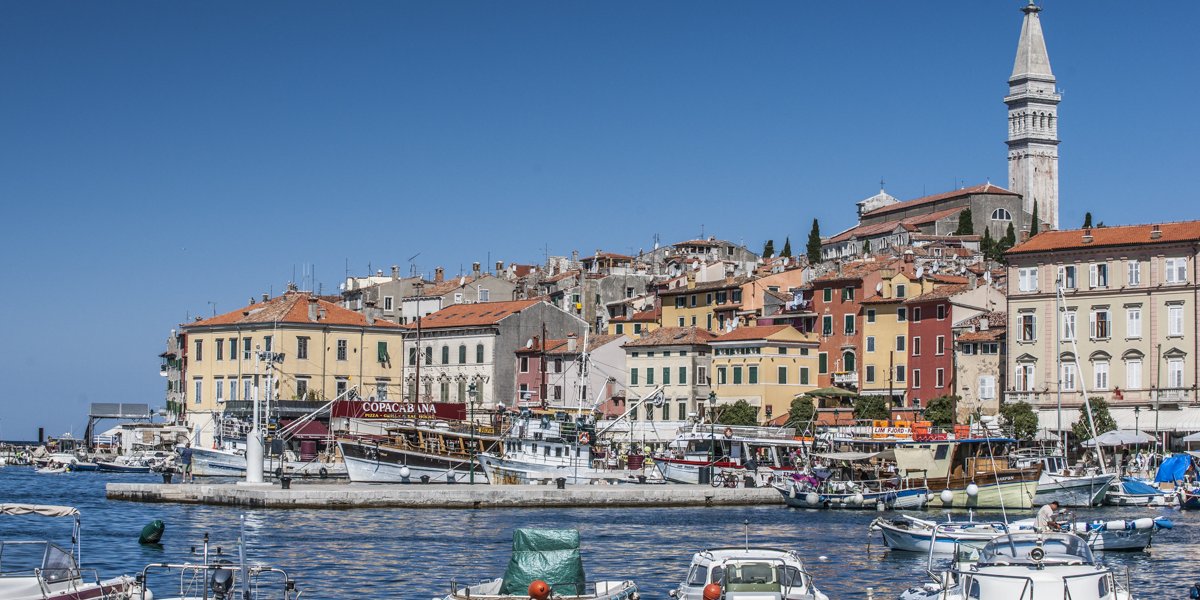
Grisia ends at the foot of the baroque basilica crowning the peninsula — the 60-meter bell tower, modeled on San Marco's in Venice, is the silhouette on every postcard of the Adriatic. Skip the plain interior and walk the low terrace behind the church: from here the sea opens in every direction, the red-tiled roofs cascade beneath your feet, and on clear mornings you can pick out the dark line of Italy across the water.
Tip: The best shot of the tower is not from the church forecourt but from the low stone wall at the northern edge of the terrace — frame the campanile against open sea rather than against buildings. Be here before noon: by 13:00 the cruise waves arrive and the light flattens. Look up at the copper rooster on the spire — if it points inland toward the town, the bora wind is coming and the boats won't sail tomorrow.
Open in Google Maps →13:15
Food
Descend the eastern slope from the basilica via Montalbano lane — a 6-minute walk through shaded alleys where fishermen mend nets in doorways — and you land on Carera, the old town's main artery. Bokeria sits at Carera 2, a tiny stone-walled bar with a handful of high tables. Order the truffle-and-prosciutto bruschetta (~11€), the Istrian sheep cheese plate with fig preserves and honey (~14€), and a glass of Malvazija (~5€). This is the honest, quick Istrian lunch you need before the afternoon walk.
Tip: Arrive by 13:00 or after 14:30 — the eight seats fill in minutes and they don't take reservations for lunch. Ask for the daily chalkboard plate: it's whatever the chef's supplier brought that morning, not listed on the menu, and it's always the best thing in the room. Skip the Aperol spritz — this is an Istrian wine house and the only drinks that belong here are Malvazija (white) or Teran (red).
Open in Google Maps →15:00
Park
From Bokeria, walk south along the harbor promenade past the marina — about 25 minutes of easy seafront strolling, stone pines leaning out over the water, until the paved road enters the forest at Zlatni Rt. This Habsburg-era park was planted with cypress and Aleppo pine in the 1890s and ends at limestone shelves where locals swim into late October. The 15:00 angle here is golden: the afternoon light rakes across the white stone and turns the shallows a shade of Adriatic blue that simply doesn't photograph the same way in the morning.
Tip: Follow the coastal path rather than the interior forest road — pass the small crescent of Lone Bay and continue to the tip at Punta Corrente, where flat limestone slabs slope into deep clear water. Halfway along you'll see the climbing wall, a local curiosity where Slovenians drive down on weekends. Bring a bottle of water: there are no kiosks inside the park itself, and the hotel bars just outside the gates charge triple what the old town charges.
Open in Google Maps →19:30
Food
Walk back toward the peninsula along the harbor as the light softens — roughly 30 minutes, with the bell tower glowing pink above the masts. La Puntulina clings to the western cliff at Sveti Križ 38, its terraces stepped directly onto the rocks above open water. This is where Rovinj's legendary sunset becomes dinner: order the homemade pljukanci pasta with scampi and Istrian truffle (~28€) and the grilled Adriatic sea bass for two (~65€), a bottle of Kabola Malvazija (~35€), and time your main course for 20:15 when the sun slides behind Sveta Katarina island and every diner falls silent at once.
Tip: Reserve at least three days ahead and specifically request a 'lower terrace' table — the upper tables are lovely but the lower ones sit directly on the rocks with nothing between you and the sea. The Rovinj tourist trap to avoid at all costs: the restaurants on Tito Square with plastic-laminated picture menus and 'fresh fish' priced by weight with no number printed — the 'seafood platter for two' scam routinely lands unsuspecting diners with €200+ bills for frozen imports. Rule of thumb: if a waiter chases you down the street waving a menu, walk on.
Open in Google Maps →Aller au jour
09:00
Landmark
Start at the harbor and pass under Balbi's Arch, the 1679 gateway topped with a Venetian lion that still guards the entry to the old town. At this hour the main square is empty — cruise-ship groups do not arrive until after 10:00, so the clock tower and the honey-coloured facades photograph without a single stray arm in frame.
Tip: Look up at both sides of the arch — a bearded Turk faces outward (the warning) and a serene Venetian faces inward (the protector). Ninety-nine percent of visitors walk under without ever seeing the two carved heads.
Open in Google Maps →10:00
Religious
From the square, climb the cobbled lane behind the town hall — a 5-minute uphill through shuttered stone passages that opens onto the basilica courtyard. The bell tower opens at 10:00 sharp; be the first on the creaking wooden staircase so the top platform is yours alone, and morning sun from the east lights the terracotta rooftops tumbling toward the sea for the defining Rovinj photograph.
Tip: The 192-step wooden staircase has no handrail on the upper landings — keep one hand on the central column and take it slowly. Tower tickets are €5 cash only; skip the ground-floor souvenir shop, the rosaries are imported and double the price of the market stall below.
Open in Google Maps →12:30
Food
Descend eastward along Svetog Krizha, a steep alley of pastel shutters that ends at a blue-framed doorway 6 minutes from the church. Inside, paper tablecloths, fishing nets on stone walls, and no English menu — the room locals still claim despite the old town rent. The Istrian fuzhi with truffle cream (€18) and the grilled sardines with Istrian olive oil (€12) come from boats moored twenty metres away.
Tip: Arrive by 12:30 or wait 30 minutes — they refuse reservations for tables under four. Order the homemade medica rakija at the end; if owner Zharko brings two shot glasses and sits down, you have been adopted.
Open in Google Maps →14:30
Neighborhood
Climb back west four minutes up a steep lane to the single street that defines Rovinj's artistic soul. Studios open their doors from 14:00, and afternoon side-light finally reaches the deep stone canyon — mornings here are dark and evenings are flat, but between 14:00 and 16:00 the pastel walls glow. Each August the whole street becomes an open-air exhibition, but year-round this is when working painters are actually at their easels.
Tip: The cleanest composition is from halfway up the hill looking back down the alley toward the slice of sea — wait for a lone figure to walk through for scale. Avoid the 'souvenir art' shops near the bottom entrance; the real painters work in the studios numbered 31–45 further up.
Open in Google Maps →16:30
Museum
Wind down to the harbourfront and follow the seawall south for 7 minutes, passing fishermen mending nets on the flat-bottomed batana boats the museum celebrates. The 17:00 bilingual short film covers the UNESCO-inscribed batana craft and Rovinj's bilingual Italian-Croatian heritage. Inside, the boat-building workshop downstairs is still operational — you can watch a hull being shaped from Istrian oak.
Tip: Ask the ticket desk about the free evening batana row-out with bitinada singers (Thursdays and Saturdays, May–September, 20:30, 30 seats, same-day sign-up opens at 17:00). It is the single most authentic thing you can do in Rovinj and costs nothing.
Open in Google Maps →19:30
Food
From the batana museum, follow the seawall clockwise around the peninsula for 10 minutes — the western rocks with St. Euphemia's silhouette rising behind you deliver a terraced wine bar built directly onto the cliff. The lower terrace faces due west over open Adriatic, and the summer sunset at 20:45 sets the water alight from your table. Order the scampi buzara (€28) with a glass of local Malvazija from the Kozlovic estate (€6).
Tip: Reserve three days ahead and specify 'lower terrace by the sea' — upper tables have the view blocked by the bar counter. Pitfall warning: skip the photogenic harbourfront restaurants on the Riva with English menus on chalkboards — prices run 40 percent higher than inland konobas, the seafood is often defrosted, and the 'cover charge' on the bill is not optional.
Open in Google Maps →09:00
Shopping
Three minutes east of Balbi Arch, the open square wakes up before the town. Fishermen unload the night catch between 08:30 and 09:30 — blue crab, branzino, live octopus — while the farmers' side peaks at 09:00 with Istrian olive oil, truffle honey, and pršut from Tinjan village. Italian is spoken as often as Croatian, a reminder that Rovinj was Venetian until 1797.
Tip: Buy olive oil only from vendors with the 'Extra Virgin Istrian' green-and-gold certification sticker — the rest cut with Italian bulk imports. A real 250ml bottle of single-estate oil is €12–18; anything cheaper is lying.
Open in Google Maps →10:30
Religious
Head south from the market along De Amicis Street for 5 minutes — a quiet residential lane that slips behind an unassuming stone wall. A pocket of silence between market bustle and midday heat. The cloister library holds 12,000 volumes including 15th-century manuscripts illuminated by local friars, and the morning light through the arches is the reason to come now rather than after lunch.
Tip: Ring the brass bell at the side entrance on Ulica De Amicis if the front door is locked — the monks still run the place and open on request. The €3 donation goes in a wooden box inside; they give no ticket and expect no tip.
Open in Google Maps →12:30
Food
Continue south from the monastery down Vladimira Nazora Street for 8 minutes, past bougainvillea-draped balconies and emerging at a waterfront terrace looking across to the Red Island. The locals' favourite for Istrian seafood without old-town markup — the grilled scampi (€22) and black cuttlefish-ink risotto (€16) are the benchmark against which every other terrace in town is measured. Request the tables behind the old olive tree; they are shaded and away from the service path.
Tip: Order the jota — a winter cabbage-and-bean soup they keep on the summer menu at €7. It is the Istrian peasant dish that never appears on tourist menus, and eating it marks you as someone who actually read about the region before arriving.
Open in Google Maps →14:30
Park
From Maestral, follow the flat seaside promenade south for 15 minutes, past the Park Hotel Garden and through the forest park's stone gate. Afternoon shade from the 130-year-old plantation of cedar, cypress, and stone pine — laid out by Austrian Count Hütterott in 1890 — keeps the heat off while filtered canopy light makes the turquoise coves photograph better than they do under flat noon sun. The signed trail loops 4 km clockwise to the Skaraba cliff viewpoint on crushed gravel.
Tip: Rent a bike at the kiosk just inside the park gate (€4 per hour, ID deposit) if walking 12 km total today sounds punishing — the loop becomes 25 minutes instead of 2 hours and you can chain together three coves. The return is flat and shaded; no uphill.
Open in Google Maps →17:30
Park
Inside Zlatni Rt, a 4-minute descent on a signed rocky path drops to flat bathing slabs over a glass-clear cove. The west-facing rocks are warmest at 17:30, the Adriatic hits 25°C by late July, and the cruise-ship day-trippers have rotated back to their ships by 17:00 — the water clarity here is such that you can count your toes at 3 metres. The pale limestone underwater turns the whole bay a pool-blue that feels staged.
Tip: Wear reef shoes — the shallow rocks have sea urchins and the entry slabs are slippery with algae. Leave bags at the small Maistra Beach bar above the cove (they watch them if you order a coffee); the trail has no lockers and no shade for packs.
Open in Google Maps →19:30
Food
Walk the shoreline back north toward the old town for 20 minutes, then climb Carera Street and the stone steps toward St. Euphemia's shadow — Monte sits just below the bell tower. Rovinj's only Michelin-starred restaurant, run by the Dešković family since 1974 and awarded its star in 2017. The seven-course tasting menu (€140) centres on Istrian black truffle, Adriatic lobster, and wild fennel; this is the single best meal on the peninsula and the right place to close a two-day trip.
Tip: Book exactly 30 days ahead — the reservation window opens then and the summer terrace fills within 48 hours. Request 'terrace table 4 or 5' for the sea view through the stone arch. Pitfall warning: the harbourfront cocktail bars advertising 'aperitif with sunset view €10' cut gin with syrup tonic and add a €7 cover charge at the bill; for a real drink afterwards walk five minutes to Valentino Cocktail Bar on the western rocks — cash only, prices posted on a chalkboard.
Open in Google Maps →
Trip builder
Plan this trip around Rovinj
Turn this guide into a bookable rail itinerary with FlipEarth.
Keep exploring
Related cities
More in the same country
FAQ
Frequently asked questions
How many days do you need in Rovinj?
Most travelers enjoy Rovinj in 1 days, with enough time for headline sights and a slower meal or museum stop.
What's the best time to visit Rovinj?
The easiest season for most travelers is May-Oct, especially if you want good weather and manageable crowds.
What's the daily budget for Rovinj?
A practical starting point is about €95 per person per day before hotels, then adjust based on museums, dining, and transport.
What are the must-see attractions in Rovinj?
A good first shortlist for Rovinj includes Balbi's Arch & Tito Square.