City Guide
Riva del Garda
Italie · Best time to visit: May-Sep.
Day-by-day plan
Choose your pace
Durée du voyage
09:00
Landmark
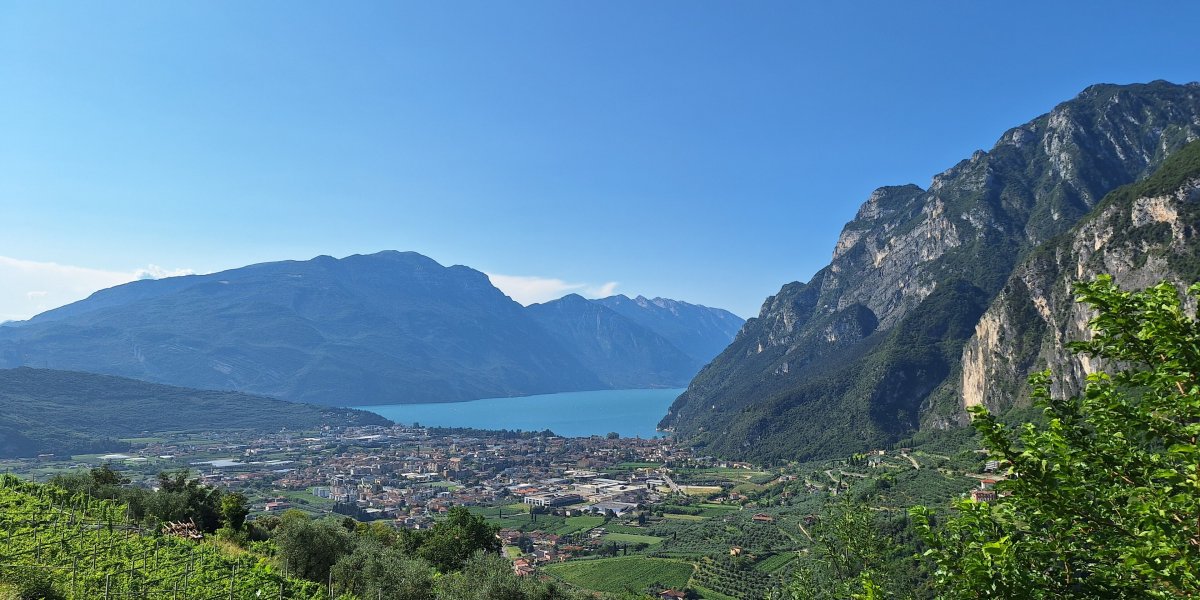
From the old-town center, walk five minutes west along Via del Bastion to where the stone-walled lane opens onto a switchback trail carved into the cliff face — the climb itself is the experience. The 15th-century Venetian watchtower at the top is just a ruin, but at every bend the lake unfolds another notch behind you, until from the terrace below the tower the whole of Lago di Garda funnels south between Alpine walls. Push twenty extra minutes higher to the tiny Capanna Santa Barbara chapel for an even more vertiginous angle straight down onto the town and harbor.
Tip: Start at 09:00 sharp — by 10:30 the sun rotates around and shoots straight into the lens of anyone trying to photograph the lake. The summit faces south, so morning light hits the cliffs from behind you and the water reads turquoise without flare. The narrow terrace 30 meters below the tower gives the wider postcard angle; the tower top itself is cramped and the railing cuts into the frame.
Open in Google Maps →11:45
Landmark
Descend the same switchbacks back to town — fifteen minutes, knees burning slightly — and emerge through Via dei Filatoi into Piazza 3 Novembre, Riva's lake-facing medieval square where pastel arcades meet the water. Circle the foot of Torre Apponale, the slim 13th-century white bell tower, peek through the porticoes at the harbor, and walk one block north along Via Mazzini to take in the moated exterior of La Rocca castle. No interiors needed — the magic here is the texture of crumbling Venetian stone against impossibly blue water.
Tip: By late morning the sun has rotated far enough that the eastern façades of the square — the pink and ochre ones with the wrought-iron balconies — glow head-on without shadow. The single antique street-lamp in front of Torre Apponale lines up perfectly with the tower for a symmetrical photo; stand on the third paving stone south of it and shoot upward.
Open in Google Maps →12:45
Food
Walk three minutes east along Viale Dante to Pasticceria Bertoldi, the working-class bakery where Riva's actual residents grab lunch — old men in linen shirts arguing about the harbor regatta, mothers picking up afternoon school snacks. Order pizza al trancio (a thick rectangular slice, 3.50€) and a panino con porchetta crackling-roast-pork sandwich (5€), and eat standing at the marble counter the way locals do. Out the door in twenty minutes, fuel for the waterfall hike sorted.
Tip: The strudel di mele (warm apple strudel, 3.50€) is the giveaway local order — ask for it riscaldato (warmed) and with una nuvola di panna (a cloud of whipped cream). Skip the lakefront cafés a hundred meters south; they all serve the same frozen lasagna at triple this price.
Open in Google Maps →14:00
Landmark
Head north out of town along Viale Dante onto Via Varone — a 45-minute walk through olive groves and vineyards with Monte Rocchetta climbing on your left, the kind of approach that frames the destination. The waterfall arrives as a sudden roar inside the rock: an 87-meter cascade enclosed in a tight limestone gorge, viewable from two grotto platforms cut directly into the cliff — a lower one where the spray soaks you, an upper one where you look down into the cauldron from above. Open to visitors since 1874, still one of the most theatrical natural sights on the entire lake.
Tip: Start with the upper grotto and descend afterwards — the noise builds gradually as you go down, which is far more dramatic than seeing the full waterfall first. Between 14:00 and 16:00 in summer the sun angles into the lower grotto and throws a mist rainbow against the back wall; you have about a fifteen-minute window. Bring a light layer — the lower platform stays 14°C even when it's 32°C outside.
Open in Google Maps →17:30
Park
Walk back into Riva along Via Damiano Chiesa — forty minutes mostly downhill, gravity on your side — cut through the old town to Spiaggia Sabbioni, the gravelly town beach just south of the harbor, then continue west along the lakefront promenade toward the windsurf beaches at Sabbioni Pini. Kick off your shoes, dip your feet (glacier-clear and shockingly cold even in August), and let the day unspool. This is the exhale — the moment the lake stops being a sight to photograph and becomes a feeling to sit with.
Tip: Find the third bench from the harbor end of the promenade and face southwest by 18:45 — the sun drops behind Monte Stivo and the lake turns hammered copper for roughly twelve minutes. The Lake Garda windsurfers ride the afternoon Ora wind back to shore exactly at this hour; their silhouettes against the copper water are the photograph that makes everyone ask where it was taken.
Open in Google Maps →19:45
Food
Six minutes back through the old town along Via Fiume brings you to Ristorante Al Volt, a vaulted 16th-century cellar serving Trentino classics under whitewashed stone arches. Order strangolapreti (handmade spinach-and-stale-bread gnocchi with brown butter and sage, 14€) and tagliata di manzo trentina con polenta concia (sliced grilled beef over cheese-laced cornmeal, 22€) — the two dishes that define the cuisine at this northern end of the lake. A glass of house Marzemino (5€) is what locals drink with red meat; it's the wine Mozart name-checks in Don Giovanni and it actually does come from these valleys.
Tip: Reserve at least a day ahead — there are nine tables and Italians arrive at 20:30 sharp. Final trap warning for Riva: avoid any restaurant directly on Via Roma or facing the harbor with multilingual photo menus or staff handing out flyers on the street — they serve identical microwaved lasagna for 18€ and pre-portioned 'gnocchi' from a vacuum bag. The genuinely good restaurants in Riva sit one street back from the water and never need to advertise to anyone.
Open in Google Maps →Aller au jour
09:00
Landmark
Start from Piazza Cavour and walk five minutes uphill to the trailhead behind Hotel Sole — a cobbled switchback path climbs through terraced olive groves for twenty minutes. Reach the squat round Venetian watchtower clinging to the cliff before the first tour groups arrive, and the whole crescent of the lake unfolds at your feet: the white-walled town, the harbour, Dolomite peaks staggered to the south. Built in 1508 to guard the Adige corridor, this little tower watched five centuries of war between the Alps and the Lombard plain.
Tip: Take the cobbled path, not the new glass panoramic elevator (€5 one-way) — the climb itself is the experience and you arrive sweating in the right way. Go before 10:00 in summer; the trail has zero shade and turns brutal by midday. The kiosk halfway up sells bottled water at €4, so carry your own.
Open in Google Maps →11:00
Landmark
Descend the same path back into town and emerge into Piazza III Novembre, the medieval heart of Riva ringed by porticoed houses in faded Veronese colours — saffron, ochre, rust. The thirteenth-century Torre Apponale rises from the lake side of the square; climb its 165 stone-and-timber steps to a 34-metre balcony, eye-level with the rooftops. The gilt angel weather vane at the summit is the town's symbol — locals call it 'l'Angeloto.' Arriving in this late-morning quiet window catches the piazza before the lunch crowds fill it.
Tip: Buy the €8 MAG combo ticket here at the tower base — it also covers the Rocca museum this afternoon and lets you skip the queue there. Tower is closed Mondays out of season; check the chalkboard at the entrance for that day's hours before you climb.
Open in Google Maps →12:45
Food
One minute east off the piazza, on the quiet corner where Via Santa Maria meets Piazza San Rocco. This stone-floored osteria is where Riva's old fishing families still come for the Trentino dishes nobody serves on the lakefront. Order the carne salada (thinly sliced air-cured beef with cannellini beans and olive oil) and the strangolapreti — 'priest stranglers,' spinach-and-bread dumplings in melted butter and sage. House Marzemino, Mozart's favourite Trentino red, is €4 a glass.
Tip: Carne salada €12, strangolapreti €11, secondi €18-22. No reservation for lunch, but the four outdoor tables go first — be at the door by 12:30. Avoid Birreria Spaten on the lakefront; it serves the same regional dishes at double price to coach tours and the carne salada there is pre-portioned from a vacuum pack.
Open in Google Maps →14:30
Museum
Cross the inner canal east of the piazza and walk five minutes to the Rocca, the moated thirteenth-century castle that now houses the town museum. Inside: Roman steles dredged from the lakebed, the original Venetian council chamber under coffered wooden beams on the top floor, and — most quietly haunting — a Pinacoteca of nineteenth-century Lake Garda landscapes by Hayez, Inganni, and Pelego that captured this water before tourism arrived. Mid-afternoon avoids the morning school groups and catches the upper galleries at their most luminous.
Tip: The Pinacoteca's view through the upper window onto the lake is itself worth the ticket — save the painting gallery for last. Closed Mondays. The €3 audio guide is genuinely good; skip the printed leaflet. The moat garden behind the keep is free to enter even without a museum ticket and has the best stealth picnic spot in town.
Open in Google Maps →16:45
Neighborhood
Exit the Rocca's south gate and turn left along the water. The lungolago runs flat and wide under century-old plane trees for 1.5 km east, past the small marina and Hotel Lido, the Ora wind ruffling the surface and windsurfers cutting white lines across the bay. End at Porto San Nicolò, a small stone harbour at the base of Monte Brione where a handful of old fishing boats still moor — and 17:30 light turns the limestone cliffs above it pink. The Ora afternoon thermal peaks now, so the lake is at its most alive.
Tip: Buy a gelato at Cristallo on Via Maffei before you set out (you pass it leaving the Rocca), then eat it sitting on the breakwater wall at Porto San Nicolò watching the sails — fior di latte and pistachio are the locals' pick. The Ora wind reliably blows south-to-north every fair-weather afternoon from April to October, which is also why this northern shore is one of Europe's great windsurfing capitals.
Open in Google Maps →19:30
Food
Walk fifteen minutes back along the lake into the medieval centre to Via Bastione. Antiche Mura sits in a vaulted stone cellar from the 1400s, family-run for three generations. Order the lavarello (the lake's whitefish) cooked over the wood grill with butter and sage, and the homemade tagliatelle al ragù di cervo — venison ragù from the Brenta mountains. The Trentino wine list is genuinely good; ask the owner for a glass of Teroldego Rotaliano.
Tip: Lavarello €22, pasta €14-16; budget €45-55 per person with wine. Reserve a day ahead in summer — only twenty tables. The four in the inner stone courtyard are quieter than the cellar; ask specifically when you book. THE RIVA RULE: avoid every restaurant on Viale Carducci with a multilingual menu and a tout at the door — they charge €18 for frozen ravioli and the lavarello on their plate has never seen this lake. If you can see the water from your table here, you usually can't trust the kitchen.
Open in Google Maps →09:00
Landmark
From the centre, take the SF1 bus from Piazzale Mimosa for the 10-minute ride north, or walk 40 minutes through vineyards (3 km gentle uphill). The waterfall is hidden inside a vertical limestone gorge — two engineered walkways carved into the rock take you behind the falling water, which has cut 75 metres deep over twenty thousand years. The roar fills the chamber, the spray hits your face, and the gorge stays cool even in August. Goethe stopped here in 1786 and could not stop writing about it.
Tip: Be at the ticket gate right at 09:00 opening — the morning sun slants directly into the upper grotto and lights the spray gold; by midday the gorge falls into deep shadow and photos go flat. Bring a light waterproof; the upper chamber is genuinely wet and stays 12°C year-round. The lower grotto is the more dramatic shot — save your phone battery for it.
Open in Google Maps →11:00
Religious
Walk back toward town along Via Varone for twenty-five minutes — the road drops slowly through olive groves with the lake reappearing ahead. Just before the historic centre, stop at the Inviolata, an octagonal Baroque sanctuary from 1611 that is the quiet surprise of Riva. The interior is one of the most lavishly decorated in all of Trentino: gilt stuccowork, swirling polychrome angels, four black-marble side altars, and a frescoed dome that pulls the eye straight up into a painted sky. The morning south windows are doing exactly what the builders intended.
Tip: Open 09:00-12:00 and 15:00-18:00 only — easy to miss in the lunch gap. Free entry, but drop €1 in the lighting box just inside the door to illuminate the side chapels — without the coin you'll see only the dome and the rest stays in shadow. Photos allowed without flash; tripods are politely refused.
Open in Google Maps →12:30
Food
Walk five minutes south along Via Fiume into the old town. Al Volt makes the best wood-fired pizza in Riva — thin Roman-style crust, blistered cornicione, Trentino mountain cheeses. Order the 'Riva' (speck, Trentingrana, walnuts, a drizzle of honey) or the simple margherita with buffalo mozzarella. Stand at the counter for a quick slice and a bottled Forst, or take one of the eight wooden tables in the small vaulted room.
Tip: Slice €4-6, whole pizza €8-13, draft beer €4. Cash preferred for under €10. Closed Wednesdays year-round. Walk past the takeaway panini shops on Viale Roma without stopping — €12 buys a sad ham sandwich on stale bread there, while the same money here buys two slices and a beer.
Open in Google Maps →14:00
Park
From Al Volt, walk eight minutes west along the lake to Spiaggia Sabbioni, the long pebble-and-sand beach where locals actually swim. The water clarity at Garda's northern tip is legendary — turquoise over white stones, the Brescian Alps rising directly from the far shore in three crisp layers. Continue along the lakeside path to Punta Lido, a small grassy headland with the prettiest swimming spot in town and shade from old willows. Afternoon is when the water temperature finally peaks.
Tip: Pack water shoes — the pebbles are sharp underfoot and the entry point hurts in bare feet. The water at the Punta Lido end stays calmer than the open Sabbioni beach when the Ora wind picks up after 14:00. Free public beach; lounger rental at the central concession is €15/day but a towel on the grass at Punta Lido is the local move. Showers are free, lockers €2.
Open in Google Maps →17:00
Neighborhood
From Punta Lido, walk eight minutes east along the lake to Piazza Catena, the small lakeside square where, until the 1700s, an iron chain (catena) was raised across the harbour mouth at sunset to close the port to enemy galleys. Wander the lanes behind it — Via Marocco, Via Florida, Via Mazzini — where Venetian arches and Habsburg shutters overlap on the same building. Many shutters are still painted in the deep yellow Riva's century under Austria left behind.
Tip: Stop at Pasticceria Maroni on Via Mazzini for a slice of torta di fregoloti, the crumbly Trentino almond cake locals serve with sweet Vino Santo — €3 a slice, €4.50 with the wine pairing. The lakeside benches between Piazza Catena and Porta San Marco face the sunset arc directly; best from 19:15 in June, 18:30 in September.
Open in Google Maps →19:30
Food
Walk five minutes north into Via Restel de Ferr, a quiet stone-paved lane safely far from the lakefront tourist menus. Restel de Fer occupies a fifteenth-century house belonging to one of Riva's oldest families and serves the most uncompromising traditional Trentino menu in town: smoked lake fish, alpine cheeses, hand-rolled pastas, game from the surrounding mountains. Order the smoked lake trout starter and the bigoli al ragù di lepre — hare ragù on thick whole-wheat pasta. Wine list is entirely regional: Teroldego, Marzemino, Nosiola.
Tip: Tasting menu €45, à la carte €40-55. Reservation essential — only eight tables and they fill a week ahead in July-August. The corner room with the open fireplace is the one to ask for. FINAL TRAP WARNING for Riva: skip the lakefront ice cream carts charging €4 per scoop with photos of fruit on the side — that 'fresh strawberry' is industrial paste. Real gelato in Riva is at Cristallo or Soraga, both inland; if the colours look fluorescent in the case, walk past.
Open in Google Maps →
Trip builder
Plan this trip around Riva del Garda
Turn this guide into a bookable rail itinerary with FlipEarth.
Keep exploring
Related cities
More in the same country
FAQ
Frequently asked questions
How many days do you need in Riva del Garda?
Most travelers enjoy Riva del Garda in 1 days, with enough time for headline sights and a slower meal or museum stop.
What's the best time to visit Riva del Garda?
The easiest season for most travelers is May-Sep, especially if you want good weather and manageable crowds.
What's the daily budget for Riva del Garda?
A practical starting point is about €90 per person per day before hotels, then adjust based on museums, dining, and transport.
What are the must-see attractions in Riva del Garda?
A good first shortlist for Riva del Garda includes Bastione di Riva, Piazza 3 Novembre & Torre Apponale, Cascata del Varone.