City Guide
Rimini
Italie · Best time to visit: May-Sep.
Day-by-day plan
Choose your pace
Durée du voyage
09:00
Landmark
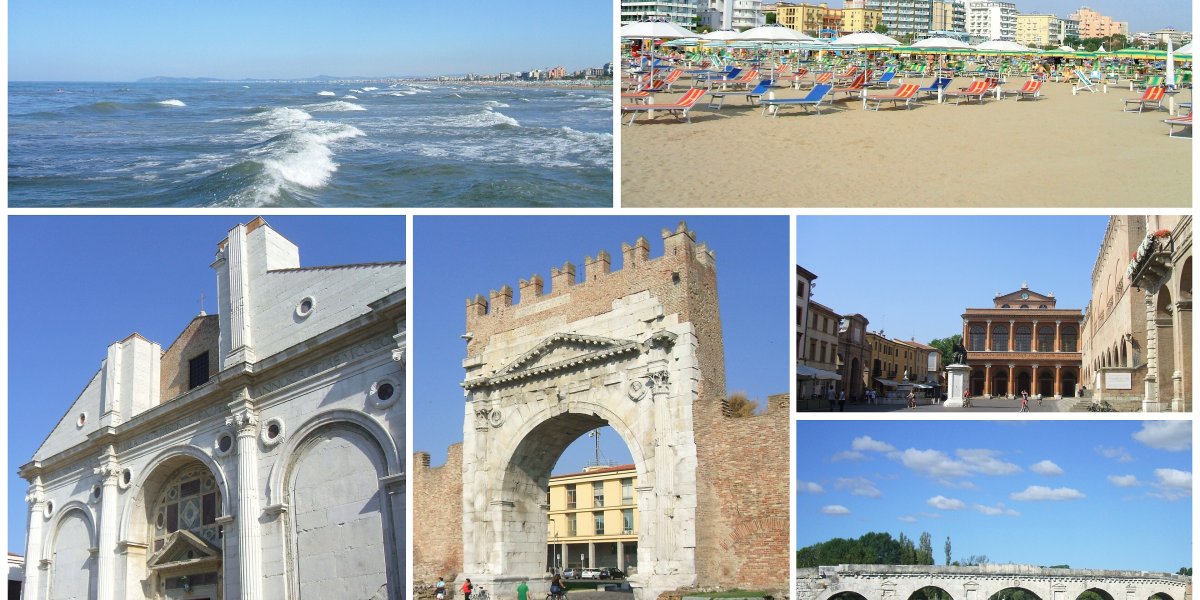
From Rimini railway station, a 12-minute walk south down Via Dante and through Piazza Tre Martiri delivers you to the city's southern gateway. The Arch of Augustus, dedicated in 27 BC, is the oldest surviving Roman arch in existence — the same threshold every northbound traveler on the Via Flaminia crossed for two thousand years. Stand on the east side just after opening: the morning sun rakes across the Corinthian capitals and the reliefs of bulls and elephants at an angle no afternoon visitor will ever see.
Tip: The hour after 09:00 is your only window with light traffic and no tour groups — by 11:00 the buses arrive. For the postcard shot, cross to the south side and back against the wall of Corso d'Augusto: the arch frames perfectly against the medieval clocktower behind it, a 1500-year time collapse in one frame.
Open in Google Maps →10:30
Landmark
Walk north up Corso d'Augusto for 12 minutes — Rimini's main pedestrian artery — passing Piazza Tre Martiri (the ancient Roman forum where Caesar reputedly addressed his troops after crossing the Rubicon) and Piazza Cavour with its 16th-century fish-market loggia. Sigismondo Malatesta's brooding 15th-century fortress, Castel Sismondo, dominates the next square: today it houses the Fellini Museum, but the spectacle is the exterior. Tobia Scarpa's 2021 reflecting pool around the castle — a circular mirror of water against the red brick — is the most photographed urban intervention in Emilia-Romagna.
Tip: Skip the interior — the museum is excellent but eats two hours you don't have. Walk the perimeter clockwise to find the bronze Sigismondo plaque on the south wall and the half-hidden back garden where locals eat panini. Best photo: from the wooden walkway over the reflecting pool around 11:00, when the sun is high enough to light the brick but the pool is still in shadow — the mirror effect is at its strongest.
Open in Google Maps →12:30
Food
From the castle, walk 8 minutes north across the Tiberius Bridge (you'll return for a proper visit after lunch) into Borgo San Giuliano, the old fishermen's quarter where every facade is painted with murals of Fellini film scenes. Dalla Lella, on Via San Giuliano, is the piadina temple every Riminese grandmother sends her grandchildren to: a cast-iron griddle, two women working it, a queue out the door by 13:00. Order the Piadina con Squacquerone, Prosciutto Crudo e Rucola (€6) — the soft local cheese is made within 20 km — paired with a glass of Sangiovese di Romagna (€3.50).
Tip: Arrive at 12:30 sharp; by 13:15 the line stretches around the corner. Eat standing at the marble counter outside — the bench across the alley is where the regulars sit. Don't order the cassone unless you're skipping dinner: one is the size of a Frisbee.
Open in Google Maps →14:00
Landmark
Walk 4 minutes west from Lella through Parco XXV Aprile — the green riverbank that opens onto Rimini's most stubborn monument. The Tiberius Bridge, begun under Augustus and finished by Tiberius in 21 AD, has carried traffic for over 2,000 years: five Istrian-stone arches anchored in the original Roman foundations, scarred but standing through earthquakes, floods, and a 1944 Wehrmacht demolition charge that failed. The best view is from the wooden footbridge over the lagoon to the west, where the bridge sits as an island monument in still water.
Tip: Walk the bridge south-to-north, then loop back along the lagoon path on the west side: at 14:30 the afternoon sun lights the upstream face of the arches and the reflection is mirror-still (the lagoon was created in 2017 by closing the old river mouth, restoring the bridge as Augustus intended). Photograph from the third stone bench along the lagoon path — it lines up the five arches perfectly with the campanile behind.
Open in Google Maps →15:30
Neighborhood
Step off the bridge directly into Borgo San Giuliano, the labyrinth of pastel alleys behind you — start at Piazzetta Gabena and let the lanes pull you east. Each spring the borgo holds a mural festival; the result is over 200 painted facades, half tributes to Fellini (whose family lived here and whose ghost runs the place) and half maritime scenes by local artists. After 90 minutes of wandering, walk east on Via Bastioni Settentrionali for 25 minutes to reach the beach at Marina Centro and the Grand Hotel — the cream Belle Époque palace Fellini turned into the dream-cathedral of Amarcord. Walk the empty late-afternoon sand south for 2 km, then back north past the Grand Hotel as the sun drops behind the city and sets its windows on fire.
Tip: Two murals not to miss: Via dei Mille (Fellini in profile, directing) and Vicolo Mainardi (the tribute to Anita Ekberg). For the Grand Hotel, don't attempt the lobby unless you're staying — walk around to the seaward terrace, where the bar opens to the public for an Aperol Spritz (€10) with the best sunset view in town. Pitfall: avoid the seafront restaurants on Lungomare Tintori with photo-menus — they're priced for tourists and most of the seafood is frozen. Walk back to Borgo for dinner.
Open in Google Maps →19:30
Food
From the Grand Hotel, walk 25 minutes west along Viale Vespucci and back over the Tiberius Bridge — now floodlit gold against black water, the best view of the bridge you'll get all day. Osteria de Borg, on Via Forzieri 12, occupies a converted 1800s slaughterhouse: the Adriatic catch arrives twice a day, and the dry-aging room for the Romagnola beef is behind a glass wall you can see from your table. Order the Tagliatelle al Ragù di Mare (€18, hand-cut pasta with cuttlefish-ink ragù) and the Grigliata Mista di Pesce (€32, whatever the boats brought in that morning).
Tip: Reserve at least a day ahead — by 20:00 they turn away walk-ins. Ask for a table in the smaller back room rather than the courtyard (the courtyard sits beneath the kitchen vent). The house Sangiovese (€18) outperforms the €40 reserves on the list; the sommelier will admit it if you ask. Budget €45-60 per person.
Open in Google Maps →Aller au jour
10:00
Museum
Step into the dry moat of Castel Sismondo on Piazza Malatesta — Sigismondo Pandolfo's 15th-century brick fortress, now reborn as Italy's largest museum dedicated to a filmmaker. Arrive at 10:00 opening to claim the 'Marcellino's Telephone Room' (vintage rotary phones suspended in inky black) before the cruise-tour buses unload at 11:00. Two floors of dreamscapes inside the castle walls, with Fellini's hand-drawn storyboards lit like reliquaries.
Tip: Buy the FellinIA combined ticket (€12) that also covers Palazzo del Fulgor — the restored 1920s cinema 200 m north where young Federico first saw a movie. The single-museum ticket (€8) ends up costing more in lost magic than money.
Open in Google Maps →12:00
Food
Exit Castel Sismondo by the eastern footbridge and stroll 5 minutes along Via Sigismondo, past artisan watchmakers and old bookshops, until the arcades open onto Piazzetta Gregorio da Rimini — the 1747 fish market where stone counters once held the morning catch. The fishmongers are gone but the small osterie around the edge serve the kind of food locals eat standing up. Order cappelletti in brodo di carne (€12) and a piadina with squacquerone cheese and rocket (€6); with a half-litre of house Sangiovese (€6), the bill lands at €20-25 per person.
Tip: Skip the menu in English — point at what the table next to you ordered. The half-litre of house Sangiovese is what locals actually drink with lunch; bottled labels double the bill for no reason.
Open in Google Maps →13:30
Landmark
Walk three minutes north from the Pescheria's stone arcade onto Corso d'Augusto, and Piazza Cavour opens like a postcard from another century — the medieval Palazzo dell'Arengo with its slate roof, the 16th-century Pigna fountain that Leonardo da Vinci praised in his notes, and the Teatro Galli rebuilt in 2018 after seventy years as a war ruin. Sit on the steps of the fountain at 13:30 and the afternoon light slants directly onto the bronze pinecone — this is the photo postcard from Rimini your grandparents would have sent.
Tip: Do not order coffee at the cafés facing the square — it's €4 for a sit-down espresso. Walk 30 seconds into Via Tempio Malatestiano to Pasticceria Dolce Letizia and stand at the bar for a €1.20 espresso the way locals do.
Open in Google Maps →14:30
Landmark
Continue south along Corso d'Augusto for 7 minutes — the same street the Romans called the cardo, the spine of the colony — until the arch appears framing the road like a single open eye. Built in 27 BC for Octavian, this is the oldest surviving Roman arch in the world, older than the Colosseum by a century, and the four medallions above the columns are the original Augustan portraits of Jupiter, Apollo, Neptune and Roma. At 14:30 the sun is past its zenith and washes the eastern face directly — exactly the angle Fellini chose for the closing shot of 'Amarcord'.
Tip: Walk through the arch, then turn around. The view back toward Piazza Cavour, framed by the arch's white Istrian stone, is the single best photograph in Rimini — and almost nobody bothers to look behind them.
Open in Google Maps →15:30
Religious
Walk back north along Corso d'Augusto for 6 minutes, then turn right into Via IV Novembre — the Tempio appears suddenly, a Renaissance facade by Leon Battista Alberti grafted onto a 13th-century Franciscan church. The marble was looted from Roman ruins, the side chapels were planned as tombs for the warlord Sigismondo Malatesta and his banned mistress Isotta, and Piero della Francesca's fresco of Sigismondo kneeling waits in the second chapel. The 15:30 reopening after the long lunch closure gives you one quiet hour before tour groups arrive at 16:30 for the final visit.
Tip: Look for the bizarre 'SI' monogram (Sigismondo and Isotta's entwined initials) carved into every chapel — it was the most scandalous PDA of the 15th century, and Pope Pius II formally condemned the church for it. Drop €0.50 in the light box of the Chapel of the Planets to see Piero's painting and the zodiac frescoes properly.
Open in Google Maps →19:30
Food
From the Tempio walk 4 minutes north onto Via Farini — the unassuming door opens into a candle-lit vault where chef Mariano Guardianelli and his Argentine partner run Rimini's most beautifully argued restaurant, Italian and Argentine traditions placed side by side on every plate. Order the cappellacci ripieni di brasato (braised-beef-filled pasta, €18) followed by entraña a la parrilla (grilled skirt steak, €26); a glass of Sangiovese di Romagna Riserva (€8) pairs both. Budget €60-75 per person without bottled wine.
Tip: Reserve 48 hours ahead — the 30-seat room is full every night and walk-ins are turned away after 20:00. Avoid the picture-menu places along Via Tempio Malatestiano advertising 'Italian Cuisine' in five languages — they're €40 a head for frozen seafood and tourist prosecco, and Abocar is the antidote.
Open in Google Maps →09:00
Landmark
Begin your morning at the north end of Corso d'Augusto, where the road becomes a 2,000-year-old Roman bridge — the Ponte di Tiberio, started under Augustus in 14 AD and finished by Tiberius in 21 AD. Five arches in white Istrian stone, dropped onto wooden pilings still intact below the water; allied bombs in 1944 and four earthquakes have failed to bring it down. At 09:00 the bridge is empty and the sun comes from the east — stand at the second arch on the upstream side for the still-water reflection that Fellini filmed in 'I Vitelloni'.
Tip: Walk down to the canal embankment on the western side via the small staircase next to the third arch. From there you can read the original construction inscription carved directly into the stone — it survives in legible Latin after twenty centuries.
Open in Google Maps →09:30
Neighborhood
Cross the Tiberius Bridge and you are immediately inside Borgo San Giuliano — Fellini's old fisherman's quarter, a maze of low pastel houses where every other wall is painted with a scene from his films. Wander Via San Giuliano, Vicolo Pedrocca, and the tiny piazzas behind them; new murals appear each September during the Festa de Borg. Look for the giant Saraghina on Via Forzieri, the painted Gradisca above Vicolo Pedrocca, and the recreated 'Amarcord' peacock on a courtyard wall along Via Bastioni Settentrionali.
Tip: Most visitors stop at the first three murals on Via San Giuliano and turn back — the real treasures are deeper in, on Vicolo Pulci and Via Marecchia. Bring the camera at 10:30: the morning sun has just cleared the rooftops and the pastel houses are at their most saturated.
Open in Google Maps →12:30
Food
From the bottom of Vicolo Pedrocca walk 3 minutes north along Via San Giuliano — Dalla Lella is the tiny corner chiosco with three wooden tables on the cobblestones and a permanent local queue at lunch. Order the cassone alle erbe (wild-greens flatbread, €5) and a piadina with prosciutto di Parma and squacquerone (€6) — Lella has been pressing them onto a black cast-iron testo for forty years. With a glass of Sangiovese (€3), the bill lands at €12-15 per person.
Tip: There is no written menu — say 'una mista' and you'll get the day's three best fillings. The chiosco shuts at 14:30 sharp for the afternoon, so arrive by 13:00 to avoid the 14:00 panic crowd of locals on their lunch break.
Open in Google Maps →14:00
Park
Walk 12 minutes east along Via Marecchia and across Piazzale Cesare Battisti — you'll emerge onto the Lungomare Tintori, the rebuilt seafront promenade where palms have replaced the parked cars. The Adriatic spreads in pale turquoise and the line of bagni — those wooden cabanas in every colour — runs unbroken for 15 km south. Walk the boardwalk down to Bagno 26 and rent a single sun-lounger at €12 for the afternoon, or kick off shoes and swim where the shelf stays knee-deep for fifty metres out.
Tip: Use Spiaggia Libera 1 just behind Piazzale Boscovich if you only want a photo and a quick swim — it's the free public strip between the paid bagni, and most tourists never realize it exists. The water turns its photogenic turquoise around 15:00 when the angle of the sun hits the fine pale sand.
Open in Google Maps →16:30
Landmark
Walk south along Lungomare Tintori for 8 minutes — palms, a fountain, then the white belle-époque towers of the Grand Hotel Rimini rise ahead like a mirage. Built in 1908, this was Fellini's lifelong obsession; he wrote that it 'represented luxury, wealth, the Orient', and Suite 315, the room he always took, is still preserved exactly as he left it. Slip into the lobby for a respectful peek and order a Negroni at the Bar Fellini overlooking the gardens (€14) — the cheapest film set you'll ever sit inside.
Tip: Walk into the garden behind the hotel (free, just stay on the pebble paths) to find the fountain Fellini filmed in 'Amarcord' — its three stone figures still spit water exactly the way they did in 1973. The 16:30 light filters through the maritime pines and is the best portrait moment of the entire trip.
Open in Google Maps →19:30
Food
Walk 6 minutes north along the Lungomare onto Via Tonale — Trattoria La Marianna is the white-curtained corner with no signage, only a hand-painted fishing boat outside the door. The Adriatic catch comes in at 17:00 from the small fleet at the canal port two streets away, and Marianna writes the menu by hand at 18:30 with whatever was unloaded. Order spaghetti alle vongole veraci (€18) followed by grigliata mista di pesce (mixed grilled fish, €28 per person), paired with a chilled Trebbiano di Romagna (€20 the bottle); budget €55-70 per person.
Tip: Avoid the four restaurants on Viale Vespucci near the Grand Hotel — they're tourist traps with photo menus in English, German and Russian, and seafood that's been frozen since December. La Marianna takes no credit cards and turns walk-ins away after 20:30 — phone to reserve at 14:00 the same day or arrive at 19:15 sharp.
Open in Google Maps →
Trip builder
Plan this trip around Rimini
Turn this guide into a bookable rail itinerary with FlipEarth.
Keep exploring
Related cities
More in the same country
FAQ
Frequently asked questions
How many days do you need in Rimini?
Most travelers enjoy Rimini in 1 days, with enough time for headline sights and a slower meal or museum stop.
What's the best time to visit Rimini?
The easiest season for most travelers is May-Sep, especially if you want good weather and manageable crowds.
What's the daily budget for Rimini?
A practical starting point is about €95 per person per day before hotels, then adjust based on museums, dining, and transport.
What are the must-see attractions in Rimini?
A good first shortlist for Rimini includes Arch of Augustus, Castel Sismondo and Piazza Malatesta, Tiberius Bridge.