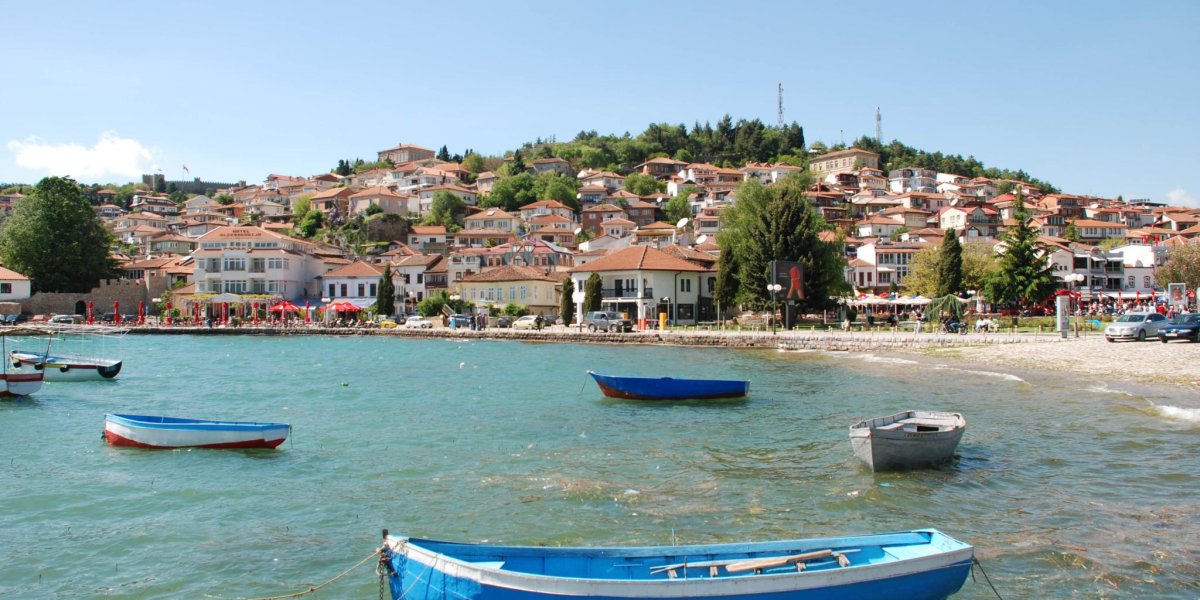
City Guide
Ohrid
Macédoine du Nord · Best time to visit: May-Sep.
Day-by-day plan
Choose your pace
Durée du voyage
09:00
Landmark
From the harbor, walk uphill through the old town and enter through Gorna Porta — the 15-minute climb through cobblestone lanes lined with Ottoman-era timber houses is the overture to the whole day. Tsar Samuel's 10th-century fortress crowns the hilltop with an unbroken panorama: Lake Ohrid stretches south toward the Albanian mountains, terracotta rooftops cascade below, and on a still morning the water mirrors everything. Walk the full circuit of the ramparts — the southeastern wall delivers the single best wide-angle shot of the entire city.
Tip: Arrive right at 09:00 when the ticket booth opens and head directly to the southeastern tower — you'll have the panorama to yourself for 20 minutes before the first tour buses arrive via the upper parking lot. The northern wall faces away from the lake; skip it and spend your time on the south and east ramparts instead.
Open in Google Maps →10:15
Religious
Exit the fortress through the southern gate and follow the stone path downhill for five minutes — the lake flashes between the trees on your left as you descend. The 11th-century Church of St. Sophia is one of the most monumental medieval churches in the Balkans, its massive stone nave and austere facade standing alone in a quiet courtyard with the lake visible behind. Walk around to the south terrace for the best framing, and if you have two extra minutes, the Hellenistic-era Ancient Theater of Ohrid sits just east — a quick bonus that adds a Roman layer to the timeline.
Tip: The south terrace behind the church is the hidden angle — place the stone apse in the foreground with the blue lake behind for a shot most visitors miss because they only photograph the front entrance. Morning light rakes beautifully across the weathered facade from the east at this hour.
Open in Google Maps →10:45
Religious
Follow the cliffside path southwest from St. Sophia through a corridor of tall cypress trees — five minutes of walking with the lake glittering below on your right. Plaoshnik is where St. Clement founded what many historians consider Europe's first university in the 9th century, and the reconstructed white church gleams against the deep blue of the lake. The archaeological excavations around the church reveal layered Roman, early Christian, and medieval remains open to view — this is where Ohrid's legend of 365 churches begins.
Tip: Walk to the lakeside edge of the Plaoshnik plateau and look south — from here you can see the Church of St. John at Kaneo perched on its cliff below, giving you a rare elevated two-churches-in-one-frame composition that most visitors only discover accidentally on the way back.
Open in Google Maps →11:15
Landmark
Descend the stone steps from Plaoshnik through pine forest — the 10-minute walk ends with one of Europe's great reveals as the 13th-century Church of St. John at Kaneo appears perched on a cliff directly above the turquoise water, with mountains rising behind. This is the single most photographed image in all of North Macedonia, and with the sun climbing high the lake turns an almost unreal shade of blue beneath the honey-colored stone. Take your time and work every angle: from the wooden viewing platform above, from the church terrace itself, and from the rocks down at water level.
Tip: The famous postcard shot is taken from the wooden viewing platform on the cliff path ABOVE the church, not from the church itself — face south with the church below you and the open lake behind. Then walk down to the rocks at water level for a dramatic low-angle perspective most tourists never attempt. Late morning to midday is actually ideal: the overhead sun eliminates harsh shadows on the stone and makes the water glow its deepest blue.
Open in Google Maps →12:00
Food
Walk down the final steps from the church to the small pebble beach — Restaurant Kaneo sits right at the water's edge, two minutes below, with tables on a wooden deck over the lake and the cliff church looming directly above. Order the grilled Ohrid trout (pastrmka na skara, ~€9) — the lake's ancient endemic species simply prepared with lemon and olive oil is the one dish you cannot leave Ohrid without tasting. Add a shopska salad (~€3) and a cold Skopsko beer (~€2) for a complete lakeside lunch under €15.
Tip: No reservation needed — just arrive before 12:30 to grab a waterside table. Point at 'pastrmka na skara' on the menu and skip the fried version. If Ohrid trout is unavailable (it's a protected species with a limited annual catch), ask for belvica — the tiny lake whitefish served whole and fried crisp, equally local and half the price.
Open in Google Maps →19:00
Food
After lunch, walk the lakefront boardwalk north toward the harbor — this 20-minute promenade past willow trees dipping into the lake and swimmers on pebble beaches is the day's most relaxing stretch, and the afternoon is yours to wander the Old Bazaar or sit at a lakefront cafe. Restoran Gladiator sits on Car Samoil Street in the old town, a no-frills local institution where you should start with tavche gravche (slow-baked white beans in a clay pot, ~€3), North Macedonia's national dish, before moving to the mixed grill platter (mešano meso, ~€7). Budget €12–18 per person with drinks.
Tip: Grab an outdoor table by 18:45 — by 19:30 the terrace fills with locals having their evening rakija. Whatever you do, avoid the waterfront restaurants lining the harbor promenade below: they charge double for half the quality and exist solely for tourists with rolling suitcases. The old town streets one block uphill are where Ohrid actually eats.
Open in Google Maps →Aller au jour
09:00
Landmark
Enter through the Upper Gate on Car Samoil street — the cobblestone climb takes about ten minutes and wakes up your legs for the day. The 10th-century fortress of Tsar Samuel crowns Ohrid's highest point, and at nine in the morning you will have the ramparts nearly to yourself. Walk the full circuit of the walls: the western side gives you an unbroken panorama of Lake Ohrid stretching to the Albanian mountains, while the eastern lookout reveals the town's terracotta rooftops tumbling toward the water.
Tip: Head straight to the southwestern corner tower first — it has the widest panorama and the best morning light for photos. By 10:00 tour groups start arriving from the parking lot below, so the first hour is your golden window.
Open in Google Maps →10:45
Museum
Exit the fortress through the Lower Gate and follow the narrow lane downhill for five minutes — you will pass a cluster of traditional houses with carved wooden balconies overhanging the lane. This 13th-century church doubles as Ohrid's most important museum of Byzantine art, housing icons from the 11th to 14th century that rival anything in Constantinople. The frescoes inside — particularly the Lamentation cycle — are among the finest medieval paintings in the Balkans, painted with an emotional intensity that still feels modern eight centuries later.
Tip: Photography is not allowed inside, so take your time absorbing the frescoes with your eyes rather than your lens. The 14th-century icon of the Annunciation near the entrance is considered one of the masterpieces of Byzantine art — stand close and notice how the gold leaf catches the candlelight.
Open in Google Maps →12:00
Food
Walk two minutes east along the cobbled lane back toward the Old Town core — Gladiator sits on a quiet courtyard just off the main pedestrian street. Order the tavče gravče (slow-baked white beans in a clay pot, €3.50) — the Macedonian national dish done properly — and a Shopska salad with tomatoes so ripe they stain the white cheese pink (€2.50). The portions are hefty and the pace is unhurried, exactly what you need before the afternoon's cliff walk.
Tip: Sit in the shaded courtyard, not inside. No reservation needed for lunch, but arrive by noon to beat the post-museum crowd. Total lunch for two with drinks runs about €20. Ask for the house-made ajvar (roasted pepper spread) — they make it in-house during autumn and jar it for the year.
Open in Google Maps →14:00
Religious
Walk southwest through the Old Town and follow signs for Plaoshnik — the path opens after ten minutes into a grassy plateau overlooking the lake, and the sudden expanse of water and sky after the narrow streets is one of Ohrid's quiet revelations. This is where St. Clement of Ohrid founded Europe's first university in 893 AD. The reconstructed church sits atop excavated 5th-century basilica mosaics, and the afternoon sun streaming through the windows lights up the interior frescoes painted in strict Byzantine tradition.
Tip: Walk around to the back of the church where the archaeological excavations are exposed — floor mosaics from the original Early Christian basilica are visible through glass panels. Most visitors miss this entirely because they only enter the church and leave. The view of the lake from the grassy slope behind the excavation site is one of the most peaceful in town.
Open in Google Maps →15:30
Landmark
Continue along the lakeside cliff path from Plaoshnik — a five-minute walk on a wooden boardwalk hugging the rocks above turquoise water, arguably the most beautiful short walk in the Balkans. Then it appears: the 13th-century Church of St. John the Theologian perched on a rocky outcrop above the lake, the single most iconic image of North Macedonia. You are here in the mid-afternoon deliberately — the sun is now in the west, front-lighting the church's honey-colored stone while the lake behind glows deep blue. Linger on the platform above, then descend to the church and sit on the warm rocks by the water.
Tip: The famous postcard photo is taken from the wooden platform on the cliff path ABOVE the church, not from the church level — look for the metal railing viewpoint. After the photo, walk down to the small pebble beach below the church where locals swim in summer. Stay until the light turns golden around 16:30 — the stone façade transforms.
Open in Google Maps →19:00
Food
Walk two minutes along the Kaneo waterfront to this terrace restaurant built directly over the lake — your table is literally above the water. This is where you eat Ohrid trout: pastrmka na skara (grilled, €10), the legendary endemic fish found nowhere else on earth. The trout is simply grilled with lemon and olive oil, and the flesh is unlike any freshwater fish you have tasted — delicate, almost sweet. Pair it with a glass of local Tikveš T'ga za Jug white wine (€3).
Tip: Reserve a waterside table for sunset — stop by after visiting the church to book for 19:00. The grilled trout is the only correct order; ignore the pizza section of the menu. Budget €15–20 per person with wine. Warning: avoid the string of restaurants along the main harbor promenade near the center — they charge double for half the quality and routinely serve frozen imported fish to tourists who cannot tell the difference.
Open in Google Maps →09:00
Religious
Start the day in the lower Old Town — the church is a two-minute walk from the main square through the pedestrian street. Built in the 11th century as the cathedral of the Archbishopric of Ohrid, St. Sophia holds some of the most significant Byzantine frescoes in existence. The interior is vast and dim, and as your eyes adjust you will find the walls covered in 11th-century paintings — the Ascension on the vaulted ceiling and the row of saints in the apse are breathtaking. Morning is the right time: the church faces east, and the early light through the narrow windows illuminates the frescoes with a warm amber glow that fades by midday.
Tip: Look up in the apse — the 11th-century fresco of the Virgin Mary enthroned is one of the most important surviving Byzantine paintings anywhere. Use your phone flashlight to see the darker side chapel frescoes that most visitors walk past without noticing.
Open in Google Maps →10:15
Landmark
Exit St. Sophia and walk uphill along Car Samoil street for three minutes — the theatre appears on your left, carved into the hillside with the lake visible between the curved rows of stone seats. This Hellenistic-era theatre (circa 200 BC), later used for Roman gladiatorial combat, was buried for centuries and only rediscovered in the 1980s. It is the only ancient theatre in North Macedonia and still hosts summer concerts. Sit in the upper rows where the acoustics are perfect and the lake fills the space where a stage backdrop would be — nature outperforms any set design.
Tip: The upper-left section of seating gives you the best photo composition — the curved stone rows frame the lake in the background. If you are visiting June through August, check the Ohrid Summer Festival schedule: performances held here at dusk, with the lake as a backdrop, are among the most atmospheric in the Balkans.
Open in Google Maps →12:00
Food
Walk downhill from the theatre toward the harbor — a seven-minute descent through the lower Old Town streets, past balconied houses and cats lounging on warm stone. Dalga sits on the waterfront promenade with views across the harbor to the mountains. Order the jagulja (Ohrid eel stew, €7) — a local specialty most tourists never discover — and the grilled peppers stuffed with white cheese (€4). The portions are generous and arrive fast, a proper refueling stop before the afternoon on the water.
Tip: Ask for a table on the upper terrace facing the water, not the street-level seats. Budget €10–15 per person. Skip the tourist menus with photos — order from the daily specials board. The eel is seasonal and best in spring and autumn; if unavailable, the baked carp in clay pot is the next best choice.
Open in Google Maps →13:30
Entertainment
The boat dock is a one-minute walk from Dalga along the harbor promenade. Board one of the traditional wooden boats for a cruise along Ohrid's western shore — you will see the Church of St. John at Kaneo from the water, a completely different perspective from yesterday's clifftop view. The boat glides past hidden coves with water so clear you can see the lake bed ten meters down, then beneath the fortress walls towering above. Lake Ohrid is three million years old, one of the oldest and deepest lakes in Europe, and from the water you finally feel its ancient scale in a way the shore never reveals.
Tip: Negotiate the price before boarding — a one-hour cruise should cost €5–8 per person, not the €15 initially quoted to tourists. The boats on the left side of the dock (facing the water) tend to be run by local fishermen who charge less than the polished tour operators on the right. Sit on the port (left) side of the boat for the best views of the churches and cliffs.
Open in Google Maps →15:30
Museum
Step off the boat and walk three minutes into the Old Bazaar quarter — narrow lanes of workshops and small galleries radiate uphill from the harbor. Browse the traditional Ohrid pearl artisans first: Ohrid pearls are made from the scales of the endemic plasica fish, a craft unique to this town and practiced for centuries. Then find the Robevi House, a stunning 19th-century merchant's mansion with dramatic jutting upper floors and carved wooden ceilings, now housing the National Museum. The ethnographic collection inside gives you a window into the Ottoman-era life of Ohrid's wealthiest trading families.
Tip: In the pearl workshops, genuine Ohrid pearls have a distinctive creamy luster — if they look plasticky and perfectly round, they are Chinese imports sold at local prices. The Talevi family workshop on the bazaar's main lane has made pearls for three generations and will show you the process. At the Robevi House, climb the steep wooden stairs to the top-floor salon — the painted ceiling is the highlight of the entire museum.
Open in Google Maps →19:00
Food
Walk five minutes uphill from the bazaar into the Old Town — Antiko is set inside a beautifully restored 19th-century Ohrid house with a vine-draped courtyard, the kind of farewell dinner setting this trip deserves. Order the mešano meso (mixed grill platter with lamb, veal, and kebapi, €9) served with house-made ajvar and warm lepinja bread, or the slow-cooked monastery-style lamb (€8). End with a glass of rakija — the grape brandy that every Macedonian meal finishes with — and let the courtyard lanterns carry you through the last evening.
Tip: Arrive by 18:45 to claim a courtyard table — no reservations for outdoor seating, first come first served. Budget €15–20 per person with rakija. End the night with a Turkish coffee and a slow walk back through the lamplit Old Town. Warning: taxi drivers at the main square routinely overcharge tourists heading to the bus station — agree on the fare before getting in (no more than €3 anywhere in town), or walk the fifteen minutes yourself.
Open in Google Maps →
Trip builder
Plan this trip around Ohrid
Turn this guide into a bookable rail itinerary with FlipEarth.
Keep exploring
Related cities
More in the same country
FAQ
Frequently asked questions
How many days do you need in Ohrid?
Most travelers enjoy Ohrid in 1 days, with enough time for headline sights and a slower meal or museum stop.
What's the best time to visit Ohrid?
The easiest season for most travelers is May-Sep, especially if you want good weather and manageable crowds.
What's the daily budget for Ohrid?
A practical starting point is about €40 per person per day before hotels, then adjust based on museums, dining, and transport.
What are the must-see attractions in Ohrid?
A good first shortlist for Ohrid includes Samuel's Fortress, Church of St. John at Kaneo.