City Guide
Odesa
Ukraine · Best time to visit: May-Sep.
Day-by-day plan
Choose your pace
Durée du voyage
09:00
Landmark
Begin where every Odesa story does — under the Italianate baroque facade of the 1887 Opera House, an architectural sister to Vienna's, washed in pastel pink and crowned by the goddess Melpomene riding her panther-drawn chariot. The morning sun rakes across the south face at this hour, lighting the carved angels with an amber glow that makes even smartphone shots look like postcards. Circle the building clockwise — every elevation is different, and the Tchaikovskoho Lane side is where the musicians slip in for rehearsal around ten.
Tip: Best photo angle is from the corner of Lanzheronivska and Rishelievska looking northeast — you catch both Melpomene atop the dome and the full pastel curve of the south wing in one frame. Avoid standing directly under the front portico for photos; the columns swallow the light and the security guards will ask you to step aside for the morning tour groups arriving at 09:30.
Open in Google Maps →10:45
Neighborhood
Exit Teatralna Square heading south on Rishelievska Street, then take the first right — two minutes and you stand at the head of Deribasivska, the car-free spine of Odesa. Stroll west under century-old plane trees, past the wrought-iron arcade of the Passage, and into City Garden where a bronze Leonid Utyosov sits on a real bench grinning over his accordion. This is the city's living room — chess players, accordion buskers, grandmothers tossing seeds to pigeons — and the place to feel Odesa's famous wit drift past in three languages at once.
Tip: Sit on the bench next to Utyosov for the photo locals actually take — rub the bronze accordion key on his right hand for luck, the patina there is polished bright from a century of fingers. Two pitfalls in the garden: the costumed 'photographer' who'll drape a live python over your shoulders before naming a €20 price, and the men with white doves who do the same trick — refuse politely and keep walking.
Open in Google Maps →12:30
Food
You're already on the right block — Kompot sits at Derybasivska 20, fifty steps from the Utyosov bench. The pavement terrace fills fast with locals on lunch break, so duck straight inside and climb to the upstairs window counter where seats turn over every fifteen minutes. This is Odesa's everyday brasserie: hand-pinched vareniki, forshmak on rye, the cold pink summer borscht that no one outside this city makes properly.
Tip: Order the forshmak (Odesa-style minced herring spread on dark bread, €3.50) and a bowl of green borscht with sorrel and egg (€5) — it's the exact lunch every grandmother in this city serves on a hot day. Skip the cake counter near the door; the savory kitchen at the back is twice as good, and the kvass on tap (€1.50) is the only drink that pairs with forshmak. Average ticket: €10-14, no reservation needed before 13:00.
Open in Google Maps →14:00
Landmark
From Kompot, walk three blocks east along Deribasivska, then turn left up Yekaterynynska — six minutes and you emerge at the western tip of Primorsky Boulevard, the city's grand sea-facing promenade. Walk its full length under flowering acacias past the pink Vorontsov Palace, the Pushkin bust, and the colonnaded City Hall, ending at the bronze Duke de Richelieu wrapped in a Roman toga, gazing over the harbor he built in 1803. The boulevard peaks at this hour — afternoon light glances off the imperial facades on your left while the Black Sea spreads silver-blue to your right.
Tip: The Duke's hidden sightline: kneel directly behind the statue on the south side, look between his bronze ankles, and you'll see he is pointing his outstretched arm in a perfectly straight line down Rishelievska Street — the entire grid of central Odesa was planned around this gesture. The benches halfway down the boulevard facing the sea are the best photo seat; the harbor cranes behind look industrial, but in late afternoon haze they soften into pure silhouette.
Open in Google Maps →16:30
Landmark
The Duke stands at the top — turn around and you're already there. The 192-step Potemkin Stairs cascade down to the port in a deliberate optical illusion: from the top you see only landings, from the bottom only steps, a 19th-century trick designed to make the descent feel like a dream. Walk down slowly (golden hour now floods the harbor with that particular Black Sea apricot light), spend ten minutes at the Sea Station promenade below, then ride the little yellow funicular back up — it runs alongside the stairs and the operator hasn't raised the fare in years.
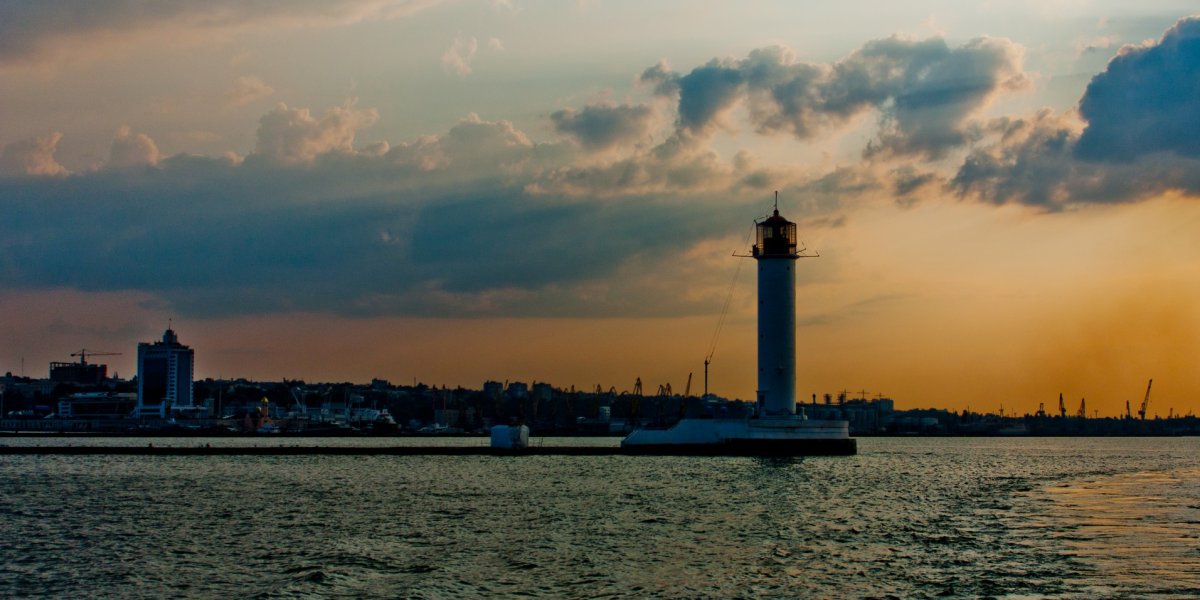
Tip: Stand at the foot of the stairs and look straight up — this is the famous reverse illusion: the steps vanish entirely and only the ten landings remain visible, like a stack of stone shelves. Time your descent so you arrive at the bottom around 17:30 in summer: the lighthouse on the breakwater begins to blink and the cruise terminal glass catches the sun like fire. Pitfall warning: refuse every 'free port photo' offered at the base — the men with old Polaroid props will demand €15-25 after the shutter clicks, and the 'amber jewelry' on the trays near the funicular is dyed plastic resin, not amber.
Open in Google Maps →19:00
Food
From the Duke Monument, walk south down Yekaterynynska Street, then right onto Bunina — eight minutes through the dusk-lit imperial quarter, ending at the courtyard gate of the 1898 Philharmonic palace. Bernardazzi is built into the palace's inner colonnade: candlelit Corinthian columns, a frescoed ceiling, a live string quartet most evenings after 20:00. This is where Odesa's old families still eat — the wine list runs deeper than any in Ukraine, the kitchen has been recommended in the Michelin guide for years, and the bill will still surprise you.
Tip: Reserve a table in the inner colonnade courtyard, not the indoor hall — call ahead (English spoken) and specifically ask for 'the columns' or table 12-15. Order the rack of Black Sea lamb with smoked aubergine (€22) and the sweet cherry vareniki with sour cream for dessert (€8) — pair with a glass of Shabo Telti-Kuruk, the indigenous white grape from the vineyards 70 km west of here that grows nowhere else on earth. Average ticket with one glass of wine: €35-45.
Open in Google Maps →Aller au jour
09:00
Landmark
Begin at the Duke de Richelieu monument crowning the 192-step staircase that Eisenstein made the most famous flight of stairs in cinema. The 9 AM eastern light pours across the cargo cranes below, and from this top platform the optical illusion reads at its strongest — the steps appear to vanish, only the landings visible. Descend once, then climb back up to feel the city open in stages.
Tip: Stand directly behind the Duke statue and aim the camera straight down the central axis at 09:10-09:20 — the sun is low enough off the harbor to backlight the stairs without blowing out the sky. Cruise passengers don't reach the top until after 10:30.
Open in Google Maps →10:30
Landmark
Stroll 8 minutes north along Primorsky Boulevard, past the cast-iron lamps and the Pushkin monument, to the cliff-edge colonnade behind Vorontsov Palace. Ten white Tuscan columns frame the working port below — this is the postcard Odesans send when they are homesick. Morning light skids in low across the water and the colonnade is at its most luminous before noon.
Tip: Walk through the columns to the cliff edge and shoot from the second column on the left, framing the harbor cranes between two pillars — locals call this 'the only honest postcard of the city'. The palace itself is closed for restoration, but the colonnade is the real prize.
Open in Google Maps →12:00
Landmark
Backtrack south on Lanzheronivska for 6 minutes and the Vienna Baroque silhouette rises suddenly between rooftops. Modeled by Fellner and Helmer in 1887 on the Vienna State Opera, its horseshoe hall has acoustics that rival La Scala. The guided tour walks you through the gilded foyer, the imperial loge, and the rehearsal floor that ticket-holders never see.
Tip: English tours run 11:00, 12:00 and 13:00 — book the 12:00 the day before through the box office on the south side of the building. If a matinee rehearsal is on, you may catch ten free minutes of music from the upper balcony.
Open in Google Maps →13:30
Food
Exit the Opera, cross to Deribasivska, and slip into Kompot's leafy interior courtyard — 4 minutes door to door. This is where Odesa's writers and editors actually lunch: gilded Soviet-era wallpaper, an old upright piano, and the city's best red borscht with smoked plums (€4). Order beef stroganoff with mash (€6.50) and the cherry vareniki for dessert (€3.50); budget €12-15 per person.
Tip: Reserve a courtyard table the night before, or walk in at 13:00 sharp before the local lunch crowd takes over at 13:30. The forshmak (herring pâté) on black bread is the most Odesan thing on the menu — order it as a starter even if no one suggests it.
Open in Google Maps →15:30
Neighborhood
Step right out of Kompot's gate onto the pedestrian heart of Odesa — Deribasivska runs four blocks of Belle Époque facades, buskers, ice-cream sellers and the city's open-air mood. At the western end, City Garden hides the bronze Twelve Chairs bench from Ilf and Petrov's novel; rub the back of the chair for luck. The afternoon sun moves with you and the building light is at its richest around 16:30.
Tip: Find the bronze of Leonid Utyosov on the City Garden bench — sit beside him for the local good-luck photo. Skip every café terrace on Deribasivska itself: prices are 40% above the side streets one block south.
Open in Google Maps →19:30
Food
Walk west on Deribasivska, turn south on Preobrazhenska, then find Bunina — 7 minutes to a candle-lit courtyard tucked behind the old Philharmonic Hall. Bernardazzi is Odesa's most romantic dinner, set inside the 1899 stock exchange and named for its Swiss architect. Order the black cuttlefish risotto (€14) or the slow-braised lamb in Crimean red wine (€22); budget €30-40 per person.
Tip: Ask for a courtyard table — reservations essential Thu-Sat; the indoor hall is grand but you came for the open-air arcade with the harpist. Pitfall: skip the 'amber sellers' working Deribasivska after dark — almost all of it is pressed resin from Asia, while every certified amber shop on Hretska closes at 19:00.
Open in Google Maps →09:00
Landmark
Order an Uber from your hotel to Nerubaiske village — 25 minutes north, €6-8 each way. The Museum of Partisan Glory marks the most accessible mouth of a 2,500-kilometer labyrinth carved over two centuries from the soft limestone Odesa was built with. Inside, the underground holds 12°C year-round and is absolute dark between bulbs; you walk through WWII partisan dormitories, a working press, and a field hospital arranged exactly as they were left in 1944.
Tip: The first English-speaking tour leaves at 10:00 — arrive by 09:45 and ask for guide Igor if available. Wear closed shoes, a light jacket and bring your phone torch as backup; the ceilings drop to 1.6 m in three places, so anyone taller should mind their head.
Open in Google Maps →12:00
Shopping
Taxi straight back from Nerubaiske and ask for the Pryvozna entrance — 20 minutes, €5. This has been the gut of Odesa since 1827: a fish hall, a meat hall, a dairy row and the legendary 'Odesa mama' vendors whose patter is part of the city's folklore. Buy 100 g of smoked sterlet (€3), a slice of bryndza cheese, and a sun-warm apricot from a Bessarabian babushka.
Tip: Walk in through the Pryvozna gate and aim straight for the fish hall — locals haggle in Russian, Ukrainian and a third language that is just Odesa. Vendors expect you to taste before you commit; refusing the offered sliver is the actual faux pas.
Open in Google Maps →13:30
Food
Walk north from Privoz on Pryvozna Street for 12 minutes, or take tram 5 one stop to Hretska Square — the green-shuttered cottage at Havanna 7 is unmissable. Kumanets is a knowingly theatrical Ukrainian tavern: embroidered linen, clay pots, a hen-themed garden and waitresses in vyshyvanka. Order red borscht with pampushky garlic rolls (€4), salo on rye with horseradish (€3) and a clay mug of uzvar (€2); budget €12 per person.
Tip: The varenyky with sour cherries (€4) is the only dessert you should order — the kitchen makes them to order, so ask the waitress to start them when you sit. Skip the touristy 'pig in honey' set menu; it's twice the price of ordering à la carte.
Open in Google Maps →15:00
Museum
Walk north 6 minutes through Greek Square to Lanzheronivska 2 — the museum lives inside the 1830s Gagarin Palace. Twenty rooms chronicle the writers Odesa minted or sheltered: Pushkin during his southern exile, Babel of the Moldavanka stories, Akhmatova, Bunin, Ilf and Petrov. The walled garden behind hides a bronze 'alley of writers' that few visitors find.
Tip: Pay the extra €1 for the garden ticket — that's where the bronze of Babel sits on a wooden bench you can join. Closed Mondays; English audio-guides are kept behind the desk and you must ask for one specifically.
Open in Google Maps →16:30
Neighborhood
Exit south on Yekaterynynska for 4 minutes to the Deribasivska corner — the Passage looks like a Parisian arcade dropped into Odesa. Eclectic 1899 architecture: stucco caryatids and gilded statues of muses holding lyres and globes under a glass barrel roof. At 17:00 the low western sun threads through the glazing and lights the upper plasterwork in honey.
Tip: Walk in from the Preobrazhenska entrance and stop dead in the middle — look straight up. The best photograph in the Passage is the ceiling, not the storefronts; almost everyone walks through staring at shop windows and misses it entirely.
Open in Google Maps →19:30
Food
Cross Preobrazhenska and continue half a block on Yekaterynynska — 3 minutes to Tavernetta. An Italian-Odesan kitchen with a fiercely loyal local crowd: house pasta with porcini and truffle (€10), Black Sea mussels in white wine (€11), and the sea bass for two (€28). Budget €25-30 per person; book the same morning by phone — they hold the courtyard tables for callers, not walk-ins.
Tip: Ask the server to confirm the per-kilo price of any whole fish before they take the order to the kitchen — the unfortunate Black Sea fish bill is Odesa's most common tourist complaint. Pitfall warning: the 'free guided tour' touts near Passage and on Deribasivska at night funnel you to commission-paying restaurants and amber shops; the catacombs scheme — strangers offering 'private tours' near Greek Square — is the same trick. Real catacomb tours leave only from Nerubaiske.
Open in Google Maps →
Trip builder
Plan this trip around Odesa
Turn this guide into a bookable rail itinerary with FlipEarth.
Keep exploring
Related cities
More in the same country
FAQ
Frequently asked questions
How many days do you need in Odesa?
Most travelers enjoy Odesa in 1 days, with enough time for headline sights and a slower meal or museum stop.
What's the best time to visit Odesa?
The easiest season for most travelers is May-Sep, especially if you want good weather and manageable crowds.
What's the daily budget for Odesa?
A practical starting point is about €70 per person per day before hotels, then adjust based on museums, dining, and transport.
What are the must-see attractions in Odesa?
A good first shortlist for Odesa includes Odesa National Academic Theater of Opera and Ballet, Primorsky Boulevard & Duke de Richelieu Monument, Potemkin Stairs.