City Guide
Odense
Danemark · Best time to visit: May-Sep.
Day-by-day plan
Choose your pace
Durée du voyage
09:00
Neighborhood
Start your day where the cobblestones still remember the boy who left for Copenhagen — Hans Jensens Stræde and the cluster of mustard-yellow gabled houses around Lotzes Have are Odense's most photographed corner. Beside them, Kengo Kuma's 2021 H.C. Andersen House rises like a stack of paper-thin pavilions wrapped in curved cedar — even from outside, the spiraling roofline and the sunken garden are a sculpture in their own right. At 09:00 the lanes are still empty: the morning light hits the yellow facades head-on from the east, and you'll have the storybook view entirely to yourself before the 10:30 tour buses arrive.
Tip: The exterior architecture is open to the public — you do not need a museum ticket to walk through the sunken garden or admire the curved cedar walls. Stand at the corner of Hans Jensens Stræde and Bangs Boder for the iconic angle: yellow houses on the left, the museum's curving roof line on the right. By 11:00 the Andersen-statue tour groups arrive in waves — be gone before they do.
Open in Google Maps →10:30
Landmark
From the museum garden, walk west along Overgade past the timber-framed merchants' houses and across Sortebrødre Torv — eight minutes of cobblestones, antique-shop windows, and the kind of small-town Denmark that hasn't been touched since the 1850s. You'll reach a tiny mustard-yellow cottage at Munkemøllestræde 3 where Andersen lived from age 2 to 14 — the entire house is smaller than most modern apartments. After photographing the facade, slip into the adjacent Munke Mose park along the Odense Å river — the duck pond mirrors the cathedral spire most cleanly mid-morning before the wind picks up.
Tip: The childhood home is a 30-second photo stop — don't try to enter. The real find is the small green metal plaque on the wall and the cobblestone lane itself, one of the only stretches in Odense paved in the same stones Andersen actually walked. Avoid the costumed actor sometimes posted near the cottage in summer; he expects a tip the moment a camera comes out.
Open in Google Maps →12:00
Food
Cut north from Munke Mose along Klingenberg, then up Jernbanegade past the train station — fifteen minutes through Odense's daily rhythm, ending at the red-brick freight warehouse on the harbor. Storms Pakhus is the city's food hall — sixteen independent kitchens crammed inside a converted 1923 rail depot. This is where Odense actually eats lunch on a weekday: the queues are Danish-quiet, the menus are short, and prices run about half of any sit-down restaurant in town.
Tip: Order from the smaller stalls along the back-left wall — the Vietnamese banh mi (85 DKK / ~11 EUR) and the Thai green curry (95 DKK / ~13 EUR) consistently outperform the burger and pizza spots near the entrance. Pay individually at each counter with card; no cash needed. The rooftop terrace is signposted in Danish only — take the stairs near the bar at the rear for the harbor view. Arrive at 12:00 sharp; by 12:45 every table is taken by office workers.
Open in Google Maps →13:30
Religious
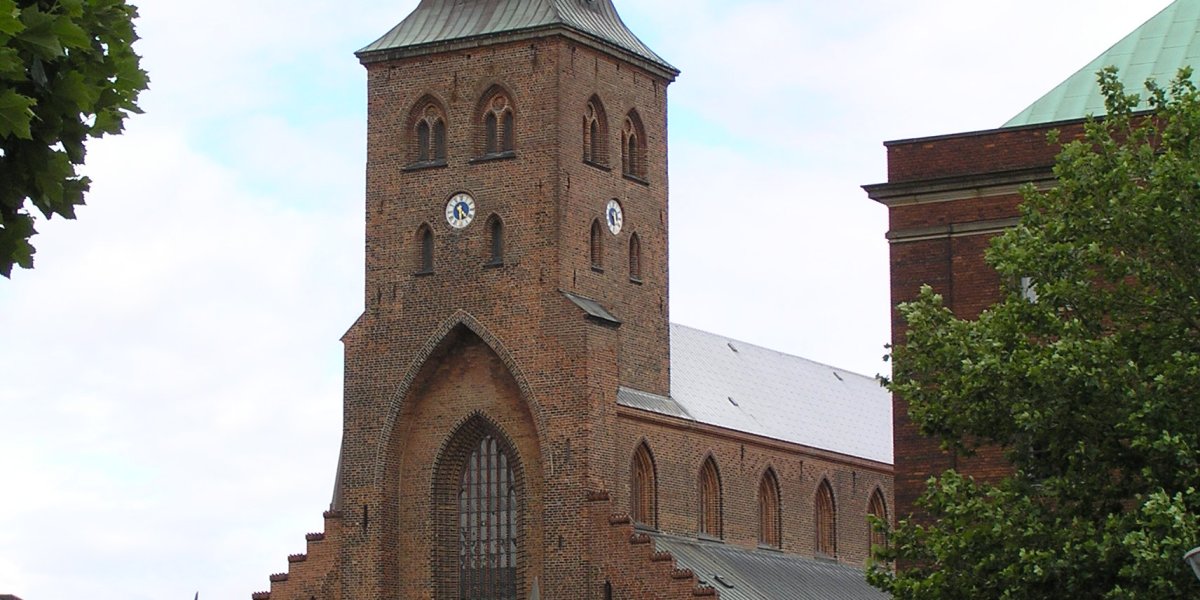
Walk back south through Kongensgade — twelve minutes down the city's pedestrian shopping spine and the most efficient route to the cathedral. Sankt Knuds Kirke is Denmark's purest Gothic cathedral, a soaring white-and-red brick monument finished in 1499 — circle the building once to see how the slender flying buttresses anchor an impossibly thin spire. Step inside (free) to find the gilded altarpiece by Claus Berg from 1521, one of the great surviving carved altars in northern Europe, then take the small staircase right of the altar down to the crypt where King Canute IV's bones rest in a glass case below the floor.
Tip: Entry is free and there is no ticket queue — walk straight through the south door. The crypt staircase is easy to miss; look for the small black sign in Danish reading 'Kongekrypt' to the right of the altar. At 14:00 on weekdays the cathedral is nearly empty, while the 11:00 organ practice and Sunday services draw crowds — your timing is perfect.
Open in Google Maps →14:30
Museum
From the cathedral, walk south through Munke Mose and follow the Odense Å riverside path — a 45-minute footpath along the willow-lined river that locals jog daily and most tourists skip entirely. The path delivers you straight to Den Fynske Landsby, a complete recreated nineteenth-century Funen village: twenty-five working farmhouses, a watermill, a smithy, and a parish school all relocated stone by stone from across the island. There are geese in the yards, smoke rising from the bakery oven, and a working blacksmith firing the forge at 15:00 and 16:00 — after a day on cobblestones, the open fields here feel like stepping out of one century and into another.
Tip: Time your arrival for 15:00 to catch the blacksmith demonstration at the Smedje — it lasts twenty minutes and is the single most photogenic moment in the village. Skip the gift shop entirely; pick up a glass of farmhouse apple cider (25 DKK) at the small kitchen behind the parish house instead — it's pressed on site from Funen orchards. To return, bus 51 from the Sejerskovvej stop reaches the center in twelve minutes, but the riverside walk back is shorter at sunset because the path lights up.
Open in Google Maps →19:00
Food
From Den Fynske Landsby, the easy return is bus 51 to the center — twelve minutes, then a five-minute walk east on Overgade to a half-timbered building with a small cobblestone courtyard. Den Gamle Kro has occupied this 1683 merchant's house since the 1960s and is Odense's oldest continuously running restaurant — the cellar dining room with its vaulted brick ceiling is where locals bring out-of-town guests when they want to show off real Danish cooking. The menu is short, traditional, and absolutely the dinner you came to Denmark for: smørrebrød, schnitzel, and roast pork belly served by pewter and candlelight.
Tip: Reserve at least one day ahead — the cellar room has only twelve tables and books out by 19:00 every night. Order the smørrebrød tasting (four open-faced sandwiches, 295 DKK / ~40 EUR) and the stegt flæsk med persillesovs (crispy pork belly with parsley sauce, 245 DKK / ~33 EUR) — these are the dishes Funen grandmothers grade kitchens on. Pitfall warning: avoid the restaurants on the Vestergade pedestrian street with photo menus and English-only sandwich boards outside — several have been flagged by locals for inflated 'tourist menus' and an undisclosed 15% service charge tacked on after the meal. The genuine Odense kitchens are all tucked into Overgade and the side streets around the cathedral.
Open in Google Maps →
Trip builder
Plan this trip around Odense
Turn this guide into a bookable rail itinerary with FlipEarth.
Keep exploring
Related cities
More in the same country
FAQ
Frequently asked questions
How many days do you need in Odense?
Most travelers enjoy Odense in 1 days, with enough time for headline sights and a slower meal or museum stop.
What's the best time to visit Odense?
The easiest season for most travelers is May-Sep, especially if you want good weather and manageable crowds.
What's the daily budget for Odense?
A practical starting point is about €85 per person per day before hotels, then adjust based on museums, dining, and transport.
What are the must-see attractions in Odense?
A good first shortlist for Odense includes H.C. Andersen's Childhood Home & Munke Mose.