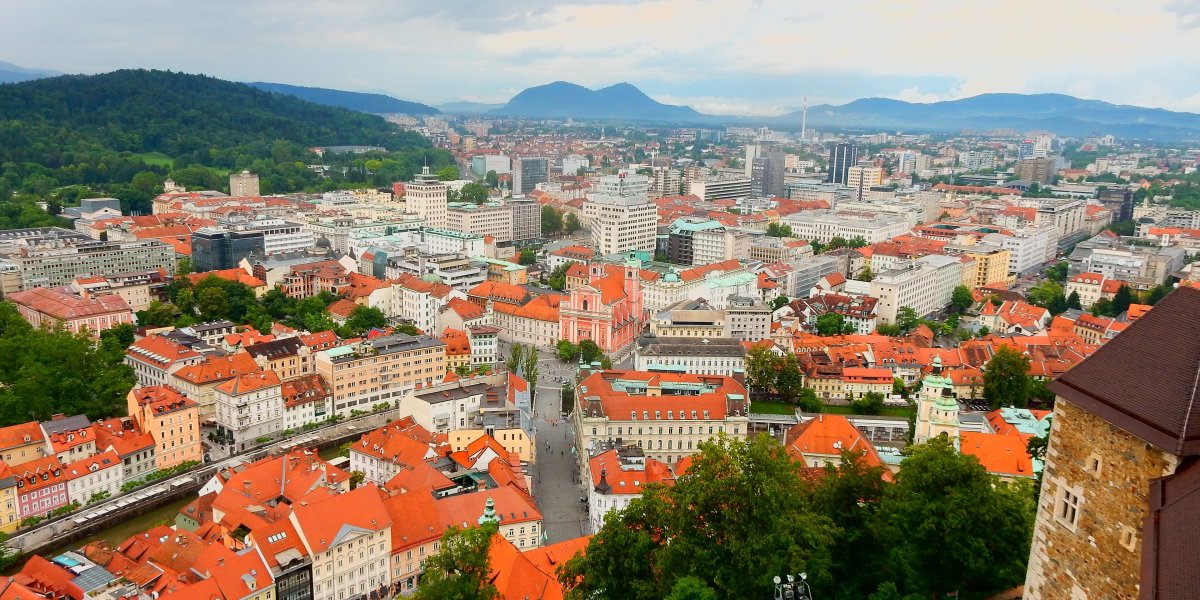
City Guide
Ljubljana
Slovénie · Best time to visit: May-Sep.
Day-by-day plan
Choose your pace
Durée du voyage
09:00
Landmark
Begin your Ljubljana blitz at the city's most beloved icon. Four copper dragons perch on Art Nouveau pedestals at each corner, their green patina glowing in the soft morning light. At this hour you'll have the bridge nearly to yourself — by noon, every tourist in town will be posing here.
Tip: Stand on the southeast corner for the money shot: two dragons framing Ljubljana Castle on the hill behind them. Morning sun hits the dragons from the east — by afternoon they're backlit and nearly impossible to photograph well.
Open in Google Maps →10:00
Neighborhood
Walk south along the Ljubljanica riverbank — 3 minutes from the Dragon Bridge, past pastel townhouses reflected in the water. Jože Plečnik's covered riverside colonnade is one of Europe's most elegant market halls, its clean lines mirrored in the canal below. The open-air section buzzes with farmers selling pumpkin seed oil, mountain honey, and truffles from the Karst region — Slovenia distilled into one city block.
Tip: Walk onto Mesarski most (Butchers' Bridge), the padlock-covered footbridge just south of the market — the view back toward the colonnade with the castle rising behind it is the most underrated photo angle in Ljubljana. Grab a sample of Slovenian pumpkin seed oil from any stall for a couple of euros; it's liquid gold.
Open in Google Maps →11:30
Landmark
Continue southwest along the river for 5 minutes, passing the Butchers' Bridge, until the salmon-pink Franciscan Church rises ahead. Plečnik's Triple Bridge fans out in front of it — three bridges where there was once one, opening the city center like a stage curtain. Late morning sun warms the church facade to its most photogenic shade of pink.
Tip: Cross the central bridge, then turn around for the classic postcard shot: river, bridge, church, castle all in one frame. If buskers are performing on the bridge, linger — the acoustics between the stone balustrades are surprisingly resonant.
Open in Google Maps →12:15
Food
Step 50 meters east along the river to this standing-room counter under the market colonnade. Klobasarna exists for one purpose: the Kranjska klobasa, a Carniolan sausage with EU Protected Geographical Indication status — meaning Slovenia is literally the only country where you can eat the authentic version. Order it with mustard, fresh horseradish, and a hunk of bread.
Tip: Kranjska klobasa with bread and mustard: €5–7. Add štruklji (rolled cottage cheese dumpling): €3. A Union pivo (local lager): €3. No seats, no reservations, no fuss — eat standing like the locals. Total under €12.
Open in Google Maps →13:00
Landmark
Walk south from the colonnade into the old town's cobblestone alleys, then follow signs up the forested hillside path — a 15-minute climb through medieval Šance fortification walls dappled in green light. At the summit, the castle courtyard opens to 360-degree panoramic views: Julian Alps to the north, terracotta rooftops directly below, Tivoli Park's canopy stretching west. Skip the museum interior — the exterior ramparts are the real show.
Tip: The western rampart has the best Alpine views — on clear days you can spot Triglav (2,864 m), Slovenia's national symbol. Walk the full perimeter; the eastern rampart gives the bird's-eye old-town rooftop shot. The funicular costs €4 one-way but the walk up through the Šance ruins is far more atmospheric and only 15 minutes.
Open in Google Maps →19:00
Food
Descend the castle's southern path to Stari trg, the old town's prettiest street — a 10-minute stroll downhill through cobblestone alleys lined with Baroque facades. Druga Violina is a social enterprise restaurant staffed by people with disabilities, serving beautifully executed Slovenian classics in a candlelit vaulted interior. It's the kind of place that makes you feel good about where your money goes.
Tip: Order the Idrijski žlikrofi (Idrija-style dumplings in meat sauce, €9–11) — handmade and rivaling any Italian pasta. Pair with a glass of Rebula white wine from the Vipava Valley (€4–5). Reserve a day ahead in summer; walk-ins work on weekdays. Budget €20–30. Tourist trap warning: avoid restaurants directly on the riverbank with laminated photo menus and waiters beckoning from the door — they charge double for mediocre food. The best places in Ljubljana are always one street back from the water.
Open in Google Maps →Aller au jour
09:00
Landmark
Take the funicular from Krekov trg — a one-minute glass-cabin ride lifts you above the treetops to the castle courtyard. At 9 AM the ramparts belong to you: the Julian Alps shimmer to the northwest, terracotta rooftops cluster below, and the Ljubljanica river threads through the old town like a green ribbon. Walk the full perimeter, climb the watchtower for the highest 360-degree panorama in the city, then duck into the Chapel of St. George for its Baroque frescoed ceiling.
Tip: Buy the combined ticket (funicular return + all castle attractions, €13) at the lower station — buying separately costs more. Take the 9:00 funicular; by 10:30 tour buses unload into the courtyard. Climb the watchtower first while legs are fresh — on clear mornings you can spot Triglav, Slovenia's highest peak, 80 km to the northwest.
Open in Google Maps →11:15
Landmark
Walk down the castle's northern forest path — a 10-minute descent through mossy fortification walls and dappled shade, emerging onto Študentovska ulica. Turn left and the four copper dragons of the Zmajski most appear ahead, their patina glowing green in the late-morning sun. Cross the bridge, then double back along the river to Vodnikov trg, where Plečnik's covered colonnade houses Ljubljana's daily market: wheels of Tolminc cheese, Karst prosciutto, mountain honey, and farmers selling pumpkin seed oil from unlabeled bottles.
Tip: Stand at the southeast corner of Dragon Bridge for the shot that gets all four dragons with the castle behind them — no other angle works as well. The market is busiest and best-stocked before noon; Saturdays are the peak. Buy a small bottle of Slovenian pumpkin seed oil (€3-4) from any stall — it's the country's liquid gold and the best edible souvenir you'll carry home.
Open in Google Maps →12:30
Food
Walk south along the market colonnade for 2 minutes, past fish stalls and flower vendors, to this tiny counter wedged under Plečnik's arcade. Klobasarna does one thing and does it perfectly: Kranjska klobasa, the Carniolan sausage with EU Protected Geographical Indication — meaning the authentic version exists only in Slovenia. It arrives on a wooden board with a bread roll, grainy mustard, and freshly grated horseradish that clears your sinuses.
Tip: Kranjska klobasa with mustard and horseradish: €5-7. Add a Union pivo (Ljubljana's local lager, €3). There are only a handful of standing spots — arrive by 12:15 to beat the office-worker rush. Do not add ketchup; the mustard-horseradish pairing is the correct way and locals will silently judge you.
Open in Google Maps →13:15
Religious
Step out of Klobasarna and the cathedral's side entrance is 1 minute across Pogačarjev trg. Before entering, study the twin bronze doors: the main west door depicts 1,250 years of Slovenian Christianity in swirling relief, added for Pope John Paul II's 1996 visit. Inside, Giulio Quaglio's Baroque ceiling frescoes erupt across the nave in a storm of color that rivals Roman churches — a startling amount of grandeur for a city this intimate.
Tip: Most visitors photograph the main west door and walk inside without noticing the completely different bronze side door on Ciril-Metodov trg — it depicts the history of the Ljubljana diocese and is equally remarkable. Inside, stand in the exact center of the nave and look straight up for the ceiling's full vertiginous impact. Free entry; a €2 donation box sits near the entrance.
Open in Google Maps →14:30
Landmark
Walk west through Stritarjeva ulica — a 5-minute stroll under the old town's covered arcade, past buskers and small galleries, onto Ljubljana's central square. The salmon-pink Franciscan Church rises above Plečnik's Triple Bridge, and the bronze statue of Slovenia's greatest poet France Prešeren gazes eternally at the window where his muse Julija once lived. Cross the triple span, linger at the riverside café terraces with a coffee, then continue 5 minutes east along the south bank to Butchers' Bridge — a glass-floored pedestrian span draped in love locks and crowned with Jakov Brdar's surreal bronze sculptures.
Tip: Afternoon sun lights the Franciscan Church's pink facade to its most photogenic warmth. For the classic postcard shot of Triple Bridge with the church and castle stacked behind it, stand on the Adamič-Lundrovo nabrežje riverbank (south side of the river, 20 meters east of the bridge). A riverside coffee at one of the smaller terraces east of the bridge costs €2.50 — half the price of the places directly on the square.
Open in Google Maps →19:00
Food
Walk south through old town along Stari trg — a 7-minute stroll past artisan workshops, antique dealers, and medieval facades curving uphill to Gornji trg. Špajza occupies a vaulted 16th-century cellar with exposed brick, candlelit tables, and a menu that reinterprets Slovenian classics with market-fresh seasonal ingredients. In spring, wild garlic appears in everything; in autumn, the porcini risotto is transcendent.
Tip: Reserve for 19:00 by phone or in person earlier in the day — the vaulted room seats only about 30 and fills by 19:30 on weekends. Ask for the back room with bare stone walls. Order the Slovenian veal cheeks with polenta (€18) or štruklji with walnut filling (€9). The house Malvazija white from the Karst region (€4/glass) is excellent and half the price of Italian labels on the list. Budget €25-40 with wine. Tourist trap warning: avoid the riverside restaurants between Triple Bridge and Cobbler's Bridge with laminated photo menus and waiters beckoning from doorways — they charge double for frozen food. Walk 5 minutes uphill to Stari trg or Gornji trg for where locals actually eat.
Open in Google Maps →09:00
Park
From the city center, walk west on Cankarjeva cesta — in 5 minutes the urban grid dissolves into a canopy of chestnut and plane trees. Ljubljana's 5-square-kilometer green lung opens with the Jakopič Promenade, a grand tree-lined avenue flanked by rotating open-air photo exhibitions that change seasonally. Continue past the ornamental garden to 17th-century Tivoli Mansion, its pale facade reflected in the fountain pool. In spring the park erupts with magnolias; in autumn the promenade becomes a golden tunnel.
Tip: Enter from Cankarjeva cesta for the most dramatic reveal — the promenade opens ahead like a cathedral nave. Morning joggers clear out by 9:30, leaving the avenue nearly empty for photos. Walk the full length of the Jakopič Promenade (500 m) — the changing photo exhibitions are curated and genuinely worth pausing for. Grab a takeaway coffee from the kiosk at the park entrance.
Open in Google Maps →10:45
Museum
Exit Tivoli from the south gate onto Prešernova cesta — the gallery's neoclassical facade is right there, a 3-minute walk. Slovenia's principal art museum holds the country's most important collection, spanning medieval church frescoes through Baroque to Impressionism. The highlight is Ivana Kobilca's luminous portraits — she is Slovenia's most celebrated painter and her 'Coffee Drinker' alone is worth the visit. The museum also houses the original Robba Fountain sculpture; the one standing in the square outside is a replica.
Tip: Start on the upper floor with the permanent collection — most visitors wander the ground-floor temporary exhibit and never make it upstairs. Find the Kobilca gallery before noon when natural light floods the room and makes her colors sing. The museum is rarely crowded; 90 minutes is enough for a focused tour. Closed Mondays.
Open in Google Maps →12:30
Food
Walk east along Slovenska cesta past the Philharmonic building, then right onto Ciril-Metodov trg — an 8-minute walk through Ljubljana's pedestrian heart. Gostilna Sokol has been feeding Ljubljana since 1867: a cavernous wood-paneled dining room where suited businessmen sit beside grandmothers, everyone eating the same hearty Slovenian classics. This is the place for Ljubljanski zrezek — the city's signature schnitzel, stuffed with ham and cheese, breaded and fried until the crust shatters.
Tip: Order the Ljubljanski zrezek (€12) — this city-specific stuffed schnitzel is hard to find done properly outside Ljubljana, and Sokol's version is definitive. Pair it with Idrijski žlikrofi (Idrija dumplings, €10) if you're hungry. Arrive by 12:15; the dining room fills with office workers by 12:45 and the kitchen slows. No reservation needed for lunch. Budget €12-18.
Open in Google Maps →14:00
Landmark
Walk northwest to Štefanova ulica — a 5-minute stroll through the central shopping district. When completed in 1933, Nebotičnik was the tallest residential building in Central Europe and a bold statement of interwar Ljubljana's ambition. Take the elevator to the top-floor terrace. The 360-degree panorama reframes everything you have seen: the castle on its hill, the old town's terracotta rooftops, Tivoli's canopy stretching west, and the Julian Alps rising behind it all. Suddenly the city's compact, green-wrapped scale makes perfect sense.
Tip: The terrace café serves drinks with the view — order a Union pivo (Ljubljana's local lager, €3-4) or a coffee and linger. Afternoon light between 14:00-16:00 is best for photography: the castle and old town glow warm, with the Alps behind. The southwest-facing side gives the most dramatic composition. No entry fee — just buy a drink.
Open in Google Maps →15:30
Museum
Walk south through the center, cross the Ljubljanica at Trnovo Bridge — a 12-minute stroll past the riverside willows. The city changes character immediately: cobblestone lanes, vegetable gardens between pastel houses, a village-within-a-city atmosphere. Krakovo is one of Ljubljana's oldest neighborhoods, where residents still tend garden plots dating back centuries. At the end of Karunova ulica, Plečnik House is the preserved home and studio of Jože Plečnik — the architect whose hand shaped every beautiful thing you have walked past for two days. The rooms, garden, and workshop remain exactly as he left them.
Tip: The guided tour (included in the €9 ticket, small groups only) is the highlight — the guide connects Plečnik's furniture experiments, obsessive sketches, and timber models to the Triple Bridge, the Market Colonnade, and the National Library you have been admiring. Book a slot online in advance as they fill quickly in summer. After the tour, wander Krakovo's garden lanes for 15 minutes — it's the most un-urban scene in any European capital. Closed Mondays.
Open in Google Maps →19:00
Food
Walk north from Krakovo back across the river, then along leafy Vegova ulica to Gosposvetska cesta — a 15-minute evening stroll as the riverside lights begin to flicker on. Monstera Bistro is Ljubljana's most celebrated contemporary restaurant, run by chef Bine Volčič. The menu changes weekly, built entirely around what arrived at the Central Market that morning. The space is deliberately unpretentious — no white tablecloths, no formality — but the cooking is meticulous, marrying Slovenian tradition with modern technique.
Tip: Reserve 2-3 days ahead — the restaurant seats about 30 and is fully booked most evenings. The 5-course tasting menu (~€45) is the best value in the city at this level of cooking. Ask the sommelier for a glass of Slovenian orange wine from the Vipava Valley — it's a revelation if you haven't tried it. Budget €30-55 with wine. Tourist trap warning: avoid the 'Slovenian Traditional Dinner' tourist packages advertised near the train and bus stations — they serve reheated food in folksy costumes at triple the price. Any restaurant a local would choose is within walking distance of where you're sitting right now.
Open in Google Maps →
Trip builder
Plan this trip around Ljubljana
Turn this guide into a bookable rail itinerary with FlipEarth.
Keep exploring
Related cities
More in the same country
FAQ
Frequently asked questions
How many days do you need in Ljubljana?
Most travelers enjoy Ljubljana in 1 days, with enough time for headline sights and a slower meal or museum stop.
What's the best time to visit Ljubljana?
The easiest season for most travelers is May-Sep, especially if you want good weather and manageable crowds.
What's the daily budget for Ljubljana?
A practical starting point is about €60 per person per day before hotels, then adjust based on museums, dining, and transport.
What are the must-see attractions in Ljubljana?
A good first shortlist for Ljubljana includes Dragon Bridge, Prešeren Square & Triple Bridge, Ljubljana Castle.