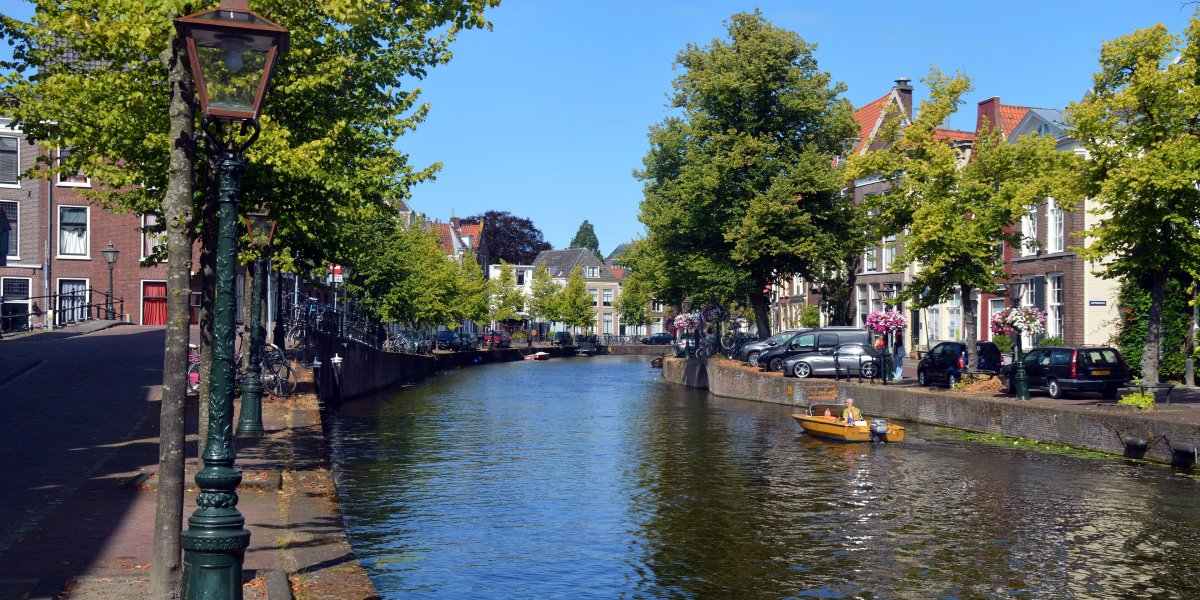
City Guide
Leiden
Pays-Bas · Best time to visit: Apr-Sep.
Day-by-day plan
Choose your pace
Durée du voyage
09:00
Landmark
From Leiden Centraal, walk four minutes south down Stationsweg, cross the Beestenmarkt, and the seven-storey brick tower suddenly rises above the Singel canal — your first 'this is the Netherlands' moment. This is Leiden's last surviving city windmill, built in 1743 on the medieval rampart, and at 09:00 the eastern sun rakes across the sails while the canal below is still glass-smooth. Skip the interior (you said exteriors only) and walk the half-circle of the Singel for the postcard frame: sails, brick, mirrored water.
Tip: Cross the little footbridge to the south bank of the Singel and shoot from the path beside the road sign — that's the angle every Dutch tourism poster uses, with the sails framed against the open sky rather than the city behind. Be there before 09:30; after that the sails are often turned 'in rust' (locked) for the day and you lose the X-shape silhouette.
Open in Google Maps →10:00
Landmark
Walk twelve minutes south-east through Haarlemmerstraat — Leiden's pedestrian shopping spine, where you'll pass red-shuttered hofjes and the gilded clock of the Stadhuis — then cut down the narrow Burgsteeg alley until a stone gatehouse appears wedged between two houses. You're standing under the 12th-century motte-and-bailey citadel, built on an artificial mound at the fork of the Old and New Rhine. Climb the spiral inside the curtain wall for a free 360° rooftop panorama: red tiles, three church towers, and the Rhine splitting the town in two. This is the moment you understand Leiden's whole layout.
Tip: The Burcht is technically a city park and the gate closes at sunset, but tour groups don't arrive until 11:15 — be on the rampart between 10:15 and 10:45 and you'll have it almost to yourself. The best photo is from the east arrow-slit looking back toward the Hooglandse Kerk, with the red tile sea between.
Open in Google Maps →12:00
Food
Descend the citadel back through Burgsteeg, turn right at the bottom — three minutes along the Nieuwe Rijn quay brings you to a small stone bridge with a single fish stand parked exactly where Leiden's fishmongers have sold since the 1400s. This is your Dutch initiation: eat standing at the counter like everyone around you. Order one Hollandse Nieuwe haring (€4) — taken whole by the tail, dipped in raw onion, tilted into the mouth — and a paper cone of kibbeling with garlic sauce (€6.50). Total under €12, ten minutes start to finish, more authentic than any sit-down lunch in town.
Tip: The herring is only properly 'nieuw' (matured in salt 5 days, deep-frozen, then served raw) — refuse if they offer 'gerookt' (smoked), that's a tourist downgrade. If the raw fish feels intimidating, ask for it 'op brood met uitjes' (in a soft white bun with onions) — same fish, half the visual commitment. Lekkerbekkie (fried haddock fillet, €7) is the safest gateway dish.
Open in Google Maps →13:00
Religious
Cross the Nieuwe Rijn bridge and walk five minutes south on Pieterskerk-Choorsteeg — the late-Gothic stone tower swallows the sky as you enter Pieterskerkhof, a triangle of cobblestone widely called one of Europe's most atmospheric church squares. This is where the English Separatists led by John Robinson worshipped from 1609-1620 before the Mayflower; Robinson is buried inside, and bronze plaques in the paving mark the Pilgrim houses that once lined the square. Sit on the steps of the Latin School (where Rembrandt was a pupil, directly opposite the church), look up at the unfinished tower — they ran out of money in 1512 — and let the silence sink in. Walk the perimeter slowly; the 'Jean Pesijnshofje' on the south side is the actual house where Robinson lived and died.
Tip: Don't pay to enter the church if you're tight on time — the exterior square and the Latin School courtyard tell the entire Pilgrim story for free, and the interior is whitewashed Protestant (more atmospheric outside). At 13:00 the south face glows; by 15:00 the tower shadow has crossed the square and the mood flips to melancholy — both are good, but for photos arrive within the first 30 minutes.
Open in Google Maps →15:00
Park
Exit Pieterskerkhof south down Kloksteeg — twenty paces and the Rapenburg opens in front of you, the wide patrician canal painted by every Dutch master and lined with the gabled houses of the 17th-century rich. Turn right and walk south along the water; the Academy Building of Leiden University (Netherlands' oldest, 1575) is the white-shuttered hall at number 73, and immediately behind it the wrought-iron gate of the Hortus Botanicus. The Hortus is one of the world's oldest botanical gardens (1590) — this is the literal soil where Carolus Clusius planted Europe's first tulip bulbs in 1593, the spark that lit the entire tulip mania. You're keeping to exteriors today, so peer through the gate at the Clusiustuin reconstruction, then continue the Rapenburg loop: cross at the southern bridge, walk back up the opposite bank, and watch the canal's gabled reflections shift as the light goes warm.
Tip: Rapenburg is at its best between 16:30 and 17:30 in spring/summer — the sun drops directly down the canal's east-west axis and lights the gables like a stage. Shoot from the small bridge at Nonnensteeg looking south: that's the exact frame painted by Jan van Goyen in 1643. Avoid the cluster of bicycles parked at the Academy steps — they're chained there permanently and clutter every photo.
Open in Google Maps →18:30
Food
Walk ten minutes north along Rapenburg as the canal turns gold, then cut east at Pieterskerkhof to the Hoogstraat — Annie's is a flight of stone steps down below the bridge, the only restaurant in Leiden built directly on the water under the arches where the Old and New Rhine meet. The 'drijvende terras' (floating terrace) at water level has been the heart of Leiden student life since the 1960s; on a clear evening this is the single most evocative seat in the city. Order the bitterballen platter (€11.50) with a glass of jenever to start — the deep-fried beef-ragout balls are the national snack done right — then the schnitzel met champignonroomsaus (€21) or, if you want lighter, the kibbeling salad (€17). Dutch comfort food, canal lapping at your shoes, university bells striking 19:00 above your head.
Tip: Arrive by 18:30 for any chance at the lower floating terrace — Annie's doesn't reserve those seats and locals queue from 18:00 in summer. If the water-level terrace is full, the upper bridge terrace is still a beautiful Plan B; do not accept the indoor cellar room (it's dark and you'll regret missing the view). Pitfall warning for your last hour in town: avoid every restaurant on Stationsweg between Annie's and the train station — the row of 'Dutch pancake houses' and pizzerias there charges €22 for frozen pancakes aimed at departing tourists, and the herring stands on Beestenmarkt are not the real Vismarkt fish (only Vishandel Atlantic at Vismarkt 14 is).
Open in Google Maps →
Trip builder
Plan this trip around Leiden
Turn this guide into a bookable rail itinerary with FlipEarth.
Keep exploring
Related cities
More in the same country
FAQ
Frequently asked questions
How many days do you need in Leiden?
Most travelers enjoy Leiden in 1 days, with enough time for headline sights and a slower meal or museum stop.
What's the best time to visit Leiden?
The easiest season for most travelers is Apr-Sep, especially if you want good weather and manageable crowds.
What's the daily budget for Leiden?
A practical starting point is about €80 per person per day before hotels, then adjust based on museums, dining, and transport.
What are the must-see attractions in Leiden?
A good first shortlist for Leiden includes Molen De Valk (De Valk Windmill), Burcht van Leiden.