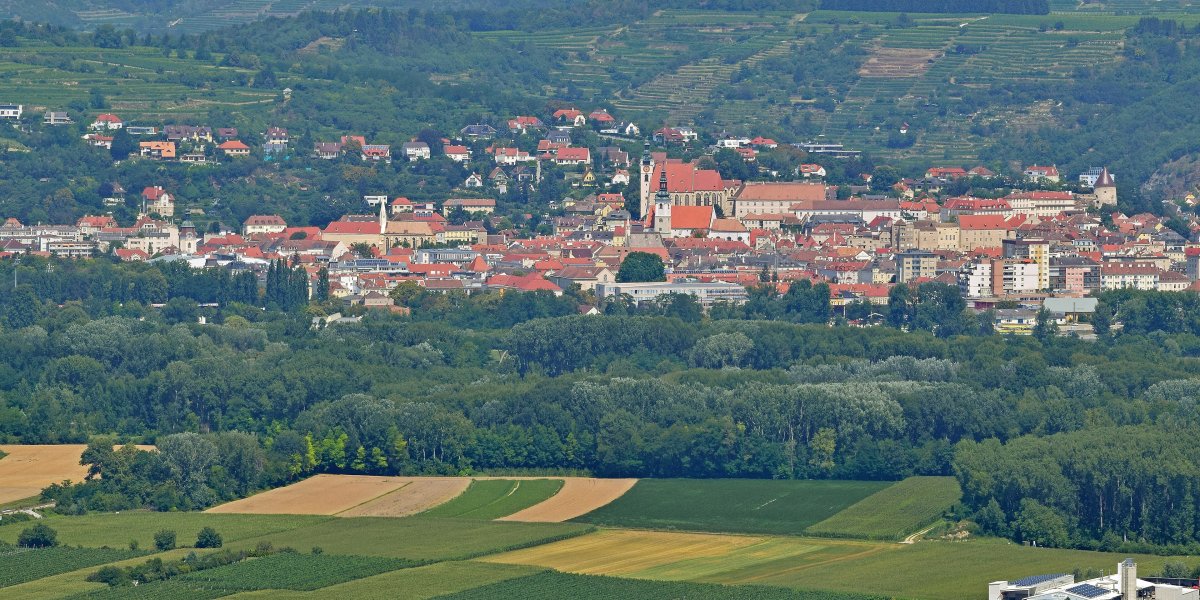
City Guide
Krems an der Donau
Autriche · Best time to visit: Apr-Oct.
Day-by-day plan
Choose your pace
Durée du voyage
09:00
Landmark
Begin at the only surviving city gate of medieval Krems — the snow-white, twin-turreted symbol of the Wachau, standing where the Roman road once entered the wine country. At 9 a.m. the eastern sun strikes the facade head-on, the lanes behind it are still empty, and the rooftop weather vane catches the first gold of the day. Walk slowly through the arch into the pedestrian Obere Landstraße — that single step is your crossing from modern Niederösterreich into a 1480 trading town.
Tip: Don't photograph it from the parking-lot side (north). Walk under the arch, turn around inside the old town, and shoot back east — the curve of Obere Landstraße frames the gate between two rows of pastel merchant houses, with no cars in frame before 10 a.m.
Open in Google Maps →09:45
Neighborhood
Continue straight west along Obere Landstraße for 300 meters — read the carved dates above the doorways (1532, 1604, 1571), this was one of Austria's wealthiest wine-trading streets. Turn right at the Pfarrplatz for the baroque Pfarrkirche St. Veit, then take the steep stone Piaristenstiege — 81 steps cut into the hillside — up to the late-Gothic Piaristenkirche perched above the town. The terrace at the top is Krems's secret rooftop balcony: red-tiled roofs at your feet, vineyards rising behind, the Danube glinting to the south.
Tip: Climb the Piaristenstiege now while your legs are fresh — it's 81 unforgiving steps with no railing on the lower half. The single bench on the terrace is the best seat in Krems: aim for the south-facing corner, and you'll see Göttweig Abbey floating on its hill across the river.
Open in Google Maps →12:00
Food
Descend the Piaristenstiege the other way (south side) back to Obere Landstraße — 4 minutes downhill, your knees will thank you. Hubmann is the bakery every Krems local stops at: their Wachauer Laberl (the rye-and-wheat hand roll that is the official bread of the Wachau valley, EU-protected) comes warm from the oven, split open and stuffed with Waldviertler ham, mountain cheese, or smoked trout for €4–6. Eat standing at the bar counter or take it 50 meters to the old market square — this is fuel, not a sit-down meal.
Tip: Order the Wachauer Laberl mit geräucherter Forelle (smoked Danube trout, €5.20) and a small glass of Almdudler — the trout is from the same river you'll walk along this afternoon. Arrive before 12:15 or after 13:15; the office crowd from the nearby Donau-Universität floods the counter at noon sharp.
Open in Google Maps →13:00
Neighborhood
Walk west out of Krems along Steiner Landstraße for 1.5 km — the road narrows, the houses lean closer, and you slip from busy Krems into Stein, Krems's tiny medieval twin that most day-trippers never realize is the more beautiful half. Pass under the Linzer Tor (the western counterpart of Steiner Tor), drift past the deconsecrated Minoritenkirche, the Großer Passauer Hof courtyard, and the riverside Pulverturm watchtower. Stein is one continuous open-air museum of 14th–16th-century facades painted in dusty pinks, ochres and pale greens — every door is a photograph.
Tip: Look up — every house on Steiner Landstraße has a carved date stone above the door (the oldest I've found reads 1414). The riverfront walk between Schürerplatz and the Pulverturm gives you the postcard shot: pastel houses lined along the Danube, vineyards climbing the slope behind, no cars, no crowds after the morning bus tours leave at 14:00.
Open in Google Maps →15:45
Religious
From the Minoritenkirche, climb the Frauenbergstiege — a stone staircase rising sharply through gardens to the roofless ruin of the Frauenbergkirche, a 14th-century church gutted in 1786 and now just walls, windows, and sky. Then pick up the Welterbesteig Wachau trail behind the ruin and walk west along the vineyard terraces for 3 km toward Förthof and back — Riesling and Grüner Veltliner vines at your fingertips, the Danube curving below in a long silver arc, Göttweig Abbey glowing on the southern hill. Time your arrival at the ruin for 17:30; the west-facing window frames the sun setting straight down the river bend.
Tip: Stay on the marked Welterbesteig Wachau (white-red-white blazes on the vine posts) — the unmarked paths into the vineyards are working land and locals do not like tourists trampling between the rows. Bring a small bottle of water; there's no fountain on the trail and the next tap is back down in Stein.
Open in Google Maps →19:00
Food
Descend the Frauenbergstiege back to Steiner Landstraße and walk 10 minutes east — Kloster Und is a former 17th-century Capuchin monastery converted into a Wachau wine institute and Toni Mörwald's restaurant, with vaulted stone ceilings and a candlelit inner courtyard. This is the proper farewell to your day: order the Wachauer Saibling (pan-fried Wachau char from the river you just walked along, €28) or the slow-braised Mostviertler suckling pig (€26), and let the sommelier pour you a Grüner Veltliner Smaragd from a vineyard literally visible from your seat. Three courses with wine pairing runs €55–70.
Tip: Reserve a day ahead in summer (April–October) and ask specifically for a table in the Kreuzgang (the cloister courtyard) — it's open until early October and is the most atmospheric seat in the Wachau. Pitfall warning: do NOT eat at any 'Heuriger' along Steiner Landstraße that has no posted price list outside the door — three of them deliberately target the Vienna day-trip bus crowd and will charge €8 for a quarter-liter of house wine that costs €3 at a real winery 100 meters away.
Open in Google Maps →
Trip builder
Plan this trip around Krems an der Donau
Turn this guide into a bookable rail itinerary with FlipEarth.
Keep exploring
Related cities
More in the same country
FAQ
Frequently asked questions
How many days do you need in Krems an der Donau?
Most travelers enjoy Krems an der Donau in 1 days, with enough time for headline sights and a slower meal or museum stop.
What's the best time to visit Krems an der Donau?
The easiest season for most travelers is Apr-Oct, especially if you want good weather and manageable crowds.
What's the daily budget for Krems an der Donau?
A practical starting point is about €110 per person per day before hotels, then adjust based on museums, dining, and transport.
What are the must-see attractions in Krems an der Donau?
A good first shortlist for Krems an der Donau includes Steiner Tor.