City Guide
Klagenfurt
Autriche · Best time to visit: May-Sep.
Day-by-day plan
Choose your pace
Durée du voyage
09:00
Landmark
Begin the day in the very heart of Klagenfurt, where the city's mythical guardian — the green Lindwurm, carved from a single block of chlorite slate in 1593 — has presided over the square for over four centuries. Walk one slow lap of the fountain: the morning sun strikes the dragon's scales from the east and lights the Hercules figure facing it down with raised club. The cafés are just rolling up their shutters, so you'll have the square almost entirely to yourself for photographs.
Tip: The Lindwurm's head is modelled on a prehistoric woolly-rhinoceros skull unearthed nearby in 1335 — the world's first paleontological reconstruction in stone. Stand on the south side of the square facing north and you'll frame the dragon, the fountain pool, and the pastel facade of the Rathaus in a single clean shot.
Open in Google Maps →10:00
Neighborhood
Walk three minutes north up Kramergasse, past pastel townhouses and arched arcades, into Alter Platz — the older Renaissance heart of the city, closed to traffic and ringed with painted facades. Step inside the inner courtyard of the Landhaus (open to the sky, no ticket needed): two onion-domed towers and three tiers of white arcades enclose what is arguably the most beautiful provincial-government building in Austria. The Trinity Column in the centre of Alter Platz has stood since 1680, raised in thanks for the end of the plague.
Tip: Loop Alter Platz → Pfarrplatz → Heuplatz: three connected squares that give you the entire Renaissance old town in twenty minutes. Enter the Landhaus from the side gate on Landhaushof — quieter than the main entrance, and the arch frames the onion-dome towers more beautifully than any postcard angle.
Open in Google Maps →12:00
Food
Walk four minutes south down Lidmanskygasse — one block off Neuer Platz, a quiet street the tour groups never find. Gasthaus Pumpe is the kind of wood-panelled Wirtshaus where the regulars order without looking at the menu and a glass of Schilcher rosé appears before they sit down. Get the Kärntner Kasnudeln (€11) — handmade ravioli the size of your palm, stuffed with curd cheese and fresh mint, browned in butter — with a side of green salad in pumpkin-seed-oil dressing.
Tip: Order at the counter and you'll be eating in seven minutes — skip the table-service wait. Don't order Wienerschnitzel here; every Austrian inn does it. Kasnudeln are the one dish Carinthians actually go out to eat, and Pumpe hand-crimps them each morning — the tiny rope-pattern edge is the giveaway that yours is real.
Open in Google Maps →13:30
Park
Set off west from the old town along Villacher Straße — about fifty minutes on foot through Europapark's lime-tree allées, the lake glittering through the trees as you approach (bus 10 or 11 cuts the trip to fifteen minutes if your legs protest). Minimundus packs 159 of the world's most famous buildings into one lakeside park at 1:25 scale — the Taj Mahal, St Peter's, the Eiffel Tower, the Sydney Opera House — all in the foreground with the real Karawanken Alps rising behind. Arrive now: the morning school groups have left, and the afternoon light flatters the western facades of the European miniatures.
Tip: The signature trick photograph: kneel low in front of the New York miniature cluster and frame the Statue of Liberty with the real Pyramidenkogel observation tower across the lake in the distance — same shot, two scales, one composition. Shoot before 16:00; after that the sun slides behind the Alps and the lake turns flat grey.
Open in Google Maps →16:00
Park
Walk three minutes north out of Minimundus's lakeside gate and the great glacial blue of the Wörthersee opens up in front of you. Strandbad Klagenfurt is Austria's largest lakeside lido — a 1920s wooden bath complex stretching half a kilometre along the shore, listed as a protected monument and painted in its original mint-and-white. Follow the lakeside promenade east through plane-tree shade toward the Maria Loretto peninsula; the water beside you is drinkable and reaches 26°C in August — the warmest large alpine lake in Europe.
Tip: Look for Strandbad's original 1920s green-and-white wooden changing pavilions facing the water — they're protected monuments and the most-photographed structure on the lake. Immediately east of the Strandbad's paid fence is the free public Klagenfurter Strand, where locals actually swim and sunbathe — same lake, same view, no ticket gate ruining the frame.
Open in Google Maps →19:00
Food
Walk the final fifteen minutes along the promenade — water on your left turning pink, a tunnel of plane trees overhead — onto the wooded peninsula crowned by the small white Schloss Maria Loretto. The restaurant's terrace hangs directly over the water and faces west across the bay toward the Pyramidenkogel tower; this is the exact view that put the Wörthersee on every Austrian postcard. Order the Wörthersee Reinanke (lake whitefish, €28) grilled in brown butter and finished with Styrian pumpkin-seed oil, with a glass of cool Welschriesling, and time the meal to the sunset — the sun drops behind the Pyramidenkogel between 20:30 and 21:00 in summer.
Tip: Reserve the Terrasse (terrace), not the inner dining room, at least three days ahead — request 'erste Reihe am Wasser', the front row at the water. Pitfall to avoid: the cluster of restaurants along Friedelstrand that you pass on the return walk trade purely on the lake view, serve frozen imported fish at double the price, and lock you into a fixed tourist menu. Locals eat lake fish at exactly two places — here, or at Hubertushof on the south shore — and nowhere else.
Open in Google Maps →Aller au jour
09:00
Museum
Begin inside the arcaded courtyard of the 1574 Carinthian state parliament — the wooden balconies and twin onion-domed towers are the first scene of every Klagenfurt postcard. Climb to the Großer Wappensaal on the second floor: 665 hand-painted coats of arms cover every wall and a trompe l'œil ceiling by Fromiller (1740) dissolves the room upward into a painted sky. Arrive at the 09:00 opening and the entire hall is yours for fifteen quiet minutes before the first tour group rolls in.
Tip: Stand in the centre of the Wappensaal at exactly 09:00 — the east windows fire low sunlight straight down the painted ceiling and the cloud illusion 'opens' for about ten minutes. Hand a 2€ tip for the audio guide; the heraldic-symbol decoding turns the wallpaper into a 16th-century gossip column.
Open in Google Maps →10:45
Landmark
Exit Landhaus through the south gate, cross Heiligengeistplatz and walk 200 m east — Neuer Platz opens up in three minutes. The Lindwurm (dragon) crouches mid-roar above a 1593 fountain, carved from a single block of chlorite schist; the snarling face was modelled on a Wooly Rhinoceros skull found in nearby gravel pits in 1335, making this Europe's oldest 'reconstruction' of a fossil. Loop north through Alter Platz and the Trinity Column to feel the full scale of the Renaissance old town.
Tip: Shoot the dragon from the south side at 11:00 — the sun lights the open jaw while the Maria Theresia monument fills the background; no crane angles needed. Skip the cafés ringing the square (they double the price for the view) — your lunch is two minutes south for a third of the cost.
Open in Google Maps →12:30
Food
Walk two minutes south down Lidmanskygasse — Pumpe is the wood-panelled corner tavern locals battle over a table at noon, run by the same Reichmann family for three generations. The Kärntner Kasnudln (€11.50) — half-moon ravioli of curd cheese, fresh mint and potato, finished with brown butter — is the dish Carinthia argues about with itself, and this is the textbook version. Pair with a small Villacher (€3.50) and finish with the Reindling cake (€5).
Tip: Arrive at 12:00 sharp — by 12:30 they turn people away at the door, and no lunch reservations are taken (only dinner). Order at the wooden bar inside, not from the pavement table; the inside service is twice as fast and the same kitchen.
Open in Google Maps →14:30
Religious
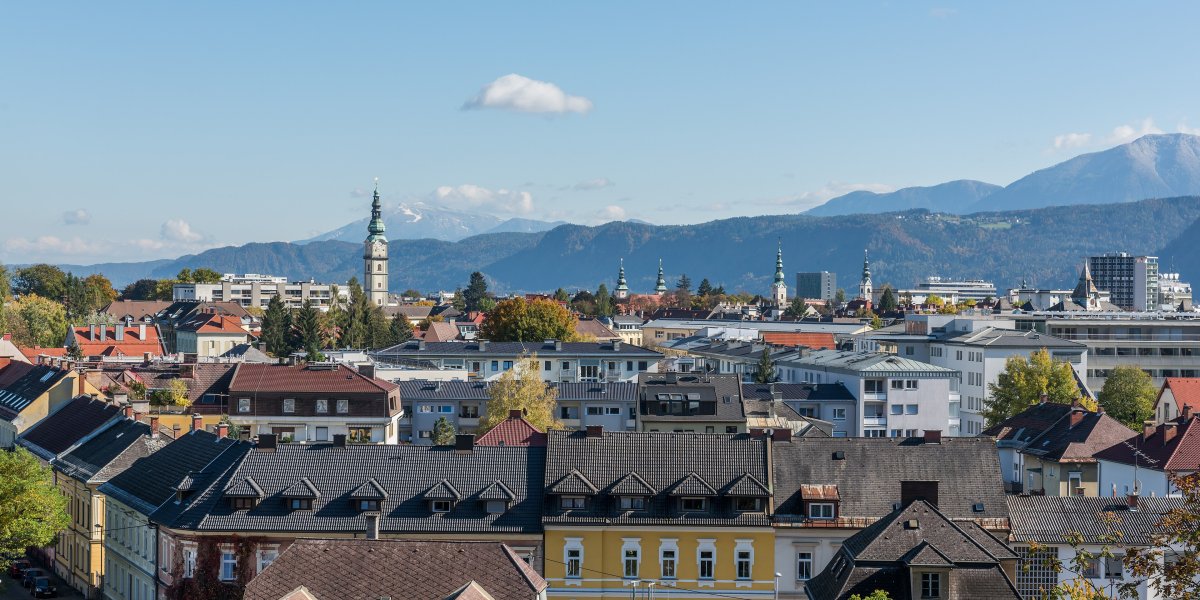
Walk five minutes north up Pfarrhofgasse — the parish church tower rises straight ahead at the end of the lane. The 14th-century interior is austere, but the prize is the climb: 225 wooden steps up the Stadtpfarrturm to an open-air gallery at 50 m. From up here the city unfolds — red roofs, the green spire of the Dom, the white Karawanken stitched along the Slovenian border to the south, and a sliver of Wörthersee glinting west, exactly where tomorrow waits.
Tip: Tower closes 17:00 sharp with last entry 16:30 — afternoon is the right window because morning haze still covers the Karawanken until noon. Bring a 1€ coin for the binoculars on the north side; Maria Saal pilgrimage church appears as a tiny white speck you'd never otherwise spot.
Open in Google Maps →16:15
Religious
Five minutes south through the Diözesanmuseum lane brings you to Domplatz — Klagenfurt's quietest baroque secret. Built in 1591 as a Protestant church and handed to the Jesuits in 1604, the interior was ceiled by Kilian Pittner in eighty metres of stucco lace: putti, garlands and saints in painted plaster. Sit in the third row on the left and look up at the second arch — the cherub closing it is winking back.
Tip: Free entry, but slip 2€ into the donation box at the rear and the high-altar lights come on for two minutes — the Daniel Gran altarpiece (1752) is only legible when lit. Avoid Sunday before noon unless you want to sit through a full sung mass.
Open in Google Maps →19:00
Food
A five-minute walk back through Alter Platz to Heuplatz — Dolce Vita's vaulted Renaissance cellar is where Klagenfurt celebrates anniversaries. Order the homemade Tagliolini ai Funghi Porcini (€19) and the lake whitefish Reinanke from Wörthersee filleted tableside (€26) — tomorrow you'll see the very water it came from. Finish with the warm Carinthian Reindling (€8.50), cinnamon-and-raisin yeast cake served with vanilla ice cream.
Tip: Reserve 48 hours ahead for a window seat onto Heuplatz at sunset (around 18:30 in summer). Pitfall: skip the souvenir shops on Kramergasse after dinner — the 'handmade' Lindwurm figurines stamped 'Klagenfurt' are mass-produced in Linz and sold at four times the price of the actual local artisan at Werkstatt Klocker on Bahnhofstraße.
Open in Google Maps →09:00
Landmark
A 25-minute drive (or bus 20 from Heiligengeistplatz, 50 min) southwest of Klagenfurt, the tallest wooden observation tower in the world rises 100 m out of the forest above Keutschach. Ride the lift up at 09:00 — you reach the deck before the morning lake haze burns off, and Wörthersee lies below like spilled mercury with the Karawanken stitching a white line behind it. Take the open-air spiral staircase up the final two floors for the unblocked 360° view, then ride the dry slide back down through the tower core.
Tip: First lift is at 09:00 but the dry slide (the world's tallest covered slide at 120 m) only opens at 10:00 — buy the €18 combo ticket and time your descent for 10:00 exactly to beat the school groups. Wear long sleeves; the slide rope-burns bare arms in three seconds.
Open in Google Maps →12:00
Food
Drive 25 minutes back east, park at the Strandbad lakeside lot — the timber pavilion of Strandcafé is two minutes away on foot. This is Klagenfurt's communal summer living room: locals in swim robes queue for Kärntner Frigga (cornmeal-cheese-bacon skillet, €13) and a glass of Schilcher rosé from neighbouring Styria. The terrace looks straight east up the entire 17 km of Wörthersee.
Tip: Order at the inside counter, not from a terrace waiter — the outside service adds a €2 cover per head. The best four tables are along the rail directly above the water; arrive at exactly 12:00 to grab one before the post-swim wave at 12:30.
Open in Google Maps →13:30
Entertainment
Walk five minutes north along Villacher Straße — Minimundus is on the right behind the picket fence. Since 1958, more than 150 famous buildings of the world have been rebuilt here at 1:25 scale using original materials: Bavarian limestone for Neuschwanstein, Tuscan marble for the Leaning Tower, real travertine on St. Peter's colonnade. Tiny working trains run between continents and the four-metre Eiffel Tower is the most photographed bonsai in Austria.
Tip: Walk counterclockwise from the entrance — tour groups go clockwise and you'll meet them past the Taj Mahal after the crowds have thinned. Bring a polarising filter (or your phone's polariser mode) — noon glare bounces hard off the white miniatures and washes the photos flat.
Open in Google Maps →15:45
Entertainment
Cross the parking lot one minute south and you're at Happ — the reason Klagenfurt's dragon legend exists in concrete form. In a small back museum sits the actual Wooly Rhinoceros skull dug from local gravel in 1335, the very specimen 16th-century sculptors used as a model for the Lindwurm you stood beneath yesterday. The outdoor garden of life-sized dinosaur replicas and indoor Europe's-largest-crocodile terrarium close the loop.
Tip: The Wooly Rhino skull is in a side room past the snake hall, easy to miss — ask reception for 'Lindwurmschädel' and they'll point. Last entry is 17:30; 45 minutes is enough if you skip the 16:00 piranha feeding (it's mostly a stick stirring water).
Open in Google Maps →17:15
Park
Walk three minutes south to the 1920s lido — wooden bathing cabanas, an Art Deco diving tower and water that holds 26°C from June through September, the reason Wörthersee earned the title of warmest large lake in the Alps. Drop into the lake for ten minutes if the day is warm, then start the 25-minute lakeside promenade south to Maria Loretto: this single mile of shoreline is the most photographed in Carinthia, sun lowering behind the limestone bluff, the twin churches of Maria Wörth glowing across the bay.
Tip: Day ticket €6.50 includes a wooden cabana and shower — perfect for a quick lake dip before dinner. Leave the lido by 18:15 to walk the promenade with the sun still high enough to light the limestone — at 18:45 the bluff falls into shadow and the photo turns flat.
Open in Google Maps →19:00
Food
The promenade ends on a tiny rocky peninsula jutting straight into Wörthersee — the very location that built Carinthian tourism in the 1880s. Order the Reinanke from Wörthersee (€28, the freshwater whitefish you've watched all afternoon from above), or the Lake-Trout in Brown-Butter (€21) if you prefer something firmer. The terrace faces due west and sunset over Maria Wörth's twin spires across the bay is the postcard you came here to make.
Tip: Reserve the 'Felsenterrasse' (rock terrace) — not the upper deck. The rock terrace is one row of tables clinging directly above the water and the small waves murmur under your feet for the entire meal. Pitfall: avoid the souvenir cowbells sold at the parking lot trinket stall — €25 for a 'handmade' bell stamped 'Made in China' inside the rim; real Carinthian smith-made bells start at €120 at Lengl in Maria Saal.
Open in Google Maps →
Trip builder
Plan this trip around Klagenfurt
Turn this guide into a bookable rail itinerary with FlipEarth.
Keep exploring
Related cities
More in the same country
FAQ
Frequently asked questions
How many days do you need in Klagenfurt?
Most travelers enjoy Klagenfurt in 1 days, with enough time for headline sights and a slower meal or museum stop.
What's the best time to visit Klagenfurt?
The easiest season for most travelers is May-Sep, especially if you want good weather and manageable crowds.
What's the daily budget for Klagenfurt?
A practical starting point is about €120 per person per day before hotels, then adjust based on museums, dining, and transport.
What are the must-see attractions in Klagenfurt?
A good first shortlist for Klagenfurt includes Neuer Platz & Lindwurmbrunnen (Dragon Fountain).