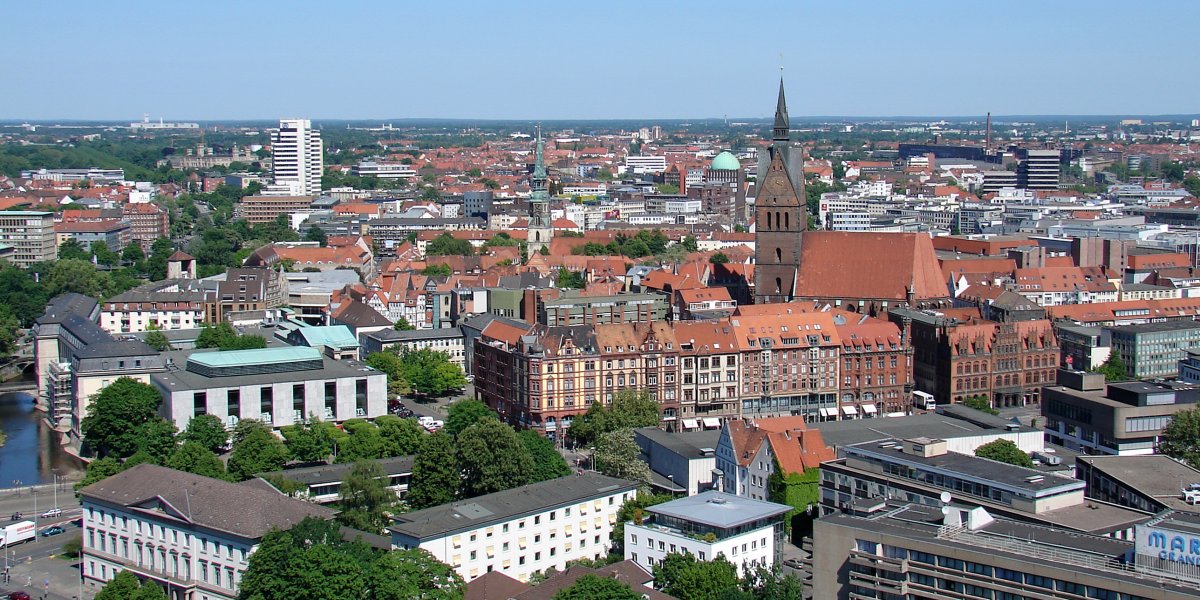
City Guide
Hannover
Allemagne · Best time to visit: May-Sep.
Day-by-day plan
Choose your pace
Durée du voyage
09:00
Park
Take tram U4 or U5 from Kröpcke to Herrenhäuser Gärten — 12 minutes, exit straight ahead and the iron gates of the Großer Garten are in front of you. This is one of the only fully preserved Baroque garden ensembles in Europe, laid out for Electress Sophie in the 1680s, and the reason George I's family ended up on the English throne. Walk the central axis to the Great Cascade, the parterres of clipped hedges spreading out like green embroidery on either side.
Tip: Hit it right at the 09:00 opening — the first tour bus pulls in at 10:30 and the parterres go from empty to dotted with tripods within ten minutes. Climb the small terrace beside the Great Cascade for the symmetrical postcard shot looking back at the castle. Skip the Berggarten across the street unless you have a full extra hour; the Großer Garten alone is the iconic image.
Open in Google Maps →12:00
Food
Tram U4/U5 back to Kröpcke, then walk two minutes south through Karmarschstraße to the steel-and-glass hall locals call 'der Bauch von Hannover' — the belly of Hannover. Forty-odd counters under one roof: butchers, Greek gyros, Italian pasta bars, oyster stands, North German fish. Lunch here the way locals do — at a standing counter, fast, loud, elbows on the steel.
Tip: Skip the seated 'restaurant' tables along the walls — they're slower and pricier for the same food. Go straight to Schlachterei Beermann for a proper Currywurst mit Pommes (€7.50) or to the Greek counter Apostelos for gyros pita (€8). Pay cash if you want to be in and out in 20 minutes. Closed Sundays.
Open in Google Maps →13:30
Neighborhood
Exit Markthalle south onto Karmarschstraße and the red-brick Gothic tower of Marktkirche rises three minutes away. From the church door, look down — the 4.2-km red line painted on the pavement is the Roter Faden, the local-only walking trail invented in 1971 to thread visitors past everything that survived 1943. Follow it east through the Altstadt's huddle of half-timbered houses (rebuilt from rubble, stone by stone) to the broken bell at Aegidienkirche, Hannover's most moving ten minutes.
Tip: The 'Altstadt' looks medieval but is 90% post-war reconstruction — Hannover lost more of its old town than any German city except Dresden. Pick up the free Roter Faden booklet from the tourist info inside the Rathaus lobby (next stop) for the 36 numbered points; even on a power walk, stops 17 (Ballhof) and 23 (Aegidienkirche) are worth the two extra minutes.
Open in Google Maps →15:30
Landmark
From Aegidienkirche follow the Red Thread south-west along Friedrichswall for eight minutes — the sprawling green Maschpark opens up and the Wilhelminian dome of the Neues Rathaus appears, floating above its own reflection in the pond. Inside the marble lobby stand four city models — medieval Hannover, the 1939 city, the 1945 field of ruins, today — the most concise history lesson in Germany. Then ride the dome elevator: built 1913, the only inclined lift in any European public building, it climbs 50 m at a 15° curve following the dome's inner skin.
Tip: Look at the four city models BEFORE the elevator — when you reach the cupola viewing platform and see the modern grid laid out below, the 1945 ruin model snaps into place under it and the city suddenly makes sense. The elevator runs only April–October and stops 30 min before closing; buy the €4 ticket at the small counter on the lobby's right side, not online. Queue is shortest right after 16:00 when the school groups have left.
Open in Google Maps →17:30
Park
Walk out the back of the Rathaus through Maschpark for four minutes and the Maschsee opens up — a 2.4-km-long lake dug entirely by hand as a 1930s make-work project, now Hannover's open-air living room. Cross to the eastern shore (Rudolf-von-Bennigsen-Ufer) and walk south. The sun drops behind the trees on the west bank, the water turns copper, and the Neues Rathaus dome lights up over your left shoulder — the city's defining skyline shot.
Tip: Walk the EAST shore, not the west — west faces into the sun and you'll squint; east gives you golden light on the water and the Rathaus dome silhouetted in the distance. The best photo bench is roughly 600 m south of the north basin, where the shore curves slightly and frames the dome between two lindens. Avoid the swan paddle-boats at the north end — €15 for 30 minutes and locals laugh at anyone in them.
Open in Google Maps →19:30
Food
Continue down the eastern shore another five minutes — the glass-fronted pavilion right on the water at house number 51 is Pier 51, the lakeside restaurant locals book for anniversaries. A terrace half-suspended over the Maschsee, the dome of the Rathaus still glowing on the far horizon. North-German cooking done seriously: order the Norddeutscher Matjes (cured herring, apple, onion, €18) to start, then Wiener Schnitzel vom Kalb (proper veal schnitzel, hand-cut fries, €28). Average dinner with wine €45-55.
Tip: Reserve a terrace table for 19:30 at least 24 hours ahead through their site — walk-ins after 19:00 in summer almost always get the indoor back room with no lake view. Ask for the Sonnendeck (sun deck) specifically. Pitfall warning for the whole day: avoid the chain pubs around Kröpcke and the schnitzel-on-the-Marktplatz tourist traps charging €25 for microwaved Jägerschnitzel — and ignore the 'Hannover Card' (€11/day), it only pays off if you ride three tram segments; for one up-and-back to Herrenhausen a single Zone A day ticket (€6.30) is half the price.
Open in Google Maps →Aller au jour
09:30
Landmark
Begin at Hannover's unmistakable silhouette — the green-copper dome of the New Town Hall mirrored in its reflecting pond. Inside, the Bogenaufzug tilts 17° as it curves up the inside of the dome to a 360° platform — the only such elevator in Europe. In the lobby, four bronze city models (1689 / 1939 / 1945 in ruins / today) tell Hannover's entire story before you've climbed a single step.
Tip: Be in the elevator queue at 9:25 — the first car of the day (9:30) has zero wait, and the morning sun lights Herrenhausen to the west and the Maschsee to the south at once. Buy the €4 ticket inside, not at the elevator door.
Open in Google Maps →11:45
Neighborhood
Exit the Rathaus north door, cross Friedrichswall past the roofless shell of the Aegidienkirche — a 1943 bomb ruin left exactly as it stood, with a Hiroshima sister-bell in its surviving tower — and pick up the red line painted on the sidewalk: the Roter Faden. The 4 cm stripe pulls you through 36 stations: the Ballhof half-timbered courtyard, under the Marstall arch, past the Leibniz House on Holzmarkt, and out onto Marktplatz beneath Marktkirche's 14th-century brick Gothic tower — the only original spire that survived the firestorm.
Tip: Grab the free 36-station Roter Faden booklet at the Tourist Info kiosk on Ernst-August-Platz (across from the main station) before you walk — it turns the line into a treasure hunt instead of a confused stroll. Step inside Marktkirche to see Lehmbruck's bronze doors, then ignore the souvenir shops on Karmarschstraße and stick to the line.
Open in Google Maps →13:00
Food
Three minutes west of Marktplatz down cobbled Schmiedestraße sits Hannover's working brewpub — fermenting its own unfiltered Hannöversch Pils on copper kettles you walk past on your way to the table. The local move is the Lüttje Lage: a tall thin beer glass and a Korn schnapps held stacked in one hand, downed in a single swallow (€4). Pair it with Schnitzel Hannoveraner Art — pork schnitzel under a creamy chanterelle sauce (€16) — or the Wurstplatte from the brewhouse butcher.
Tip: No reservation — at 13:00 walk past the front room (tourists) and sit at the long Stammtisch tables in the back left, where locals lunch. Order a Lüttje Lage and the waiter will physically demonstrate the two-glass hold; spilling on your shirt is part of the initiation. The dish you'll regret missing is not the schnitzel but the Bauernfrühstück (€12) — potato-egg pan with bacon.
Open in Google Maps →15:00
Museum
Twelve minutes south of the Brauhaus, through Maschpark and back past the Rathaus, the Sprengel's grey concrete cube sits on the north lip of the Maschsee. Inside is one of Germany's three most important 20th-century collections — Picasso, Léger, Kirchner, Beckmann — and crucially the reconstructed Merzbau room of Kurt Schwitters, whose original Dadaist installation a few streets away was destroyed in 1943. The afternoon light, low and slanted, hits the Schwitters room exactly the way he designed it for.
Tip: Closed Mondays. Buy the €7 ticket at the side door (no queue), skip the temporary exhibition, and head straight to Room 4 (Schwitters Merzbau reconstruction) — most people end up there last, exhausted; you'll have it alone. The museum café terrace overhangs the lake — but save coffee for outside on the Maschsee, you'll be there in ten minutes.
Open in Google Maps →16:45
Park
Step out the Sprengel's south door and the lake is at your feet. Walk clockwise along the west promenade — the shore that catches the late-afternoon sun — past the rowing-club boathouses, the Strandbad beach, and the white sails of the Friday after-work fleet. The lake is artificial (dug 1936 as Nazi-era make-work), but the joggers, the kids on the rented pedal-swans and the kiosk beer drinkers are pure contemporary Hannover.
Tip: At the lake's south tip is the 1936 stone bull statue — turn around there. The reflection shot of the Neues Rathaus dome above the moored sailboats works only from the bull's pedestal at 17:30–18:00 in summer (sun behind your right shoulder). Walking further south just adds kilometers without payoff.
Open in Google Maps →19:30
Food
From the bull, walk back five minutes north along the west shore — the glass pavilion of Pier 51 cantilevers directly over the Maschsee, its terrace tables half a meter above the water. Order the Maschsee-style pan-fried Felchen (whitefish from Lake Constance, €24) with a glass of Sekt from Hannover's wine-partner town Hildesheim. As the sun drops, the Neues Rathaus dome you stood inside this morning is reflected in the window glass behind you.
Tip: Reserve a 'Terrasse See' table 24 hours ahead by phone — the indoor tables are pleasant but you came here for the lake. After dinner, do not walk south through the Döhren underpass back to a tram (poorly lit, beggars cluster there); cut north along the lakeshore promenade to Aegidientorplatz and take Tram 1, 2 or 8 back to Hauptbahnhof. Tourist-trap warning for this zone: the 'beer-bike' tour boats moored at the north basin charge €18/head for warm Pils and a bad accordion — avoid.
Open in Google Maps →09:00
Park
From Hauptbahnhof, Tram 4 or 5 westbound — 15 minutes to Herrenhäuser Gärten station. You step out facing the eastern gate and the entire Baroque axis hits at once: 50 hectares of clipped hornbeam, parterre embroidery, bronze gods on plinths and the Great Fountain at the far end. This is the garden Sophia von der Pfalz — mother of the future King George I of Britain — designed in the 1690s; she died here in 1714, three weeks before she could collect the English crown.
Tip: The Great Fountain (Große Fontäne) — an 82-meter jet, the tallest of its era in Europe — runs 11:00–12:00 and 14:00–17:00 only. Be at the eastern basin rim at 11:00 sharp with the sun behind you; the rainbow inside the mist appears for exactly 90 seconds before the wind shifts it. Skip the renting of audio guides — the symmetry explains itself.
Open in Google Maps →11:15
Park
Cross Herrenhäuser Straße at the tram stop and the Berggarten gate is 100 m on — the botanical half of the Herrenhausen ensemble. Inside: Germany's largest orchid collection (5,000 species under glass), a tropical rainforest pavilion warm enough to fog your camera, and at the far end, deep in a dark stand of oaks, the small classical mausoleum holding Sophia herself and her son George I. Two graves, two unclaimed and one claimed English crown.
Tip: The Berggarten is included in your Großer Garten ticket — keep the stub. Enter the Orchid House first (room temperature shock works in your favor — fewer people stay long), then the Tropenhalle, then walk the long allée to the mausoleum last; the silence around the two royal graves is the experience, not the building.
Open in Google Maps →13:00
Food
Exit Berggarten south, take the Stadtbahn one stop to Leinaustraße or walk 18 minutes through the Welfengarten and across the Ihme bridge into Linden-Nord — Hannover's Kreuzberg, half-timbered tenements covered in murals, Turkish bakeries and craft-beer windows. Heimweh sits at Limmerstraße 47, plain wooden tables and a hand-written daily card; the cooking is modern Niedersächsisch — Senfeier with sourdough (€11), braised pork cheek over celeriac purée (€18) — local ingredients, no flourish.
Tip: Walk in at 13:00 — by 13:30 the long table is full. Skip the lunch menu printed on the wall and ask the waiter what's 'auf der Tafel heute' (today's chalkboard); that's the dish the chef actually wants you to eat. After lunch, the entire Limmerstraße for two blocks is the local Saturday flea-market — five minutes of browsing is worth it.
Open in Google Maps →15:00
Entertainment
From Limmerstraße, walk south to Schwarzer Bär and catch Bus 100 or 200 east — the city's panoramic line, crossing the Maschsee and the city center in 25 minutes to drop you at the Zoo gate. Inside, you board a flat-bottomed boat through the Sambesi river-savanna (zebra, giraffe and hippo on both banks at eye level), then walk the Yukon Bay shipwreck pier where polar bears swim half a meter below your feet behind glass. This is not a glass-box zoo; it's the European prototype that every other immersive zoo has copied since.
Tip: Buy the ticket online the night before (saves €3 and the queue at the gate). At 15:00 the morning bus tours have left and the air shows are starting — head straight to Sambesi for the boat (line drops dramatically after 15:30), then Yukon Bay for the 16:00 sea-lion feeding. Skip Mullewapp (children's farm) unless travelling with kids; it eats 30 minutes for no payoff.
Open in Google Maps →18:00
Park
Exit the Zoo's east gate and step directly into Eilenriede — at 640 hectares, the largest forest inside any German city, twice the size of Central Park. Follow the Bismarckweg signposts west-northwest through beech and oak; the late sun cuts horizontally through the trunks at this hour and joggers, dog-walkers and Friday picnickers materialize in patches of light. After 35 minutes you emerge at the Pferdeturm — a stone medieval tower at the forest edge — and the city begins again on Hindenburgstraße.
Tip: Stick to the wide gravel Hauptweg — the narrow side paths are a maze and you will lose 20 minutes. Around the Lister Turm clearing, look up: the canopy at this hour glows orange-green, the single best photograph of your two days in Hannover, and almost no visitor ever sees it.
Open in Google Maps →19:30
Food
Two minutes south of where you emerged from the forest, Hindenburg Klassik occupies a ground-floor corner of a Wilhelmine apartment block — white tablecloths, brass lamps, the kind of grown-up German dining room that has not changed décor in twenty years and does not need to. Order the Niedersächsischer Sauerbraten (red-wine-braised beef with red cabbage and Klöße, €26) or the Saddle of Venison from local forests in season (€34), and finish with the Welfenspeise — a yellow-and-white royal Hanover dessert invented for the dukes, still served exactly here.
Tip: Reserve by phone — this is where Hannoverans bring out-of-town parents, not where TripAdvisor sends backpackers, and the eight tables fill by 19:00. Order the Welfenspeise even if you're full; refusing dessert here is mildly rude. Tourist-trap warning for the List/Pferdeturm area: the 'Italian' restaurants along Lister Meile with sidewalk touts and laminated picture-menus are pure tourist factory — the locals' street is one block east on Bödekerstraße. Walking back to Mitte, take Tram 3 or 7 from Sedanstraße, not the Pferdeturm stop after dark.
Open in Google Maps →
Trip builder
Plan this trip around Hannover
Turn this guide into a bookable rail itinerary with FlipEarth.
Keep exploring
Related cities
More in the same country
FAQ
Frequently asked questions
How many days do you need in Hannover?
Most travelers enjoy Hannover in 1 days, with enough time for headline sights and a slower meal or museum stop.
What's the best time to visit Hannover?
The easiest season for most travelers is May-Sep, especially if you want good weather and manageable crowds.
What's the daily budget for Hannover?
A practical starting point is about €120 per person per day before hotels, then adjust based on museums, dining, and transport.
What are the must-see attractions in Hannover?
A good first shortlist for Hannover includes New Town Hall & Inclined Dome Elevator.