City Guide
Gorlitz
Allemagne · Best time to visit: May-Sep.
Day-by-day plan
Choose your pace
Durée du voyage
09:00
Landmark
Start at Demianiplatz where the 51-metre Reichenbacher Turm — a round 1376 watchtower — anchors the western edge of the old town. Walk two minutes south to the Görlitzer Warenhaus, the Art Nouveau department store whose pink-marble lobby and glass dome were used as the interior of Wes Anderson's Grand Budapest Hotel. Circle around to Marienplatz for the diagonal angle that catches the full pink facade in morning light before it falls into shadow.
Tip: Stand at the diagonal corner of Marienplatz to fit the full pink facade and glass dome of the Warenhaus into one frame — the exact angle Wes Anderson's location shots use. Eastern light works until 10:00 sharp, then the building goes into deep shadow.
Open in Google Maps →10:30
Landmark
Walk east through Steinweg and Brüderstraße — three minutes — and the cobblestones widen into Untermarkt, the most complete Renaissance square in Germany. The town hall's external staircase carries a gilded Justitia holding her sword backwards so as not to offend the Habsburg emperor, and the wooden warrior on the astronomical clock rolls his eyes every minute. Loop slowly around the central Bäckerbänke to see all four sides of the patrician houses with their vaulted arcades.
Tip: Photograph the Rathaustreppe from the southwest corner by Hotel Börse — most tourists shoot from the steps themselves and miss the gilded Justitia framed against the Schönhof gable opposite. Around 11:00 the wooden warrior on the tower turns to face Poland — wait one minute for it.
Open in Google Maps →12:30
Food
Two hundred metres back up Brüderstraße sits Tischendorf, the Görlitz bakery dynasty baking Silesian rye and Mohnstollen on the same square since 1893. Order a Belegtes Brötchen mit Leberkäse (€4.50) and a thick slice of Schlesischer Mohnkuchen (€2.80) — the poppy-seed cake is a regional speciality you won't find west of the Elbe. Take it away and eat on the stone bench facing the Dreifaltigkeitskirche tower across Obermarkt.
Tip: Skip the wooden chairs inside and take the takeaway counter — the cake selection runs out by 13:00, so order Mohnkuchen before sandwiches. Total spend €10 with a coffee — half the price of any sit-down café in town.
Open in Google Maps →13:30
Religious
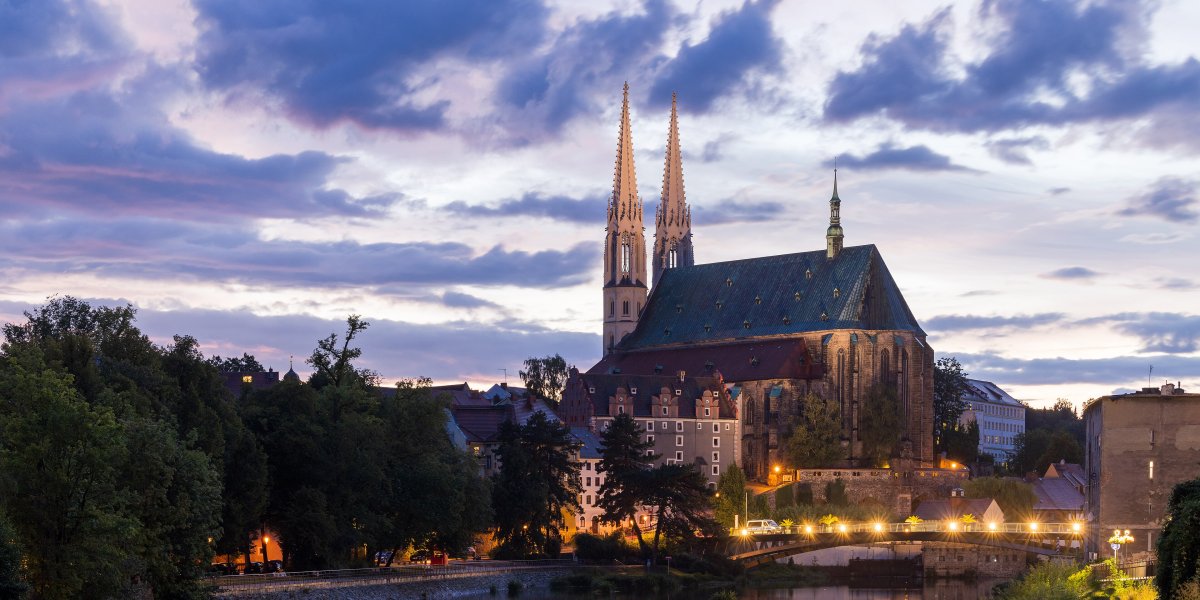
Cross Untermarkt and follow Neißstraße north for 300 metres to the river end of the old town, where the five-towered Peterskirche dominates everything. Climb the small grass terrace on the Vogtshof side for the angle that catches the church spires framed by the half-timbered Waidhaus — the oldest building in Görlitz. Continue five minutes further north into Nikolaiviertel to the roofless Gothic ruin of Nikolaikirche, used as a memorial and the most haunting place in the city.
Tip: Free Sun Organ recitals inside Peterskirche play daily at 12:00 (Mon-Thu) — but the exterior is the icon here, and you're after lunch. Don't pay any private guide for the Nikolaikirche ruin; the public grass approach from Nikolaistraße has the same atmospheric view for free.
Open in Google Maps →16:00
Neighborhood
From the Nikolaiviertel walk down cobbled Hothertorstraße — six minutes — to the Altstadtbrücke, the slim sandstone footbridge over the Lusatian Neisse. There is no border post; one step is Germany, the next is Poland. Walk twenty metres up the Polish embankment, turn around, and the postcard image of Görlitz — Peterskirche's five towers mirrored in the river — exists only from this side.
Tip: The Polish-side promenade has the only angle for the Peterskirche-in-river reflection; sunset light hits the German facades from 17:30 onwards (May-Sep) and stays gold for about fifteen minutes. Carry a 5 PLN note — a Polish Bambino ice cream from the Zgorzelec-end kiosk costs 3 PLN, half the German price across the water.
Open in Google Maps →19:00
Food
Cross back over the Altstadtbrücke and walk thirty metres north along the German bank to Vierradenmühle, the easternmost restaurant in Germany — its terrace literally hangs over the Polish border. Order Schlesisches Himmelreich (smoked pork with dried apricots and prunes, €18) and the Silesian potato soup with marjoram (€8) — dishes rarely served west of here, paired with a glass of Saale-Unstrut Riesling (€6). Ask for 'Tisch direkt am Wasser' and watch the last light fall on the Polish bank across the river.
Tip: Reserve before noon for a riverside terrace seat, or arrive at 18:45 sharp and ask for 'Tisch direkt am Wasser, bitte'. Pitfall warning: avoid the 'Silesian' tourist restaurants clustered along Steinweg and around Demianiplatz — twice the price, half the soul, and not a single local on the tables. Bill around €30-35 with wine; tip 10% in cash.
Open in Google Maps →Aller au jour
09:00
Landmark
Start at the very heart of Goerliwood, a square ringed by 16th-century Renaissance merchant houses that the locals call the city's living room. Look up at the Ratsapotheke — its two sundials from 1550 still mark Babylonian and Bohemian hours, the kind of detail Wes Anderson's location scouts went mad for. Walk a slow loop around the cobblestones; almost every facade here was a film set, from The Reader to Inglourious Basterds.
Tip: Stand at the south-east corner in front of the Ratsapotheke and shoot back across the square — at 09:00 the rising sun lights up the western facades while the square itself stays in cool shadow, giving you the painterly contrast every film here was after.
Open in Google Maps →10:00
Religious
Leave Untermarkt by Bruederstrasse, a 4-minute uphill walk that opens onto the twin spires above the Neisse. Inside hangs the legendary Sonnenorgel (Sun Organ) of 1703, named for the gilded sunburst pipes that fan from the choir loft. Time your visit for the noon recital — 12:00 every Tuesday, Thursday, and Sunday in summer — when the church empties of tour groups and the sound shakes the stone vaults.
Tip: Skip the main nave and head down to the crypt-level Georgenkapelle first — it is almost always empty, and the 1497 sandstone reliefs are the oldest art in town. Then climb back up just before 12:00 to claim a pew under the organ loft.
Open in Google Maps →12:15
Food
A 5-minute downhill walk along Peterstrasse drops you into a vaulted Silesian cellar restaurant tucked beneath one of the old patrician houses. Order the Schlesisches Himmelreich (smoked pork with stewed dried fruit and bread dumplings, around 16.50 euros) — it is the dish that defined this borderland kitchen and almost nowhere in western Germany still serves it. Pair with a local Landskron Pilsner brewed 800 metres down the road.
Tip: Walk in by 12:15 to land a table in the back vault under the brick arches — by 12:45 the day-trip coaches arrive and the front room fills. Cash and card both work, but tip in cash (round up about 8 percent).
Open in Google Maps →14:00
Landmark
Walk west along Steinweg for 6 minutes through the medieval wall line — you'll pass the Kaisertrutz bastion on your left before the round tower rises ahead. This is the only one of the old city towers you can climb; 165 steps lead to a 360-degree view where you can read the entire layout of Goerlitz against the green of the Neisse valley and, on a clear day, the first ridges of the Polish Sudetes.
Tip: Buy the combined Reichenbacher Turm + Kaisertrutz ticket (6 euros) at the tower entrance — it gets you into the modern art floors of the Kaisertrutz on the way back down with zero queue. Afternoon light from the top is best between 14:00 and 15:00 when the sun hits the orange tile roofs head-on.
Open in Google Maps →15:30
Museum
Walk back east along Steinweg and turn into Bruederstrasse — 7 minutes — to the Schoenhof, Germany's oldest Renaissance burgher house (1526), which has been turned into the country's only museum devoted to the lost world of Silesia. The collection tells the harder story under Goerlitz's prettiness: a region split in 1945, populations exchanged, a culture rebuilt on two sides of a river. Afternoon is the right slot — by 16:00 the tour buses are gone and you have the gabled rooms almost to yourself.
Tip: Pick up the free English audio guide at reception — without it, the post-1945 expulsion rooms on the second floor read as just photos and suitcases; with it, they become the most affecting part of the city.
Open in Google Maps →19:00
Food
A 3-minute walk back across Untermarkt brings you to the city's beloved southern-Italian kitchen, run by a Sicilian family for over twenty years and the standing answer when you ask any Goerlitzer where they take guests. Order the homemade tagliatelle al ragu di cinghiale (wild boar ragu, around 17 euros) and the gnocchi al gorgonzola (around 15 euros). The wine list leans into small Sicilian producers — let Salvatore pick.
Tip: Reserve the day before by phone — twelve tables, and weekends fill by Wednesday. Pitfall warning for the Untermarkt area: avoid the tourist-menu restaurants facing directly onto the square with photo-laminated menus; they coast on the film-set view and serve frozen schnitzel at double the price. The locals' places, like this one, sit one street back.
Open in Google Maps →09:00
Religious
Start the day in the quiet Nikolaivorstadt district north of the old town — a 12-minute walk up Nikolaistrasse from your hotel, climbing gently past timbered houses almost no day-tripper reaches. The complex is a miniature Jerusalem built in 1481 by a Goerlitz mayor who walked to the Holy Land and came back determined to recreate it: an exact-scale Chapel of the Holy Sepulchre, a Garden of Gethsemane, a Mount of Olives, all in Saxon sandstone. It is one of only three medieval Jerusalem replicas left in Europe and most travelers have never heard of it.
Tip: Arrive at 09:00 exactly when the gate opens — for the first half hour you'll likely be alone inside the Sepulchre chapel itself, and the morning light through the east window onto the altar stone is what 15th-century pilgrims came for. The custodian sells a 1-euro illustrated leaflet at the gate; take it, the chapels have no signage inside.
Open in Google Maps →10:45
Landmark
Walk 5 minutes south down Heilige-Grab-Strasse and the lane narrows into the most atmospheric graveyard in Saxony — a terraced hillside of Baroque burial chapels stacked above the Neisse valley. Find the modest tombstone of Jakob Boehme (died 1624), the shoemaker-mystic whose writing influenced Hegel and Schopenhauer; it is in the lower terrace against the wall. The Nikolaikirche above, gutted by fire and now an empty Gothic shell, is used for sound installations and contemporary art.
Tip: The Boehme stone is easy to miss — look for the round arch chapel at the bottom of the cemetery, then count three graves to the right along the wall. Photographers: the long view back up the terraces with the church spire above works best at 11:00, when side light catches the sandstone.
Open in Google Maps →12:00
Food
Walk south along Nikolaistrasse for 8 minutes back into the old town to a low-ceilinged, candle-lit tavern in a 16th-century cellar — the place locals send you for proper Saxon-Silesian cooking. Order the Goerlitzer Pflaumentoffel (potato cakes with plum compote, around 11 euros) for the regional sweet-savoury combination, and a half-portion of the Krautwickel (cabbage roll, around 9 euros). The midday menu is the best value in town.
Tip: Arrive at 12:00 sharp — they don't take lunch reservations and by 12:30 every cellar table is taken. Ask for the small alcove room on the right past the bar; quieter and the framed 1920s photographs of Goerlitz on the walls are worth a slow look.
Open in Google Maps →13:45
Landmark
Walk 4 minutes east down Peterstrasse, past the church, and the cobbles spill straight down to the Neisse — the old town bridge, rebuilt in 2004 on the original stone piers, is the shortest international crossing in Europe. You can stand mid-bridge with one foot in Germany, one in Poland; below you, swans and the green river that became the EU's outer border in 1945 and an inner one again in 2007. There is no passport check, just a small plaque.
Tip: Cross around 14:00 when the light flattens out — and bring a few euros plus any Polish zloty if you have them; the Polish-side cafes accept both but give better change in zloty. Your phone may briefly lose German signal mid-bridge; that's normal.
Open in Google Maps →14:30
Neighborhood
From the bridge, head right along the Polish riverbank promenade — a flat, leafy 10-minute walk — and you arrive in what was the eastern half of Goerlitz until 1945. The contrast is the point: the same Wilhelminian villas as across the river, but socialist-era plaster, Cyrillic-looking shop signs, prices a third lower. Loop up to the Dom Kultury (House of Culture), a vast 1902 building meant as a German Kaiser hall and now the cultural anchor of the Polish side, then drop back through the riverside park for the best view of the Goerlitz skyline.
Tip: Stop at the Polish bakery Cukiernia Trufla on Daszynskiego for a paczek (filled doughnut, about 5 zloty / 1.20 euros) — it is the snack every Goerlitz resident crosses the bridge for. The Dom Kultury cafe terrace, often empty, has the single best free panorama of the Goerlitz waterfront.
Open in Google Maps →19:00
Food
Cross back over the Altstadtbruecke and walk 4 minutes up Neissstrasse to the city's most quietly elegant dinner address — a converted patrician hall where the kitchen does seasonal Italo-Saxon cooking and the wine list is the most serious within 200 km. Try the housemade pumpkin ravioli with sage butter (around 18 euros) and the venison from local Oberlausitz forests with juniper (around 26 euros). The candlelit back room overlooks an inner courtyard you didn't know was there.
Tip: Book a day ahead and specifically ask for the Hinterzimmer (back room) — the front gets noisy. Pitfall warning for the bridge and old town: ignore the unofficial 'currency exchange' touts near the Altstadtbruecke offering to swap euros and zloty — rates are 15-20 percent worse than the ATMs on either side, and several have been flagged for short-changing tourists.
Open in Google Maps →
Trip builder
Plan this trip around Gorlitz
Turn this guide into a bookable rail itinerary with FlipEarth.
Keep exploring
Related cities
More in the same country




FAQ
Frequently asked questions
How many days do you need in Gorlitz?
Most travelers enjoy Gorlitz in 1 days, with enough time for headline sights and a slower meal or museum stop.
What's the best time to visit Gorlitz?
The easiest season for most travelers is May-Sep, especially if you want good weather and manageable crowds.
What's the daily budget for Gorlitz?
A practical starting point is about €85 per person per day before hotels, then adjust based on museums, dining, and transport.
What are the must-see attractions in Gorlitz?
A good first shortlist for Gorlitz includes Reichenbacher Turm & Görlitzer Warenhaus, Untermarkt & Rathaustreppe.