City Guide
Dingle
Irlande · Best time to visit: May-Sep.
Day-by-day plan
Choose your pace
Durée du voyage
09:00
Landmark
Start your day at the heart of Dingle, the small working pier where the trawlers tie up after their pre-dawn run. Walk east along the Marina, past the painted wooden hulls and the lobster pots stacked on the quay, then out onto the stone pier for the postcard angle back at the colored facades of Strand Street. The whole village funnels down to this water — every story in Dingle, from Fungie the dolphin to the famine boats, starts here.
Tip: The trawlers unload between 08:30 and 09:30 — stand on the south side of the pier and shoot back toward the town with the rising sun behind your shoulder; the painted hulls glow against the still-cool morning water. Avoid the harbor-side benches between 10:00 and 11:00 when the tour buses arrive.
Open in Google Maps →10:00
Landmark
From the marina, cross the small bridge over the Milltown River and follow the signposted lane south up Carhoo Hill — about 25 minutes of steady uphill through stone-walled sheep pasture, with the harbor opening up wider behind you at every gate. The tower itself is a squat stone finger built in 1847 as famine-relief work; from its base the entire Dingle Peninsula unfolds — the bay, the Iveragh mountains across the water, and on a clear day the jagged tooth of Skellig Michael 50 km to the south. Save the climb for now while your legs are fresh and the air is still clear of afternoon haze.
Tip: The wooden finger on top of the tower points toward the harbor entrance — it was once a navigation aid for ships. Walk around to the south side of the tower for the cleanest shot down Dingle Bay; the north side is into the sun until mid-afternoon. Wear shoes you don't mind getting muddy — the last 300 m is a worn farm track, not a paved path.
Open in Google Maps →13:00
Food
Descend Carhoo Hill, recross the bridge, and follow Bridge Street five minutes into the village — Reel Dingle is the small green-fronted chipper on the corner. This is the only fish-and-chip shop in Ireland to win national 'Best Chipper' for several years running, and the reason is simple — the fish was on the trawler at dawn and in the fryer by lunch. Order the fresh haddock and chips (€13) with a side of mushy peas (€3); the batter is light, golden, and shatters when you bite it.
Tip: Seating inside is tiny — order takeaway and walk two minutes back to the marina benches to eat with a harbor view. The queue at 12:45-13:15 can spill out the door; arrive at 12:55 sharp or wait until 13:30 once the first wave clears. Ask for the fresh catch of the day rather than the menu default — it's chalked on the small board behind the counter.
Open in Google Maps →14:00
Landmark
From Bridge Street, head east along Strand Street and pick up the narrow coastal lane that hugs the north shore of the harbor — roughly 5 km one way out to the white-washed lighthouse at the harbor mouth. Along the way you'll pass Hussey's Folly (a 19th-century stone tower built to give famine laborers honest work), open hayfields with views across to Carhoo Hill, and quiet coves where Fungie the dolphin used to surface. The lighthouse itself is small and squat, sitting on a low rocky shelf where the Atlantic crashes against the harbor mouth — this is the most westerly working lighthouse in Europe.
Tip: Time your arrival at the lighthouse for 15:30-16:00 — the sun is behind you over the town, lighting the white tower and the surf in front of you in full color. The lane is narrow and shared with the occasional farm vehicle; walk on the right side of the road facing oncoming traffic. Bring a windbreaker even on a sunny day — the harbor mouth is two degrees colder and twice as windy as the village.
Open in Google Maps →17:30
Neighborhood
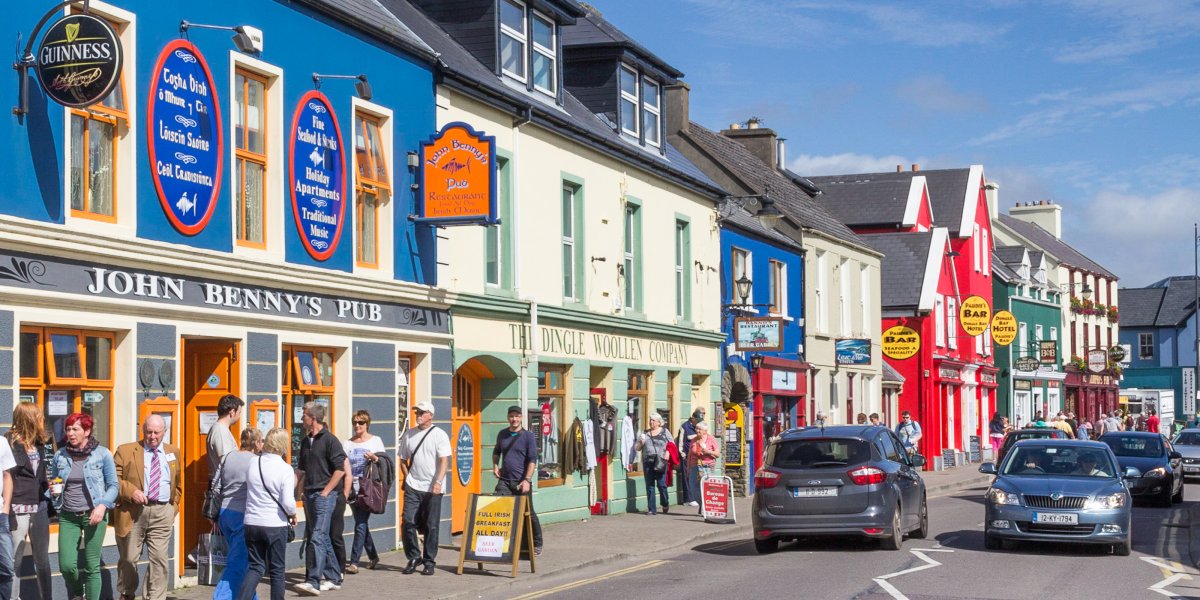
Walk back along the coastal lane and turn up into the village at Strand Street — five minutes from the harbor edge to the start of Main Street. This is the Dingle of postcards — Pepto-pink, butter-yellow, and seaweed-green shopfronts crammed shoulder to shoulder, every one a working pub, ironmonger, or wool shop. Stop at Murphy's on Strand Street for ice cream made with sea salt harvested from Dingle Bay and milk from local Kerry cows — the Sea Salt with Caramelized Sugar and the Dingle Gin sorbet are the two flavors locals actually order. Wander up Green Street with your cone in hand as the late sun turns every wall golden.
Tip: Murphy's has a long queue at midday but is almost empty between 17:00 and 18:30 — this is your window. For the cleanest shot of the painted shopfronts, stand at the bottom of Green Street looking up — the curve of the street stacks five colors into a single frame. The shop window of Dick Mack's (an old leather-goods bar two doors from Murphy's) is one of the last working cobblers in Ireland — worth a look in even if you don't drink.
Open in Google Maps →19:30
Food
Walk down Green Street to the waterfront on the western end of the quay — three minutes from Main Street. Out of the Blue is a tiny blue-painted shack right on the harbor that serves only what the boats brought in that morning — there is no printed menu, no chips, and no apology for it. The board changes daily, but pan-fried John Dory (€34) and Dingle Bay scallops with cauliflower purée (€18) are the regulars. The dining room is twelve tables of bare wood and candle stubs; through the window the sun drops behind the Slea Head hills as your plate arrives.
Tip: No reservations — arrive at 19:15 and put your name on the chalkboard outside; the first seating turns over by 19:45 at the latest. If the wait is long, walk one minute to Dick Mack's pub for a pint of Tom Crean's lager while you wait. Pitfall warning — skip the multi-language 'traditional Irish' menus on Strand Street with photos of the dishes outside; they're 30-40% overpriced versions of what you'd eat at Out of the Blue, Global Village, or McCarthy's. A few small Dingle bars are still cash-only, and ATMs in town have a habit of running empty on summer weekends — pull €100 in the afternoon to be safe.
Open in Google Maps →Aller au jour
09:00
Landmark
Begin at the eastern end of Dingle Pier as the morning fishing boats unload their catch — the same fish you'll eat at lunch. Walk west along the harbor wall toward the foot of the Eask Tower for the postcard view: jewel-toned houses spilling down to a horseshoe bay. The bronze statue of Fungie the dolphin still greets visitors at the marina, a quiet nod to the bottlenose who put Dingle on the map for 37 years before passing in 2020.
Tip: Be on the pier by 9:00am — that's when the boats land and skippers chat with locals over coffee, and the low eastern light hits the colored facades head-on for photos. Skip any harbor cruise still advertising 'Fungie sightings' — they're selling a ghost.
Open in Google Maps →10:30
Landmark
Walk 10 minutes west along the marina past the moored trawlers — you'll spot the brick chimney before the building. Dingle Distillery is one of Ireland's youngest independent operations, founded in 2012, and one of the very few that produces whiskey, gin, and vodka all under one copper-stilled roof. The tour walks you through the still room and finishes with a guided tasting in the wood-lined bar.
Tip: Book the 10:30am slot online — small groups, no rush, and the stills are still warm from the morning run. The gin tasting steals the show — their Original Pot Still Gin uses local rowan berries and bog myrtle from the peninsula. Buy a bottle at the distillery shop; town gift shops mark it up €15+.
Open in Google Maps →12:30
Food
Walk 8 minutes east back along the harbor to Bridge Street. Reel Dingle Fish is a tiny six-seat chipper that took home the All-Ireland title for best fish & chips, and the queue out the door is locals as much as tourists. Cod or haddock fresh off the boats you watched this morning, beer-battered and fried in beef dripping — exactly as it was done a hundred years ago.
Tip: Order the cod & chips (€15) — flakier than the haddock, and ask for tartar and curry sauce on the side. Get it takeaway and walk three minutes back to the pier bench — better view than the cramped indoor stools. Closed Sundays.
Open in Google Maps →14:00
Religious
Walk five minutes west up Green Street through the candy-colored shopfronts to the unmarked stone gate of An Díseart. This former convent quietly houses twelve stained glass windows by Harry Clarke, Ireland's greatest 20th-century artist, depicting the life of Christ in his signature deep cobalt and sapphire blues. Most visitors pass it without realizing what's inside — that's part of the magic.
Tip: Come between 2:00pm and 3:00pm — that's when the afternoon sun moves across the western windows and Clarke's blues ignite. €5 suggested donation, drop it in the wooden box. Tour buses skip this entirely; you'll likely have the chapel to yourself.
Open in Google Maps →15:30
Food
Walk one block north onto Strand Street — Murphy's red-and-white storefront is impossible to miss. The Murphy brothers churn sea-salt ice cream using Atlantic seawater literally hauled from the bay outside, plus Dingle gin sorbet from the bottle you watched made this morning. Take a cone and wander Main Street's old bookshops, leather workshops at Holden, and the famously cramped front bar of Dick Mack's across the road.
Tip: Order one scoop sea salt + one scoop brown bread (€5.50) — the brown bread flavor is their original signature, a traditional Irish toasted-bread ice cream you'll find nowhere else on earth. Arrive at 3:30pm, between the lunch and after-school rushes — the line vanishes.
Open in Google Maps →19:00
Food
Walk five minutes south back to the waterside — Out of the Blue's weathered blue-shingled shack sits literally on the harbor wall. No reservations, no printed menu — only what came in on today's boats is chalked on the board behind the bar. Halibut, John Dory, hake, monkfish — whatever's listed swam this morning. Widely considered the finest seafood restaurant on the entire peninsula.
Tip: Arrive at 5:30pm sharp when the doors open — by 6pm the wait is 90+ minutes. The hot-smoked salmon starter (€14) and whole-roasted day fish (€32-38) are the standout pairing. Pitfall: ignore the harborfront tourist pubs charging €25 for frozen chowder — Out of the Blue and John Benny's are the only seafood worth queueing for in town, and 'cash only' rumors are outdated, they take card.
Open in Google Maps →09:00
Landmark
Drive 6 km west of Dingle along the R559 — the Slea Head Drive proper begins past Ventry Beach. Dunbeg is an Iron Age promontory fort perched dramatically on a cliff edge above the Atlantic, with stone defensive walls 5 m thick and a small beehive hut at its center. The visitor center across the road runs a short film that frames what you're about to walk down to.
Tip: Drive the loop clockwise (west out of Dingle) — this keeps you on the seaward side of the narrow one-lane road at every photo pull-off, no crossing traffic for shots. €5 covers fort plus the famine cottages on the same ticket. A 2014 storm collapsed part of the cliff edge — stay behind the rope, what remains is still extraordinary.
Open in Google Maps →10:30
Landmark
Drive 4 km further west — watch for the hand-painted 'Beehive Huts' signs on a stone wall and a farmhouse charging €5 cash at the gate. Caher Conor is the best-preserved cluster of clochans on the peninsula: corbel-roofed dry-stone huts where early Christian monks lived in the 6th century, with the Blasket Islands rising from the sea in the distance.
Tip: Pay the €5 cash at the farmhouse — the family has stewarded this land for generations and the fee keeps the huts standing. Step inside the largest hut and frame the doorway around Mount Eagle and the sea — that's the postcard shot every Dingle guidebook uses. Touch the roof: not a drop of mortar, still waterproof after 1,400 years.
Open in Google Maps →12:30
Food
Continue 8 km west into Dún Chaoin (Dunquin) — Kruger's is the westernmost pub in mainland Europe, opened by 'Kruger' Kavanagh in 1900 and run by the same family ever since. The walls are lined with framed black-and-whites of Hollywood crews who filmed 'Ryan's Daughter' and 'Far and Away' on these cliffs. Hearty seafood chowder, slow-pulled Guinness, Gaelic spoken at the bar.
Tip: Order the seafood chowder (€11) — it arrives with two thick slabs of warm Dingle brown bread and is a meal on its own. Sit in the back snug where the old film-set photos and Irish-language signs are; the front bar fills with tour-bus crowds around 1:00pm.
Open in Google Maps →14:30
Landmark
Walk five minutes down from Kruger's to the cliff edge — the zig-zag concrete ribbon you've seen on every Ireland calendar is Dunquin Pier, carved into the rock face in the 1840s as the only crossing point to the Great Blasket Island, abandoned in 1953. From the top, the Blaskets float like sleeping giants in the haze. Drive 2 km south afterward for Coumeenoole Beach — turquoise water and the opening scene of 'Ryan's Daughter.'
Tip: Walk down in 10 minutes, back up in 20 — the climb is steeper than it photographs. The iconic frame is from the bend two-thirds of the way down, not from the top viewing platform. Time it for 2:30-3:30pm when the sun is behind you and the path is lit. At Coumeenoole, stay above the tide line — the riptide here is genuinely dangerous, no swimming.
Open in Google Maps →17:00
Religious
Drive 15 km northeast back toward Dingle, following the brown signs to Gallarus through ever-narrowing hedgerows. The Gallarus Oratory is a 1,300-year-old early Christian church built entirely of unmortared stone, shaped like an upturned boat — the oldest fully intact church in Ireland and one of the only buildings of its age in Europe with a still-watertight roof. Step inside and the wind dies completely.
Tip: Park at the small free roadside pull-in 200 m before the official €3 visitor center — the gravel path to the oratory is identical from either side. Arrive at 5:00pm when the low western sun aligns through the single east-facing window onto the back wall — exactly what the monks engineered. Five minutes inside is enough; the magic is the silence after the wind.
Open in Google Maps →19:30
Food
Drive 12 km back into Dingle — John Benny's sits on Strand Street, two doors from yesterday's Murphy's. The pub is owned by John Benny himself, a renowned squeezebox player, and the trad music session every night at 9:30pm pulls in fiddlers, pipers and singers from across the peninsula. Dingle Bay mussels in white wine, slow-braised lamb stew, and pints of Tom Crean's lager from the local brewery.
Tip: Eat at 7:30pm, then keep your table for the 9:30pm session — order another round of stout and you've earned your seat for the night. The Dingle Bay mussels (€16) come from the harbor you walked yesterday morning. Pitfall: skip any 'authentic Irish music dinner' package selling for €60+ at tour-bus restaurants — every real Dingle pub runs free trad sessions nightly, and John Benny's, Dick Mack's, and Murphy's Pub are the three locals actually drink at.
Open in Google Maps →
Trip builder
Plan this trip around Dingle
Turn this guide into a bookable rail itinerary with FlipEarth.
Keep exploring
Related cities
More in the same country
FAQ
Frequently asked questions
How many days do you need in Dingle?
Most travelers enjoy Dingle in 1 days, with enough time for headline sights and a slower meal or museum stop.
What's the best time to visit Dingle?
The easiest season for most travelers is May-Sep, especially if you want good weather and manageable crowds.
What's the daily budget for Dingle?
A practical starting point is about €95 per person per day before hotels, then adjust based on museums, dining, and transport.
What are the must-see attractions in Dingle?
A good first shortlist for Dingle includes Dingle Harbour & Marina, Eask Tower on Carhoo Hill, Walk to Dingle Lighthouse.