City Guide
Brescia
Italie · Best time to visit: Apr-Oct.
Day-by-day plan
Choose your pace
Durée du voyage
08:30
Landmark
From Brescia FS station, walk 18 minutes north along Corso Martiri della Libertà — the city wakes up around you with shutters rolling open and the smell of espresso, then the lane curls up Contrada di Sant'Urbano onto Cidneo Hill. One of Italy's largest medieval fortresses crowns the hilltop with a Visconti keep, Venetian ramparts, and the only working vineyard inside any Italian city center. At this hour the panoramic terrace hands you all of Brescia in slanted golden light, with the snow line of the Adamello Alps still faintly visible on the horizon before the midday haze swallows it.
Tip: Skip the funicular and climb on foot — Contrada di Sant'Urbano is the prettiest approach and you'll pass the urban vineyard. The viewing terrace at the Mirabella Tower has the cleanest panorama; the one near the Arms Museum is partially blocked by cypress trees, so don't waste your camera there.
Open in Google Maps →11:15
Landmark
Descend Cidneo Hill via cobbled Via del Castello — a 15-minute downhill stroll past medieval houses and the tiny Church of San Pietro in Oliveto deposits you directly onto Via dei Musei, in front of the Brixia archaeological park. Built in 73 AD by Emperor Vespasian, the Capitolium temple rises in startling whiteness from the Roman forum floor, with the half-buried Roman Theater curling away behind it — together they form Northern Italy's largest Roman site and a UNESCO listing. By late morning the sun strikes the Corinthian capitals at exactly the angle that makes the columns glow, and the Lake Garda tour buses haven't yet rolled in.
Tip: Photograph the temple from the southwest corner of the forum — the three reconstructed columns frame perfectly against the cypress slope of Cidneo Hill behind. Don't bother circling to the Roman Theater entrance; the best view is from the iron railing on Via dei Musei looking down into the orchestra pit.
Open in Google Maps →12:30
Food
Two minutes' walk south through the vicoli takes you to La Vineria, a tucked-away enoteca that fills at 13:00 with Brescia lawyers and architects on their lunch break — barely a tourist in sight. Order the casoncelli alla bresciana (hand-pinched pasta filled with beef, breadcrumbs and amaretto, dressed in butter and sage — €13) and a tagliere of local Bagòss cheese and salumi (~€14), washed down with a glass of Franciacorta brut (~€7). Pull up a stool at the marble counter rather than a table — the service is twice as fast and the chef will chat. Budget €22-28.
Tip: The casoncelli sells out by 13:30 — order it the moment you sit down. Ask the staff for a glass of Bellavista or Lo Sparviere Franciacorta; this is the home region of Italy's answer to Champagne, and a single glass costs less than a tourist espresso on the Loggia.
Open in Google Maps →14:00
Religious
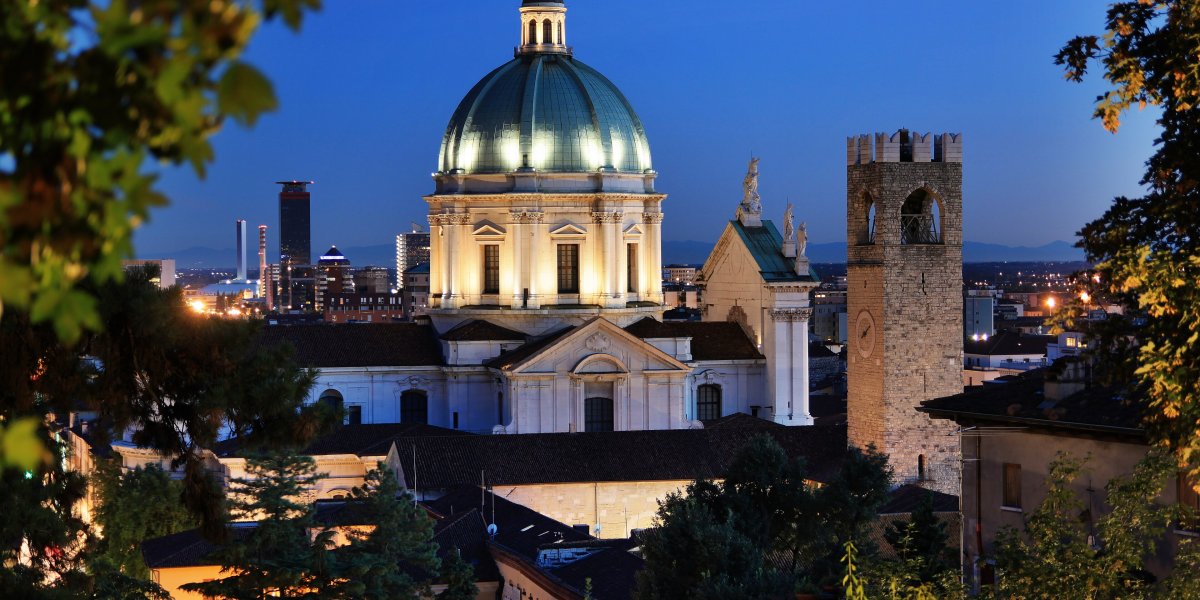
Walk west along Via dei Musei for 6 minutes, then cut south through Vicolo San Zenone — you emerge into Piazza Paolo VI, one of only two squares in Italy holding two cathedrals shoulder to shoulder. The 11th-century Duomo Vecchio, known as La Rotonda, is a rare circular Romanesque cathedral built directly atop the city's Roman baths; its sunken nave sits a full meter below the piazza, giving it a strange, half-buried gravity. Beside it the Baroque Duomo Nuovo soars upward with Italy's third-tallest cupola — the contrast between the two, 700 years apart, is the most photographed pair in Brescia.
Tip: The Rotonda closes for lunch and reopens at 15:00 — arriving at 14:00 means circling the exterior first, then stepping inside the moment the doors open, when low afternoon sun filters through the lone west window onto the Roman floor. Stand on the bronze grate near the altar: you can see straight down into the Roman thermal baths beneath your feet.
Open in Google Maps →16:00
Landmark
Step under the arcade on the north flank of Piazza Paolo VI and walk 3 minutes to emerge into Piazza della Loggia — Brescia's Renaissance heart, and the square that breaks first-time visitors out into a smile. The white marble Palazzo della Loggia (Sansovino, Palladio and Vanvitelli all left their fingerprints on it) faces the astronomical clock tower whose two bronze figures, the 'Macc de le Ure' (the Mad Men of the Hours), still hammer out every hour as they have since 1581. Linger until the 18:00 chime, then drift through the elegant Corso Zanardelli arcades and Piazza della Vittoria for the long approach to dinner.
Tip: Time your visit to be in the square at 17:00 sharp — the white marble facade ignites in the gold hour, and the Macc de le Ure striking the hammer is a 90-second photo opportunity tour groups always miss. Stand at the column on the eastern arcade with the small bronze plaque; it marks the 1974 bombing memorial and is the most respectful (and best-framed) angle of the whole square.
Open in Google Maps →19:30
Food
Two minutes south from the Loggia, on the quiet Via Gasparo da Salò, sits Osteria al Bianchi — a working osteria since 1880 with marble-topped tables, dark wood beams and zero pretense. This is where you finally sit down. Order the spiedo bresciano (Brescia's defining dish: a slow-roasted skewer of pork, rabbit, chicken and quail rotated for hours over open flame, served with cornmeal polenta — €22), or the manzo all'olio (beef braised in cold-pressed Garda olive oil — €18). Pair with a half-litre of local Botticino red (~€9). Total budget per person: €38-45.
Tip: Reserve by phone the same morning — they have no booking website on purpose, and walk-ins after 20:00 are turned away. Avoid the glossy 'menu turistico' places fanning out from Corso Zanardelli and Via X Giornate: the spiedo there is reheated under a heat lamp instead of slow-roasted on the spit, and the wine markup triples. Bianchi is the only address in the centro that does it the old way.
Open in Google Maps →
Trip builder
Plan this trip around Brescia
Turn this guide into a bookable rail itinerary with FlipEarth.
Keep exploring
Related cities
More in the same country
FAQ
Frequently asked questions
How many days do you need in Brescia?
Most travelers enjoy Brescia in 1 days, with enough time for headline sights and a slower meal or museum stop.
What's the best time to visit Brescia?
The easiest season for most travelers is Apr-Oct, especially if you want good weather and manageable crowds.
What's the daily budget for Brescia?
A practical starting point is about €90 per person per day before hotels, then adjust based on museums, dining, and transport.
What are the must-see attractions in Brescia?
A good first shortlist for Brescia includes Castello di Brescia (Cidneo Hill), Brixia Roman Park (Capitolium & Roman Theater), Piazza della Loggia & Torre dell'Orologio.