City Guide
Bari
Italie · Best time to visit: Apr-Oct.
Day-by-day plan
Choose your pace
Durée du voyage
09:00
Neighborhood
Slip into Bari Vecchia through the Arco di Sant'Onofrio and let your nose lead you down a narrow lane to Strada Arco Basso — locals call it Via delle Orecchiette. This is the one street in Italy where grandmothers have official permission to sell their hand-shaped pasta from wooden boards in their own doorways, and at 9am fingers fly so fast the little ears of dough seem to fall from a magician's sleeve.
Tip: Come before 10:30 — after that the tour buses spill in from the cruise terminal and the nonnas turn shy. A bag of dried orecchiette is €5 and travels home in a suitcase; buying one is the unspoken price of admission for taking photos. The 'pasta queens' to look for are Nunzia and Anna near the Arco Basso end.
Open in Google Maps →10:30
Religious
Walk east through the alleys for three minutes — the lane suddenly opens onto Largo Abate Elia, and the Basilica di San Nicola rises like a white limestone fortress. This is where Bari's sailors brought the relics of Saint Nicholas back from Myra in 1087, making this Romanesque church the spiritual home of the man who became Santa Claus. The facade glows in the morning sun and the bronze doors are still warm to the touch before the 11am tour groups arrive.
Tip: Descend to the crypt — the 28 columns are each carved differently, and Russian Orthodox pilgrims have left silver icons that line the side chapels (Bari is a rare Catholic site they still venerate). The 'Colonna Miracolosa' behind the iron grille is said to heal those who touch it; the grille is there because a fight once broke out among believers.
Open in Google Maps →12:00
Food
Exit the basilica by the south door and walk five minutes down Strada Palazzo di Città to an unmarked white doorway with a line of locals — Panificio Fiore has been baking in the same wood-fired oven since 1956. Order one slab of focaccia barese, still hot, with cherry tomatoes pressed into the dough and Pugliese olive oil pooling on top. This is Bari's signature carb, eaten standing on the cobbles, and one slab is a perfect lunch.
Tip: A slab of focaccia is €4; also ask for the calzone alla cipolla (sweet caramelised-onion turnover, €3) and the sgagliozze (fried polenta squares, €2) if they have them. Pay first at the till, then bring your paper ticket to the counter. They close at 14:00 sharp and the noon batch is the best of the day.
Open in Google Maps →13:00
Landmark
From Panificio Fiore walk five minutes west along Strada Palazzo di Città and the bulk of Castello Svevo appears behind the city walls. Frederick II's 13th-century fortress is squat and unromantic by design — it was a power statement, not a palace. Walk the empty moat counter-clockwise to see the original Norman base layered beneath the later Hohenstaufen towers; the warm afternoon light hits the western wall now and the round towers throw long shadows across the dry ditch.
Tip: Skip paying for the interior — the art collection is minor and you already saw a better Romanesque facade at San Nicola. Circle to the western moat side: that angle frames both round towers against open sky with no modern buildings in the shot. The shadow line at 13:30 is exactly right for the stonework.
Open in Google Maps →14:30
Landmark
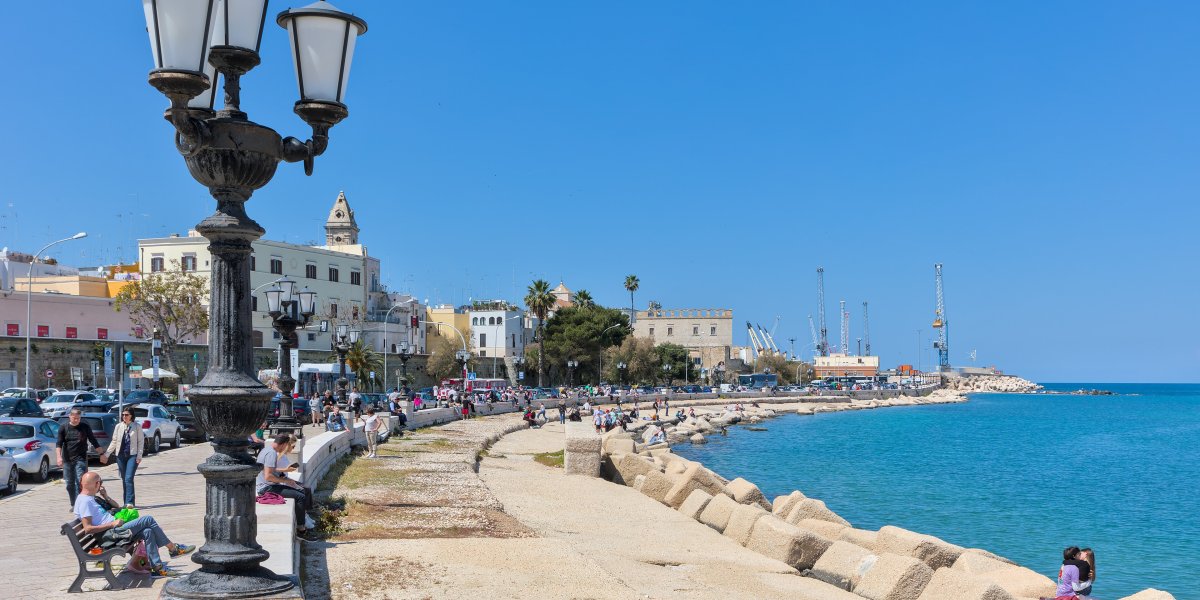
Leave the castle's east side, cross Piazza Federico II di Svevia and you're suddenly on the Lungomare Nazario Sauro — the longest urban seafront in southern Italy. Walk south with the Adriatic on your left, past the white-domed Teatro Margherita on its pier, past fishermen mending nets at Molo San Nicola, past Fascist-era ministries and art-nouveau hotels lit by the western sun. Keep going to Pane e Pomodoro beach about 2.5 km down, where locals swim until October and the city skyline curves back behind you for the postcard shot.
Tip: Walk south first to Pane e Pomodoro, then turn back north around 18:30 — the setting sun lights up the white limestone palazzi from behind you, and the old town walls glow gold from about 19:00. Stop at the kiosk by Teatro Margherita on the way back for a €3 Crodino aperitivo while the lamplights come on along the breakwater.
Open in Google Maps →19:30
Food
Turn inland at Teatro Margherita and walk ten minutes north into Bari Vecchia, ducking into Piazza Mercantile under the lamp-lit columns of the Sedile dei Nobili. La Locanda di Federico occupies a vaulted underground hall that feels like dining inside a Romanesque crypt. This is where Baresi take visiting cousins, and the orecchiette con cime di rapa here is the version you'll still be thinking about after you fly home.
Tip: Order orecchiette con cime di rapa (€11) and tubettini con cozze, patate e riso (the Pugliese mussel-potato-rice pasta, €13); split a burrata di Andria (€9) to start. Reserve for 19:30 — by 20:30 there's a queue down the alley. Pitfall warning: every other restaurant on Piazza Mercantile with an English menu, photos of the food, and a waiter standing outside waving you in is priced for cruise day-trippers (€18 for a basic carbonara is normal there). La Locanda has prices only in Italian, no photos on the menu, and Italians at the next table — that's how you spot the real ones in Bari Vecchia.
Open in Google Maps →Aller au jour
09:00
Neighborhood
Enter the old town through Porta Marina and the alley narrows in an instant; within five minutes Via Arco Basso opens up and the famous pasta nonnas are already at their wooden boards, thumbing semolina dough into tiny ears at the rate of one per second. Come now, before 10:30, while the air is cool and the work is fresh — by lunchtime they pack the boards away. Buy a small bag of dried orecchiette directly from them (around €5); it is the cleanest souvenir you will ever take home.
Tip: The most authentic stretch is between Via Arco Basso 12 and Via delle Crociate. Do not film their faces without asking — a smile and a quick 'Posso?' gets you a nod. The signora with the blue plastic chair at #12 is Nunzia, the unofficial matriarch of the street.
Open in Google Maps →10:30
Religious
Walk 300 metres east through the limestone alleys, passing the Cathedral on your right, until Piazza San Nicola broadens in front of you. The plain Romanesque façade hides one of the most important shrines in Christendom: the bones of Saint Nicholas, taken from Myra by Bari sailors in 1087. Descend straight into the crypt — its low Norman columns and the lit icon of the saint create a hush you will feel in your chest. Arrive before the 11:30 service crowd settles in.
Tip: Skip the main nave first and head down to the crypt for ten quiet minutes — the relics are visible through a grate behind the altar, and the famous 'manna' (a clear liquid said to seep from the bones) is drawn each May 9th. Modest dress is enforced; bare shoulders are turned away at the door.
Open in Google Maps →12:30
Food
Two-minute walk behind the Cathedral on Strada Palazzo di Città — you will smell the wood oven before you see the door. Panificio Fiore has baked focaccia barese in the same coal-fired oven since 1980: a thick, oil-slicked slab studded with cherry tomatoes and Cerignola olives. Order half a tray (mezza teglia, €4) and a fried panzerotto with mozzarella and tomato (€2). Eat standing in the alley like everyone else.
Tip: Cash only, and get there by 12:45 — by 13:30 the day's bake is gone and they close until 17:00. Ask for 'ben cotta' (well-cooked); the dark, crisp edges where the oil has caramelised are the prize most tourists miss by asking for the pale slabs.
Open in Google Maps →14:00
Religious
Double back fifty metres into Piazza dell'Odegitria — the Cathedral stands like a quieter, older sister to San Nicola. Built in the 11th century atop a Byzantine basilica, its real treasure is underneath: a vast hypogeum where you walk on glass over Roman roads and an 8th-century mosaic floor. The acoustics in the nave are extraordinary; if a choir is rehearsing, sit down and do not move until they finish.
Tip: The hypogeum requires a separate €5 ticket bought at the gift shop inside, not at the front door — most tour groups skip it entirely. On Tuesday and Thursday afternoons a custodian is usually downstairs and will point out the original 12th-century rose window viewed from below.
Open in Google Maps →16:00
Landmark
Walk five minutes west along Strada Sant'Anselmo, hugging the city walls — the moat opens up suddenly to your left and Frederick II's Swabian castle squats at the corner of the old town. Built by the Normans in 1131, fortified by Frederick, then softened into a Renaissance palace by Isabella of Aragon — every owner left a layer in the stone. The 16:00 light turns the limestone honey-gold, and the inner courtyard is the best spot in Bari for photos without a single car or scooter in frame.
Tip: Climb to the ramparts (included with the €10 entry) for the only elevated view over Bari Vecchia's roofs — the angle places San Nicola's bell tower directly above the orange-tile sea of old roofs. The castle closes early on Tuesdays (14:00), so plan around it.
Open in Google Maps →19:30
Food
A six-minute stroll back along the Lungomare Imperatore Augusto — sea air on your right, the limestone of Bari Vecchia on your left — brings you into Piazza Mercantile and the door of La Locanda di Federico. Vaulted stone ceilings, candles on the table, and a kitchen that does Puglia without apology. Order the orecchiette con cime di rapa (€11) and the tagliata di tonno con cipolla rossa (€18); the house red is a Primitivo di Manduria worth every cent.
Tip: Reserve a day ahead on +39 080 522 7705 and ask for table 12 in the rear vault — locals book Friday and Saturday solid. Pitfall: avoid the restaurants directly facing Piazza del Ferrarese with menus in five languages and photo boards outside — they are tourist traps serving bagged orecchiette reheated to order at twice the price.
Open in Google Maps →09:30
Landmark
Start the day on Corso Cavour in front of Italy's fourth-largest opera house — a Belle Époque temple finished in 1903, burned to ash by arson in 1991, and rebuilt over nineteen years to the original drawings. The morning guided tour (English at 10:00) takes you onto the stage itself and up to the royal box where Pavarotti sang his Bari farewell. The chandelier and gold leaf are best photographed in this morning light, before the afternoon glare flattens the colour.
Tip: Book the tour through teatropetruzzelli.it the night before — Saturday walk-ins are routinely turned away. Sit at the back of the royal box, not the front: the chandelier reflected in the gold leaf of the ceiling is the photograph you actually want.
Open in Google Maps →11:00
Shopping
Step out of the theatre, cross Corso Cavour, and Via Sparano opens in front of you — a marble-paved pedestrian boulevard running eight blocks straight to the old town. This is where Bari dresses up: Italian heritage brands, palazzi with Liberty-style balconies, and the locals' Sunday-best passeggiata. Pause at Piazza Umberto I halfway down, under the magnolias, where the city's grid plan radiates outward and the bourgeois 19th-century soul of the new town is most visible.
Tip: The best Art Nouveau façades are on the north side between Via Putignani and Via Calefati — look up, not at the shop windows. The fountain in Piazza Umberto only runs from morning through early afternoon; by 16:00 it is dry, so photograph it now.
Open in Google Maps →13:00
Food
Double back one block to Corso Cavour, where Mastro Ciccio is the lunch counter Bari office workers queue at — split focaccia barese stuffed to the rim with Puglia in sandwich form. Order 'La Pugliese' (€7): focaccia, burrata, sun-dried tomatoes, capocollo di Martina Franca, and rocket. Take it across to Piazza Umberto and eat on a bench under the magnolias like a local on lunch break.
Tip: The queue at 13:15 looks brutal but moves in ten minutes — order at the counter, pay first, collect at the end. Hidden trick: ask for 'extra stracciatella' (+€1.50) on any sandwich — it transforms a good panino into the best one you will eat in southern Italy.
Open in Google Maps →14:30
Museum
A fifteen-minute walk east along Via Piccinni brings you to Lungomare Nazario Sauro and the pink Palazzo della Provincia, a vast Liberty-style building facing the Adriatic. The Pinacoteca occupies its top floor and the collection is far better than its low profile suggests: a Bellini Madonna, three Veroneses, and the namesake Giaquinto's enormous 18th-century Rococo ceiling pieces. Indoors at the hottest part of the afternoon, and largely empty on weekday afternoons.
Tip: Head straight to Room 12 (Giaquinto) and Room 7 (the Bellini Madonna with Child) — the rest you can skim. The terrace café on the same floor has the best sea view in Bari, costs €2 for an espresso, and almost no tourists know it exists.
Open in Google Maps →16:30
Park
Exit the Pinacoteca and turn right (south) — the Lungomare Nazario Sauro continues for two palm-lined kilometres, the longest seafront promenade in southern Italy. Locals jog, cycle, and gather on the low sea wall to watch the light turn. Walk all the way to Pane e Pomodoro, the urban beach at the far end; the sand is fine, the water is shallow, and the view back toward the old town's white silhouette is the postcard of Bari that nobody photographs.
Tip: Time your walk so you reach Pane e Pomodoro around 17:30 — the sun is behind you and lights up the old town's stone like a film set. Bring a small towel; locals dip their feet even in shoulder season. The beach has free public access — ignore the lido pay-stations near the entrance, the public sand is on the right.
Open in Google Maps →19:45
Food
Walk back along the Lungomare toward Piazza del Ferrarese — about fifteen pleasant minutes with the breeze cooling — and turn into Corso Vittorio Emanuele II. Biancofiore sits in a 16th-century palazzo with white-vaulted ceilings and one of the most refined kitchens in Bari. Order the tagliolini al ragù di polpo (€16) and the catch-of-the-day baked in a salt crust (€26 for two). The wine list is a love letter to small Puglia growers, and the sommelier will pour you a Negroamaro you will think about on the plane home.
Tip: Reserve at least two days ahead on +39 080 523 5446 — only twelve tables. Ask for the cantina (basement) room; the upstairs is fine but the cantina has the original 1500s vaults. Final pitfall: avoid the laminated photo menus posted along Corso Vittorio Emanuele on the seaward side — in Bari, picture menus mean frozen seafood at triple the price and a forced cover charge that appears only on the bill.
Open in Google Maps →
Trip builder
Plan this trip around Bari
Turn this guide into a bookable rail itinerary with FlipEarth.
Keep exploring
Related cities
More in the same country
FAQ
Frequently asked questions
How many days do you need in Bari?
Most travelers enjoy Bari in 1 days, with enough time for headline sights and a slower meal or museum stop.
What's the best time to visit Bari?
The easiest season for most travelers is Apr-Oct, especially if you want good weather and manageable crowds.
What's the daily budget for Bari?
A practical starting point is about €60 per person per day before hotels, then adjust based on museums, dining, and transport.
What are the must-see attractions in Bari?
A good first shortlist for Bari includes Castello Svevo di Bari, Lungomare Nazario Sauro.