City Guide
Zurich
Switzerland · Best time to visit: Jun-Sep.
Day-by-day plan
Choose your pace
Duración del viaje
09:00
Landmark
Step out of Zürich HB's west exit and the castle is right in front of you — turrets, towers, and a moat, as if medieval Switzerland built an airport welcome committee. Walk around to the Platzspitz park behind it where the Limmat and Sihl rivers merge; the building's reflection in the still morning water, backed by the old town skyline, is the shot. No need to go inside — the exterior is the main attraction.
Tip: The best photo angle is from the small bridge at the northern tip of Platzspitz park, where the two rivers converge — arrive before 09:30 while the water is still glassy and joggers are your only company.
Open in Google Maps →09:50
Park
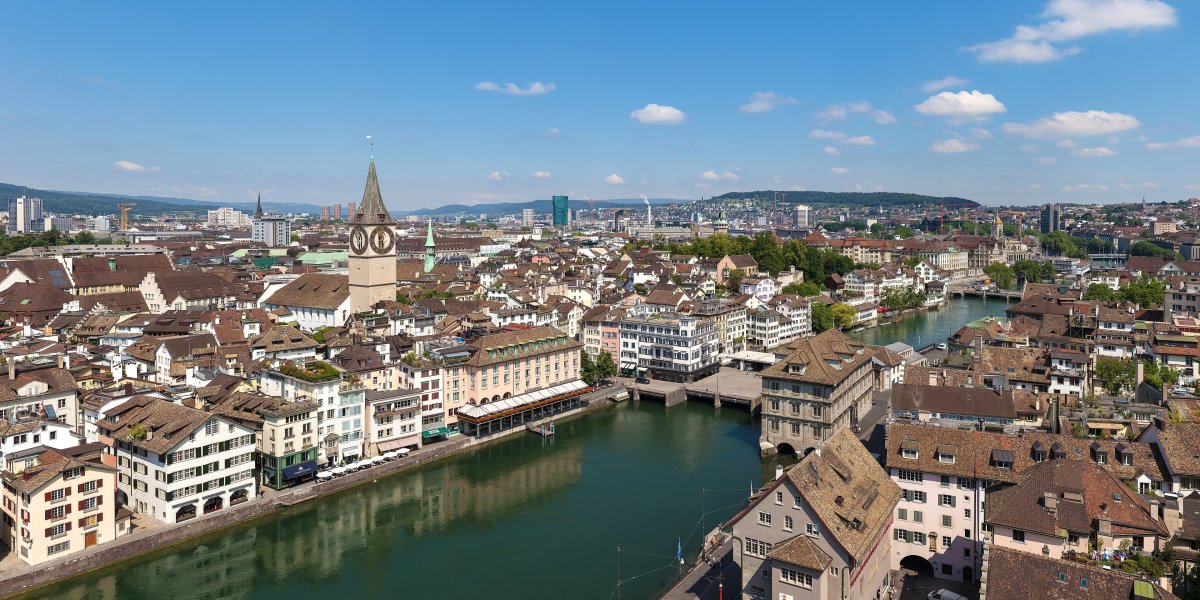
Walk south along the Limmat's west bank for 8 minutes, ducking through narrow medieval lanes past painted guild houses with flower-box balconies — the streets themselves are half the experience. Climb the stone steps to this hilltop square, a Roman fort turned leafy overlook, where the twin towers of Grossmünster, the university spire, and the blue-green river below assemble into Zurich's most effortless panorama.
Tip: Stand at the eastern railing for the textbook shot: Grossmünster centered between terracotta rooftops with the river below. Morning light is ideal here since you face east. The giant chess boards on the square are played by locals daily — photograph the game, not just the view.
Open in Google Maps →10:30
Religious
Descend from Lindenhof to the river and cross the Münsterbrücke — pause mid-bridge for a wide-angle shot with the church ahead and the green-spired Fraumünster behind you; this single frame captures Zurich's entire soul. The Romanesque twin towers have anchored the skyline since the 12th century, and the rear garden at Zwingli-Platz offers a quieter angle with the river as foreground.
Tip: Skip the Karlsturm tower climb (CHF 5) — the queue is long and the Lindenhof view you just had is better and free. The bronze doors on the south side, carved by Otto Münch in 1935, are easy to miss but worth a close look.
Open in Google Maps →12:00
Food
Walk 5 minutes south along the east bank past café terraces to Bellevueplatz, where you'll spot the permanent queue at Zurich's most beloved sausage stand, grilling nonstop since 1963. Order the Kalbsbratwurst (veal sausage, CHF 8.50) with a Bürli bread roll and eat standing at the counter or perched on the Bellevue steps watching trams clatter past — this is how Zurich does a working lunch.
Tip: Order the veal bratwurst (Kalbsbratwurst), not pork — it's the one locals choose. Use the house mustard, never ketchup. The queue looks intimidating but moves in under 5 minutes. Budget CHF 10–14 per person including a drink from the adjacent kiosk.
Open in Google Maps →13:00
Landmark
Cross from Bellevue to Bürkliplatz and begin the finest urban lakeside walk in Switzerland. Follow the Utoquai promenade south for 3 km toward Zürichhorn — a tree-lined path past swans, moored sailboats, and sunbathers on the grassy banks, with the jagged white wall of the Alps rising above the far shore on clear days. End at the Zürichhorn sculpture park where Jean Tinguely's kinetic iron fountain sputters and clanks on the waterfront lawn.
Tip: The Alps are most visible between 13:00–15:00 when afternoon light sharpens the peaks — if the Föhn wind is blowing, the mountains appear impossibly close. The last bench before the Chinagarten entrance has the widest unobstructed lake-and-Alps view. Skip the Chinagarten entry (CHF 4); the free lakeshore beside it gives you the same panorama.
Open in Google Maps →19:00
Food
Walk back north along Bahnhofstrasse — 15 minutes of window-shopping past Cartier and Chanel — to this cavernous beer hall occupying a medieval arsenal since 1487. Halberds hang from vaulted ceilings above long communal oak tables, and the menu reads like a Swiss greatest hits album. Order the Zürcher Geschnetzeltes mit Rösti (sliced veal in cream sauce with a crispy potato cake, CHF 38) — the dish Zurich is named for in kitchens across the country.
Tip: Arrive at 18:45 to grab a table without a reservation — after 19:30 the wait is 20+ minutes. Ask for the back room (Hinterstube) for the oldest vaulted ceiling and less noise. Budget CHF 40–55 per person with a beer. Avoid the tourist restaurants on Niederdorfstrasse — they charge 30% more for half the quality and target visitors who won't return to complain.
Open in Google Maps →Saltar al día
09:00
Park
From the Hauptbahnhof, follow the old town lanes south for ten minutes as they slope gently upward until the trees open and the city drops away below you. This Roman hilltop is where Zurich was born — linden trees frame the finest free viewpoint in the old town, with the Limmat below, Grossmünster's twin towers across the water, and the university hillside beyond. At nine in the morning, the benches are yours alone.
Tip: Stand at the eastern railing for the cleanest shot of Grossmünster with the river foreground — at 09:00 the morning sun lights the towers from behind you. The giant outdoor chess set by the fountain is free to play and rarely occupied this early.
Open in Google Maps →10:00
Landmark
Walk downhill from Lindenhof, cross the Limmat on Rathausbrücke, and follow the east bank south for five minutes — the twin towers grow above the rooftops. This 12th-century Romanesque cathedral is Zurich's defining silhouette: climb the 187 steps of the Karlsturm for a 360-degree panorama stretching from the Altstadt rooftops across Lake Zurich to the distant Alps. Back inside, Sigmar Polke's ethereal stained glass fills the choir with color that shifts with the light, and a weathered Charlemagne sits enthroned in the crypt below.
Tip: The Karlsturm tower opens at 10:00 — arrive right at opening. The staircase is medieval-narrow and one-way in sections; one tour group ahead of you means a 15-minute delay at every landing. Buy the CHF 5 ticket at the desk inside the nave, not from anyone outside.
Open in Google Maps →11:45
Religious
Exit the Grossmünster, cross the Münsterbrücke — a three-minute walk with the Limmat shimmering below — and the Fraumünster entrance is directly ahead. The church exists in most travelers' memories for one reason: five stained glass windows by Marc Chagall, installed in 1970, that flood the choir with jewel-bright blues, greens, and reds in his unmistakable dreamlike style. Late morning is ideal — the sun is high enough to fully penetrate the east-facing choir, making the colors burn at their brightest.
Tip: Photography is strictly forbidden inside. After the Chagall windows, look up at the south transept rosette window by Augusto Giacometti — most visitors fixate on the choir and miss it entirely. The CHF 5 entry fee keeps crowds thinner than at the free Grossmünster.
Open in Google Maps →12:30
Food
Walk five minutes north along Münsterhof and cut through to Bahnhofstrasse — the Zeughauskeller is tucked behind the grand shopping boulevard in a 15th-century former arsenal. Under vaulted stone ceilings hung with medieval weapons and canton flags, long communal wooden tables fill fast with a lunch crowd of locals and office workers. This is the honest, unhurried Zurich lunch — no pretension, no small plates, just proper Swiss food and cold beer.
Tip: Order the Zürcher Geschnetzeltes with rösti (CHF 34) — sliced veal in cream sauce over crispy shredded potato, the city's signature dish. Pair it with a half-liter of Hürlimann draft (CHF 7). Arrive by 12:30 for a ground-floor table; after 13:00 the wait hits 20 minutes. Budget CHF 35-45 per person.
Open in Google Maps →14:00
Museum
Walk north up Bahnhofstrasse toward the Hauptbahnhof — a straight ten-minute stroll past luxury storefronts — and the museum's castle-like silhouette appears flanking the station. The Landesmuseum packs Switzerland's entire story into one surprisingly engaging circuit: medieval armor, Reformation-era relics, reconstructed period rooms, and a sleek modern extension that examines Swiss identity through multimedia installations. The afternoon crowd is thin here, and the cool galleries are a welcome reset after a morning on your feet.
Tip: Head straight to the permanent 'History of Switzerland' exhibition on the second floor — it is the highlight and needs at least 90 minutes. The 2016 extension wing has excellent temporary shows worth checking. Free on the first Saturday of each month. Closed Mondays.
Open in Google Maps →19:00
Food
From the museum, walk south along the Limmat's east bank — a twenty-minute evening stroll past old town lights reflecting on the water — to Bellevueplatz. The Kronenhalle has operated since 1924, its wood-paneled dining rooms hung with original Picasso, Chagall, Miró, and Matisse — not reproductions. This is where Thomas Mann and James Joyce were regulars, and where Zurich's cultural establishment still comes to eat the same dishes they ordered a century ago.
Tip: Reserve at least two days ahead — walk-ins rarely work at prime dinner hours. The Wiener Schnitzel (CHF 54) is the move: golden, oversized, crackle-crisp. Finish with the Coupe Kronenhalle dessert (CHF 22). Budget CHF 80-120 with wine. Pitfall: the restaurants ringing Bellevueplatz with outdoor touts and laminated photo menus are tourist traps charging Zurich prices for cafeteria quality — walk past them to Kronenhalle's discreet entrance.
Open in Google Maps →09:00
Neighborhood
Start your second morning in the narrow pedestrian lanes of Niederdorf, Zurich's liveliest old-town quarter on the Limmat's east bank. Before the bars and restaurants that own these streets at night have fully woken, the neighborhood belongs to bakers setting out trays and locals buying bread — walk slowly through Spiegelgasse, where a plaque at No. 14 marks the flat where Lenin lived during his 1917 exile. The smell of fresh pastry from Conditorei Schober's ornate 19th-century interior will stop you mid-step.
Tip: Conditorei Schober at Napfgasse 4 is worth stepping inside even if you do not buy — the rococo interior is the most photogenic café in Zurich. Lenin's plaque at Spiegelgasse 14 is easy to miss; look for it at eye level on the left side heading south. The cobblestones get slippery when wet — wear proper shoes.
Open in Google Maps →10:15
Museum
Walk south from Niederdorf for five minutes to Heimplatz, where Pipilotti Rist's glowing pod installation marks the entrance to the new extension. Switzerland's most important art museum holds a permanent collection running from medieval altarpieces through Monet's water lilies and a dedicated Giacometti room to one of Europe's finest Munch holdings. The 2021 David Chipperfield extension doubled the space — the underground passage connecting old and new buildings is an experience in itself.
Tip: Go to the Giacometti room first (second floor, old building) — the slender bronze figures in natural light are the museum's emotional peak. The Chipperfield extension connects underground; do not skip the passage. Wednesday evenings often have free admission after 17:00 — verify on their website. Closed Mondays.
Open in Google Maps →12:00
Food
Exit the Kunsthaus and walk eight minutes downhill on Rämistrasse — the lake glints ahead, and at Bellevueplatz you will spot the blue-and-white awning with a permanent queue of locals. Sternen Grill has been Zurich's most beloved sausage stand since 1963, where bankers and students eat the same bratwurst standing at the same counter. It looks like nothing, and it is perfect.
Tip: Order the classic bratwurst with Bürli bread roll (CHF 8.50) — the gold bratwurst in premium veal (CHF 12.50) is worth the upgrade. Eat standing at the counter like every local does. The queue looks long but moves in under five minutes. Budget CHF 10-15. Skip the sit-down restaurant upstairs: same kitchen, triple the price.
Open in Google Maps →13:00
Landmark
From Bellevueplatz, cross to the Utoquai and follow the lakeside path east — linden trees, park benches, and sailboats tacking across blue water stretch ahead. This gentle two-kilometer promenade to Zürichhorn park is the walk that explains why people live in Zurich: the lake extends south to a vanishing point framed by green hills, with a wall of Alps on the horizon on clear days. Take it slow — sculptures dot the shore, locals leap in at the swimming spots, and no one here is in a hurry.
Tip: The Alps are sharpest in the morning and after rain — afternoon haze can soften them, but the lake light in early afternoon more than compensates. The most photogenic angle of the full lake-and-Alps panorama is from the curved bench just past the Zürich-Horn tram stop, where the shoreline bends. Strandbad Utoquai, the public swimming area along the way, costs CHF 8 for a summer swim.
Open in Google Maps →14:45
Park
Continue along the shore path for another five minutes — the pagoda roof and zigzag bridge appear at Zürichhorn's eastern edge, unmistakable against the water. Built in 1994 as a gift from Zurich's sister city Kunming, this is an oasis of cultivated silence: lotus ponds, carved lattice windows, bonsai, and a lakeside pavilion where you can sit watching the water and the distant Alps. Thirty minutes here feels like it slows your heart rate.
Tip: The zigzag bridge over the lotus pond is the best photo spot — it was designed to confuse evil spirits, who travel only in straight lines per Chinese folklore. Lotus flowers bloom spectacularly in July and August. The garden is small; 30-40 minutes is enough. Open April through October only.
Open in Google Maps →19:00
Food
Walk back along the lake or hop tram 2/4 from Fröhlichstrasse to Paradeplatz in ten minutes — Hiltl is one block south on Sihlstrasse. Open since 1898 and Guinness-certified as the world's oldest vegetarian restaurant, it has survived over a century by being genuinely excellent rather than a novelty. The menu spans Indian curries, Middle Eastern mezze, and Swiss-inspired plates — even committed carnivores leave converted.
Tip: The dinner buffet (CHF 4.80 per 100g, from 18:00) is the local move — pile on the Indian curries and fresh salads. If ordering à la carte, the Hiltl Tartar, a beet tartare (CHF 22), is the signature dish. Budget CHF 40-55 per person. The ground floor gets loud by 19:30; head upstairs to the quieter first-floor dining room for a calmer farewell dinner. Pitfall: the Bahnhofstrasse restaurants between Paradeplatz and the station with 'Swiss Fondue' signs in the window are tourist mills — locals have not eaten in them for decades.
Open in Google Maps →
Trip builder
Plan this trip around Zurich
Turn this guide into a bookable rail itinerary with FlipEarth.
Keep exploring
Related cities
Nearby cities
More in the same country
FAQ
Frequently asked questions
How many days do you need in Zurich?
Most travelers enjoy Zurich in 1 days, with enough time for headline sights and a slower meal or museum stop.
What's the best time to visit Zurich?
The easiest season for most travelers is Jun-Sep, especially if you want good weather and manageable crowds.
What's the daily budget for Zurich?
A practical starting point is about €80 per person per day before hotels, then adjust based on museums, dining, and transport.
What are the must-see attractions in Zurich?
A good first shortlist for Zurich includes Swiss National Museum, Lake Zurich Promenade.