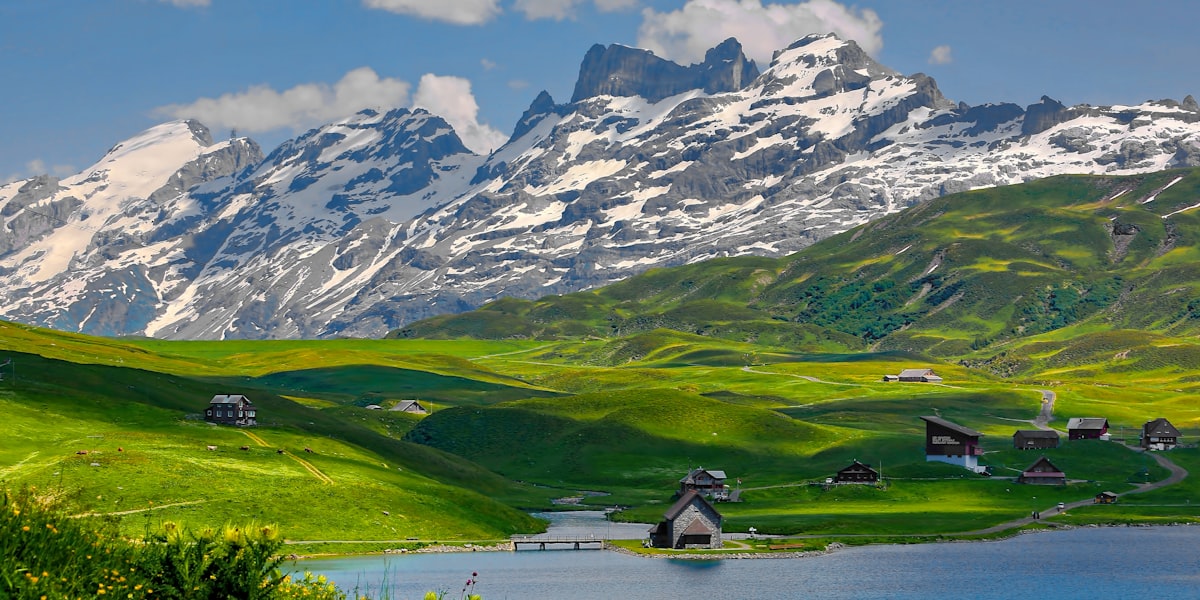
City Guide
Lucerne
Switzerland · Best time to visit: May-Oct.
Day-by-day plan
Choose your pace
Duración del viaje
09:00
Landmark
Step out of Lucerne's train station and look left — the 14th-century wooden bridge is already in sight, angling across the turquoise Reuss River with its octagonal Water Tower rising from the current. Cross slowly: the ceiling holds 17th-century triangular paintings telling Lucerne's history, and in the morning the sun pours through the east-facing flower boxes casting amber light on the dark timber. Pause at the tower midpoint for the shot everyone comes here for — the bridge curving toward the Jesuit Church dome with the snow-dusted silhouette of Mount Pilatus behind it.
Tip: Before 09:30 you will share the bridge with joggers and no one else. Stand at the centre of the bridge facing south for the classic postcard angle — the curved bridge framing the Water Tower with Pilatus behind. The north side catches better morning light for portraits. Walk the full length and exit on the Old Town side at Rathausquai.
Open in Google Maps →10:15
Landmark
From the Old Town end of Chapel Bridge, walk north up Kapellgasse through Hirschenplatz — look up at the painted Renaissance facades — then continue along Löwenstrasse for about 12 minutes. You will emerge at a quiet sandstone grotto where a dying lion is carved into the cliff face, his paw draped over a Bourbon shield. Mark Twain called it 'the most mournful and moving piece of stone in the world,' and in the mid-morning stillness, with the reflecting pool absolutely flat, you will understand why. The sculptor Lukas Ahorn carved it in 1821 to commemorate the Swiss Guards who fell defending the Tuileries in 1792.
Tip: Arrive before 10:30, when the first tour buses unload and the grotto fills with selfie sticks. The best photograph is from the far-left bench at pool level, where the lion's reflection completes the composition symmetrically in the water. Skip the Glacier Garden museum next door — not essential for a one-day visit.
Open in Google Maps →11:15
Landmark
From the Lion Monument, walk five minutes west along Museggstrasse — you will see medieval ramparts rising above the rooftops. Climb the Männli Tower staircase for a panorama that stops you mid-step: the entire terracotta Old Town laid out below, the lake glittering beyond the rooftops, and on clear days the Bernese Alps lining the southern horizon in a white serrated wall. Walk westward along the top of the 870-year-old fortification, wildflowers growing from the cracks in the stone, passing between three climbable towers before descending at the far end near Nölliturm.
Tip: The Zyt Tower houses the oldest clock in Lucerne (1535) and holds the rare privilege of chiming one minute before every other clock in the city — listen for it at noon. Three of the nine towers are open to climb: Schirmer, Zyt, and Männli. Männli has the best unobstructed view. The wall is only open April through November and closes in rain.
Open in Google Maps →12:45
Food
Descend from the western end of the Musegg Wall and walk eight minutes south through Mühlenplatz back into the heart of the Old Town, passing half-timbered houses and stone fountains. Heini is a Lucerne institution — locals have grabbed quick lunches here for decades. The glass cases are stacked with golden pastries and the smell of fresh bread hits you from the street. This is the fastest way to refuel properly without committing to a full Swiss sit-down.
Tip: Order the Käseschnitte — an open-faced cheese toast baked until blistering (around CHF 9) — and a coffee. Total damage: CHF 12-16. If you need something for the road, grab a slice of their Luzerner Lebkuchen, a spiced honey cake that is this city's signature sweet. Eat standing at the counter like the locals; you will be walking again in twenty minutes.
Open in Google Maps →13:30
Landmark
Walk six minutes south from Heini to reach Schweizerhofquai, the grand lakeside promenade. Turn right and follow the water westward — the early-afternoon sun lights up the Alps across the lake and white passenger steamers glide past trailing silver wakes. This is the stretch where Lucerne becomes cinematic: swans on glassy water, Belle Époque hotel facades to your left, and the twin spires of the Hofkirche rising above the chestnut canopy ahead. Continue past the Nationalquai gardens all the way to the KKL Luzern, Jean Nouvel's arts centre whose enormous cantilevered roof hovers over the lake like a landed spacecraft.
Tip: Between 14:00 and 15:00 the mountains across the water lose their midday haze and sharpen against the sky — this is the best window for lake photographs. Walk all the way to the KKL rooftop terrace (free access, take the lift inside) for the widest unobstructed lake-and-Alps panorama in the city. If tempted by the 1-hour panoramic boat cruise (CHF 28, departs pier 1), know that walking the full promenade actually gives you more variety in less time.
Open in Google Maps →18:30
Food
From the KKL, walk ten minutes west along the south bank of the Reuss, crossing at the Geissmattbrücke — the evening light turns the glacial river a luminous blue-green. Galliker has occupied this wood-panelled corner on Schützenstrasse since 1856, and the menu reads like it has not changed much since. The room smells of roasting butter and simmering cream; every second table seems to have the same golden pastry shell in front of it. This is where off-duty chefs and old Lucerne families eat — the kind of place where the waiter already knows what you should order.
Tip: Order the Luzerner Chügelipastete (CHF 32) — a puff-pastry shell filled with veal, mushrooms, and raisins in a cream sauce that defines this city's cuisine. Galliker's version is the benchmark; every other restaurant in town is measured against it. Pair it with a draft Eichhof (CHF 6), the local brewery. Arrive at 18:30 sharp — by 19:00 every seat is taken and they do not accept reservations. Whatever you do, do not eat at the waterfront restaurants flanking Chapel Bridge: they charge double for half the quality and exist purely for tourists who do not know better.
Open in Google Maps →Saltar al día
09:00
Landmark
Begin where Lucerne begins — on Europe's oldest covered wooden bridge, built in 1333. Walk slowly from the south bank: 111 triangular paintings under the timber roof narrate the city's history in faded pigment, and the octagonal Water Tower at the bridge's bend — once a prison, a torture chamber, a treasury — stands like a sentinel over the Reuss. At nine in the morning the eastern sun pours through the crimson flower boxes and catches the swans drifting below in a golden haze. This is the single most photographed scene in Switzerland, and at this hour you will have it nearly to yourself.
Tip: Walk south-to-north so the morning sun is behind you — this lights the Water Tower and flower boxes perfectly. At the bridge's bend, crouch slightly and shoot toward the tower with Mount Pilatus in the background: that is the postcard angle. By 10:00 the first tour groups arrive and the bridge feels like a different place.
Open in Google Maps →10:00
Landmark
Walk north from Chapel Bridge through Weinmarkt — Lucerne's oldest square, where medieval mystery plays were once staged — and into Hirschenplatz, a pocket of frescoed facades and cafe tables. Ten minutes of cobblestones lead you to a quiet sandstone grotto shaded by linden trees. Carved into the cliff face is a dying lion, ten meters long, his paw draped over a Bourbon shield, a broken spear through his flank. Mark Twain called it 'the most mournful and moving piece of stone in the world.' It commemorates the 760 Swiss Guards massacred at the Tuileries during the French Revolution in 1792.
Tip: The reflecting pool in front of the lion creates a perfect mirror image on windless mornings — crouch at the pool's left edge for a symmetrical photo with the linden trees framing both sides. Arrive before 10:30; by 11:00 tour buses empty into the grotto and the silence that makes this place powerful is gone.
Open in Google Maps →10:45
Landmark
From the Lion Monument, walk five minutes northwest up Museggstrasse — you will see the crenellated wall rising above the rooftops like something from a storybook. This is Lucerne's original 14th-century fortification: 870 meters of rampart linking nine towers, four of which you can climb on steep wooden stairs. The Zyt Tower houses the city's oldest clock, granted the privilege of chiming one minute before all other clocks in Lucerne since 1535. Walk the full rampart from Schirmerturm to Wachtturm — the terracotta rooftops of the old town tumble below you, the lake glitters beyond, and Pilatus and Rigi stand on opposite horizons like bookends.
Tip: Climb the Männliturm for the best direct view of the lake and Chapel Bridge below, then continue to the Wachtturm for the full 360-degree Alpine panorama — Pilatus, Rigi, and the Bernese peaks are all visible on clear days. The wall walk is uneven stone with steep tower staircases; wear proper shoes. Towers are open April through November only.
Open in Google Maps →12:30
Food
Descend from the wall back into the old town — an eight-minute walk south through narrow lanes and past Mühlenplatz's painted facades to Unter der Egg, a covered arcade running along the north bank of the Reuss. This brewery-restaurant sits directly on the river, its terrace looking across the water to the colorful south-bank houses. They brew their own unfiltered lager on-site and serve it alongside hearty Swiss-German food to a crowd that is conspicuously more local office workers than tourists. On warm days the terrace fills fast; in cooler weather the vaulted interior with its copper brew kettles is just as satisfying.
Tip: Order the Naturtrüeb (house unfiltered lager, CHF 6.50) with the Bratwurst and Rösti plate (CHF 27) — the sausage is from a local butcher and the rösti is properly crisp. The weekday Tagesmenu (daily special, around CHF 22) is the best value lunch in the old town. Arrive by 12:15 to claim a riverside terrace seat without waiting.
Open in Google Maps →14:00
Entertainment
Walk five minutes south from the brewery to the lake piers at Europaplatz — you will pass the KKL Luzern, Jean Nouvel's striking cultural center whose massive cantilevered roof floats above its own reflection in the water. Board the one-hour panoramic cruise from Pier 1. Lake Lucerne — Vierwaldstättersee, the Lake of the Four Forested Cantons — is shaped like an irregular cross and enclosed by mountains on every side. As the boat turns, Pilatus, Rigi, and Bürgenstock rotate around you in slow-motion panorama. The scale of the Alps meeting the water only makes sense when you are on it.
Tip: Sit upper deck, starboard (right) side for the best view of Pilatus and the old town skyline receding behind you. With a Swiss Travel Pass the entire Lake Lucerne boat network is free — if you are doing Pilatus tomorrow, a two-day pass more than pays for itself. The 14:00 departure is noticeably quieter than the packed morning boats.
Open in Google Maps →19:30
Food
From the lakefront, walk ten minutes north through the old town back toward Löwenplatz. The Old Swiss House has stood here since 1931 — a wood-paneled institution with stained-glass windows, antique Swiss armoires, and the feeling of dining inside a beautiful music box. The showpiece is their Wiener Schnitzel: pounded, breadcrumbed, and fried tableside by your waiter with theatrical precision. It arrives golden, audibly crackling, and draped over the plate's edge. The restaurant is famous, yes — but the quality has never wavered, and the ritual is worth experiencing once.
Tip: The tableside Wiener Schnitzel (CHF 52) is non-negotiable — it is the reason this place has survived nearly a century. Pair it with a glass of Lucerne white from Meggen (CHF 9). Reserve at least one day ahead for a window table. Avoid the restaurants lining Schwanenplatz two blocks south — the watch-shop square charges Zurich prices for cafeteria food, staffed to catch cruise-ship overflow with laminated menus in six languages.
Open in Google Maps →08:30
Landmark
From Lucerne's Pier 1, board the morning boat to Alpnachstad — a dreamy ninety-minute cruise through the lake's narrowing southern arm as the mountains close in around you. At Alpnachstad, step onto the world's steepest cogwheel railway (48% gradient). For thirty minutes it grinds upward through wildflower meadows, limestone cliffs, and Alpine dairy pastures until you emerge at Pilatus Kulm, 2,132 meters above sea level. On clear days the summit terrace reveals a staggering panorama of seventy-three Alpine peaks — the Eiger, Jungfrau, Titlis — with Lake Lucerne a deep blue comma far below. After lunch, descend by aerial cableway and gondola to Kriens, then catch bus 1 back to Lucerne center in ten minutes.
Tip: The cogwheel railway operates mid-May to mid-November only; outside this window, take the gondola from Kriens both ways (still spectacular). At the summit, skip the crowded main terrace and walk the Drachenweg (Dragon Path) — a ten-minute cliffside trail to the Esel peak with fewer people and an unobstructed 360-degree view. Check the pilatus.ch webcam that morning: if the summit is in cloud, swap Day 1 and Day 2. Free with a Swiss Travel Pass.
Open in Google Maps →12:00
Food
Before beginning your descent, eat lunch at 2,132 meters in the historic Pilatus-Kulm hotel restaurant — a wood-paneled dining room with panoramic windows that frame the Bernese Alps like a painting. Queen Victoria herself took a horse up the old mule track in 1868 and ate here. This is not a tourist cafeteria: the kitchen sources cheese from local Alpine dairies and the rösti is as good as anything in the valley below. Eating a proper Swiss meal at this altitude, surrounded by peaks on every side, is one of those Lucerne moments that stays with you.
Tip: The Älplerrösti — a mountain-sized rösti topped with melted local cheese and a fried egg (CHF 28) — is what everyone at the next table is eating. Follow their lead. If the sun is out and the terrace is open, eat outside: you are at eye level with the Bernese Oberland, and this is the only meal in your life you will eat at this altitude above Lucerne.
Open in Google Maps →14:30
Neighborhood
After the gondola descent to Kriens and a ten-minute ride on bus 1, you are back in central Lucerne. Walk five minutes west along the Reuss riverbank to Lucerne's other medieval covered bridge. The Spreuerbrücke is less famous than Chapel Bridge but more haunting: sixty-seven triangular panels by Kaspar Meglinger depict the Totentanz — the Dance of Death — painted during the plague years of the 1620s. Death visits kings, merchants, children, even the painter himself. Cross the bridge and step into Mühlenplatz, the prettiest small square in the old town: medieval houses with hand-painted facades surrounding a stone fountain, nearly empty because it sits just off the tourist track.
Tip: On the bridge, look for panel number three — Death visiting a merchant's counting house — the most artistically detailed and the most chilling. Mühlenplatz's painted facades catch the best light in the late afternoon when the sun angles directly onto them. Café Luz on the square does excellent Swiss pastries and proper espresso — a perfect rest stop after the mountain.
Open in Google Maps →15:30
Religious
Walk five minutes east along the south bank of the Reuss — the church's twin onion-domed towers are visible ahead, reflected in the river alongside the colorful old-town facades. Built in 1666, this was the first large Baroque church in Switzerland. The interior is a revelation: a soaring white-and-pink stucco ceiling, gilded altars, and an ornate pulpit that catches the afternoon light streaming through tall windows. The church is often empty midafternoon — just you and the silence and the Baroque excess overhead.
Tip: Look up at the ceiling: the trompe-l'oeil painting creates the illusion of a dome where none exists — it takes a moment to realize the entire vault is flat. Free entry and rarely crowded. The church occasionally hosts evening organ concerts; check the poster by the entrance on your way in.
Open in Google Maps →16:15
Religious
Walk ten minutes southeast along the lakefront promenade — Schweizerhofquai with its grand Belle Époque hotels on one side and the glittering lake on the other. Lucerne's most important church stands on a low hill above the water, its twin Renaissance spires visible from everywhere in the city. Built in 1633 after fire destroyed the medieval original, the interior holds carved wooden choir stalls, gilded side altars, and an organ with 4,950 pipes — one of the finest instruments in Switzerland. But the real discovery is outside: the arcaded cemetery cloister wrapping around the church, with wrought-iron gates, painted coats of arms, and the weathered tombs of old Lucerne families. Almost no tourists find this spot.
Tip: Skip the interior if short on time, but do not skip the cemetery cloister — walk the full arcade and read the epitaphs. The carved 17th-century gravestones and painted family crests are extraordinary and you will likely be completely alone. On Sundays the 10:00 mass features the full 4,950-pipe organ — if your schedule allows, it is an unforgettable sound in this stone space.
Open in Google Maps →19:00
Food
Walk fifteen minutes west from Hofkirche through the quiet residential streets south of the river to Schützenstrasse. Wirtshaus Galliker has been family-run since 1856 — five generations serving the dishes that Lucerne's own residents grew up eating. The dining room is wood-paneled and unpretentious, the tables are close together, and the menu has not changed because it does not need to. This is the restaurant Lucerne locals will name when you ask where to eat real food — and on your last evening in the city, that is exactly what you want.
Tip: The Luzerner Chügelipastete (CHF 32) — a vol-au-vent filled with veal ragout, mushrooms, and raisins in a creamy wine sauce — is the city's signature dish and this is the definitive version. Share an Älplermagronen (Alpine mac and cheese with applesauce, CHF 24) for the table. No reservations for small parties — arrive at 18:45 to be seated before the 19:00 rush. Steer clear of the fondue-experience restaurants near Kapellbrücke charging CHF 45 per person for a pot of cheese barely worth CHF 15 — Galliker's honest cooking is the antidote to that entire genre.
Open in Google Maps →
Trip builder
Plan this trip around Lucerne
Turn this guide into a bookable rail itinerary with FlipEarth.
Keep exploring
Related cities
Nearby cities
More in the same country

FAQ
Frequently asked questions
How many days do you need in Lucerne?
Most travelers enjoy Lucerne in 1 days, with enough time for headline sights and a slower meal or museum stop.
What's the best time to visit Lucerne?
The easiest season for most travelers is May-Oct, especially if you want good weather and manageable crowds.
What's the daily budget for Lucerne?
A practical starting point is about €85 per person per day before hotels, then adjust based on museums, dining, and transport.
What are the must-see attractions in Lucerne?
A good first shortlist for Lucerne includes Chapel Bridge and Water Tower, Lion Monument, Musegg Wall and Towers.