City Guide
Tallinn
Estonia · Best time to visit: Jun-Aug.
Day-by-day plan
Choose your pace
Duración del viaje
09:00
Religious
Begin high on Toompea Hill — the upper town — where the morning is still hushed and tour buses have not yet arrived. The cathedral's five black onion domes catch the first eastern light against a pale Baltic sky, while across Lossi plats the Estonian tricolor is just being hoisted on Pikk Hermann tower. This is the single most photogenic Orthodox exterior in Northern Europe, and you have it nearly to yourself for the next forty minutes.
Tip: Stand on the Toompea Castle side of the square, not the cathedral side — at 09:00 the sun lights all five domes head-on from the east, and the rising flag on Pikk Hermann gives you the frame. You can step briefly inside (free, no photos); if it's a weekday you'll catch the choir warming up — three minutes is enough.
Open in Google Maps →10:15
Landmark
Walk two minutes east along Toom-Rüütli, past the pink-walled Toompea Castle, then duck through the narrow lane at Kohtu 3 to the cliff edge. This is the postcard view of Tallinn: a cascade of medieval red tile roofs, St. Olaf's needle spire piercing the sky, and the Baltic beyond — the wall inscription 'The Times We Had' sets the tone. When you're done here, walk five minutes west along the ridge to Patkuli platform for the harder, wider view over the old harbor, the ferry terminal, and the Soviet-concrete bulk of Linnahall.
Tip: Skip the crowded central railing at Kohtuotsa — step to the far-left corner behind the wild rosebushes. From there St. Olaf's spire lines up exactly between two red gables. Tour groups rotate through every 20 minutes; arriving at 10:15 beats the midday peak by one full rotation. The descent afterwards is via Lühike jalg — the 'Short Leg' covered stairway — which drops you straight into the Lower Town, so don't climb back up.
Open in Google Maps →12:30
Food
Descend Lühike jalg through its medieval gate tower and you'll pop out onto Rataskaevu street with Kompressor three doors down. This is Tallinn's pancake temple — dinner-plate-sized savory pancakes stuffed so absurdly full that one feeds a hungry adult. The smoked chicken with mango chutney (€7.50) and the goat cheese with walnut and honey (€8) are the two unmissable orders; a shared table, two pancakes, and a beer is the local strategy. Budget €12-15 per person including drink.
Tip: Arrive right at 12:30 or wait until 14:00 — the 13:00-14:00 window is when Viru Centre office workers fill every long wooden table. No reservations, just walk in. Pair with a small Saku On Ice (€3.50) — that's the house pour locals drink, not the 'craft' beers on the tourist menu. Cash and card both fine; no tip expected beyond rounding up.
Open in Google Maps →14:00
Landmark
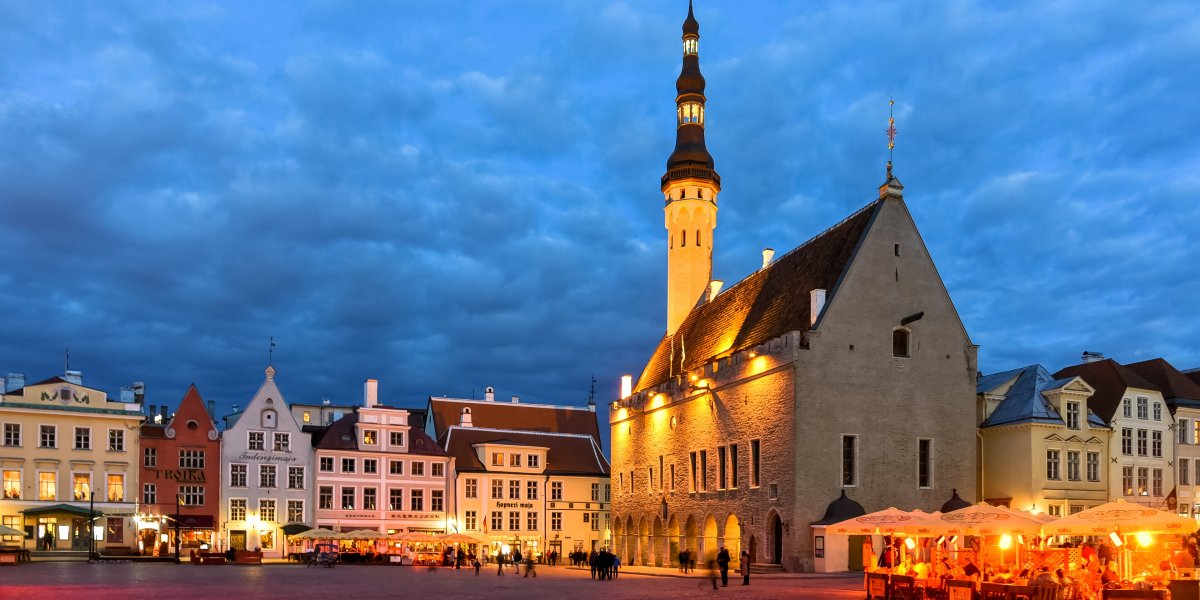
Turn right out of Kompressor and follow Rataskaevu east for three minutes; the narrow stone lane opens suddenly onto the square. The town hall (built 1404) is the oldest surviving in Northern Europe, with Old Thomas the weathervane watching from the spire since 1530. Early afternoon light rakes across the pastel Hanseatic merchant houses on the north side and throws the town hall's gothic arches into theatrical shadow — this is the light the square was painted in for six centuries. Duck into Raeapteek on the northwestern corner: the oldest continuously operating pharmacy in Europe (since 1422), with medieval remedies like burnt hedgehog powder still on display.
Tip: Stand at the northeastern corner of the square facing the town hall — from there the spire, Old Thomas, and the tower of the Holy Spirit Church line up in one clean frame. Raeapteek closes at 18:00 weekdays, 16:00 Saturdays, and is shut Sundays — fit it in now, not after dinner. The costumed hawkers pushing 'almond tasting' at the square stalls are upselling; two almonds cost a euro, a bag runs €8.
Open in Google Maps →16:00
Neighborhood
Leave the square heading north along Pikk — 'Long Street' — the merchant artery of Hanseatic Tallinn. In the next 400 meters you pass the Great Guild Hall, the Three Sisters gabled houses (now a hotel, but walk in to see the original 14th-century stonework in the lobby), and at Pikk 59 the former KGB headquarters — look for the bricked-up basement windows where the interrogation cells once were. At street's end stands St. Olaf's Church: for nearly two centuries (1549-1625) the tallest building on earth at 124 meters, and still Tallinn's northern anchor point. Continue 60 meters past the church to Fat Margaret, the squat coastal defense tower that marks the old sea gate, then follow the medieval wall walk back south along Laboratooriumi for the hidden inner-wall perspective almost no tour group sees.
Tip: For the classic St. Olaf's shot, stand at Pikk 67 facing north — the spire frames perfectly between two medieval gables and the late-afternoon light turns the limestone walls gold around 17:00. Skip the tower climb (€5): the interior is austere Lutheran with nothing to see, and the Kohtuotsa view you already had is strictly superior. Don't miss the narrow Laboratooriumi wall walk on the return — the sign 'Meistrite Hoov' leads to a courtyard of working artisan studios, not a shop-trap.
Open in Google Maps →19:00
Food
From the medieval wall walk cut east onto Uus street — three minutes — to number 31. The restaurant is hidden behind a stone wall in its own walled garden, easy to miss from the street (look for the small wooden sign that just says 'Leib'). 'Leib' means black bread, and the restaurant is the sharp antithesis of the costumed medieval inns on Town Hall Square: serious new Nordic Estonian cooking served at garden tables against the floodlit medieval wall. The Baltic herring with sour cream, red onion, and house black bread (€13) and the slow-braised wild boar with juniper and root vegetables (€26) are what Tallinn locals book weeks ahead for. Two courses, a glass of Estonian rhubarb wine, and coffee runs about €45 per person.
Tip: Reserve at least three days ahead and request a wall-side garden table — the indoor dining room is fine but the point of Leib is eating against the 15th-century city wall with the sconces lit. Pitfall warning for the entire Old Town: the three costumed 'medieval' restaurants around Town Hall Square (Olde Hansa, Peppersack, III Draakon) look charming from the street but run tourist-menu prices, and their 'authentic' cinnamon-and-honey beer is a 1990s marketing invention. Avoid any Pikk or Viru street restaurant with a hawker posted outside — those exist entirely for cruise-ship day trippers and will overcharge 40-50%.
Open in Google Maps →Saltar al día
09:00
Religious
Begin the day at Toompea Hill's highest point, where five onion domes rise against the morning light. Built in 1900 as a symbol of tsarist Russian power, this Orthodox cathedral now offers Estonia's most photographed facade — black spires striking against the limestone walls of Toompea Castle opposite. Morning is the only moment the square is quiet: by 10:30 the cruise-ship tour groups arrive in waves.
Tip: Step inside for the Byzantine choir during Divine Liturgy but slip out discreetly — photography is strictly forbidden in the nave. Walk around the cathedral's south side for an unusual angle framing the onion domes with the Parliament's pink facade behind.
Open in Google Maps →10:15
Landmark
Leave the cathedral, cross Lossi plats and follow Piiskopi street north — a 4-minute walk between crumbling bishops' houses leads you behind Toomkirik to the cliff edge. Two platforms crown the limestone ridge: Kohtuotsa faces east over an ocean of terracotta roofs and medieval spires (Estonia's most iconic panorama), while Patkuli, 3 minutes further, looks north toward the harbor. Morning sun lights the roofs in warm orange; by noon the angle flattens and tour buses claim the railings.
Tip: The rusted 'The Times We Had' sign at Kohtuotsa is the viral Instagram spot — stand to its left for the full roof sweep without other tourists in frame. Patkuli's 157-step staircase down toward the lower town is a tempting shortcut but wait: you'll descend the Short Leg next, which is more atmospheric.
Open in Google Maps →12:15
Food
Descend the Short Leg (Lühike jalg) staircase — a cobbled 14th-century merchants' passage — and turn right onto Rataskaevu for a 6-minute walk down to a legendary no-frills pancake joint. Kompressor serves pannkoogid the size of dinner plates: thin, stuffed, eaten with knife and fork. Since the 1990s this has been where students, office workers and in-the-know travelers refuel at long shared wooden tables — the smoked chicken & cheese pancake (7€) and the cranberry-goat-cheese sweet one (6€) are the two every local orders. With a Saku beer (4€), total 11-13€.
Tip: Arrive at 12:15 sharp — by 12:45 the queue reaches the street and every table turns twice. No reservations, card accepted but cash is faster. Order at the counter first, then grab any seat: half portions don't exist, and one pancake feeds one person with no room for dessert.
Open in Google Maps →14:00
Landmark
From Kompressor walk 3 minutes east down Dunkri street — the square opens suddenly in front of you, framed by pastel merchants' houses. This is the 700-year-old heart of Tallinn, dominated by the only surviving Gothic town hall in Northern Europe. Step into Raeapteek on the square's north corner — Europe's oldest continuously operating pharmacy (1422), still dispensing medicine while doubling as a free museum of medieval remedies. Exit through the archway onto Vene street and into St. Catherine's Passage, the moody lane where medieval tombstones line the wall.
Tip: The free Raeapteek museum hides in the back room — ask at the counter and staff will wave you through past the prescription window. Skip every restaurant directly on the square: they charge triple for mediocre food, a classic Old Town trap. Photograph the square from the corner of Dunkri and Raekoja plats at 15:00, when the sun lights the town hall tower but leaves the square in soft shadow.
Open in Google Maps →16:30
Religious
From St. Catherine's Passage exit onto Vene street, turn left onto Pikk — the oldest merchant road in town — and walk 7 minutes past guild houses with carved stone doorways. At 124 meters, this was the tallest building in the world from 1549 to 1625, and its observation deck remains the highest accessible viewpoint over medieval Tallinn. Climb 258 worn stone steps up a claustrophobic spiral stairwell for a 360° sweep: Old Town roofs on one side, the Baltic Sea and cruise port on the other. Late-afternoon light turns every copper roof gold.
Tip: Last entry is 17:45 in summer — arrive by 16:30 to beat the sunset crowd on the narrow spiral. The stairs have no rails for the final third; wear grip-soled shoes and don't attempt it carrying a heavy backpack. Tower is open only April through October.
Open in Google Maps →19:00
Food
Walk 6 minutes back down Pikk, turn right onto Rataskaevu — look for the unassuming wooden door at number 16, slightly below street level. Tucked inside a 15th-century merchant house, this is Tallinn's most beloved restaurant — a warm vaulted cellar where Estonian grandmother cooking meets chef-level finesse. The slow-braised elk roast with juniper cream (24€) has been the signature since 2010, and every returning local orders the sheep-cheese starter with sea buckthorn (12€) or the honey-baked Baltic salmon (22€). Mains with wine budget 35-45€.
Tip: Reserve 2-3 weeks ahead via their website — walk-ins are turned away nightly. Request the window table in the front room for cobblestone street views. Warning: ignore the costumed medieval-themed restaurants on Vana turg one block north (Olde Hansa, Peppersack) — the waiters in monk robes, honey beer in clay mugs and €40 mock-medieval platters are Tallinn's most infamous tourist trap, overpriced by a factor of three.
Open in Google Maps →09:00
Neighborhood
Take tram 1 or 2 from Viru keskus to Balti Jaam — 6 minutes — then walk north on Vana-Kalamaja street as the cityscape shifts from Soviet blocks to pastel wooden villas. A former fishermen's and factory workers' quarter where 19th-century wooden houses have been lovingly restored in every shade of mint, ochre and dusty pink, Kalamaja is where young Estonian creatives moved after the Old Town became a museum. Wander Salme, Vabriku and Soo streets at an unhurried pace — this is about absorbing a neighborhood's mood, not ticking monuments.
Tip: The rainbow row of Soo street 15-25 photographs best before 10 AM, when the low sun lights the facades and parked cars haven't filled the frame. If you see a carved wooden porch with a blue door — that's Kalamaja telliskatus style: gently point and ask residents, they're used to admirers and often wave back.
Open in Google Maps →10:30
Museum
From Soo street walk 10 minutes north along Kalaranna toward the sea — the trio of concrete hangar domes rises ahead, Tallinn's maritime icon. Housed inside a 1917 seaplane hangar — the world's first large-scale reinforced concrete shell structure, and itself a protected monument — this is Estonia's maritime museum reborn as immersive theater. Climb into the Lembit submarine (1936, the only preserved pre-WWII submarine still afloat), board the icebreaker Suur Tõll outside in the harbor basin, and stand under a replica seaplane hanging from the self-supporting 36-meter dome.
Tip: Enter at 10:00 opening sharp — by 11:30 the submarine interior has a 30-minute queue (the narrow ladder can only admit one at a time). Buy the ticket online the night before (€16, €2 cheaper than the counter and no line). Skip the ground-floor children's play hangar unless you're traveling with kids.
Open in Google Maps →13:15
Food
Walk 15 minutes south along Kalaranna, cutting inland at Kalju street — you'll pass Kalamaja park and a Soviet submarine on display before the glass market hall appears opposite the train station. Tallinn's reimagined market — a 2017 renovation turned a scruffy post-Soviet bazaar into the Baltics' best food hall, with 80 vendors selling black sprats, kama yogurt, Georgian khinkali and Uzbek plov. Try a pirukas hand pie with sauerkraut and pork from Pagaripoisid (2.5€), smoked Baltic sprats on rye at the fish counter (6€), and the Estonian curd snack kohuke (1.5€) for dessert — total 10-12€. Locals genuinely shop here, which is the whole point.
Tip: Eat standing at the long bar along the ground-floor fish counters — the view into the smokehouses beats any table seat upstairs. The basement has Tallinn's best deli (Kalakaubamaja) for taking home smoked eel and vacuum-sealed sprats. Avoid the upstairs Asian food stalls: they cater to tourists and quality drops noticeably.
Open in Google Maps →14:45
Neighborhood
From the market's south exit cross the railway bridge on Kopli street — 3 minutes — and red-brick industrial gates appear on the right. A former Soviet electrotechnical complex turned into the Baltics' largest creative hub: 10 hectares of converted factories housing design shops, street art murals, coffee roasters and the four-floor Fotografiska photography museum. Spend time inside Fotografiska's rotating exhibitions (curated with the same eye as Stockholm's flagship), then wander the alleys for murals by NoNaMe Crew and the stencil artist Edward von Lõngus.
Tip: The Fotografiska ticket (€16) grants access to its top-floor restaurant without queuing — worth it just for the view across the rail yards back to Old Town spires. The best murals hide on the back side of Building F, reachable via the narrow alley behind Café Frieda — most visitors miss them entirely.
Open in Google Maps →17:00
Landmark
From Telliskivi's east gate walk 15 minutes along Rannamäe tee, past shipyard cranes and the cruise terminal entrance — the vast limestone steppe rises ahead like a pyramid dropped by the sea. Built for the 1980 Moscow Olympics sailing regatta and abandoned in 2010, this Soviet mega-structure is decaying into the Baltic yet strangely beautiful — brutalism slowly reclaimed by moss, graffiti and teenage couples. Climb the monumental limestone staircase to the rooftop for an uninterrupted sea horizon, with Old Town spires lit gold to the east.
Tip: The rooftop is officially closed but the stairs remain open and locals ignore the faded signs; wear sturdy shoes — the concrete steps are uneven and crumbling at the edges. Arrive 60-90 minutes before sunset for golden-hour light on the Old Town silhouette. Skip the dim passages on the building's north (sea-facing) side: they're sketchy after dark and lead nowhere.
Open in Google Maps →19:00
Food
Walk 15 minutes back west on Rannamäe tee, cross the rail tracks at Kotzebue, and enter Telliskivi from its north side — F-hoone is the first tall industrial hall on your left. The restaurant that launched Telliskivi in 2010 — a former factory canteen reborn with exposed brick, factory windows three stories tall, and a menu that single-handedly taught Tallinn what Nordic-Estonian bistro cooking could be. The beef stroganoff with rye dumplings (17€) and wild mushroom risotto (14€) are on every local's short list; the rye-bread starter with smoked butter (6€) is non-negotiable. Mains with wine: 25-35€ — roughly half an equivalent Old Town dinner.
Tip: Reserve online at least 3 days ahead for Friday or Saturday — walk-ins wait 45+ minutes. Request the mezzanine for the best factory-window views; the ground-floor tables get loud after 20:00. Warning: the nearby Telliskivi Depoo food-truck yard looks tempting but the €12 burgers and lukewarm noodle boxes are genuinely mediocre — F-hoone is the only sit-down kitchen in this complex that consistently delivers at its price.
Open in Google Maps →
Trip builder
Plan this trip around Tallinn
Turn this guide into a bookable rail itinerary with FlipEarth.
Keep exploring
Related cities
More in the same country
FAQ
Frequently asked questions
How many days do you need in Tallinn?
Most travelers enjoy Tallinn in 1 days, with enough time for headline sights and a slower meal or museum stop.
What's the best time to visit Tallinn?
The easiest season for most travelers is Jun-Aug, especially if you want good weather and manageable crowds.
What's the daily budget for Tallinn?
A practical starting point is about €85 per person per day before hotels, then adjust based on museums, dining, and transport.
What are the must-see attractions in Tallinn?
A good first shortlist for Tallinn includes Kohtuotsa Viewing Platform, Raekoja plats (Town Hall Square).