City Guide
Belgrade
Serbia · Best time to visit: Apr-Oct.
Day-by-day plan
Choose your pace
Duración del viaje
09:00
Religious
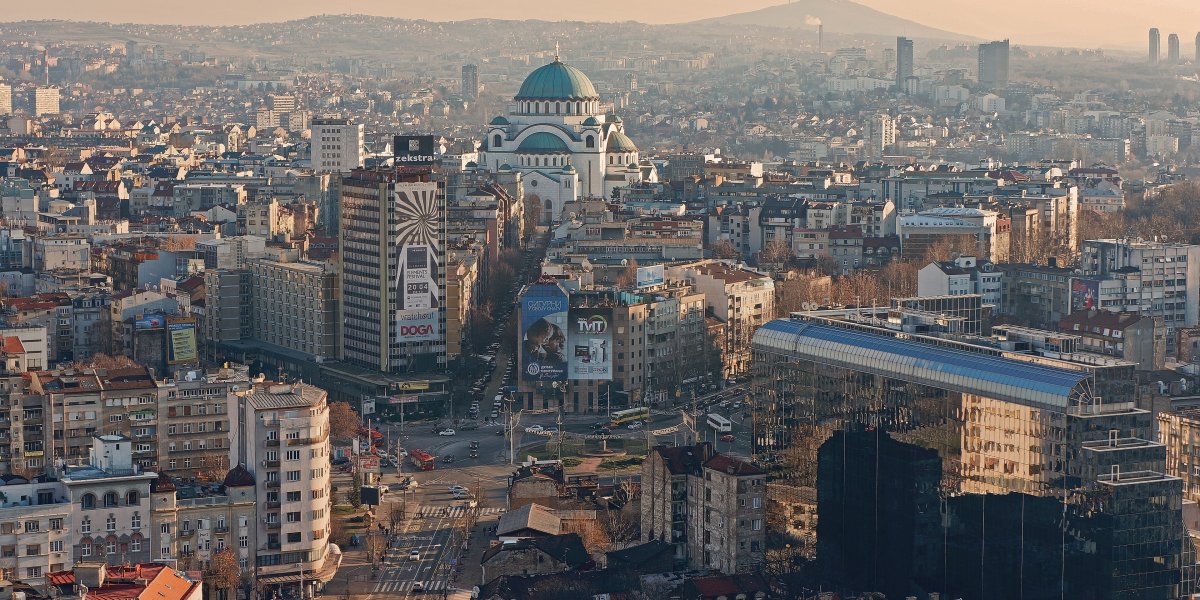
Start on the Vračar plateau where the largest Orthodox church in the Balkans commands the skyline. The Temple of Saint Sava is a fortress of white granite and marble crowned by a 70-metre dome — monumental even by Byzantine standards. The morning sun strikes the south facade at a low, warm angle, carving every arch and mosaic into sharp relief. Circle the building counterclockwise to take in the four-storey bronze doors, the gold mosaic above the main entrance, and the view south across the rooftops of residential Belgrade stretching toward the horizon.
Tip: The best photo frame is from the fountain in the south park, where you can capture the full facade symmetrically with no obstructions. Before 10:00, tour buses have not arrived and the plaza is nearly empty — this is the only hour you will get the building to yourself.
Open in Google Maps →10:30
Neighborhood
Walk north from the temple through the quiet residential blocks of Vračar — past corner bakeries exhaling the smell of fresh burek and old men playing chess in pocket parks — for about 25 minutes until cobblestones suddenly replace asphalt underfoot. Skadarlija is Belgrade's bohemian quarter: a single short cobblestoned lane of gas lanterns, ivy-wrapped facades, and century-old kafanas that has sheltered poets, painters, and rebels since the 1870s. In the late morning, before the lunch crowds and live musicians arrive, the street belongs to you and the resident cats.
Tip: The most photogenic shot is from the southern entrance looking uphill, with the wrought-iron lanterns converging into perspective. Come before noon — by 12:30 the street fills with diners and strolling musicians, atmospheric but impossible to photograph cleanly.
Open in Google Maps →12:00
Food
You are already on Skadarlija — Dva Jelena (Two Deer) sits mid-street behind a carved wooden sign and chestnut-shaded terrace. This kafana has occupied the same stone building since 1832, making it one of Belgrade's oldest operating taverns. Order the ćevapi u lepinji — ten hand-rolled beef-and-lamb fingers in warm flatbread with raw onion and kajmak, the tangy clotted cream that elevates Serbian grilled meat from good to transcendent (~€5). Add a cold draft Jelen Pivo (~€1.50). In and out in 30 minutes.
Tip: Sit on the terrace for the people-watching. Skip the 'tourist platter' some waiters push — locals order only the ćevapi or pljeskavica (Serbian meat patty, ~€6). Budget €7-10 per person with a beer. Do not linger past 12:45; you have a city to walk.
Open in Google Maps →13:15
Neighborhood
Exit Skadarlija at its northern end and cross Cara Dušana street — Republic Square opens up immediately to your right. Photograph the bronze equestrian Prince Mihailo with the columned National Theatre behind him, then turn northwest onto Knez Mihailova, Belgrade's grand pedestrian artery. Stroll its full 800-metre length toward Kalemegdan: Austro-Hungarian facades in cream and terracotta frame both sides, buskers fill the air with accordion waltzes, and the energy of a city that refuses to take itself too seriously pulses through the crowd. As the buildings thin and chestnut trees replace shopfronts, the fortress gates loom ahead.
Tip: The street performers on Knez Mihailova are genuinely talented — Belgrade's music scene starts on the pavement. Resist sitting at the branded outdoor cafés lining the street; they charge double normal Belgrade prices for the same espresso. Save your money for the kafana tonight.
Open in Google Maps →15:30
Landmark
Knez Mihailova deposits you at the park gates of Kalemegdan — follow the shaded gravel paths uphill past chess players and rose gardens toward the fortress walls. This citadel has been fought over 115 times across two millennia; every empire from Rome to Ottoman to Habsburg left a layer in the stone. Head straight for the Pobednik (Victor) monument on the river bastion: here the Sava and Danube converge in a panorama stretching from the Vojvodina plains to the towers of New Belgrade. In the afternoon light, the two rivers show distinctly different colours — one grey-blue, one green — merging into a single current below your feet.
Tip: After the Victor monument, walk the full circuit of the outer fortress walls facing northwest — the light on the confluence grows warmer by the hour. Then descend to the Lower Fortress terrace where locals gather with guitars and cheap wine as the sky softens over Zemun across the water. This is one of the finest free viewpoints in all of southeast Europe.
Open in Google Maps →19:00
Food
Walk downhill from the fortress gate along Kralja Petra street — in three minutes you will see a small stone building with a single oversized question mark on its facade. Znak Pitanja is Belgrade's oldest tavern, pouring since 1823. When the Serbian church across the street objected to the original religious name, the owner replaced it with a question mark — and it stuck for two centuries. Order the Karađorđeva šnicla — breaded rolled veal stuffed with kajmak, a dish invented in Belgrade and now the unofficial national entrée (~€8) — with a Šopska salata (~€3) and a glass of local Prokupac red wine (~€3).
Tip: Arrive by 19:00 to beat the dinner rush; by 20:00 every table is taken and the wait hits 30 minutes. A pair can usually grab a terrace table without a reservation. Budget €15-20 per person for a full meal with wine. Warning: the streets around Knez Mihailova and Republic Square are thick with restaurant touts pushing 'traditional Serbian food' at inflated prices — walk past all of them. The best food in Belgrade is always in the places that never need to hustle on the sidewalk.
Open in Google Maps →Saltar al día
09:00
Landmark
Start your Belgrade story at the exact spot where the Danube swallows the Sava — a confluence visible from nowhere better than the tip of this 2,000-year-old fortress. At 9 AM the morning sun lights the rivers from the east, turning the water into two distinct ribbons of silver and green. Walk the Upper Town ramparts, pass through the Stambol Gate, and end at the Pobednik (Victor) monument perched on a Roman column at the fortress edge — the single most iconic image of Belgrade.
Tip: Walk directly to the Pobednik monument first — at 9 AM you'll have the viewpoint nearly to yourself. Stand at the stone railing to the LEFT of the monument for the widest two-river panorama without the statue blocking the frame. By 10:30 tour buses arrive and the platform gets three-deep with selfie sticks.
Open in Google Maps →11:15
Neighborhood
Exit Kalemegdan through the main park gate and you're immediately on Belgrade's grand pedestrian boulevard — a straight, 800-meter promenade lined with ornate 1870s Austro-Hungarian facades, buskers, and the city's best people-watching. Don't rush through it as a transit corridor; look up at the second-floor ironwork balconies and carved caryatids that most visitors walk right past. The street funnels you naturally south toward Republic Square.
Tip: Skip the chain stores at street level — the real value is architectural. At number 46, duck into the Akademski Plato courtyard (the passage next to the SANU academy building) for a hidden square with a fountain that most tourists never find. It's 30 seconds off the boulevard and completely silent.
Open in Google Maps →12:30
Food
From the southern end of Knez Mihailova, turn right on Kralja Petra and walk 3 minutes to Belgrade's oldest kafana — open continuously since 1823. It's called 'The Question Mark' because the Orthodox cathedral next door objected to the original name, so the owner simply hung a '?' sign instead and never changed it. The courtyard tables sit in the shadow of the cathedral wall, one of the most atmospheric lunch settings in the city. At midday this is not a tourist restaurant — it fills with courthouse lawyers from across the street.
Tip: Order the ćevapi sa kajmakom (€4.50) — the kajmak (Serbian clotted cream) here is house-made and alone worth the stop. Add a šopska salata (€3) and a draft Jelen pivo (€2). Sit in the courtyard if the weather allows; the indoor room is charming but dark. Budget €8-12 per person.
Open in Google Maps →14:00
Museum
Walk 5 minutes back to Republic Square — the imposing neoclassical building on the north side reopened in 2018 after 15 years of painstaking renovation, and it was worth the wait. The collection spans from Vinča culture pottery (7,000 years old, predating anything in the Louvre) through medieval Serbian frescoes to a solid Impressionist gallery. For a focused 90-minute visit, go straight to the second floor: the Roman-era gold from Viminacium and the medieval gallery of Serbia's legendary monastery frescoes are the highlights.
Tip: Closed on Mondays. The Miroslav Gospel room (ground floor, room 4) houses one of the oldest Cyrillic manuscripts in existence — it takes 2 minutes to see but it's a UNESCO Memory of the World treasure. The post-lunch slot is ideal: the museum is never overcrowded, but at 14:00 you'll share entire galleries with nobody.
Open in Google Maps →16:00
Neighborhood
Exit the museum, cross Republic Square diagonally east, and within 5 minutes you're standing at the entrance arch of Belgrade's bohemian heart — a 400-meter cobblestone lane that has hosted poets, painters, and rebel musicians since the 1830s. Walk the full length slowly from south to north. In the late afternoon, restaurant musicians begin warming up, galleries throw open their doors, and the slanting golden light turns the pastel facades into something from a film set. The street is short but it's Belgrade's emotional center.
Tip: The southern end of Skadarska (near the entrance arch) is quieter with better craft shops and galleries. By 17:00 the accordion players start tuning up — tip 200 RSD (€2) and they'll play a request. Avoid the restaurants on the side street Cetinjska behind Skadarlija; they exist to catch overflow tourists with lower-quality food at the same prices.
Open in Google Maps →19:30
Food
You're already on Skadarska — Tri Šešira (Three Hats) at number 29 is the kafana that defines this street, pouring rakija since 1864. The interior is a time capsule of dark wood, old portraits, and candlelight. The live folk band starts around 20:00 and will serenade your table whether you planned on it or not. This is the definitive Belgrade dinner experience: unhurried, generous, and loud with laughter by the second carafe of šljivovica.
Tip: Reserve for 19:30 to be seated before the 20:00 rush. Order the vešalica (grilled smoked pork loin, €8) — the house signature, served sizzling. Start with urnebes (fiery cheese spread, €3) and finish by asking for a house rakija — they'll often pour a complimentary glass. Budget €15-25 with drinks. Warning: the restaurants with aggressive touts on Cara Dušana street behind Skadarlija are tourist traps with inflated prices — stay on the cobblestones.
Open in Google Maps →09:00
Religious
Take bus 40 or 41 from Stari Grad south to Vračar — a 10-minute ride to the hilltop plateau where one of the world's largest Orthodox churches commands the skyline. Step inside and stop. The interior, completed only in recent years after decades of painstaking work, blazes with over 50 million hand-placed gold mosaic tiles covering the dome, arches, and apse in a radiance that rivals anything in Istanbul or Ravenna. The central dome soars 70 meters above you — the scale makes language useless.
Tip: Enter through the south door and walk slowly north toward the altar — the gold mosaic of Christ Pantocrator in the dome reveals itself gradually, which is the architect's intended experience. Don't skip the crypt below (Church of Saint Lazar): white marble and gold mosaics in a completely different, intimate register. Before 10:00 you'll have the nave mostly to yourself.
Open in Google Maps →10:45
Museum
Walk 15 minutes north from Saint Sava through quiet, tree-lined Vračar streets — past sidewalk cafes on Krunska — to this small but electrifying museum housed in a 1920s villa. It holds Tesla's actual ashes (inside a golden sphere), his personal notebooks, original patent drawings, and most importantly, working replicas of his inventions demonstrated live by the guides. The English guided tour is essential — without it the museum is just glass cases and you'll miss everything that matters.
Tip: English guided tours run roughly every hour — arrive at 10:45 to buy your ticket and secure a spot on the 11:00 tour. The Tesla coil demonstration, where they light a fluorescent bulb wirelessly in your hand, is genuinely jaw-dropping even if you know the physics. The museum is small; the 45-minute tour plus browsing fills 1.5 hours perfectly.
Open in Google Maps →12:30
Food
Walk 12 minutes south through residential Vračar — past corner bakeries and grandmothers on balconies — to Belgrade's largest and most vibrant farmers' market, a sprawling outdoor-indoor maze where the city feeds itself. This is not a tourist market; it's where Belgrade buys its kajmak by the kilo and argues over pepper prices. Your lunch is here: grab a massive cheese burek from the bakery stalls flanking the Maksima Gorkog entrance, a cup of fresh yogurt, and whatever seasonal fruit catches your eye.
Tip: The bakeries on the Maksima Gorkog side have the best burek — ask for 'sa sirom' (cheese, €1.50) or 'sa mesom' (meat, €2) and a cup of yogurt (€0.50). Walk through the indoor dairy hall to see kajmak sold from open buckets — buy a small tub (€2) with fresh pogačica bread for an absurdly good lunch under €4. The market winds down after 14:00, so don't linger past 13:30.
Open in Google Maps →14:00
Neighborhood
Walk 25 minutes northwest from Kalenić down Nemanjina street — past the grand old railway station facade — until the hill drops you into Savamala, Belgrade's gritty-turned-creative quarter wedged between the hillside and the Sava riverbank. Once a decaying warehouse district, it has become the city's artistic nerve center: five-story murals blaze across entire building facades, industrial spaces house galleries and design studios, and the energy here is raw, young, and unmistakably Belgrade's future.
Tip: The densest street art is concentrated on Karađorđeva street between Gavrila Principa and the riverbank — walk slowly and look up at the building sides for the massive murals. The neighborhood is perfectly safe by day but poorly lit on the back streets at night; stick to Karađorđeva and the river promenade after dark.
Open in Google Maps →16:30
Neighborhood
Continue south along the Sava from Savamala and the grit suddenly gives way to glass, steel, and a manicured 2-kilometer riverfront promenade — Belgrade Waterfront is the city's ambitious new development, and whatever you think of the politics behind it, the Sava Promenade at golden hour is undeniably beautiful. Walk south toward Ada Bridge as the late afternoon light hits the water from the west, turning the river into liquid copper. This is Belgrade's newest face, and the contrast with old Savamala five minutes behind you is striking.
Tip: The best sunset view is from the promenade facing southwest toward Ada Bridge — peak light between 17:30 and 18:30 in spring and summer. The riverside cafes are surprisingly fair (espresso €2, craft beer €3). The Galerija shopping mall at the north end has clean restrooms and air conditioning if you need a break before dinner.
Open in Google Maps →19:00
Food
Walk 15 minutes north along the riverbank promenade to Beton Hala — a row of converted concrete warehouses on the Sava that house Belgrade's finest waterfront restaurants. Ambar serves modern Balkan small plates designed for sharing: deconstructed Serbian classics paired with excellent local wines, on a terrace overlooking the river and the illuminated Brankov Bridge after dark. This is Belgrade's contemporary dining at its peak — ambitious food in a city where a world-class dinner costs what a mediocre lunch costs in Paris.
Tip: Book the unlimited small plates tasting (around €22) — extraordinary value that lets you try 10+ dishes including kajmak croquettes, smoked trout, and slow-cooked lamb. Request a riverside terrace table when reserving. Pair with a glass of Prokupac (Serbia's indigenous red grape, €4) — it's an underrated wine that deserves to be famous. Budget €25-35 with wine. Final tip: ignore the 'city tour' touts loitering near Beton Hala offering overpriced guided walks — you've already seen the best of Belgrade on your own feet.
Open in Google Maps →
Trip builder
Plan this trip around Belgrade
Turn this guide into a bookable rail itinerary with FlipEarth.
Keep exploring
Related cities
More in the same country
FAQ
Frequently asked questions
How many days do you need in Belgrade?
Most travelers enjoy Belgrade in 1 days, with enough time for headline sights and a slower meal or museum stop.
What's the best time to visit Belgrade?
The easiest season for most travelers is Apr-Oct, especially if you want good weather and manageable crowds.
What's the daily budget for Belgrade?
A practical starting point is about €45 per person per day before hotels, then adjust based on museums, dining, and transport.
What are the must-see attractions in Belgrade?
A good first shortlist for Belgrade includes Kalemegdan Fortress.