City Guide
York
United Kingdom · Best time to visit: Apr-Oct.
Day-by-day plan
Choose your pace
Trip length
09:00
Landmark
Start the day elevated. Climb the stone stair at Bootham Bar — the northern gateway — and walk the medieval ramparts eastward to Monk Bar. The 1.2 km stretch is the finest section of the entire 3.4 km circuit: the Minster rises on your right and shifts angle with every step, first a silhouette through the trees, then looming full-height above the rooftops. Morning light comes from the east and throws the cathedral's north face into sculpted relief — a view no ground-level street will ever give you.
Tip: Enter Bootham Bar before 09:30 — tour groups only start arriving at 10:00. Stop at the third bench before Monk Bar (you'll see it; most people walk past): it frames the Minster's east end perfectly with the morning sun behind you, lighting the stone honey-gold. Wear grippy soles — the steps are worn smooth by 700 years of feet.
Open in Google Maps →10:45
Religious
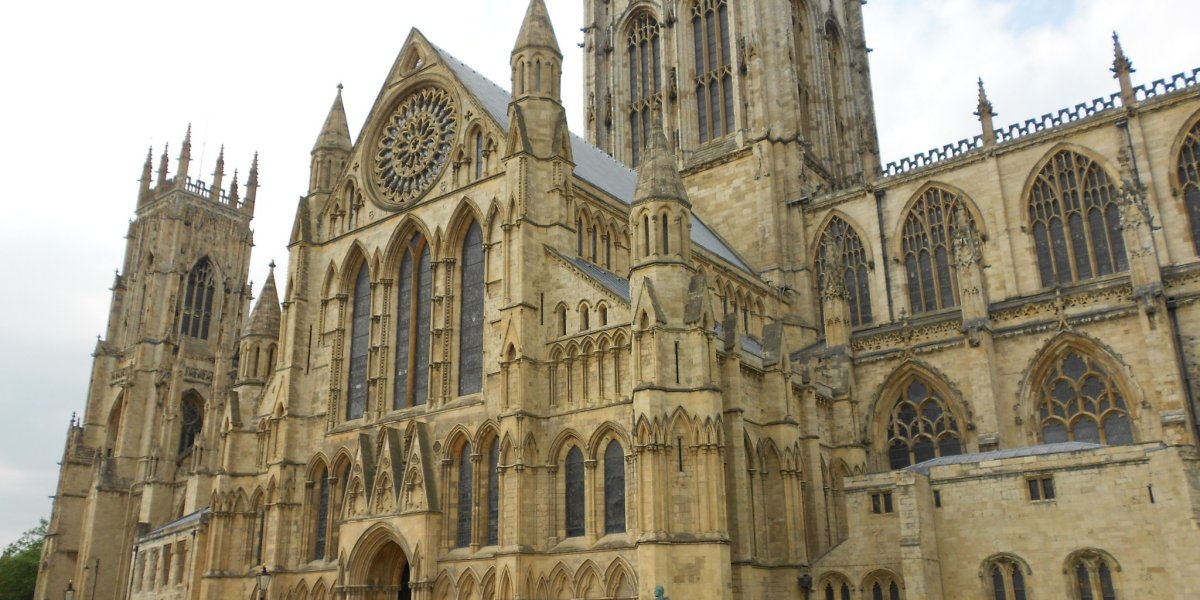
Descend the steps at Monk Bar and walk three minutes south down Deangate — the West Front reveals itself all at once, which is the way medieval pilgrims were meant to see it. The largest Gothic cathedral in Northern Europe, 160 metres long, with the finest medieval stained glass in the world still locked inside its walls. We won't go in — the value today is the envelope, and specifically two angles most visitors miss.
Tip: Skip the West Front selfie spot where everyone clusters. Walk 90 seconds around to Dean's Park behind the Minster — from the Treasurer's House lawn you get the East Window, the Chapter House, and the Central Tower in one frame, with a medieval stone wall foreground. 10:45 is the sweet spot: the coach-tour rush has moved inside, and the sun has swung south enough to evenly light the tracery without casting a harsh shadow from the tower.
Open in Google Maps →12:00
Neighborhood
From the Minster's south door, follow Low Petergate down for four minutes — the street narrows, the timber facades lean in, and you step into the 14th century. The Shambles is Europe's best-preserved medieval street: a butcher's lane since 1086, with overhanging upper floors that nearly kiss above the cobbles. The hooks where carcasses once hung are still bolted to the beams. J.K. Rowling is widely said to have pulled Diagon Alley from this exact view.
Tip: Midday is deliberate — the sun is high enough to drop light between the overhanging eaves onto the cobbles; any earlier and the whole street sits in deep shadow. Halfway down, duck into Little Shambles on your right: shoot back through the stone archway for a cleaner, crowdless composition that almost no visitor knows about. Ignore the ten identical "Harry Potter wand shops" — they opened in 2018 and charge £35 for a stick.
Open in Google Maps →12:50
Food
Thirty seconds from the bottom of the Shambles, on your left at number 24. A tiny takeaway counter that won the BBC Good Food Street Food award — Yorkshire pulled pork shoulder slow-cooked overnight, carved to order onto a brioche bap with apple slaw and house sauce. Real locals queue here at lunchtime; the Instagram crowd queues down the street at the sandwich shop with the neon sign.
Tip: Order the 12-hour pulled pork bap (£8.50) or the Korean beef brisket bao (£8) — both unbeatable. Arrive at 12:50 sharp, not 13:00: the queue triples between 13:00 and 13:30. Take the food two minutes to King's Square and eat on the benches with the street performers — far better than the cramped interior. Budget £10-14 with a drink.
Open in Google Maps →14:15
Landmark
Cut south from the Shambles through Pavement and down Castlegate for seven minutes — the tower rises suddenly on its Norman motte, a lone stone quatrefoil like a chess piece left on a green lawn. Circle the base, climb the grassy mound steps for the full 360° panorama of the city (walls, Minster, and rooftops in one sweep), then descend through Tower Gardens to the River Ouse. Follow the waterside path upstream under Skeldergate Bridge — the walk itself, along the willows with the Minster towers floating above the rooftops, is the quiet reward of the day.
Tip: Afternoon is the right window — the sun hits the tower's west face, lengthening shadows down the motte and making the 13th-century stonework look three times taller. Save the entry fee; the exterior is what matters, and the best photograph is from the Eye of York car park below with daffodils (spring) or cherry blossom in foreground. Finish the walk by crossing Skeldergate Bridge to the south bank — the view back toward the city from mid-bridge is the shot most people miss.
Open in Google Maps →18:30
Food
From Skeldergate Bridge, follow the river path past the Bonding Warehouse and climb up to Micklegate — ten minutes along the water, ending at number 98. Chef Neil Bentinck's small-plates restaurant is York's most acclaimed table, regularly ranked in the UK top 100. The menu changes weekly around what Yorkshire's farms delivered that morning: think crispy pig cheek with kimchi and sesame (£10), Whitby crab crumpet (£12), and the legendary short rib with smoked bone marrow (£14). Four to six plates is the sweet spot.
Tip: Reserve a minimum of one week ahead — they have 10 tables and walk-ins are turned away nightly. Request the kitchen counter when booking: you watch every plate built in front of you, and the pass-chef will explain what's on the next course. Budget £40-55 per head with wine. Pitfall warning: don't be tempted into the chain "traditional English pubs" lining Stonegate and Petergate — they microwave £18 shepherd's pies and have laminated menus in four languages. A real York pub has one handwritten chalkboard and no sign in Mandarin.
Open in Google Maps →Jump to day
09:30
Religious
The largest Gothic cathedral in Northern Europe, 250 years in the building (1220 to 1472), with more medieval stained glass packed into its walls than anywhere else in Britain. Enter at the stroke of opening, before the coach groups arrive, so you have the nave, the chapter house and the Great East Window almost to yourself. The 275 spiral steps of the central tower finish 60 metres up, on a roof that looks straight down York's red-tile chessboard to the Yorkshire Wolds.
Tip: Book the 09:30 tower climb slot online two weeks ahead — it is the first of the day, only 50 tickets per slot, and the roof is empty before the 11:00 crowds. The stairs are 13th-century narrow and strictly one-way; wear trainers, leave the backpack in the cloakroom.
Open in Google Maps →12:00
Food
Exit the Minster's south door and turn left down Low Petergate — the red-brick shop with the hog turning on the spit in the window is three minutes away. Order the Yorkshire pudding wrap: a pillow-soft pudding folded around roast pork, crackling, sage stuffing and a ladle of gravy, invented on this very street. You eat it standing, elbows on the counter, in seven minutes — lunch as York actually does it.
Tip: Ask for the classic pork wrap with extra crackling (£7.50) or, if you have skipped breakfast, the 'Yorkshire Big Pig' (£9) will carry you to dinner. Go before 12:15 or after 13:30 — the 20-minute queue at 12:45 is entirely avoidable.
Open in Google Maps →13:00
Neighborhood
Continue down Low Petergate and turn right — two minutes later you step into a street whose shape has not changed since 1400. The overhanging timber butcheries lean toward each other across the cobbles, narrow enough that neighbours on opposite upper floors could shake hands, meat hooks still bolted to the beams. Duck through the archway behind into Shambles Market for York's only real street-food yard: a circle of sourdough, Wensleydale and Yorkshire gin stalls ringed by the medieval roofline.
Tip: Walk to the Pavement end first and shoot back up the street at head height — the converging timbers frame the shot no guidebook gets right. Ignore the three 'Harry Potter' stores; the wizarding link is invented marketing and their merchandise is twice the Warner Bros. price.
Open in Google Maps →14:30
Museum
Backtrack up Stonegate — the discreet passage of Coffee Yard on your left opens into Barley Hall, four minutes from the Shambles. A 14th-century timber hall that survived by being swallowed inside a Victorian warehouse until workmen found it in 1984, now staged as a wealthy merchant's home with painted plaster, a minstrel's gallery and a glowing oriel window. Fewer than 80 visitors an hour pass through — the hush is part of the experience.
Tip: Stand at the far end of the Great Hall with the gallery at your back and shoot toward the oriel — the afternoon light comes through stained glass onto the long table and gives you a Holbein painting in a single frame. Roughly half the hall is 1980s reconstruction, but every visible timber frame is original.
Open in Google Maps →15:45
Landmark
Cut through Grape Lane and across Duncombe Place — the Minster will be over your right shoulder for the whole five-minute walk to Bootham Bar. Climb the worn stone stairs onto York's 13th-century walls and follow them east along the 1.2 km stretch that skirts the cathedral close; the Minster's south transept aligns itself perfectly between every crenellation on this section alone. You finish at Monk Bar, the tallest of the four medieval gatehouses, with its portcullis still hanging in its grooves.
Tip: Start at Bootham Bar within 90 minutes of sunset — the Yorkshire limestone turns amber and the Minster windows catch the low light from the west. Warning: the tea rooms clustered on Low Petergate charge £12 for a joyless cream tea; cross to Bettys on St Helen's Square if you want the real thing, and ignore anyone handing out 'York Ghost Walk' flyers at Monk Bar — two of the three operators are unlicensed and their routes repeat the same three pubs.
Open in Google Maps →19:00
Food
Descend Monk Bar's steps, walk west past the Minster's east end and across Lendal Bridge — the Ouse runs black beside you in the dusk, fifteen minutes to Micklegate. Skosh is a nine-table room run by chef Neil Bentinck, serving small plates drawn from a Yorkshire larder and a Korean-Japanese pantry — the most exciting cooking in York, without a white tablecloth in sight. This is where York chefs eat on their nights off.
Tip: Order the smoked cod's roe with katsu sauce (£9), the crispy pig's head nugget (£8) and the braised beef-and-kimchi dumplings (£12) — four plates per person is the right volume. Book online two weeks ahead for a Saturday; early Friday (18:00) walk-ins at the four-seat bar are usually possible if you arrive the minute they open.
Open in Google Maps →10:00
Museum
Make your way to Coppergate — Jorvik's entrance is tucked beside the shopping centre fountain, almost invisible from the street. A time-car runs you slowly through a block-for-block reconstruction of Viking Jorvik in AD 975, built directly above the 1976-81 archaeological dig that produced every house, every animated face and every smell you pass. It is the single place in Europe where a Viking city is rebuilt on the ground where it was found.
Tip: Arrive at 09:55 with a pre-booked 10:00 timed ticket — the first car of the day has no queue and you will drift through the village with no one ahead of you. The smell is authentic (developed from the Coppergate dig soil samples) and slightly fishy; breathe through your mouth in the 'quayside' scene.
Open in Google Maps →11:45
Landmark
Exit Jorvik and turn right down Castlegate — the grassy mound with the stone keep on top rises five minutes ahead. William the Conqueror's motte was rebuilt in quatrefoil stone in the 1240s, burned in 1190 during the massacre of York's Jewish community who had taken refuge inside, and reopened in 2022 with a timber sky-deck that floats inside the roofless shell. Climb for the 360° panorama where the Minster, the Ouse and the walls all line up in a single frame.
Tip: On the sky-deck, face north-west — the Minster sits exactly on axis with the roof of Fairfax House and the crook of the Ouse, the single best city panorama in York. Fewer than half of visitors notice the Hebrew memorial plaque at the foot of the mound; read it before you go up.
Open in Google Maps →13:00
Food
Descend the tower's wooden stairs, cross Clifford Street and follow Coney Street north — ten minutes along York's shopping spine brings you to the quiet end of Blake Street. Mannion's is a family deli-café in a creaky-floored Georgian house, the kind of place York lawyers have taken their visiting parents for twenty years. Flat whites pulled properly, a Yorkshire rarebit with Henderson's relish bubbling under the grill, a counter of Wensleydale and Fat Rascal scones to take away.
Tip: Order the Yorkshire rarebit with Henderson's relish (£9.50) and a flat white — and buy one Wensleydale-and-fruit Fat Rascal scone (£3.50) for the afternoon. Sit at the window bench on Blake Street; arrive before 12:30 or after 13:30 to miss the lunch rush, as the deli seats only 28.
Open in Google Maps →14:15
Museum
Exit Mannion's and walk west along Museum Street — the museum's Greek Revival portico rises through the plane trees of Museum Gardens in four minutes. Three objects justify the visit on their own: the Middleham Jewel (a 15th-century gold pendant set with a sapphire, insured for £2.5 million), the Ninth Legion sarcophagus dug out from beneath York station, and the Coppergate Helmet — the most complete Anglian helmet ever found in Britain, pulled whole from a Fishergate pit in 1982. All from this one city.
Tip: Skip the geology gallery on the ground floor and go straight up to the Medieval Gallery — the Middleham Jewel is in the back-left corner and most tour groups miss it entirely. Photography is allowed without flash; the jewel's sapphire catches the gallery's spotlight if you shoot from a 30° angle above.
Open in Google Maps →16:00
Park
Step out of the museum's back door — the abbey ruins are thirty seconds away, framed on a sloping lawn where peacocks still wander in summer. St Mary's was the richest Benedictine abbey in northern England until Henry VIII pulled its roof off in 1539; the west wall still stands four storeys high, an empty rose window cutting the sky, Yorkshire's most photogenic ruin. Come at 16:00 in season, when the late-afternoon light pours through the arch from the west.
Tip: Stand on the lawn directly in front of the west wall and shoot low with the rose-window arch framing the Minster towers behind — it only aligns from one patch of grass, about 20 paces from the stonework. Warning: the 'Ghost Walk' operators hovering near Lendal Bridge at dusk oversell badly; the Original Ghost Walk of York (20:00 nightly from the King's Arms on King's Staith, £8) is the only one locals rate, and it runs in any weather.
Open in Google Maps →19:00
Food
Stroll south through Museum Gardens to the riverside path — The Star occupies the old Lendal engine house, three minutes with the Ouse on your left. Chef Andrew Pern's Michelin-starred North Yorkshire cooking, distilled — Yorkshire blue cheese soufflé, slow-cooked moorland lamb shoulder, rhubarb-and-ginger trifle — served in a glass-walled room that hangs over the water. The right farewell dinner for York.
Tip: Order the Yorkshire blue cheese soufflé (£14) to start and the slow-cooked moor lamb (£32) as the main — Pern's signatures, both, and priced well below his Michelin-starred Harome mother-ship. Request the riverside terrace when booking (only 20 seats); reserve a week ahead for Saturday, and ask for the 19:00 slot so you catch the last light on the river before the kitchen closes.
Open in Google Maps →
Trip builder
Plan this trip around York
Turn this guide into a bookable rail itinerary with FlipEarth.
Keep exploring
Related cities
More in the same country

FAQ
Frequently asked questions
How many days do you need in York?
Most travelers enjoy York in 1 days, with enough time for headline sights and a slower meal or museum stop.
What's the best time to visit York?
The easiest season for most travelers is Apr-Oct, especially if you want good weather and manageable crowds.
What's the daily budget for York?
A practical starting point is about €110 per person per day before hotels, then adjust based on museums, dining, and transport.
What are the must-see attractions in York?
A good first shortlist for York includes York City Walls (Bootham Bar to Monk Bar), Clifford's Tower & River Ouse Walk.