City Guide
Trujillo
Spain · Best time to visit: Apr-Jun, Sep-Oct.
Day-by-day plan
Choose your pace
Trip length
09:00
Landmark
Arrive on Plaza Mayor before the first coaches from Cáceres pull in — at this hour the rising sun strikes the eastern arcade and turns the sandstone the exact gold the conquistadores once shipped home from Peru. Stand beneath the bronze equestrian Pizarro and look across to the Palacio de la Conquista, whose corner balcony is carved with the family coat of arms; the man who toppled the Inca Empire was born in a hut three streets from this square. The whole plaza is a Renaissance set piece you'd swear was built for a film.
Tip: The best photo angle is from the steps of the Iglesia de San Martín at the northeast corner around 09:15, when the low southern sun rakes across the Palacio de la Conquista's facade and lights up the family portraits carved into the balcony. Skip the cafés directly on the square — they charge double. Walk one block south to Café Beatriz for the locals' morning coffee at half the price.
Open in Google Maps →10:15
Religious
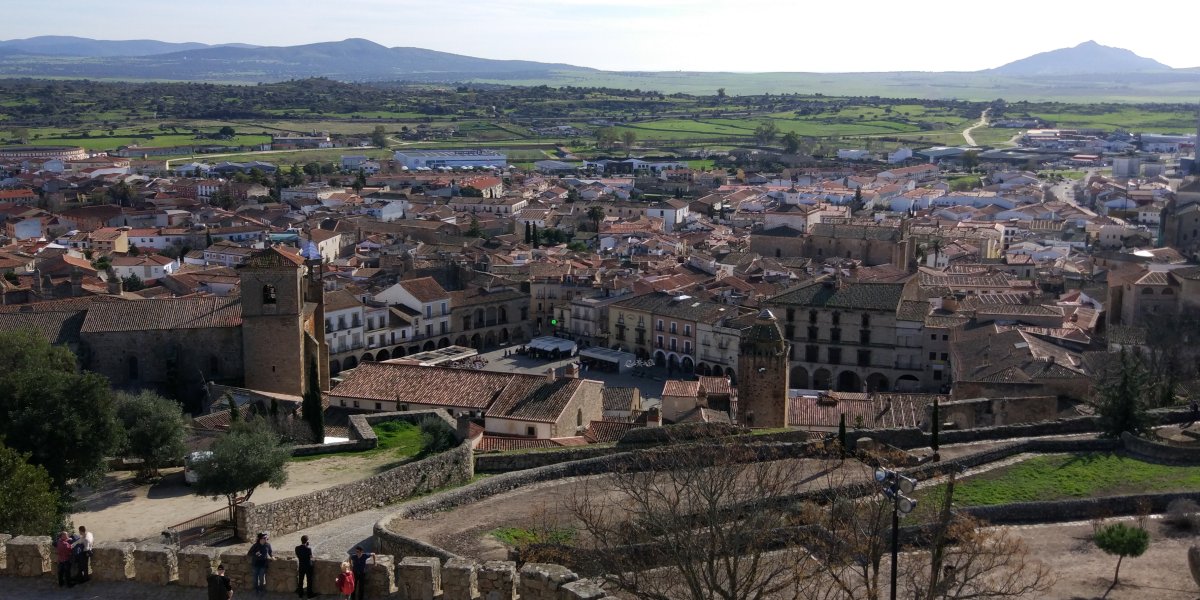
From Plaza Mayor, head north up Calle Ballesteros — a steeply cobbled lane through the old Jewish quarter, five minutes of climbing past escutcheoned doorways and noble houses still bearing their medieval iron lanterns. Santa María la Mayor rises at the top, the Gothic-Renaissance church where Queen Isabel I of Castile attended mass when the royal court came to Trujillo, and where Pizarro was baptized in 1471. Circle the granite apse for the carved capitals, then step out behind it for your first long view down across the terracotta rooftops to the dehesa.
Tip: By 10:30 the southwest light catches the bell tower from the small overlook on the path that climbs toward the castle — that's your best frame, with the tower in the foreground and the dehesa stretching out behind it. Don't bother detouring to the Iglesia de San Francisco in the lower town; it's heavily 19th-century-restored and underwhelming compared with what's still to come.
Open in Google Maps →11:15
Landmark
Continue up the same lane behind Santa María for eight minutes — the cobbles give way to bare granite outcrops and you'll feel the wind change as you crest the hill. The Moorish castle was raised by the Almohads in the 9th century, taken back by Christian forces in 1232, and now sits empty atop the town like a stone crown. Walk the full circuit of the curtain walls for the 360° view across the Extremaduran dehesa — the rolling oak savanna where the iberico pigs roam, the same horizon a barefoot teenage Pizarro stared at before sailing west.
Tip: Climb the eastern tower nearest the old cistern — it gives the cleanest framing of the dehesa to the north and is almost always empty, even when the main keep has a small crowd. There is no shade on the ramparts and no fountain inside the walls; carry water. The Virgen de la Victoria statue on the central tower is the spot where locals come at sunset, but at midday the light is harsher and your photos will be better from the northwest corner.
Open in Google Maps →13:30
Food
Descend by the same lane — it's faster down than the southern route, eight minutes back to Plaza Mayor, then duck into Calle Tiendas just behind the square. 7 Jaras is the locals' iberico shrine: a tiny standing-room tapería where the hams hanging from the ceiling are bellota-grade from nearby Montánchez. Order a tabla of jamón ibérico de bellota (€14), a slab of queso de la Serena (€6), and a glass of Ribera del Guadiana tinto (€2.50) — that's the entire lunch, eaten standing at a marble counter with farmers in muddy boots, and that is exactly the point.
Tip: Arrive at 13:30 sharp — by 14:00 the bar fills with regulars off the morning shift and you'll wait twenty minutes for a counter spot. Ask for picos (the little breadsticks) which are free, instead of the bread basket which they charge for. The secret order is the €4 montadito de presa ibérica — pork shoulder grilled rare on dark bread; the owner only makes it on request and it's better than anything on the printed menu.
Open in Google Maps →15:30
Neighborhood
Three minutes from 7 Jaras you're back on Plaza Mayor — and now you walk the money trail in stone. Start at the Palacio de la Conquista on the southwest corner (Hernando Pizarro built it with Inca gold and had his family's portraits carved into the corner balcony), drift south through the lanes to the Palacio de los Duques de San Carlos with its spiral Renaissance staircase visible through the open courtyard, then loop east to the Palacio de Orellana-Pizarro and the Casa de las Cadenas — its iron chains over the door marking it as a sanctuary granted by the Catholic Monarchs. Finish along the medieval walls on the southern side of the old town, where the light starts to gild the granite as the afternoon tips toward evening.
Tip: Around 17:30 the raking western sun hits the corner balcony of the Palacio de la Conquista exactly head-on — the four carved family portraits jump out of the stone for about fifteen minutes and you'll never get a better shot of them. The courtyard of the Palacio de los Duques de San Carlos is free to enter through the gate on Calle de los Mártires (it's now a convent — knock politely; the nuns let visitors look at the staircase between 16:00 and 18:00).
Open in Google Maps →19:30
Food
Two minutes back into Plaza Mayor — Mesón La Troya is at number 10, the most legendary table in Extremadura. The matriarch Concha ran it for sixty years and even now every diner is set down with a free starter of tortilla de patatas, chorizo, and pickles before the menu arrives — that ritual has not changed. Order the migas extremeñas (€9) and the costillas de cordero al estilo Trujillo, slow-roasted lamb ribs (€19), drink the house Ribera del Guadiana, and you'll understand why farmhands and government ministers eat shoulder-to-shoulder at the same long oak tables.
Tip: Phone ahead for 20:00 if you possibly can (+34 927 32 13 64) — walk-ins are seated but often share tables with strangers, which is half the experience but unpredictable on weekends. Portions are notoriously huge: two people should order one starter and one main between them, no more. AVOID the restaurants directly facing Plaza Mayor with laminated picture menus in five languages — they charge double and the food is half; they survive entirely on day-trippers who don't know better. Also ignore the touts handing out 'free tapa with drink' cards in the square — they funnel you to overpriced bars on Calle Sillerías. La Troya is the only address on the plaza that locals will defend.
Open in Google Maps →
Trip builder
Plan this trip around Trujillo
Turn this guide into a bookable rail itinerary with FlipEarth.
Keep exploring
Related cities
More in the same country
FAQ
Frequently asked questions
How many days do you need in Trujillo?
Most travelers enjoy Trujillo in 1 days, with enough time for headline sights and a slower meal or museum stop.
What's the best time to visit Trujillo?
The easiest season for most travelers is Apr-Jun, Sep-Oct, especially if you want good weather and manageable crowds.
What's the daily budget for Trujillo?
A practical starting point is about €95 per person per day before hotels, then adjust based on museums, dining, and transport.
What are the must-see attractions in Trujillo?
A good first shortlist for Trujillo includes Plaza Mayor & Statue of Francisco Pizarro, Castillo de Trujillo.