City Guide
Newcastle upon Tyne
United Kingdom · Best time to visit: May-Sep.
Day-by-day plan
Choose your pace
Trip length
09:00
Neighborhood
Begin at the foot of Grey's Monument, the 41 m Doric column to Earl Grey (yes, of the tea), and radiating south from it is Grainger Town — England's finest Georgian quarter outside Bath, where curving Grey Street earned its title of "Britain's most beautiful street." Loop through the cast-iron-roofed Grainger Market and past the Theatre Royal's six-column portico; this is Newcastle's stately face, and most visitors skip it for the Quayside, which is exactly why you start here while the city is still waking up.
Tip: At 09:00 the morning sun fires straight down Grey Street from the north — stand at the Monument's south steps and shoot the curve before delivery vans clog the frame after 10am. The honey-stone shopfronts glow gold for about 40 minutes only.
Open in Google Maps →10:30
Landmark
Walk south on Grey Street and slip down the narrow Side past St Nicholas Cathedral — 8 minutes downhill to the cluster of medieval sandstone marooned by Victorian railway viaducts. The "New Castle" of 1080 (rebuilt 1172) and the 13th-century Black Gate are the reason this city has its name, and the cobbled alley running between them — Norman walls below, soaring rail arches overhead, the Tyne flashing beyond — tells a thousand years of Tyneside history in a single frame.
Tip: Skip paying for the Keep interior — the free Castle Garth terrace behind the Keep gives you the postcard shot of the Tyne Bridge framed by the railway arches, the same view an £8 ticket buys from inside. Stand at the south-east corner of the platform for the cleanest line.
Open in Google Maps →12:00
Food
Climb back up onto Mosley Street and turn down High Bridge — 5 minutes through Newcastle's narrowest medieval lane to the cash-walled, no-airs Sardinian-Italian institution every Geordie grew up eating at. Order the Penne Pollo Pani (chicken, pesto, cream — £12) or the Sardinian sausage panino (£9); plates are huge, service is loud, and an hour here primes you perfectly for the long Quayside walk.
Tip: Walk in at 12:00 sharp and you'll be seated immediately; after 12:30 the queue runs down High Bridge for 30+ minutes. No reservations for under 8 people, and the daily specials chalkboard (often a Sardinian gnocchi) is always better than the printed menu.
Open in Google Maps →13:00
Landmark
Take the Dog Leap Stairs (or follow the Side around) down to Sandhill — 8 minutes, all downhill, ending under the green steel arch of the Tyne Bridge (1928, the prototype for Sydney Harbour, built by the same Middlesbrough firm). Walk west along the Quayside past the squat Swing Bridge and the soaring stone tiers of Robert Stephenson's High Level Bridge; this 1.5 km stretch puts six bridges in one view and is where Geordies bring out-of-towners to say, "this is ours."
Tip: The classic six-bridges photo is taken from the south end of the Swing Bridge looking west, but locals know the better one is from the High Level Bridge's lower pedestrian deck — you frame the green arch of the Tyne Bridge through Victorian stone arches with the river below. Free, and you'll be the only one up there.
Open in Google Maps →15:30
Landmark
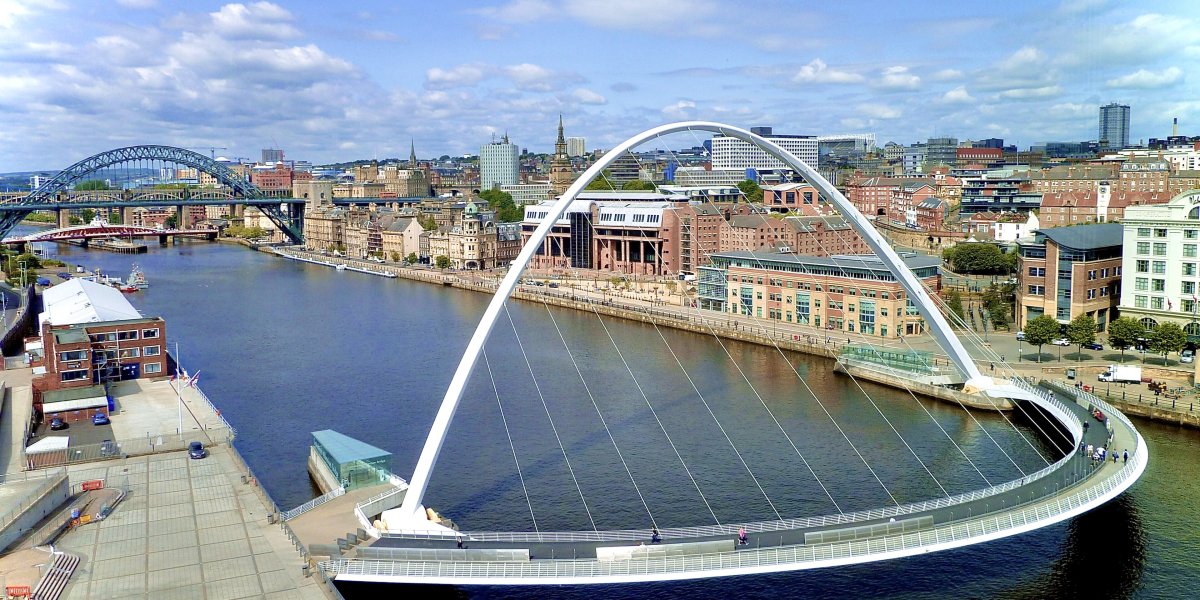
From Sandhill walk 600 m east along the wooden Quayside boardwalk past moored boats — the white arc of the Gateshead Millennium Bridge (the world's only tilting bridge) appears at the end. Cross it on foot to Gateshead, where the BALTIC Centre for Contemporary Art rises out of a 1950s flour mill and Norman Foster's wave-roofed Glasshouse concert hall sits beside it; linger through golden hour, when the low western sun catches BALTIC's brick wall and the white bridge throws a clean reflection on the Tyne.
Tip: The bridge's "blinking eye" tilt runs on an unpublished daily schedule — ring BALTIC reception (+44 191 478 1810) the morning of your visit for the day's tilt times. Position yourself on the Gateshead side looking back so the opening eye frames the Tyne Bridge in the gap; the whole spectacle takes about 5 minutes and almost no tourist plans for it.
Open in Google Maps →19:00
Food
Take the BALTIC's exterior glass lift to Level 6 — 30 seconds, and the doors open onto the floor-to-ceiling north window framing the Tyne Bridge and the city lighting up at dusk, the most-photographed dining-room view in north-east England. The kitchen is modern British and Northumbrian-led: roast Northumberland beef sirloin (£32), grilled North Sea hake (£26), seasonal regional cheese plate (£14); confident cooking that knows better than to upstage the window.
Tip: Reserve 7-10 days ahead and write "north-window table, please" in the request box — without that note you'll be sat against the back wall and lose the entire reason you came. Pitfall: walking back after dinner, re-cross via the Millennium Bridge (lit white at night) and head up Grey Street — avoid Bigg Market and Pudding Chare after 22:00, when Newcastle's notorious stag-night strip takes over and the pavements turn sticky.
Open in Google Maps →Jump to day
10:00
Landmark
Begin at the very stone that gave the city its name — the 12th-century Castle Keep raised in 1080 on the rock above the Tyne, with the only fortified medieval gatehouse left in England (the Black Gate) twenty paces away. Climb the narrow spiral stair to the rooftop battlements: from up here you see exactly why the Normans chose this perch — the river curves below, the Tyne Bridge's green arch frames the Quayside, and the High Level Bridge thunders directly beneath your feet. Trains rumble across it every few minutes, shaking the ramparts a little.
Tip: Buy the joint Keep + Black Gate ticket from the Black Gate kiosk, not the Keep — there's never a queue there. Climb the Keep first while you have fresh legs; the last flight to the roof is steep and narrow, but the 360° panorama of all seven Tyne bridges from the battlements is the single best photograph you will take all weekend. Aim to be up top by 10:30 before the late-morning coach groups arrive.
Open in Google Maps →11:45
Neighborhood
Leave the Castle by the river-side door and take the steep cobbled Castle Stairs down to the Quayside — a 6-minute descent passing directly under the iron underbelly of the High Level Bridge. Walk east with the river on your right and the Tyne Bridge's green arch growing ahead; this is Newcastle's signature view, seven bridges in a single sweep, with Gateshead's silver Glasshouse echoing the curves on the south bank. Pause at the Swing Bridge — still rotated by Victorian hydraulics — and look straight up: the Tyne Bridge from directly underneath is a cathedral of riveted steel.
Tip: Walk on the north (Newcastle) bank heading east — the light hits the bridges better in late morning and the south bank reflects back at you in the water. The Geordie photographer's angle: stand in front of Pitcher & Piano looking east, framing the white arches of the Millennium Bridge with the Tyne Bridge curve behind. If it is a Sunday the Quayside Market (09:00-16:00) takes over the riverside — brilliant on Sundays, quieter and cleaner on every other day.
Open in Google Maps →12:30
Food
Five minutes further east along the Quayside, just past Pitcher & Piano, you will spot two stacked shipping containers planted on the riverside boardwalk — that is Riley's, Newcastle's most-loved seafood shack. Owner Adam Riley smokes North Sea fish over coals at the back and serves it in warm flatbread wraps that you eat at communal tables on the river's edge. Order the smoked haddock wrap with seaweed butter (£11) or the Tyne king scallops with chorizo (£10), washed down with a Wylam Brewery pale ale (£5.50).
Tip: Riley's does not take bookings and the queue at 13:00 can be 30 minutes — arrive at 12:30 sharp or come back at 14:15 once the lunch rush thins. Order at the hatch, take the buzzer, then climb to the upper deck for the view straight down the Tyne. Skip the £5 chips and save room for a wrap — they are bigger than they look. Cash and card both fine; on a windy day grab a seat tucked behind the brick chimney wall.
Open in Google Maps →14:00
Museum
Walk 3 minutes east to the Gateshead Millennium Bridge — the world's only tilting bridge — and cross to Gateshead on foot. If you are lucky you'll catch it 'blink': roughly once an hour the whole structure pivots upward on its haunches to let ships pass beneath, and watching it tilt is mesmerising. The bridge delivers you straight to the door of BALTIC, a Brutalist former 1950s flour mill turned into Northern England's leading contemporary art space — five floors of changing exhibitions, free admission, and a rooftop viewing box with the best free panorama of the Tyne in the city.
Tip: Take the lift straight to Level 5 first — the rooftop viewing box is the photograph nearly every visitor misses, with the entire Newcastle Quayside framed through floor-to-ceiling glass and the Millennium Bridge directly below. Work your way down through the galleries as the afternoon light slants in. Check the Gateshead Council website that morning for the bridge tilt schedule (usually published 24h ahead) — timing your crossing to catch it tilting is the moment that turns a weekend into a memory.
Open in Google Maps →16:30
Neighborhood
Recross the Millennium Bridge and climb 8 minutes uphill via Dean Street — you will emerge onto Grey Street, voted England's most beautiful street, a curving crescent of golden Georgian sandstone sweeping up to Grey's Monument. The light at this hour glows on the upper façades and the Theatre Royal portico catches fire. Cut west through the Central Arcade — itself a glazed Edwardian jewel — into Grainger Market, a Grade I-listed Victorian covered market still trading since 1835 with butchers, cheese stalls, and the original tiny Greggs counter where the bakery empire began.
Tip: Grainger Market shuts at 17:30 Mon-Sat (closed Sunday) — get inside before 17:00. Find Stall No. 26 (Greggs Original) at the east end: it is the actual first-ever Greggs from 1939 and the sausage roll costs the same as anywhere else, but you can say you bought it where the whole British high-street empire started. Then walk back to Grey's Monument at 17:15 for the golden-hour photograph looking down Grey Street with the curve lit by raking light.
Open in Google Maps →19:30
Food
Walk 10 minutes back down Pilgrim Street toward the river — The Broad Chare hides on a narrow medieval lane behind the Live Theatre, one of those pubs you only ever find because a Geordie told you. This is regional cooking taken seriously: Lindisfarne oysters (£3.50 each), a famous game pudding under suet pastry (£19), and Tyne salmon when in season. The bar pours Wylam Brewery cask ales brewed two miles upriver and there is a fire in winter.
Tip: Book ahead — the dining room seats forty and locals fill it by 19:30. Order the pork pie with pickled walnuts (£8.50) to start; the Telegraph once called it the best pork pie in England and they were not exaggerating. Pitfall warning: do not be tempted into the chain bars 200m north on Bigg Market or the Diamond Strip on Collingwood Street after dinner — the Saturday-night stag and hen do crowd takes over from 22:00 and prices double. Walk back along the Quayside instead — the bridges are lit and the city feels yours.
Open in Google Maps →09:30
Religious
Begin your Sunday morning in the white-stone quiet of Newcastle Cathedral, ten minutes north of your hotel and famous for its unique 15th-century lantern tower — crowned not by a spire but by a stone 'crown of thorns' supported on flying buttresses, lit from within so it once served as a navigational beacon for ships entering the Tyne from 1448. Step inside for the 17th-century pre-Reformation font cover (an extraordinary survival) and Newcastle's only fragment of pre-Reformation stained glass.
Tip: Come now: the cathedral is free and almost empty at 09:30, but by 11:00 Sunday morning service occupies the whole nave and visitors are politely asked to wait. Sit on the bench directly beneath the lantern tower and look up — the crown of stone glows white against the sky, and it is the photograph almost nobody takes because everyone forgets to look up. Donate £3 in the box by the door if you can.
Open in Google Maps →10:30
Museum
Walk 12 minutes north along Northumberland Street and across Barras Bridge — the columned Greek-revival façade of the museum appears on your right, facing the Newcastle University quad. Inside is the city's intellectual treasure: the only complete scale model of Hadrian's Wall — all 73 miles of it, every fort and milecastle in miniature — alongside the actual Roman silver hoard from Corbridge, a reconstructed Mithraic temple, and upstairs a Living Planet hall with a T. rex skeleton presiding over it. This is the closest you will get to Roman Britain without a 90-minute drive to Vindolanda.
Tip: Head straight to the Hadrian's Wall gallery on the ground floor — by 11:30 it fills with school groups. The scale model has a button on its central plinth: press it and the milecastles light up one by one along the entire 73-mile line, north to south, exactly as the Romans saw them. Then upstairs to the Mithraic temple reconstruction — easy to miss on the right as you enter the second floor, and the most atmospheric thing in the building.
Open in Google Maps →13:00
Food
Walk 18 minutes south back down Northumberland Street and Pilgrim Street, dropping toward the river — Quay Ingredient is the tiny corner café on Queen Street directly opposite the Tyne Bridge that locals queue around the block for at weekends. Their signature is The Magpie stottie (£8.50): a Geordie stottie cake (a flat, heavy bread baked on the oven floor that does not exist outside the North East) stuffed with smoked bacon, black pudding, brown sauce, and a fried egg with a yolk that breaks the moment you bite. It is the entire Newcastle breakfast condensed into one perfect handful.
Tip: Quay Ingredient opens 08:00-15:00 only, no bookings — arrive by 13:00 on weekends or the queue runs around the corner toward the Guildhall. If the wait is long, order takeaway and eat on the Quayside wall facing the Tyne Bridge: the view is the second course. Skip the avocado-toast options and order the stottie or the Geordie breakfast (£12) — those are the dishes locals come for, and the stottie bread itself is the thing you cannot eat anywhere else in England.
Open in Google Maps →14:30
Landmark
Walk 12 minutes east along the Quayside to Ouse Street, on the edge of Ouseburn Valley — the green metal hatch in the embankment is the only public entrance to a hidden Newcastle the surface city has forgotten. Beneath your feet runs a 2.4-mile 19th-century coal wagonway re-purposed in 1939 as a WW2 air-raid shelter, with original brick arches, wartime bunks, latrines, and electric lights left exactly as they were. You descend 25 feet underground in a hard hat, lit by your own headlamp, while the guide tells you about the families who slept down here through 503 air-raid warnings as Luftwaffe bombs fell on the Quayside above.
Tip: Book online at least 48 hours in advance — tours run only on selected days and weekend slots sell out completely. Bring a light jumper: the tunnel sits at a steady 8°C year-round, even in August. Wear flat shoes because the floor is uneven gritstone, and skip if you are claustrophobic (one stretch is genuinely narrow). The 1941 pencil graffiti from sheltering schoolchildren is on the left wall about halfway in — ask the guide to shine the torch on it.
Open in Google Maps →16:45
Neighborhood
Step out of the tunnel hatch and you are already in Ouseburn — Newcastle's converted-warehouse creative quarter, a pocket of breweries, artist studios, and independent pubs Geordies have been disappearing into for two centuries. Walk up Lime Street past murals on every shutter (look for the kingfisher on the lower lock-keeper's wall and the giant Geordie face under the railway viaduct), cross the Glasshouse Bridge for the postcard view back across the Ouseburn river toward Byker, then climb the path to the Cumberland Arms — a 19th-century pub on a green hilltop with views over the whole valley.
Tip: The largest murals run along Lime Street and directly under the Byker Bridge railway viaduct — the artist line-up rotates roughly every six months, so even repeat visitors find new pieces. On Sundays the Ouseburn Farm at the bottom of the valley is free and open until 16:00 — rare-breed pigs and Northumbrian goats in a working farm a five-minute walk from the city centre, and almost no tourist knows it exists. Buy a half-pint at the Tyne Bar's beer garden under the railway bridge and listen to the trains rumble straight overhead.
Open in Google Maps →19:30
Food
Walk 5 minutes back down to Foundry Lane where Cook House sits in a converted Ouseburn warehouse — chef-owner Anna Hedworth runs one of the North East's most quietly excellent kitchens, where everything is sourced from named Northumbrian farms (the lamb arrives with the shepherd's name on the menu). The card changes daily but expect dishes like Lindisfarne crab on toast (£14), Northumbrian rib-eye with bone marrow butter (£32), and a salted-caramel custard tart that travels by word-of-mouth across the city.
Tip: Book ahead — only thirty covers and weekend tables vanish two weeks out; the bar counter facing the open kitchen is the seat to request if a table is full. Ask for the Lindisfarne oysters as a one-piece supplement (£3.50 each) — they come from a 90-minute drive up the coast. Final pitfall warning for the weekend: do not be drawn into the Quayside chain bars (TGI's, Slug & Lettuce) or the Diamond Strip clubs on the way home — Sunday-night transport thins out fast after 22:00 and the Bigg Market crowd peaks; book an Uber back from Ouseburn at the table before you order dessert.
Open in Google Maps →
Trip builder
Plan this trip around Newcastle upon Tyne
Turn this guide into a bookable rail itinerary with FlipEarth.
Keep exploring
Related cities
More in the same country

FAQ
Frequently asked questions
How many days do you need in Newcastle upon Tyne?
Most travelers enjoy Newcastle upon Tyne in 1 days, with enough time for headline sights and a slower meal or museum stop.
What's the best time to visit Newcastle upon Tyne?
The easiest season for most travelers is May-Sep, especially if you want good weather and manageable crowds.
What's the daily budget for Newcastle upon Tyne?
A practical starting point is about €100 per person per day before hotels, then adjust based on museums, dining, and transport.
What are the must-see attractions in Newcastle upon Tyne?
A good first shortlist for Newcastle upon Tyne includes Castle Keep & Black Gate, Quayside & Tyne Bridge, Gateshead Millennium Bridge & BALTIC Centre.