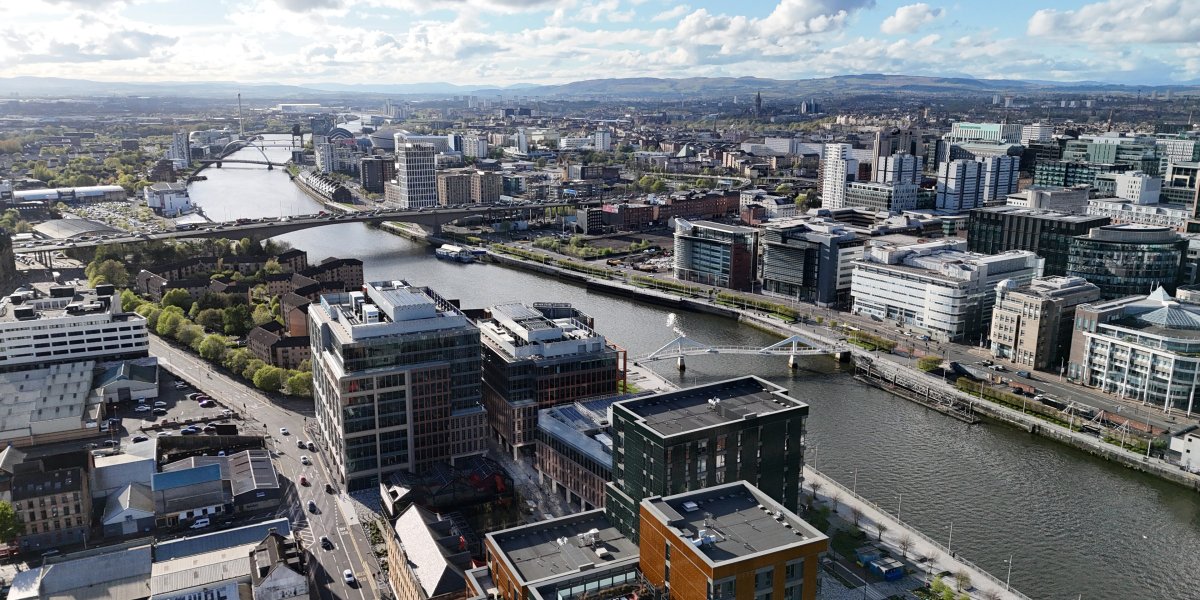
City Guide
Glasgow
United Kingdom · Best time to visit: May-Sep.
Day-by-day plan
Choose your pace
Trip length
09:00
Landmark
From Glasgow Queen Street station, walk east along Cathedral Street for 12 minutes — the blackened spire of Glasgow Cathedral grows larger with every step, setting the tone for what this city is about. The Necropolis is a Victorian cemetery draped over a hill behind the cathedral, modeled after Père Lachaise in Paris. Climb the winding paths past elaborate merchant tombs to the John Knox Monument at the summit for a panoramic sweep of the city — cathedral below, cranes on the Clyde in the distance, and the Campsie Fells on the horizon.
Tip: Go straight to the top first while your legs are fresh — the best photo is from the Knox Monument looking southwest with the cathedral in the foreground. On the way down, pause at the entrance bridge for a moody shot framing the cathedral through the ornate ironwork. The Necropolis is empty before 10:00; after that, walking tours arrive and the paths feel crowded.
Open in Google Maps →10:45
Landmark
Walk west along Cathedral Street through the Merchant City — Glasgow's oldest quarter, where 18th-century tobacco lords built their fortunes. In 15 minutes you'll emerge into George Square, the civic heart of the city. The Glasgow City Chambers on the east side is a jaw-dropping Italian Renaissance palace in marble and granite, opened in 1888 — its facade is more opulent than many national parliaments. Stand in the center of the square facing east for the full impact of the Chambers, then circle the square to take in the forest of statues honoring everyone from Queen Victoria to Robert Burns.
Tip: The City Chambers facade catches the best light mid-morning when the sun is still in the east. Position yourself at the cenotaph in the center of the square for a photo that captures the full width of the building with the statues in the foreground. If the main doors are open, step into the entrance hall for 30 seconds to glimpse the Carrara marble staircase — it's free and rivals the Paris Opéra.
Open in Google Maps →12:00
Food
Walk south from George Square down Queen Street for 3 minutes — you'll pass the Gallery of Modern Art, where the Duke of Wellington statue permanently wears a traffic cone on his head (Glasgow's most beloved act of defiance — stop for the photo, it's a rite of passage). Turn left on Miller Street; Paesano is halfway down on the right. This no-frills Neapolitan pizzeria is where half the city center comes for lunch. Dough is proved for 24 hours and blistered in a wood-fired oven. Order at the counter and grab a seat — food arrives in under five minutes.
Tip: Order the Number 1 (San Marzano tomato, fior di latte, basil — £6.50) — it's the purist's test and Paesano passes with honors. If you want heat, the Number 6 with nduja and honey is a cult favorite (£8). No reservations, no table service — arrive at noon on the dot to beat the office crowd. The entire lunch costs under £12 with a drink. Skip the tourist-priced chains on Buchanan Street; they charge triple for half the quality.
Open in Google Maps →13:30
Landmark
Head west along Bath Street, then continue through the Charing Cross junction — the 30-minute walk shows you how Glasgow shifts from Victorian commercial grandeur to leafy residential terraces. Turn up University Avenue and the Gothic Revival main building appears above the trees like a scene from a period film. Designed by Sir George Gilbert Scott and completed in 1870, this is the building that makes every visitor say 'it looks like Hogwarts.' Walk through the main gate into the cloisters — the vaulted undercroft and two quadrangles are hauntingly beautiful and completely free to wander.
Tip: Enter through the main gate on University Avenue, walk straight into the East Quadrangle, then through the cloisters to the West Quadrangle — this sequence gives you the full cinematic reveal. The best exterior photo is from the south-facing lawn on the Kelvingrove Park side, looking up at the tower framed by trees. The cloisters photograph beautifully in overcast light, which Glasgow generously provides most days.
Open in Google Maps →15:30
Landmark
Walk south from the University through Kelvingrove Park — a gentle 8-minute downhill stroll through one of Glasgow's most loved green spaces, with the River Kelvin on your left. As you descend, the red sandstone facade of the Kelvingrove appears through the trees. This Spanish Baroque-style building from 1901 is one of the most photographed buildings in Scotland. Walk around to the south-facing front on Argyle Street for the grand entrance view — the building was deliberately designed to be most impressive from this angle, with twin towers flanking a soaring central hall.
Tip: The south facade in afternoon light is the postcard shot — the red sandstone glows warm when the sun is in the west. Walk around to the north side too; most visitors miss it, but the rear entrance overlooking the park and river is equally stunning and far less photographed. The park benches along the River Kelvin just east of the gallery are the perfect spot to rest your legs before the evening stretch to dinner.
Open in Google Maps →19:00
Food
Walk north from Kelvingrove through the park, emerging onto Byres Road — the West End's main artery, buzzing with independent bookshops, vintage stores, and students from the university. Turn left onto Ashton Lane after 10 minutes — a cobbled alley strung with fairy lights that is Glasgow's most atmospheric dining street. The Ubiquitous Chip has been the West End's culinary institution since 1971, championing Scottish produce long before farm-to-table was a phrase. The main restaurant is a courtyard draped in trailing plants under a glass roof — there is no more Glasgow place to end a day.
Tip: Book the main restaurant, not the brasserie upstairs. Order the haggis, neeps and tatties starter (£9.50) — their version with whisky cream sauce converts even the skeptics. For a main, the venison or line-caught haddock (mains £18–26) are outstanding. Two courses with a glass of Scottish gin run about £40–45. Reserve online — even midweek, the dining room fills by 19:30. Avoid the tourist-trap restaurants on Sauchiehall Street near the center; Ashton Lane is where Glasgow actually eats.
Open in Google Maps →Jump to day
09:30
Religious
Scotland's only medieval mainland cathedral to survive the Reformation intact — arrive right at opening to have the extraordinary vaulted lower church nearly to yourself. The tomb of Saint Mungo, Glasgow's patron saint, sits in candlelit silence beneath a forest of 13th-century stone columns. This is where Glasgow began, and at 9:30 on a weekday morning, you'll feel it.
Tip: Skip the nave and go straight down to the lower church — the ribbed vaulting is more impressive than anything upstairs, and most visitors rush past it. The four stained-glass lancet windows on the east wall catch the morning sun perfectly at this hour.
Open in Google Maps →10:45
Landmark
Cross the Bridge of Sighs directly behind the cathedral — a 3-minute walk uphill through iron gates into a Victorian city of the dead modeled on Père Lachaise. Over 3,500 monuments crown this dramatic hilltop where Glasgow's 19th-century merchant kings competed to build the grandest tombs. The morning light rakes across the western monuments, and the view of the cathedral from the John Knox column at the summit is the single best photograph in Glasgow.
Tip: Take the path to the right of the main entrance — it's the gentler slope. Climb all the way to the John Knox monument at the top for a 360° panorama from the Campsie Fells to the city skyline. The Celtic Cross section on the eastern slope is the most atmospheric and least visited corner.
Open in Google Maps →12:00
Food
Walk downhill along High Street past Provand's Lordship (Glasgow's oldest house, 1471), then turn left into the Merchant City's cobblestoned heart — 15 minutes. Glasgow's most beloved café since 1979, set in an old cheese market with handcrafted Tim Stead oak furniture. Order the Cullen skink (€9), Scotland's definitive smoked haddock soup — rich, creamy, with chunks of Finnan haddie — or the haggis, neeps and tatties (€16) for the full Scottish baptism. Budget €15–25.
Tip: Arrive by noon to beat the lunch rush — by 12:30 there's often a queue out the door. Sit downstairs for the original interior with its sculpted wooden furniture; the upstairs extension is newer and has none of the soul.
Open in Google Maps →13:30
Landmark
Walk west along Ingram Street through Merchant City's elegant Victorian arcades, then north on Queen Street — 8 minutes past some of the finest 19th-century commercial architecture in Britain. George Square is Glasgow's civic heart, but the spectacle is the City Chambers on its east side: the Italian Renaissance facade hides interiors more lavish than most palaces, with Carrara marble staircases, a mosaic ceiling modeled on the Vatican, and a banqueting hall that out-golds the Palace of Versailles.
Tip: Free guided tours run at 10:30 and 14:30 on weekdays — catch the 14:30 tour to see the marble staircase and banqueting hall (no booking needed, just arrive 10 minutes early at the main entrance). On weekends, you can still admire the lobby and ground-floor corridor freely.
Open in Google Maps →15:00
Museum
Walk south down Buchanan Street — Glasgow's main pedestrian boulevard, usually buzzing with buskers — and duck into Mitchell Lane on your left, an alley easy to miss. The Lighthouse was Charles Rennie Mackintosh's first public commission (1895), originally the Glasgow Herald building. Now Scotland's centre for design and architecture, the main draw is the 134-step Mackintosh Tower spiral staircase leading to a rooftop viewing platform — the best free 360° panorama in the city centre, and the afternoon light makes the sandstone skyline glow.
Tip: The spiral staircase is narrow — go up anti-clockwise and pause at the window landings for framed views of the city. The design exhibitions on floors 3 and 4 change regularly and are consistently excellent. Closed Sundays — if your Day 1 falls on a Sunday, swap this with the Kelvingrove visit on Day 2.
Open in Google Maps →19:00
Food
Walk west along Sauchiehall Street past the Theatre Royal and music venues — 15 minutes into Glasgow's creative corridor. Ox and Finch transformed Glasgow dining with its hyper-seasonal Scottish sharing plates and has never dipped in quality since opening. Order the lamb ribs with anchovy and rosemary (€14) and the hand-dived scallops (€16) — three or four plates between two people is the move. Budget €35–50 with wine.
Tip: Book at least two days ahead — Thursday to Saturday tables vanish fast. Ask for a seat at the bar counter if the dining room is full; you'll get served faster and the kitchen view is a bonus. Avoid the restaurants clustered around George Square and Buchanan Street — they're priced for tourists and the food rarely matches what you'll find ten minutes away.
Open in Google Maps →09:00
Landmark
Walk west from the city centre through Kelvingrove Park along the River Kelvin — a 30-minute scenic warm-up past ancient trees and rowing clubs, or take the subway one stop from Buchanan Street to Hillhead. The University's 1870 Gothic Revival main building looks lifted from a fantasy novel. Enter the East Quadrangle to find The Cloisters — the vaulted stone undercroft that went viral as 'real-life Hogwarts' — hushed and golden in the early morning light before the first lectures begin.
Tip: The Cloisters entrance is easily missed — look for the stone archway on the left side of the East Quadrangle. Before 10:00 you'll have the corridors to yourself for photos. The on-campus Hunterian Museum (free, Scotland's oldest public museum) is worth 20 minutes if you're ahead of schedule.
Open in Google Maps →10:15
Museum
Walk downhill from the university through Kelvingrove Park — a 10-minute stroll through towering elms with the museum's red sandstone towers rising ahead like a cathedral. Scotland's most visited museum is completely free and houses everything from a suspended Spitfire to Dutch Masters. The crown jewel is Salvador Dalí's 'Christ of Saint John of the Cross' in the South Balcony — Glasgow bought it in 1952 for £8,200 and it remains one of the most famous paintings in any British gallery outside London.
Tip: Head straight to the South Balcony upper floor for the Dalí before the gallery fills after 11:30. The pipe organ in the central hall plays at 1pm on select days — check the board at reception. Opens 10:00 Monday–Saturday, 11:00 Sunday; if visiting on a Sunday, spend the extra time at the Hunterian before walking down.
Open in Google Maps →12:30
Food
Exit Kelvingrove's main entrance on Argyle Street, walk north along Kelvin Way past the Stewart Memorial Fountain, then east on Sauchiehall Street — 10 minutes. Mother India has been Glasgow's definitive curry house since 1990, long before the city earned its reputation as the curry capital of Britain. The kitchen serves Punjabi home-style cooking meant for sharing: order the lamb karahi (€15) and garlic chilli king prawns (€16). Budget €18–25.
Tip: Book ahead for weekends — this place fills within 30 minutes of opening. The sharing-plate format means three dishes between two people is the sweet spot: one meat, one seafood, one vegetable, with pilau rice and a garlic naan to share.
Open in Google Maps →14:00
Park
Walk north along Byres Road — a 12-minute stroll through the West End's busiest street, past independent bookshops, vintage stores, and bakeries worth noting for later. The Botanic Gardens are a pocket of Victorian elegance, but the reason you're here is the Kibble Palace: a vast 1873 iron-and-glass glasshouse filled with towering tree ferns from the Southern Hemisphere. On a sunny afternoon, the light filtering through curved glass onto the fern canopy is one of Glasgow's most photogenic moments.
Tip: The main glasshouse behind Kibble Palace houses orchids and tropical plants and is almost always empty — don't skip it. On a warm day, the riverside path along the Kelvin at the back of the gardens is one of the most peaceful walks in the city, and leads back toward Byres Road.
Open in Google Maps →15:30
Neighborhood
Exit the gardens onto Queen Margaret Drive, walk south past Oran Mor — a converted Edwardian church turned pub and performance venue — and turn right into the cobblestoned alleyway. Ashton Lane is Glasgow's most charming passage: narrow, fairy-light-strung, lined with pubs, restaurants, and the 1921 Grosvenor Cinema. Late afternoon is when the lights switch on and locals drift in for post-work drinks — this is where Glasgow's West End comes alive.
Tip: Grab a pre-dinner drink at Brel, the Belgian beer bar at the end of the lane — the hidden back garden behind the building is one of Glasgow's best-kept secrets and catches the last of the evening sun. The Grosvenor Cinema screens art-house and mainstream films in a beautiful 1920s auditorium if you have time to kill.
Open in Google Maps →19:00
Food
Walk 30 seconds deeper into Ashton Lane — dark green frontage on your left. The Chip has been the beating heart of Glasgow's restaurant scene since 1971, pioneering modern Scottish cooking when the rest of the country was still serving deep-fried everything. The glass-roofed courtyard, dripping with vines and ferns around a fish pond, is the space you came for. Start with venison haggis in whisky cream (€13), then the Highland venison loin or Buccleuch Estate beef (€35). Budget €40–55 with wine.
Tip: Book the downstairs courtyard restaurant, not the upstairs brasserie — the courtyard is the entire experience. Request a table near the fish pond for the full atmosphere. If you want good Scotch whisky, skip the overpriced gift shops on Byres Road; The Pot Still on Hope Street back in the city centre has over 700 bottles at local prices with no tourist markup.
Open in Google Maps →
Trip builder
Plan this trip around Glasgow
Turn this guide into a bookable rail itinerary with FlipEarth.
Keep exploring
Related cities
More in the same country
FAQ
Frequently asked questions
How many days do you need in Glasgow?
Most travelers enjoy Glasgow in 1 days, with enough time for headline sights and a slower meal or museum stop.
What's the best time to visit Glasgow?
The easiest season for most travelers is May-Sep, especially if you want good weather and manageable crowds.
What's the daily budget for Glasgow?
A practical starting point is about €75 per person per day before hotels, then adjust based on museums, dining, and transport.
What are the must-see attractions in Glasgow?
A good first shortlist for Glasgow includes Glasgow Necropolis, George Square, University of Glasgow Main Building.