City Guide
Dublin
Ireland · Best time to visit: May-Sep.
Day-by-day plan
Choose your pace
Trip length
09:00
Landmark
Your Dublin story starts at the most beautiful campus in Ireland. Pass through the grey Portland stone Front Gate on College Green — the archway frames the cobblestoned Front Square with the Campanile bell tower dead centre, a composition that has launched a million photographs. These grounds have been academic since 1592; Oscar Wilde, Samuel Beckett, and Bram Stoker all walked these same stones. Loop past the cricket pitch and the curved facade of the 1937 Reading Room, feeling four centuries of scholarship underfoot, then circle back through the Regent House passage to College Green.
Tip: Stand directly under the Front Gate arch facing inward at 9:15 AM — the low eastern sun backlights the Campanile and throws long shadows across the cobblestones for the single best photograph in Dublin. The grounds are free to enter and nearly empty at this hour. Skip the Book of Kells queue inside the Old Library: it stretches to 90 minutes by 10 AM, costs €18, and the dimly lit vellum manuscript doesn't photograph well behind glass.
Open in Google Maps →10:30
Neighborhood
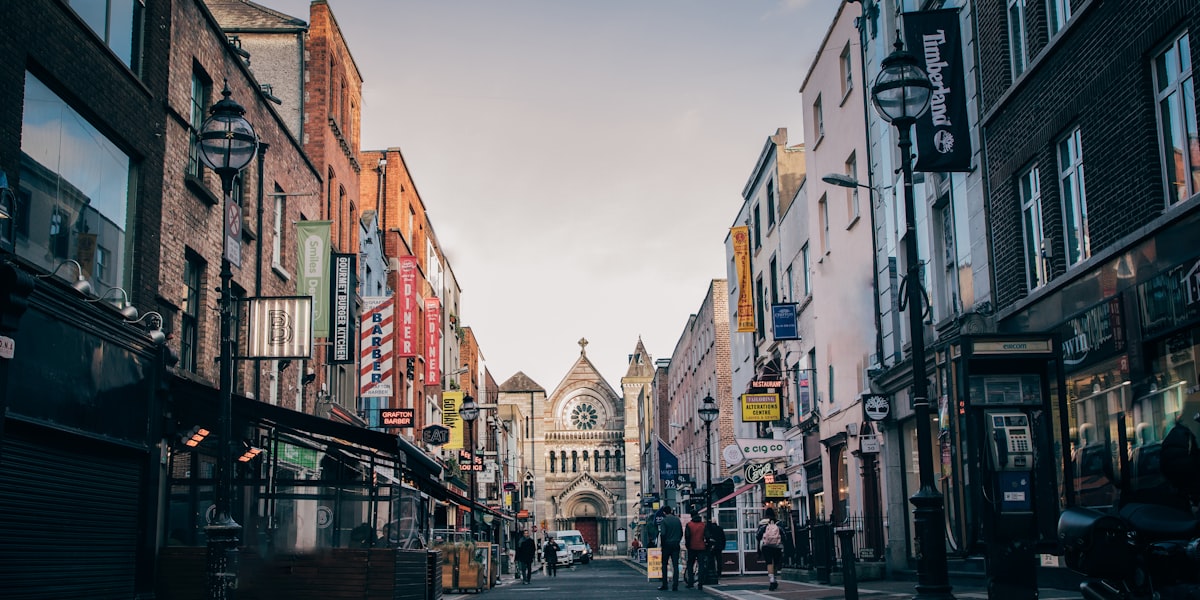
Exit Trinity through the Front Gate, cross College Green, and walk west along Dame Street — take the second right into narrow Crown Alley where busker music bounces off the stone walls. 7-minute walk. This is Dublin's chaotic, paint-splashed cultural quarter. The crimson-red facade of the Temple Bar pub is the mandatory photo, but the magic is in the side streets: street-art murals on Essex Street East, the arthouse courtyard of the Irish Film Institute, and cobblestoned Cow's Lane lined with independent Dublin designers. Weave through Meeting House Square and end at Merchant's Arch, the stone tunnel that perfectly frames the Ha'penny Bridge ahead.
Tip: The Wall of Fame on the side of the Button Factory on Curved Street displays portraits of Irish music legends — Van Morrison, U2, Sinéad O'Connor — and makes a far better backdrop photograph than any pub facade. Do not buy drinks in Temple Bar: pints cost €8–9 here versus €6 two streets away. This district is for cameras, not for your wallet.
Open in Google Maps →12:00
Food
Two-minute walk south along Temple Bar street from the pub — look for the green shopfront at number 20. Boxty is a traditional Irish potato pancake, crispy outside and pillowy inside, folded around slow-cooked fillings you will not find outside Ireland. Order the Boxty with Beef and Guinness Stew (€18): the stew has been simmering since dawn and the Guinness reduction is deep, malty, and genuinely excellent. This is working-class Irish comfort food that has fed Dubliners for generations — not a tourist invention, the real thing.
Tip: Arrive at noon sharp to grab a table without waiting — by 12:30 every seat is taken and the queue spills onto the street. If you're still hungry, add the seafood chowder (€10): thick, creamy, and loaded with smoked haddock from Howth harbour. Service is brisk; you will be back on the street in 35 minutes.
Open in Google Maps →13:00
Landmark
Walk north from Boxty House through Merchant's Arch — a stone passageway that spits you out on the south bank of the River Liffey with the bridge directly ahead. 3-minute walk. The Ha'penny Bridge is Dublin's most recognised silhouette: a white cast-iron arc from 1816, named for the half-penny toll once charged to cross. Stand at the crown and look east for a corridor view down the river to O'Connell Bridge and the pale neoclassical dome of the Custom House. Cross to the north bank, turn right, and walk east along the quays — the river walk past the Millennium Bridge gives you the best angle on Dublin's Georgian quayside, with seagulls wheeling overhead and the Liffey pulling at the mossy walls below.
Tip: The best photograph is taken from the south bank, about 10 metres east of the bridge, shooting northwest so the white ironwork curves against the sky. At 1 PM the high sun eliminates harsh shadows on the bridge deck and the iron glows against the water. After crossing, glance west along the quays — the elegant building with the book sign at number 40 is The Winding Stair, where you will have dinner tonight.
Open in Google Maps →13:50
Landmark
Walk east along the north quays from Ha'penny Bridge to O'Connell Bridge, then turn left up O'Connell Street — the 121-metre Spire needle will be visible piercing the sky ahead the moment you turn the corner. 8-minute walk. This is Dublin's grand boulevard and the stage of Irish independence. The General Post Office is where Patrick Pearse stood on Easter Monday 1916 and read the Proclamation of the Irish Republic to a bewildered crowd — the British Army's bullet scars are still pressed into the Portland stone columns. Stand at the base of the Spire, a stainless steel needle rising from the pavement like a silver thread stitching the city to the clouds, and look south for the classic postcard view: the Daniel O'Connell monument, the wide Georgian boulevard, and the river glinting beyond.
Tip: Run your fingers along the GPO's front columns and you will feel the bullet pockmarks from 1916 — most visitors walk straight past them. The Spire photographs best from about 30 metres south, shooting upward with a wide-angle lens so the needle tapers into the clouds. If you have spare time before dinner, walk 5 minutes east along the quays to the Custom House — its neoclassical dome reflected in the Liffey at this hour is one of Dublin's most underrated views.
Open in Google Maps →19:00
Food
Walk south down O'Connell Street, cross O'Connell Bridge, and turn right along Lower Ormond Quay on the north bank — The Winding Stair sits at number 40, directly above its famous secondhand bookshop, overlooking the Ha'penny Bridge you crossed this afternoon. 10-minute walk. End your Dublin day in a restaurant that is the city in miniature: a bookshop downstairs, a candlelit dining room with Liffey views above, and cooking that lets Irish ingredients speak without interruption. Order the pan-fried Clare Island salmon with seasonal greens (€29) or the dry-aged Irish rib-eye (€34), paired with a glass of Longueville House cider. As the late light turns the Ha'penny Bridge gold outside your window, you will understand why people get emotional leaving this city.
Tip: Book a window table overlooking the river — call ahead or reserve online, as there are only four river-view seats and they go first. If the Clare Island salmon is on the menu, order it without hesitation; the fish arrives from the west coast the same morning. Budget €45–55 per person with one drink. On your walk to dinner, ignore the clipboard fundraisers on O'Connell Street — a polite 'no thanks' without breaking stride is all it takes. And avoid the tourist-trap restaurants along the quays advertising 'authentic Irish stew' with laminated photo menus in the window: if the menu is displayed outside on a sandwich board, keep walking.
Open in Google Maps →Jump to day
08:30
Landmark
Start at the Front Gate on College Green — at 08:30 you'll walk through the cobblestone courtyard with barely a soul in sight, a world apart from the midday crush. The Long Room, with its barrel-vaulted ceiling and 200,000 ancient volumes, is the single most breathtaking interior in Ireland. The Book of Kells, displayed in the gallery below, is a 1,200-year-old manuscript so detailed that its pages feel alive under glass.
Tip: Book timed entry online at least 3 days ahead — walk-up queues exceed 90 minutes by 10:30. In the Long Room, look up: the ceiling was flat until 1860, when it was raised to its current barrel vault to make room for more books. Most visitors stare at the shelves and miss it entirely.
Open in Google Maps →10:15
Museum
Exit Trinity via the Nassau Street gate, walk south along Dawson Street past its Georgian townhouses — a 10-minute stroll that sets the tone for the quarter. Arrive before 11:00 to beat the tour bus groups. This gem, crammed into a townhouse at 15 St. Stephen's Green North, tells Dublin's 20th-century story through objects donated by ordinary Dubliners: love letters, protest signs, a JFK visit program. It's the antidote to every impersonal national museum you've ever visited.
Tip: Always join the guided tour (included in admission) — the guides are natural-born storytellers who turn every object into a comedy routine or a tear-jerker. The top-floor room has a little-known view across St. Stephen's Green that most visitors never see.
Open in Google Maps →12:00
Food
Step out of the museum and walk five minutes north up Dawson Street, turning right onto Grafton Street — Dublin's main pedestrian artery, usually alive with buskers. Bewley's has anchored this street since 1927, and Dubliners still treat it as their living room. The interior is an Art Deco wonder, with six Harry Clarke stained-glass windows that belong in a cathedral, not a café.
Tip: Sit in the back room beneath the Harry Clarke windows — most tourists grab a table at the front and never see them. Order Mary Ann's Baked Eggs (€13) or the Bewley's Full Irish (€16). Budget €15-20. No reservation needed, but arrive at noon sharp to beat the 12:30 office-worker rush.
Open in Google Maps →13:15
Museum
Walk east along Nassau Street, then turn right at Clare Street toward Merrion Square — a 10-minute walk past some of Dublin's finest Georgian doorways with their candy-colored fanlights. The gallery is free, world-class, and almost never crowded. Early afternoon is ideal: the natural light flooding the upper galleries makes the Yeats collection glow, and the post-lunch lull means you'll have entire rooms to yourself.
Tip: Go straight to Room 31 for Caravaggio's 'The Taking of Christ' — lost for centuries, discovered hanging in a Jesuit dining room in Dublin in 1990, now the single most valuable painting in Ireland. Then find the Jack B. Yeats rooms: his late paintings are Ireland's answer to Turner. Open late until 20:30 on Thursdays.
Open in Google Maps →15:00
Park
Walk five minutes west along Merrion Row and enter the Green through its southeast gate. By mid-afternoon the light softens and the lunch crowds have cleared, leaving the Victorian bandstand, the arched stone bridge over the lake, and the flower beds to you and the resident swans. This nine-acre park has been a public garden since 1880 and remains Dublin's most elegant outdoor room.
Tip: Walk to the lake and cross the arched bridge for the best photo angle — the reflection of the trees and bandstand in the water is Dublin's most underrated shot. In May and June the flower beds along the south side are at full bloom. Exit via the Grafton Street gate (northwest corner) for a final browse of the shopping street.
Open in Google Maps →19:00
Food
An easy three-minute walk from the Green's southeast corner brings you to Merrion Row, where Etto occupies a narrow, candlelit room that fills every night with Dubliners who know their wine. This Italian-Irish restaurant sources obsessively from Irish farms and Italian pantries, and the handmade pasta alone justifies booking ahead. The atmosphere is intimate without being precious — exactly the kind of place that doesn't exist on tourist maps.
Tip: Reserve at least 2 days in advance — it seats only 35. Order the handmade pappardelle with slow-cooked lamb ragù (€24) and start with the burrata (€16). The natural wine list is exceptional; ask for an orange wine pairing. Budget €40-55 with wine. Tables at the back are quieter.
Open in Google Maps →09:30
Landmark
Take the 15-minute walk west along Thomas Street or hop on the Luas to James's — either way, arrive for the 09:30 opening when the seven-storey atrium is nearly empty. This is not just a brewery tour; it's the story of how a single dark beer became Ireland's most famous export. The building itself is shaped like a giant pint glass, and the journey from grain floor to rooftop bar is surprisingly cinematic.
Tip: Don't rush to the Gravity Bar — spend time on the 3rd-floor Tasting Experience where you learn to taste stout properly (most visitors skip straight past it). Then take the Gravity Bar at 11:00 when it's still quiet: the 360° panorama of Dublin's rooftops and the Wicklow Mountains is the best free view in the city. Book online for a €5 discount over walk-up price.
Open in Google Maps →11:45
Religious
Walk east from the Storehouse along Thomas Street through the heart of the Liberties — Dublin's oldest working-class neighborhood, where market vendors have traded since Viking times. The 12-minute walk deposits you at Ireland's largest cathedral, a Gothic limestone fortress standing since 1220. Late-morning light streams through the stained glass at its most vivid angle, and the nave's staggering scale feels earned after the Guinness crowds.
Tip: Find Jonathan Swift's corner — he was Dean here for 32 years and wrote Gulliver's Travels in the Deanery next door. His self-penned epitaph on the wall is devastating in its brevity. Then look for the 'Door of Reconciliation' near the north transept: in 1492, two feuding earls cut a hole through it to shake hands — giving English the phrase 'chancing your arm.' On Sundays, the choir sings Evensong at 15:15; arrive early for a seat.
Open in Google Maps →13:00
Food
Walk five minutes south from the cathedral along Clanbrassil Street, then turn left onto Fumbally Lane — a quiet backstreet that feels nothing like tourist Dublin. This airy, white-walled café in a converted warehouse is where Liberties locals and creative-industry types come for honest, seasonal cooking. The menu changes daily, the sourdough is baked in-house, and the communal tables guarantee you'll be sitting next to a Dubliner.
Tip: No reservations — arrive by 13:00 or you'll queue out the door. Order the shakshuka with sourdough (€14) or whatever grain bowl is on the daily board (€15). Budget €14-18. On sunny days grab the bench outside; otherwise the long communal table by the window is the best seat.
Open in Google Maps →14:30
Landmark
Walk 12 minutes northeast — up Patrick Street, past Christ Church Cathedral's flying buttresses — to the castle's main gate on Dame Street. Afternoon tours are less crowded than the morning rush. For 700 years this was the seat of British rule in Ireland; now it hosts presidential inaugurations. The State Apartments are lavish, but the real discovery is underground: the excavated Viking foundations and the original dark pool — dubh linn — that gave Dublin its name.
Tip: After the State Apartments, cross the castle courtyard into the Chester Beatty Library — it's free, uncrowded, and houses one of the world's great collections of illuminated manuscripts, Japanese woodblock prints, and Quranic calligraphy. If you have only 20 minutes, go straight to the Sacred Traditions Gallery on the top floor.
Open in Google Maps →15:45
Neighborhood
Step out of the castle gate, cross Dame Street, and you're in Temple Bar — a 3-minute transition. Skip the main pub strip and cut through Meeting House Square, the cultural heart of the district where the Irish Film Institute and a weekend food market live. Work north through Crown Alley — Dublin's best street art corridor — to the Liffey, then cross the Ha'penny Bridge, a cast-iron footbridge from 1816 named for the half-penny toll once charged to cross it.
Tip: The best photo of Ha'penny Bridge is from Merchant's Arch on the south bank, looking north with the bridge framed by the archway — afternoon light hits the ironwork perfectly. Do NOT eat or drink on the main Temple Bar strip: prices are 40% higher than surrounding streets for significantly worse food and stale-pint pubs. The cobblestoned lanes around Cow's Lane and Essex Street West have better bars with actual Dubliners in them.
Open in Google Maps →19:00
Food
Cross Ha'penny Bridge to the north bank and turn right along Ormond Quay — a 3-minute walk brings you to one of Dublin's most beloved restaurants, perched directly above the river. The Winding Stair began life as a bookshop in 1978 (still operating downstairs) and became a restaurant that celebrates Irish ingredients without pretension. The dining room's wide windows frame the bridge and the Liffey, and at sunset the light on the water is the farewell Dublin moment you'll remember.
Tip: Book a window table — the sunset view over Ha'penny Bridge is one of Dublin's great dining moments. Start with Atlantic mussels in white wine and garlic (€16), then the slow-braised lamb shoulder with colcannon (€28). Budget €35-50 with wine. Browse the bookshop downstairs while you wait — it's one of Dublin's oldest independent stores. Warning: avoid the 'pub crawl' tours that swarm Temple Bar after dark — overpriced, overcrowded, and more stag parties than culture. Walk 5 minutes north to Stoneybatter instead for genuine local pubs.
Open in Google Maps →Jump to day
09:00
Museum
Enter through the Front Gate on College Green — Dublin's scholarly heart since 1592. At opening, the Long Room's barrel-vaulted ceiling arching over 200,000 leather-bound volumes is nearly empty, and the morning light falls through the eastern windows at its most golden. The Book of Kells manuscript glows under glass downstairs — Ireland's most treasured artifact, and it deserves the quiet of an early visit.
Tip: Book timed-entry tickets online at least two days ahead — walk-up queues exceed 45 minutes by 10:30. Stand at the far end of the Long Room and shoot back toward the entrance for the most dramatic photograph, with the marble busts receding into infinity.
Open in Google Maps →12:00
Food
Walk south through Trinity's Front Square, exit via the side gate, and stroll 5 minutes down Grafton Street — Dublin's buzzing pedestrian spine — to Bewley's glowing facade. This café has anchored Grafton Street since 1927; order the seafood chowder (€11, thick with smoked haddock) and the open crab sandwich on brown bread (€16) under the Harry Clarke stained-glass windows.
Tip: Sit upstairs in the Harry Clarke Room for the quietest tables and the best view of the stained glass. Skip the pastry counter queue on the ground floor — the sit-down menu has the same food, served faster.
Open in Google Maps →13:30
Museum
From Bewley's, walk east along Nassau Street and turn left into Merrion Square — a 7-minute stroll past Georgian townhouses with their famous painted doors. The gallery holds Caravaggio's 'The Taking of Christ,' rediscovered in a Dublin Jesuit house in 1990 — one of art history's greatest finds — and at early afternoon the Millennium Wing's skylights flood the galleries with the day's softest natural light.
Tip: Head straight to Room 54 on the ground floor for the Caravaggio before afternoon tour groups arrive — most visitors wander chronologically and reach it last. Admission is free, so note anything you want to revisit on another day.
Open in Google Maps →15:30
Park
Exit the gallery onto Clare Street, turn right, and walk 5 minutes along Merrion Row to reach the northeast gate of St. Stephen's Green — nine acres of manicured gardens at the city's center. The afternoon light filters through old plane trees onto the ornamental lake; use any remaining time to stroll back up Grafton Street, catching buskers and the fading-afternoon energy of Dublin's living room.
Tip: Enter through the Fusiliers' Arch at the Grafton Street corner and walk diagonally to the lake — this path gives you the most photogenic canopy of mature trees. The park closes at dusk; check seasonal hours if visiting after October.
Open in Google Maps →19:00
Food
Etto sits on Merrion Row, a 3-minute walk from the Green's southeast corner. This tiny, wine-driven restaurant is where Dublin's chefs eat on their night off — the handmade pasta (€16) and whatever fresh fish came in from Howth that morning are the right choices, paired with a glass from the all-Italian wine list.
Tip: Arrive by 18:45 — this small room fills fast and by 19:30 you may wait 30 minutes. Ask the server to choose your wine glass rather than studying the list; the Italian selection here is exceptional and they know it cold.
Open in Google Maps →09:00
Landmark
Take the Luas Red Line to Suir Road (15 minutes from the center) and walk 5 minutes north to the gaol's imposing grey entrance. The first guided tour of the day leads through the cells where every major Irish rebel was imprisoned, ending in the stone execution yard where fourteen 1916 Rising leaders were shot at dawn — the stark morning light in the Victorian east wing creates one of Ireland's most powerful photographs.
Tip: Tickets sell out weeks in advance and are almost never available walk-up — book on heritageireland.ie the moment your trip is confirmed. The guided tour is the only way in; it lasts about 50 minutes, plus 20 minutes for the museum.
Open in Google Maps →11:00
Landmark
Walk east from Kilmainham along Bow Lane and South Circular Road — a 15-minute stroll through the Liberties, Dublin's oldest neighborhood, where the air carries the scent of roasting barley from the brewery walls. Seven floors spiral upward through the brewing process inside a 1904 fermentation plant, peaking at the rooftop Gravity Bar where your ticket includes a pint of Guinness with a panorama stretching to the Wicklow Mountains.
Tip: Book the first available slot online for the cheapest price and thinnest crowds. At the Gravity Bar, claim a stool facing south for the mountain panorama — skip the ground-floor restaurant, your fish & chips are waiting 10 minutes downhill.
Open in Google Maps →13:30
Food
Walk east from the Storehouse along Thomas Street and down Nicholas Street — a 12-minute downhill stroll through the Liberties, past antique shops and a fragment of the medieval city wall at Lamb Alley. Leo Burdock's has fried fish on this corner since 1913; order the fresh cod and chips (€12) and eat on the bench across the road with Christ Church Cathedral as your backdrop.
Tip: Get the large cod — the batter-to-fish ratio is better than on the small. Add salt and vinegar at the counter, not from the bottle outside. This bench-and-cathedral moment is one of Dublin's great simple pleasures.
Open in Google Maps →14:30
Religious
Cross the road — Christ Church rises directly above you, 30 seconds away. Founded by Norse Vikings in 1030, Dublin's oldest building still in daily use hides Ireland's largest medieval crypt below the nave, where a mummified cat and rat frozen mid-chase inside an organ pipe have been the city's strangest residents for centuries.
Tip: The crypt is the highlight — look for the 'cat and rat' display case near the back wall; it's small and easy to walk past. The combined ticket with Dublinia next door adds an hour and is only worthwhile if traveling with children.
Open in Google Maps →19:00
Food
Walk west along Cook Street and down Bridge Street Lower — a 7-minute stroll along medieval Dublin's original main road. Ireland's oldest pub has poured pints since 1198; duck through the low doorway, claim a table in the snug, and order the beef and Guinness stew (€18) with a pint of plain — the stew is slow-cooked until the meat falls apart, and it tastes like Dublin distilled into a bowl.
Tip: Live traditional music starts nightly at 21:30 in the back bar — arrive by 21:00 for a seat. Avoid the tourist restaurants on Essex Street and the overpriced pubs in central Temple Bar on your walk here; the Brazen Head delivers three times the atmosphere at half the price.
Open in Google Maps →09:30
Museum
Walk 10 minutes from any city center hotel via Dame Street to the castle gate. Join the first State Apartments tour — the gilded rooms where Irish presidents are inaugurated — then cross the courtyard to the Chester Beatty, a free and stunning collection of Islamic manuscripts, East Asian prints, and Egyptian papyri that won European Museum of the Year and rivals institutions ten times its size.
Tip: The State Apartments open at 09:45 — join the first tour for the smallest group. Chester Beatty opens at 10:00 (Tue-Fri; 11:00 weekends; closed Monday); don't miss the Roof Garden on the top floor.
Open in Google Maps →12:00
Food
Exit through the Palace Street gate and walk 3 minutes north into Temple Bar's pedestrian lanes. Gallagher's is the only restaurant in Dublin dedicated to boxty — the traditional Irish potato pancake; order the one filled with braised beef and Guinness (€18, golden-crisp outside, pillowy inside) and finish with a proper Gaelic coffee (€9), built with whiskey, brown sugar, and cream floated on the back of a spoon.
Tip: Arrive right at noon to beat the Temple Bar lunch rush — by 12:30 every table is taken. Ask for the back room, which is quieter than the front facing the busy pedestrian street.
Open in Google Maps →14:00
Entertainment
Cross the Ha'penny Bridge — pause for the obligatory photo on its white cast-iron arch over the Liffey — and continue north through Jervis Street to Smithfield Square, a 12-minute walk. The original Jameson distillery, where whiskey was made from 1780 to 1971, now runs the Bow St. Experience: a guided tour through grain to glass ending with a three-whiskey comparative tasting that makes you understand, viscerally, why Irish whiskey is triple-distilled.
Tip: Book online for a guaranteed time slot — walk-ups dry up after 14:00. The Jameson Black Barrel is the standout at the tasting; you can buy a bottle with an exclusive Bow St. label in the gift shop.
Open in Google Maps →16:00
Neighborhood
Walk east from Smithfield along the north bank of the Liffey — a 10-minute stroll past the Four Courts, its green copper dome reflected in the water. Turn onto O'Connell Street, Dublin's grandest boulevard, where the GPO's bullet-scarred Ionic columns still stand as they did during the 1916 Rising; cross O'Connell Bridge and pause to look west as the late-afternoon light gilds the Liffey's bridges in perfect recession.
Tip: Stand on O'Connell Bridge around 16:30 and look west — the afternoon light catches the Custom House dome and the bridges recede in textbook one-point perspective; this is Dublin's best free photograph. The souvenir shops on O'Connell Street charge double what you'll find at Dublin Airport — walk past them.
Open in Google Maps →19:00
Food
Walk west along the south quays from O'Connell Bridge and cross back to the north bank at Ha'penny Bridge — The Winding Stair sits directly on Ormond Quay, 2 minutes away, its dining room windows over the water. Named after the Yeats poem, this is modern Irish cooking at its most confident: the pan-fried hake with colcannon and mussel broth (€29) is the definitive Dublin dinner plate, and the brown bread arrives warm from the house oven.
Tip: Reserve a window table at least 3 days ahead — the Liffey view at dusk is worth the planning. Skip the restaurants on the Temple Bar pedestrian streets directly south; they charge €20 for a mediocre burger and survive on tourists who don't know this place exists two minutes away.
Open in Google Maps →Jump to day
09:00
Landmark
Walk through the front arch on College Green and step into a cobblestoned quadrangle that has barely changed since the 18th century. The Book of Kells exhibition opens at 9:00 — arrive five minutes early to be among the first inside, when you can stand alone before the illuminated manuscript without a single elbow in your peripheral vision. The Long Room upstairs, with its barrel-vaulted ceiling and 200,000 ancient volumes, is one of the most photographed libraries on earth — the morning light through the east windows gives it a warm amber glow that fades by noon.
Tip: Book your timed-entry ticket online at least a week ahead — walk-ups often sell out by 10:30. The best photo angle of the Long Room is from the far end looking back toward the entrance, where the barrel vault compresses into a stunning vanishing point.
Open in Google Maps →12:00
Food
Exit Trinity through the Nassau Street side gate, turn right past the railings, and follow Merrion Row for three minutes — Etto is the unassuming door on your left with a small wine list chalked in the window. This Italian-leaning wine bar is where Dublin's food crowd eats on their day off. The hand-rolled cacio e pepe (€16) is deceptively simple and perfect; the burrata with 'nduja and sourdough (€14) disappears before you've finished your first glass. Budget €25–35 per person with wine.
Tip: Arrive right at noon to snag a table without a reservation — by 12:30 on weekdays, every seat is taken. If you can, sit at the counter facing the open kitchen; it's the best seat in the house.
Open in Google Maps →13:30
Park
Walk two minutes south from Etto and enter St. Stephen's Green through the Grafton Street corner gate. This nine-acre Victorian park is Dublin's breathing room — locals eat lunch on the grass, ducks patrol the central lake, and a waterfall hides in the southwest corner that most visitors walk right past. After a rich lunch, the circuit walk around the lake takes about twenty minutes and is the perfect gentle reset before your next museum.
Tip: Head to the far southwest corner to find the waterfall and grotto — it's the most peaceful spot in the entire park and almost always empty. The bench facing the lake near the bandstand has the best mix of afternoon sun and people-watching.
Open in Google Maps →15:00
Museum
Exit St. Stephen's Green from the northeast gate and walk five minutes along the south side of Merrion Square — the gallery entrance is at the end of Clare Street. Admission is free, and by mid-afternoon the rooms are often half-empty. Go directly to Room 33 for Caravaggio's 'The Taking of Christ,' rediscovered in a Jesuit dining room in 1990 after being lost for centuries. Then find the Jack B. Yeats collection upstairs — his late paintings of the west of Ireland are some of the most emotionally overwhelming works in any European gallery.
Tip: Open until 17:30 daily, Thursdays until 20:30, so an afternoon visit gives you unhurried time. Skip the ground-floor temporary exhibitions on a first visit — the permanent collection upstairs is the reason to come.
Open in Google Maps →19:00
Food
From the gallery, walk north through Merrion Square, cross the Liffey at O'Connell Bridge — the river turns gold at this hour — and turn left along Lower Ormond Quay for five minutes. The Winding Stair sits above its namesake bookshop, overlooking the Ha'penny Bridge. The pan-fried hake with seaweed butter (€28) is the signature; the brown bread with Clare Island smoked salmon (€16) is the best opening bite in Dublin. Budget €45–55 per person with wine. Book ahead for a window table — watching the bridge light up at dusk while eating is the kind of evening you came to Dublin for.
Tip: Request the window table overlooking the Ha'penny Bridge when you reserve — there are only two. Avoid eating in Temple Bar, which is directly across the bridge: nearly every restaurant on its main strip charges double for mediocre food aimed at tourists, and the €8 pints are not worth the 'atmosphere.'
Open in Google Maps →09:30
Museum
Enter Dublin Castle from the Palace Street gate and cross the cobblestoned courtyard to the Clock Tower building — Chester Beatty is inside. This free museum holds one of the greatest collections of manuscripts, rare books, and miniature paintings in Europe, amassed by an American mining magnate who chose Dublin as his final home. The Islamic Gallery's illuminated Qurans and the East Asian woodblock prints are extraordinary. At 9:30, you will often have entire rooms to yourself — a quiet, contemplative morning before the Guinness crowds this afternoon.
Tip: Closed on Mondays. Start on the top floor (Sacred Traditions gallery) and work down — most visitors do the opposite, so you'll stay ahead of the flow. The rooftop garden has hidden views over Dublin Castle's gardens that few people know about.
Open in Google Maps →12:30
Food
Exit Dublin Castle through the Ship Street gate, turn right, and walk ten minutes south through the quiet backstreets of the Liberties — Dublin's oldest neighborhood, where street names like Cornmarket and Weaver's Square still whisper of medieval trades. The Fumbally is a high-ceilinged café in a converted warehouse on Fumbally Lane, packed with designers and creatives from the surrounding studios. The shakshuka with sourdough (€14) is the move; the roasted cauliflower salad (€13) is almost as good. Budget €15–20.
Tip: Come hungry — portions are generous and the pastry counter is impossible to walk past. If the communal tables feel too social, the bench seating along the wall by the window offers more privacy.
Open in Google Maps →13:45
Religious
Walk five minutes north from The Fumbally along New Street — you'll see the cathedral spire rising above the rooftops before you turn the corner. Ireland's largest church has stood here since 1220, and Jonathan Swift — yes, the Gulliver's Travels author — served as Dean for over thirty years. His grave is in the nave floor, marked by a simple brass plate. The Lady Chapel's stained glass catches the western afternoon light beautifully, and the choir is one of the oldest in Ireland.
Tip: Look for the carved wooden door in the north transept with a hole cut into it — this is the origin of the phrase 'chancing your arm,' from a 1492 feud between two earls. Most visitors walk right past it; ask a guide to point it out.
Open in Google Maps →15:15
Landmark
Walk twelve minutes west from St. Patrick's along Thomas Street — the beating heart of the Liberties, where the air has smelled of roasting barley since 1759. The Storehouse is seven floors of immersive storytelling inside a former fermentation plant, but the real reason to come is the Gravity Bar on the top floor: a 360-degree glass panorama of Dublin where your admission includes a perfectly poured pint of Guinness. Arriving at 15:15 means the morning tour-bus crowds have thinned and you can take your time learning to pour your own pint at the Connoisseur Experience on the fourth floor.
Tip: Book online for a €3–4 discount and a timed-entry slot. The self-pour experience is included in your ticket but most visitors miss it entirely — do not skip it. Avoid the Storehouse's own restaurants; the pubs on Thomas Street outside the gates serve better food at half the price.
Open in Google Maps →19:30
Food
Walk fifteen minutes south from the Storehouse along the South Circular Road, past the red-brick Victorian terraces of Rialto. Bastible is a small, calm dining room that has become one of Dublin's most celebrated restaurants without ever raising its voice. The chef lets the Irish ingredients speak — aged Hereford sirloin (€36), Connemara lamb shoulder, and a brown-bread ice cream with whiskey caramel that will ruin all other desserts for you. Budget €50–80 per person. Reserve at least three days ahead.
Tip: Ask for the table near the open kitchen if you enjoy watching the brigade work. Trust the sommelier's wine pairing — the list is short but every bottle is chosen with unusual care. Walking back to the city center afterward, take South Circular Road east to Camden Street rather than the unlit canal path near Dolphins Barn.
Open in Google Maps →09:00
Museum
Take the Luas Red Line to Suir Road stop (ten minutes from the city center) and walk five minutes uphill to the gaol entrance. The guided tour of Kilmainham Gaol is one of the most powerful experiences in Ireland — you will stand in the execution yard where fourteen leaders of the 1916 Easter Rising were shot at dawn, the bullet-pocked wall still bearing the marks. The Victorian east wing, with its tiers of iron walkways around a sunlit central atrium, is hauntingly beautiful and one of the most photographed interiors in Dublin. Bring a jacket; the stone cells are cold even in summer.
Tip: Tickets sell out days in advance — book online the moment they are released, as no walk-up tickets are available. The first tour of the day (9:00 or 9:30) has the smallest group. Photography is allowed everywhere except the chapel.
Open in Google Maps →12:00
Food
Walk twenty minutes east from Kilmainham along the Liffey quays — you'll pass the Royal Hospital Kilmainham gardens and watch the Four Courts dome growing larger ahead. The Legal Eagle sits on Chancery Place behind the Four Courts, a handsome gastropub in a former solicitor's office with original tiled floors and mahogany fittings. The beef shin pie with buttered mash (€19) is the best pub lunch in Dublin; the beer-battered fish and chips with mushy peas (€18) runs it close. Budget €20–30.
Tip: The barristers from the Four Courts eat here on weekday lunches — always a reliable sign. If the main dining room is full, the snug in the back seats six and is the coziest corner in the building.
Open in Google Maps →13:30
Museum
Walk ten minutes west along the quays and turn left into the gates of Collins Barracks — an enormous 18th-century military complex that now houses the National Museum's decorative arts collection. Admission is free. The 'Proclaiming a Republic' exhibition about the 1916 Rising and War of Independence pairs powerfully with this morning's Kilmainham visit — the personal letters and photographs here will hit differently after standing in that execution yard. The building itself, wrapped around a vast parade ground, is worth the walk alone.
Tip: Most visitors skip this museum entirely in favor of the Kildare Street branch, which means you'll often have galleries to yourself. The café in the courtyard serves surprisingly good coffee. Allow twenty minutes to wander the parade grounds.
Open in Google Maps →16:00
Park
Exit Collins Barracks from the north side and walk ten minutes along Benburb Street to the Parkgate Street entrance of Phoenix Park — at 707 hectares, one of the largest enclosed public parks in any European capital. Within the first ten minutes of entering, you will almost certainly see wild fallow deer grazing on the Fifteen Acres. The light at this late-afternoon hour is golden and low, and the deer silhouetted against the grass make for extraordinary photographs. Walk the Chesterfield Avenue axis toward the Phoenix Monument, then loop back through the Victorian People's Garden near the entrance.
Tip: The deer are wild but habituated to people — you can approach within about fifteen meters before they move off. Use a zoom lens or phone telephoto; do not attempt to feed or touch them. The People's Garden near the Parkgate entrance is a charming Victorian garden that rarely appears in any guide.
Open in Google Maps →19:00
Food
Walk south from Phoenix Park's Parkgate entrance for fifteen minutes through Stoneybatter's terraced streets to 18 Manor Street. L. Mulligan Grocer is a craft-beer gastropub in a converted Victorian grocery that has become the anchor of Stoneybatter's food scene. The boxty with braised beef cheek (€18) is rich and comforting after a long day outdoors; the craft beer flight of four Irish microbrews (€12) is the best way to discover what's being brewed beyond Guinness. Budget €25–35.
Tip: Sit in the back room for a quieter meal. After dinner, walk five minutes to The Cobblestone on King Street North for an unscripted traditional Irish music session — it's the real thing, not a tourist performance, no cover charge. Avoid the souvenir shops along the Liffey quays on your walk back; they sell mass-produced imports at triple the price and nothing in them was made in Ireland.
Open in Google Maps →10:00
Neighborhood
Sleep in — today has no museum opening to race to. Walk fifteen minutes south from St. Stephen's Green or ride a Dublin Bike to Portobello, where the Grand Canal curves through one of Dublin's most quietly beautiful residential neighborhoods. Candy-pastel terraced houses line the water, swans drift past the locks, and the morning light on the canal is painter-quality. Walk east along the towpath toward Baggot Street Bridge, where you'll find the bronze statue of poet Patrick Kavanagh sitting on a bench, gazing at the water he once wrote was 'stilly greeny at the heart of summer.' Sit beside him. There is no rush.
Tip: The canal banks between Portobello and Baggot Street are where Dubliners sunbathe, read, and drink takeaway coffee on any day above 15°C — it is the city's most honest public space. Grab a coffee from a Portobello café and join them on the grass.
Open in Google Maps →12:00
Food
Double back along the canal to Lennox Street — a five-minute walk from the Kavanagh statue. Lennox Café is a tiny, bright room that serves the best brunch in this part of Dublin, and the locals guard it jealously. The eggs Royale with Burren smoked salmon (€15) is the signature; the French toast with seasonal fruit compote (€13) is what to order if you want something slower and sweeter. Budget €15–20. The coffee is excellent — they roast their own.
Tip: Weekend brunch fills by 11:30, but a noon arrival on weekdays usually means an immediate table. The outdoor bench seats on the street get the midday sun and are the most coveted spots in the neighborhood.
Open in Google Maps →13:30
Park
Walk ten minutes north along Harcourt Street from the café. The entrance to Iveagh Gardens is an unmarked gate on Clonmel Street behind the National Concert Hall — blink and you will miss it. This is Dublin's secret garden: a cascade fountain, a rustic grotto, a rosarium, and an archery lawn, all designed in 1865 and somehow still overlooked by nearly every visitor to the city. On a weekday afternoon you may have the entire garden to yourself. Sit on the bench facing the fountain and let the afternoon happen.
Tip: The entrance on Clonmel Street is the only one — there is no sign from Harcourt Street, which is exactly why most people never find this place. If the roses are in bloom, the northwest corner has the most fragrant varieties.
Open in Google Maps →15:00
Shopping
Walk eight minutes north along Wexford Street and onto George's Street — you'll pass record shops, vintage boutiques, and at least three pubs with doors propped open to the afternoon. George's Street Arcade is a Victorian covered market trading since 1881, the oldest of its kind in Dublin. Inside: secondhand book stalls, vintage clothing, vinyl records, handmade jewelry, and a fortune teller who has been reading palms here for decades. Each stall has a personality and a story — this is the polar opposite of a shopping mall.
Tip: The vinyl stall near the center aisle has an excellent Irish folk and trad selection. The vintage clothing at the Drury Street end is the best curated. For a quick bite, the crêpe stand near the Fade Street exit has been keeping Dublin students alive with Nutella crêpes since the 1990s.
Open in Google Maps →19:00
Food
Walk ten minutes south back down Camden Street — the sunset light down this long straight avenue is one of Dublin's underrated views. Delahunt is a modern Irish restaurant in a former Victorian grocery at number 39, with original tiled floors and dark wood counters that still feel like they belong to another century. The cured mackerel with pickled rhubarb (€16) is a perfect opener; the dry-aged sirloin with bone-marrow butter (€36) is among the best steaks in Dublin. Budget €45–65. Reserve at least two days ahead. This is the kind of quiet, confident meal that ends a trip perfectly.
Tip: The upstairs bar serves the full menu and feels more intimate than the main dining room. After dinner, resist the late-night bars on Camden Street's upper end — most are overpriced and aimed at pub-crawl tourists. Instead, walk five minutes south to Whelan's on Wexford Street for a live gig in one of Dublin's best small venues; any act playing there is worth hearing. A perfect last night.
Open in Google Maps →
Trip builder
Plan this trip around Dublin
Turn this guide into a bookable rail itinerary with FlipEarth.
Keep exploring
Related cities
Nearby cities
More in the same country
FAQ
Frequently asked questions
How many days do you need in Dublin?
Most travelers enjoy Dublin in 1 days, with enough time for headline sights and a slower meal or museum stop.
What's the best time to visit Dublin?
The easiest season for most travelers is May-Sep, especially if you want good weather and manageable crowds.
What's the daily budget for Dublin?
A practical starting point is about €100 per person per day before hotels, then adjust based on museums, dining, and transport.
What are the must-see attractions in Dublin?
A good first shortlist for Dublin includes Trinity College Dublin, Ha'penny Bridge, O'Connell Street and the General Post Office.