City Guide
Chester
United Kingdom · Best time to visit: Apr-Oct.
Day-by-day plan
Choose your pace
Trip length
09:00
Religious
Begin at the red-sandstone facade of Chester Cathedral, which the low 09:00 sun turns the color of warm caramel — the best photo light of the day, before the coach groups arrive around 10:30. Slip through the small archway off St Werburgh Street into the free cloister garth as it opens, when the lawn is empty and the 1,000-year-old monastic stones are yours alone. Walk the full perimeter to spot the flying buttresses on the south transept and the falconry mews tucked behind the chapter house.
Tip: Skip the paid interior ticket — the cloister, garth, and falconry garden are all free, and the best parts of the cathedral (the buttresses, the sandstone color, the medieval garth) are on the outside. Photograph the west front from the corner of St Werburgh Street rather than head-on; the diagonal angle catches both towers and the rose window in a single frame.
Open in Google Maps →10:30
Landmark
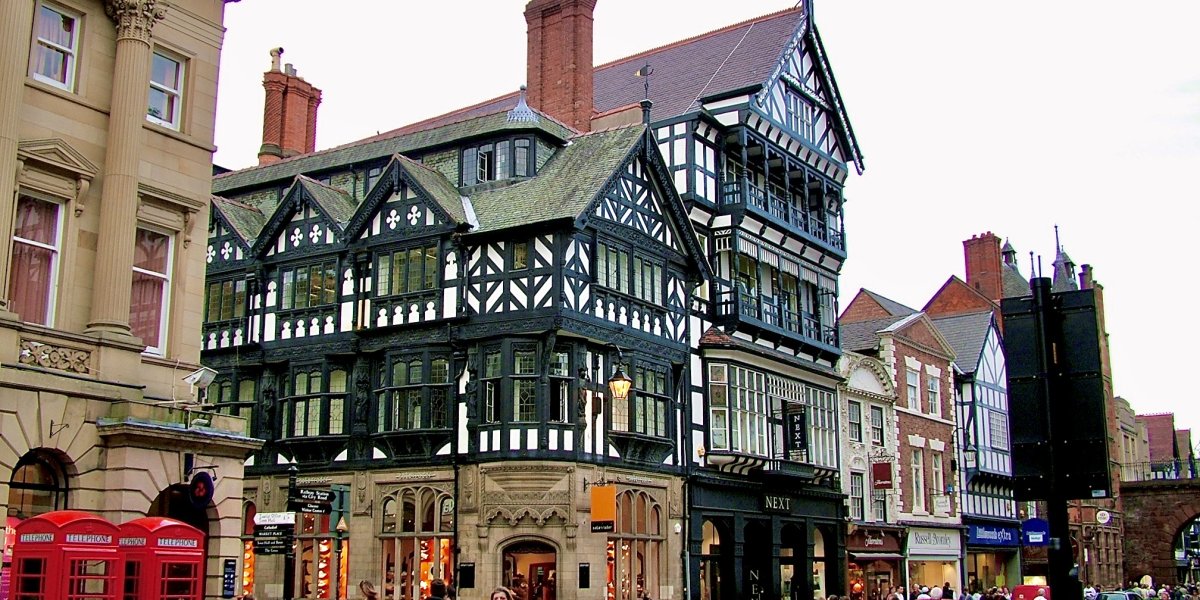
From the cathedral, walk three minutes south down St Werburgh Street and the green Eastgate Clock floats into view above the medieval arch — the second-most-photographed clock in Britain after Big Ben. Catch The Rows now at 10:30, before the noon shopping crowds fill the galleries: Chester's unique 13th-century two-tier covered shopping streets are an invention found nowhere else in the world. Walk the upper level of Bridge Street and Watergate Street for the best-preserved oak beams, then return to ground level for the Tudor timber-framed Bishop Lloyd's House on Watergate Street.
Tip: Photograph the Eastgate Clock from the south side of Eastgate Street (looking west from in front of the Grosvenor Hotel) — the late-morning sun lights the clock face directly and the four spires of the wrought-iron canopy come out clean against the sky. The upper Row on Watergate Street between Bridge Street and Weaver Street is the oldest and most authentic; the Eastgate stretch has been heavily Victorianized.
Open in Google Maps →12:30
Food
Backtrack five minutes north up Northgate Street to the gleaming new Chester Market hall in Exchange Square (opened 2022), where around twenty independent traders share a single timber-and-steel-roofed space. Grab a wood-fired pizza slice, a Vietnamese banh mi, or a plate of Cheshire-cured charcuterie — most plates run £8-12 (€10-14). Sit at the communal benches: fast, cheap, properly local, and exactly the fuel needed for the long afternoon on the walls.
Tip: Arrive before 12:30 or after 13:30 to skip the office-lunch crush at the bar counters. Walk through the full hall once before committing — the back corner stalls often have the shortest queues, and the Cheshire cheesemonger near the rear can vacuum-pack a wedge of Appleby's for you to eat on the walls.
Open in Google Maps →13:30
Landmark
Walk twelve minutes south through the city — down Northgate Street, across Eastgate, then east on Pepper Street — to the curved stone bowl of the Roman Amphitheatre, the largest in Britain. Only the northern half is excavated; the rest still lies sealed under Georgian houses, frozen mid-discovery, which is half the magic of the place. After 14:00 the schoolgroups have cleared, so you can stand on the arena floor in silence with the sandstone tiers rising around you, then loop next door into the Roman Gardens to see the column drums and hypocaust pillars salvaged from across the city.
Tip: Photograph the amphitheatre from the upper viewing platform on the north side rather than from inside the bowl — the elevated angle shows the full elliptical sweep with the cathedral towers visible in the background, an image impossible to capture from ground level. It is entirely free and has no opening hours, so use it as a quiet recovery stop between the Rows and the walls.
Open in Google Maps →14:30
Landmark
Climb the worn stone steps right beside the amphitheatre at Newgate — you are now standing on top of England's only complete medieval city wall, a 3-kilometer circuit that has stood, in one form or another, for nearly 2,000 years. Walk clockwise: south past Bridgegate, drop down to The Groves for a willow-lined riverside detour along the Dee (at its best in afternoon light), climb back up at Old Dee Bridge, then continue past Bonewaldesthorne's Tower and the Water Tower at the northwest corner. The northern stretch behind the canal towpath is the quietest; arriving back at Eastgate Clock around 17:00 gives you the photograph of the day, the clock face glowing gold against a cobalt sky.
Tip: Walk clockwise (south first) so you finish at Eastgate Clock with the late-afternoon sun behind you — no shadows on the face, no backlight. Pause at King Charles Tower on the northeast corner: this is where Charles I watched his army lose the Battle of Rowton Heath in 1645, a small free viewpoint that most visitors march straight past without realizing what they are standing on.
Open in Google Maps →19:00
Food
Descend the walls at Eastgate, walk six minutes north up Northgate Street, and you arrive at Joseph Benjamin — a slate-floored, candle-lit neighborhood restaurant run by two brothers since 2005, serving the kind of modern British food that Chester locals book for their own birthdays. The menu changes monthly but slow-cooked Welsh lamb, locally-landed fish, and a Cheshire cheese plate (£12-14 / €14-17) anchor most evenings. Two courses with a glass of wine runs around £40-45 per head (€48-55) — roughly half what equivalent food costs in London.
Tip: Book at least a day ahead, especially Friday and Saturday — they only have around twelve tables. If you could not book, their sister tapas bar Porta on the corner of Northgate Street takes walk-ins and shares the same kitchen ethos. Chester pitfall warning: avoid the chain pubs and 'Tudor-themed' tourist restaurants along Bridge Street and immediately around the amphitheatre — they charge twice the price for microwave food. Northgate Street, north of the cathedral, is where locals actually eat.
Open in Google Maps →Jump to day
09:00
Landmark
Start your weekend two thousand years up. The only complete medieval wall circuit in England wraps three kilometres around the old Roman fort, and the eastern stretch is its photogenic spine. Climb the sandstone steps beside the Eastgate Clock, walk north past King Charles' Tower (where Charles I stood on the morning of 24 September 1645 and watched his cavalry annihilated at the Battle of Rowton Heath), then double back south above the Roman amphitheatre to Newgate. The morning sun lights the clock from the east — the only hour it photographs without backlight.
Tip: Stand on the wall directly above Eastgate Street at 09:15, facing west. The sun is behind you, the wrought-iron clock face is fully illuminated, and the coach tours have not yet arrived. By 11:00 you will be queuing with thirty other phones for the identical shot.
Open in Google Maps →10:00
Religious
Descend the wall steps beside the clock and walk four minutes north up St Werburgh Street — the red sandstone tower rises directly ahead. A working Benedictine abbey for nine hundred years before Henry VIII made it a cathedral in 1541, this is one of England's most quietly extraordinary great churches and almost no foreign tourist gives it the time it deserves. The 14th-century choir stalls — carved oak misericords with grinning beasts and rude pilgrims hidden under each seat — are arguably the finest in Britain. Step into the cloisters: a square of green silence pressed against the city's busiest streets.
Tip: If you visit Thursday to Saturday, book the cathedral tower climb at the welcome desk on arrival (£15, 45 minutes, 216 steps). The view takes in all four medieval gates and, on a clear day, the Welsh hills — and the slots usually sell out by 11:30.
Open in Google Maps →12:30
Food
Leave the cathedral by the south door, cut across the small green outside the consistory court, and walk five minutes south along the inside of the wall — you will find the Albion tucked into Park Street, where it looks like 1916 forgot to end. Chester's strict Edwardian pub: no music, no chips, no children, no swearing, no mobile phones at the bar. The walls are plastered with WWI memorabilia the landlord has collected for forty years. Order the homemade steak and Guinness pie (£14.50) with mushy peas, or the corned beef hash (£12.50). A half-pint of locally brewed Weetwood Eastgate ale to wash it down.
Tip: Twelve tables, no reservations, food orders stop at 14:00 sharp — arrive by 12:30 or you will not eat here. If the door is locked when you arrive, it means full house, not closed; come back at 13:15 when the first wave leaves.
Open in Google Maps →14:00
Landmark
Step out of the Albion, turn left, and follow the inside of the wall south for three minutes — the half-buried oval opens at your feet just outside Newgate. Britain's largest Roman amphitheatre, only the northern arc excavated; the southern half still sleeps under the Georgian terrace opposite, and will keep sleeping because no one is willing to demolish protected houses to find more stone. Seven thousand spectators once roared here for gladiators and bear baiting. Walk on into the adjacent Roman Gardens — fragments of column capitals and hypocaust pillars rescued from across the city, arranged along the wall toward the river.
Tip: Stand at the iron railing on the south side of the arena around 14:30 — afternoon light slants across the curved sandstone seating and turns it bronze. The bronze diorama on the entrance path shows what the buried half would look like if anyone ever dug it out. They never will.
Open in Google Maps →15:30
Neighborhood
From the Roman Gardens, walk six minutes north up Lower Bridge Street — the slope steepens and two-tier covered galleries appear on both sides. There is nothing else like the Rows anywhere in Europe: continuous first-floor walkways dating from the 13th century, when merchants stored their goods in undercrofts at street level and traded above. Walk the full cross — Bridge Street, Eastgate Street, Watergate Street, Northgate Street — meeting at the Chester Cross where the town crier still calls the noon news on summer days. Half the timber-framed buildings are genuinely medieval; half are Victorian black-and-white revival so convincing only a local can tell them apart.
Tip: The truly old buildings hide on Watergate Street: Leche House (1500s) and Bishop Lloyd's Palace (1615, now a free heritage centre — duck inside for the painted plaster ceilings that most visitors never see). The picture-perfect black-and-white facades on Eastgate Street are mostly 1880s reproductions.
Open in Google Maps →19:00
Food
Walk eight minutes north up Northgate Street from the Cross — Joseph Benjamin sits on the corner opposite the wall, three doors down from the Pied Bull. Two brothers have run Chester's most quietly serious restaurant here for fifteen years, building a daily-changing menu around Cheshire farms within a thirty-mile circle. Tonight's certainties: hand-rolled beetroot tagliatelle with whipped goat's curd (£16), Cheshire lamb rump with charred leek and salsa verde (£28). Three-course set menu £42, with a short list of small-grower English wines that punches well above its length.
Tip: Book the first-floor window table by phone (not online) — you will eat with the floodlit city wall at eye level across the road. PITFALL WARNING: avoid the picturesque-looking restaurants along Eastgate Row at the Cross — they trade entirely on tour-bus traffic, charge London prices for defrosted scampi and chicken liver pâté, and locals do not eat there. If Joseph Benjamin is full, the Chef's Table on Music Hall Passage is the same league at a slightly lower price.
Open in Google Maps →09:30
Landmark
Begin where the canal meets the wall at the foot of Phoenix Tower — the smoke-blackened octagonal stub at the northeast corner, again where Charles I once stood. The northern walls are the wildest, least-visited section. Trains rumble through the canyon below Northgate, where the Shropshire Union Canal slides past the Bridge of Sighs — the narrow stone footbridge that condemned prisoners crossed to receive their last sacrament from the nuns of St John's. Walk west past Pemberton's Parlour to the Water Tower, the squat 14th-century outpost that once stood ankle-deep in the River Dee before the river silted up and marooned it in a public park.
Tip: Halfway across the Bridge of Sighs, look down at the canal — the rust-stained towpath was cut directly through two thousand years of Roman wall in 1779, the only deliberate breach in the entire circuit. Stand on the east parapet facing west around 10:00 and you get canal water, old prison wall, and Bridge of Sighs in one frame. Most visitors miss it entirely and walk straight past.
Open in Google Maps →11:30
Landmark
Walk south along the inside of the wall for fifteen minutes — past the Roodee racecourse on your right and across Grosvenor Bridge Road — and the squat Agricola Tower appears above an unexpected military parade ground. Almost nobody comes here, which is the point. The Norman keep is the oldest building in Chester (1070s), its first-floor chapel of St Mary de Castro covered in faded 13th-century wall paintings most visitors never know exist. The Cheshire Military Museum filling the surrounding barracks tells the story of four county regiments from Waterloo to Helmand — small, dense, surprisingly moving.
Tip: The chapel paintings on the upper floor of Agricola Tower are extraordinarily fragile — only twelve visitors are admitted at a time and the warden controls access by hand. Ask at the museum desk on arrival rather than waiting until you reach the tower; you may be given a slot 30 minutes out and a strong torch to take with you.
Open in Google Maps →13:00
Food
Walk four minutes east from the castle along Castle Street, cross Lower Bridge Street, and the Bear and Billet leans into the road on your right — a four-storey timber-framed pub built in 1664 as the town house of the Earls of Shrewsbury, now arguably the most photogenic facade in Chester. Inside is dark oak panelling and uneven floors that have settled into themselves over three and a half centuries. Order the Cheshire cheese and ale rarebit on doorstop sourdough (£11) and the slow-braised local ox cheek with horseradish mash (£17). A half of Spitting Feathers Old Wavertonian, brewed five miles outside the city.
Tip: Ask for a table in the front room with the leaded bay window — you eat looking straight out onto the medieval Bridgegate. The upstairs rooms feel like a Tudor film set but the floor is so warped that one chair leg sits two inches lower than the others; not a fault, just gravity at work for 360 years.
Open in Google Maps →14:30
Museum
Walk three minutes north up Lower Bridge Street, turn left onto Grosvenor Street, and the red brick Victorian museum sits opposite the castle wall. Free, deeply under-visited, and home to the finest collection of Roman tombstones in Britain outside the British Museum — the carved likenesses of the soldiers who garrisoned Deva Victrix when Chester was the second city of Roman Britain. The Period House attached to the back is a full Victorian-to-1920s home preserved room by room, from the kitchen scullery to the children's nursery. End in the natural history gallery's stuffed-bird cabinets — wonderfully strange and untouched since 1886.
Tip: The Roman tombstones are the unmissable room — turn left immediately on entering and skip the modern art on the ground floor. The 1st-century cavalryman riding down a Briton (the Sextus Iulius stone) is the single most important Roman carving in northern England; the museum lights it perfectly from the side. Sunday opening is 14:00, so don't try to come earlier on a Sunday — closed.
Open in Google Maps →16:15
Park
Leave the museum, walk five minutes east down Castle Street and Lower Bridge Street to the Bridgegate, then descend the stone steps to the riverside promenade. The Groves is Chester's Victorian linear park — a tree-lined kilometre along the north bank of the Dee, where bandstands still host brass on summer Sundays. Cross the white iron Queen's Park Suspension Bridge (1923) to the south bank for the postcard view of the city skyline above the water, then walk back over the medieval Old Dee Bridge — the original Roman river crossing, rebuilt in stone in 1387 and still the only bridge into Wales from this side of Chester.
Tip: From the centre of the Suspension Bridge at around 17:00 the late light bounces off the river and lights the cathedral tower from below — a shot no postcard sells because the angle requires you to be on the wrong side of the river. Skip the £10 ChesterBoat 30-minute river cruises; they go upstream past suburban housing, not down past the city.
Open in Google Maps →19:00
Food
Walk twelve minutes west — back over the Old Dee Bridge, up Castle Drive, and across the racecourse car park — to The Architect, a Georgian house turned restaurant standing alone above the western edge of the Roodee. From the wrap-around terrace you eat looking down across Britain's oldest active racecourse (continuously raced since 1539) toward the Welsh hills, with the city wall on one flank and the river on the other. Order the Cheshire ribeye with bone marrow butter (£32) or the half-roast Goosnargh duck (£26), and ask for a window table on the first floor.
Tip: Reserve a table for 19:30 specifically and request 'first floor, west-facing' — at this season sunset over the racecourse lands directly through that window between 19:50 and 20:15. PITFALL WARNING: on race days (mostly Wednesdays and Saturdays May to September) The Architect doubles its prices and triples the bar crowd; check the Chester Racecourse calendar before booking, and if there is a race on, switch to Sticky Walnut in Hoole (ten-minute taxi) instead. The 'medieval banquet' tourist restaurants advertising around the Cross are pure pantomime — overpriced costume theatre, no locals, never go.
Open in Google Maps →
Trip builder
Plan this trip around Chester
Turn this guide into a bookable rail itinerary with FlipEarth.
Keep exploring
Related cities
More in the same country

FAQ
Frequently asked questions
How many days do you need in Chester?
Most travelers enjoy Chester in 1 days, with enough time for headline sights and a slower meal or museum stop.
What's the best time to visit Chester?
The easiest season for most travelers is Apr-Oct, especially if you want good weather and manageable crowds.
What's the daily budget for Chester?
A practical starting point is about €110 per person per day before hotels, then adjust based on museums, dining, and transport.
What are the must-see attractions in Chester?
A good first shortlist for Chester includes The Rows & Eastgate Clock, Roman Amphitheatre & Roman Gardens, City Walls Circuit (Full 3 km Loop).