City Guide
Windermere
Vereinigtes Königreich · Best time to visit: May-Sep.
Day-by-day plan
Choose your pace
Reisedauer
09:00
Landmark
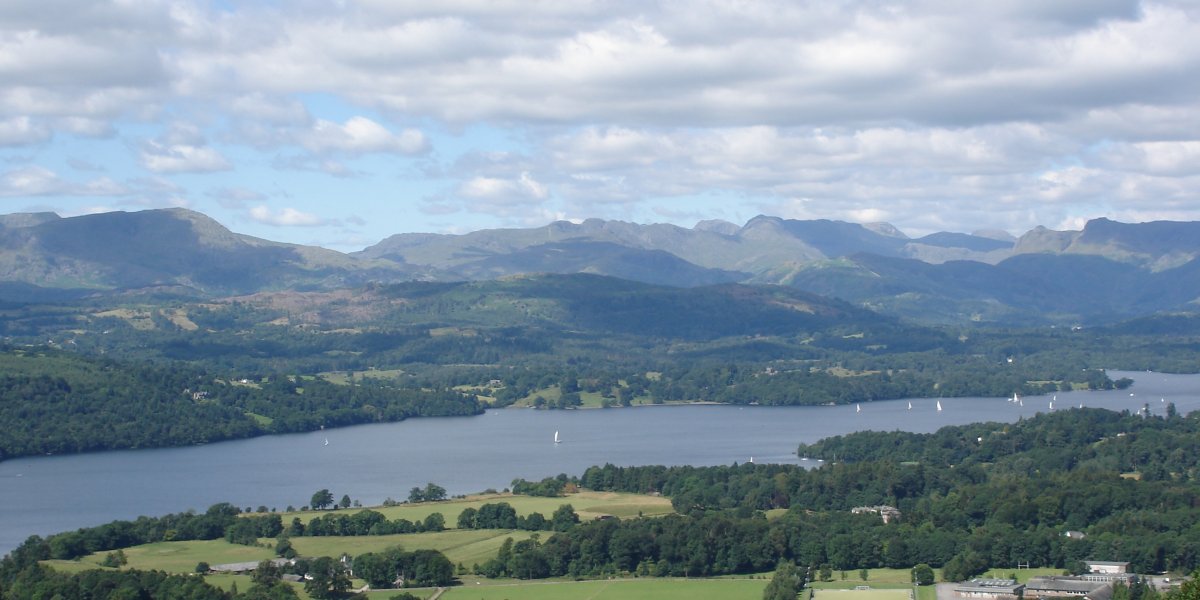
Cross the road directly opposite Windermere train station and follow the discreet 'Orrest Head' sign through the wooden gate — a 1 km zig-zag climb through bluebell-floored oak woodland brings you to the bare summit cairn. This is the exact view that knocked 23-year-old Alfred Wainwright sideways in 1930 and launched the most famous walking guides in history: the entire 17 km length of Windermere unspooling south, the Langdale Pikes jagged to the west, and Coniston Old Man behind. At 09:00 the lake is still mirror-flat with the night's haze peeling off in ribbons, and you'll share the bench with nothing louder than a buzzard.
Tip: Step off the 08:43 train from Oxenholme and you'll reach the summit before the 10:30 coach tours start their climb. The south-facing slate bench is the postcard angle; the smaller cairn 40 m to the north-west looks toward the Coniston fells and almost no one finds it — that's where the photograph is.
Open in Google Maps →11:15
Neighborhood
Descend Orrest Head by the longer eastern path, then drop south through Windermere village and the field path through Beemire Wood and Brant Fell — a 4 km gentle downhill where blackface sheep watch you over drystone walls and the lake appears in widescreen between every stile. Bowness itself is the Lake District in pure postcard form: slate cottages stacked against the hill, Edwardian boating sheds painted Wedgwood blue, and a flotilla of swans patrolling the bay where the 1930s steamers come and go. Walk the promenade west to the old stone jetty before lunch.
Tip: Stand at the small stone jetty 80 m left of the boat-hire kiosks — locals call it 'the Henley shot' because it frames Belle Isle, a moored steamer, and the Coniston fells in a single composition. Skip the World of Beatrix Potter attraction with the queue out the door; the real Hill Top farm is 8 km away and is not on today's route.
Open in Google Maps →13:00
Food
Walk 250 m up Lake Road from the bay to a slim timber-clad shopfront covered in painted sheep — The Crafty Baa, the Bowness locals' antidote to the souvenir-shop strip. The kitchen turns out fast, proper Cumbrian plates built around the family farm: the Cumberland sausage roll with red-onion chutney (£8) is the obvious order, but the smoked Herdwick lamb flatbread with mint yoghurt (£12) is what the regulars come back for. Pair it with a half of Hawkshead Lakeland Gold pulled from the rotating cask line; budget £15-20 per person.
Tip: Walk-ins only — arrive at 12:55 and head straight up the narrow staircase to the mezzanine; the two-top under the small dormer window is the only seat in Bowness with both a lake glimpse and earshot of the kitchen. Ask for the off-menu 'Baa Board' (£16): a rotating Cumbrian charcuterie of air-dried mutton, Doddington cheese, and damson pickle the kitchen keeps back for in-the-know visitors.
Open in Google Maps →14:15
Entertainment
From the Baa it's a 4-minute walk down Glebe Road to Bowness Pier 3, where the 'Red Cruise' to Waterhead boards on the hour. You want the MV Swan or MV Teal — the Art Deco steamers built on the Clyde in the 1930s, still running their original lines. The 40-minute crossing carries you past Belle Isle's Italianate villa (the lake's only inhabited island), the wooded Claife shore where Beatrix Potter rowed across in summers, and finally the Fairfield Horseshoe ridge rising in a perfect amphitheatre dead ahead over Waterhead.
Tip: Buy a single one-way ticket only — you're walking on from Ambleside, not coming back. Climb to the upper open deck and plant yourself at the bow on the starboard (right-hand) side: that's the western shore, where every jetty, slate cottage, and moored yacht looks like a 19th-century watercolour. Avoid the indoor saloon — the diesel hum drowns the wash of the bow.
Open in Google Maps →15:30
Park
Disembark at Waterhead Pier and follow the lakeshore path 1.3 km north through Borrans Park into Ambleside, with the Fairfield ridge rising in front of you the whole way. From the slate-roofed Salutation Hotel, slip up Stock Ghyll Lane behind the church to Stock Ghyll Force — a 70-foot twin cascade hidden inside a Victorian fern grotto only 12 minutes from the centre. Continue the loop up to the lower slopes of Wansfell for the high view back over the lake, then return through Rothay Park and the old packhorse bridge for a properly varied 5 km Lakeland walk.
Tip: Cross the small iron footbridge at the top of the falls (most visitors stop at the lower viewing platform and miss it entirely) — this is the only angle where the twin chutes fall in line with the afternoon light, and around 16:30 in summer the spray catches the sun like a Pre-Raphaelite painting. Pitfall warning: ignore the chalkboards outside the 'Old England Lakeside' chain restaurants in Ambleside's market square — they target coach-tour day-trippers with £24 cod and chips of supermarket grade; Lucy's, where you're headed, is on a different planet.
Open in Google Maps →19:00
Food
From the falls it's a 6-minute walk back down into Ambleside, ending at the slate-stepped doorway of Lucy's on a Plate on Church Street — the small bistro that Lucy Nicholson opened in 1989 and which still defines modern Cumbrian cooking. Candlelit slate floors, a wood-burner, the smell of slow-braised lamb shoulder when the door opens. Order the Herdwick shepherd's pie with rosemary mash (£22) and finish with the sticky toffee pudding flooded in damson-gin custard (£10) — both have been on the menu since the Major government and remain untouchable. Budget £40-55 per person with a glass of Cumbrian fell-side gin.
Tip: Book the 19:00 first seating at least 48 hours ahead and request the small back room with the open kitchen pass — that's where the chefs plate up and where Lucy herself still tweaks the herb garnish. Pitfall warning: in Ambleside avoid the loudly advertised 'lakeside dining cruises' touted from market square boards — the food is reheated and you'll miss the only golden hour of your day staring at a buffet line.
Open in Google Maps →Zu Tag springen
08:30
Landmark
From Windermere train station (your arrival point), cross the A591 and look for the iron kissing-gate beside the Windermere Hotel — the signed path climbs gently through bluebell woods for 20 minutes. The summit cairn unveils all ten miles of England's largest lake spread beneath you, the exact panorama that converted a 16-year-old Beatrix Potter into a Lakeland devotee for life. Arriving before 10am means the rock-bench viewpoint is almost always yours alone.
Tip: Skip the muddy 'shortcut' branching right after the first stile — it loops you onto a steep bracken slope that adds 30 minutes. Stick to the wider main track marked with blue wooden signs the whole way.
Open in Google Maps →10:30
Entertainment
Descend the Orrest path back to Windermere village, then continue south down Lake Road on a gentle 25-minute downhill into Bowness — the lake widens beside you the entire way. Board the wooden-decked MV Tern (built 1891, still original engine) at Bowness Pier 3 for the 45-minute Red Cruise circling Belle Isle and the Storrs Hall mansions. The morning departure runs on the east-facing side, so the western fells are lit golden against blue water — afternoon cruises lose this light entirely.
Tip: Buy at the kiosk, not online — the £2 'Freedom of the Lake' upgrade is the only ticket that also covers your Hill Top ferry crossing this afternoon, saving £4.50. Sit upper-deck stern (back) — the bow gets engine wind.
Open in Google Maps →13:00
Food
From Bowness Pier, walk 4 minutes uphill via Ash Street to the slate-fronted 1612 inn tucked one street behind the tourist promenade — Bowness's oldest pub, named for the hatch through which a blacksmith once passed pints to the wall next door. Order the Cumberland sausage ring with grain mustard mash (£14.50) and a half-pint of Hawkshead Bitter beside the open fire. Locals fill the back snug after 13:30, so come at one o'clock sharp for the window seat under the original beams.
Tip: Don't order the steak — it's the pub's only tourist concession. The slow-braised Herdwick mutton stew (specials board only, served Wed–Sun) is what the farmers eat when they come down from the fells.
Open in Google Maps →14:30
Museum
After lunch, walk 8 minutes back to the lakefront and board the Windermere Ferry (the chain-ferry crosses every 20 minutes, 10-minute passage); from the Far Sawrey landing it's a 25-minute uphill country walk through Beatrix's own pastures into Near Sawrey village. The 17th-century farmhouse is preserved exactly as she left it in 1943 — Tom Kitten's kitchen tiles, Samuel Whiskers' staircase, the dolls in their original glass case her father gave her. Walking in through the front garden, you are stepping into the cover illustration of 'The Tale of Tom Kitten' itself.
Tip: The National Trust enforces strict timed-entry tickets and they routinely sell out 24h ahead — book the 15:00 slot online the night before, never on the day. Photography is banned indoors, but the kitchen garden out back is the actual setting of Peter Rabbit's Mr McGregor scene — that's where to take photos.
Open in Google Maps →17:30
Neighborhood
Catch the 17:00 chain ferry back across to Bowness and walk 3 minutes along the promenade past the swan-thronged jetty to St Martin's churchyard. The 1483 stained-glass east window — rescued from Cartmel Priory during the Dissolution and reinstalled here in secret — glows red and amber from the inside in late afternoon; push the heavy oak door open even if a service has just ended. The south-east corner bench gives a quiet view back over Bowness Bay as the day-trippers disperse onto the Manchester coaches.
Tip: Look up at the west wall — there's a carving of a skeleton holding an hourglass that Wordsworth wrote about in a letter to Coleridge. Most guidebooks miss it because it's at ceiling height behind the font.
Open in Google Maps →19:30
Food
From St Martin's, walk 3 minutes uphill along Helm Road — the Angel's whitewashed Georgian gable appears on your left with the lawn rolling down towards Belle Isle. Order the slow-braised Herdwick lamb shoulder with rosemary jus (£28) — Herdwick is the hardy Lakeland breed Beatrix Potter spent her final decades saving from extinction, and her surviving flock still grazes the fells visible from the dining room window. Pair it with the local Hawkshead Damson Stout (£6).
Tip: Avoid every single restaurant along the main Bowness 'Promenade' / Glebe Road tourist strip — they sell £18 microwaved scampi and £14 fish-and-chips to coach groups, exactly the trap to dodge. The Angel, the Hole in t'Wall, and the Hideout (one street back) are the only three places locals actually eat in Bowness.
Open in Google Maps →08:30
Landmark
From Windermere or Bowness, the 555 bus reaches Grasmere church at 08:25; walk 10 minutes north up Easedale Road to the signed Helm Crag path beside Lancrigg Gate. The 90-minute ascent climbs sharply through gorse and bracken to the summit's twin rock pinnacles — known across England as 'The Lion and the Lamb' — visible from Wordsworth's bedroom window his entire life. The 08:30 start beats the 11:00 fell-runner traffic and delivers Coniston Old Man, the Langdale Pikes and Helvellyn in crystalline morning light before the cloud descends.
Tip: Don't try to scramble onto the actual Lion-and-Lamb rock tower itself — it's a Grade-3 scramble with a 30-metre vertical drop and Mountain Rescue evacuates someone almost weekly. The unmistakable view-of-the-tower photo is from the false summit 50 metres east, not from on top of it.
Open in Google Maps →12:00
Food
Descend Helm Crag back into Grasmere village in 45 minutes; cross the stone bridge over the river Rothay and the tiny former village schoolhouse appears on your left — Sarah Nelson has baked the same secret-recipe gingerbread inside this 1854 cottage continuously for 171 years (£2.45 per piece, buy six). Then walk 60 seconds across the green to Heidi's Grasmere Cafe for a bowl of homemade Lakeland lamb hotpot (£13.50) and elderflower lemonade. Eat the warm gingerbread with the savoury hotpot — that's how the shepherds always did it.
Tip: The recipe was given to Sarah by Wordsworth's housekeeper at Dove Cottage in 1854 and is still kept inside a bank vault in Ambleside — only the current matriarch knows it. The shop only takes cash for amounts under £5; bring coins.
Open in Google Maps →13:30
Museum
Walk 10 minutes east from Grasmere village green along the A591 footpath; the road bends past the old vicarage and Dove Cottage's lime-washed walls appear on your left, exactly as Wordsworth left them in 1808. He wrote 'I Wandered Lonely as a Cloud', 'Ode: Intimations of Immortality' and most of the great poetry of his life inside these eight low-ceilinged rooms (1799–1808); the lime trees he planted in the orchard still shade his sister Dorothy's writing bench. The 14:00 guided tour lets you sit on that actual bench, which the museum will not let you photograph but will let you touch.
Tip: Ask the guide to show you the slate floor crack in the upstairs bedroom — Dorothy recorded the night Coleridge fell through it drunk in 1802 in her Grasmere Journal, and the crack is still visible. They don't volunteer this but always show it if asked.
Open in Google Maps →15:30
Park
From Dove Cottage, cross the lane 100m east — the Coffin Route trailhead is signed at White Moss car park and runs three miles through ancient oak woodland high above Rydal Water. This is the medieval funeral path along which Rydal villagers carried their dead, balanced on flat 'coffin stones', to consecrated ground at Grasmere — the stones still stud the trail at intervals. The path emerges directly into the gardens of Rydal Mount, Wordsworth's grander later home, where he planted the terraces himself and watched the daffodils his sister Dorothy described in her journal entry of 15 April 1802.
Tip: Mid-afternoon light angles through the oak canopy at exactly this hour and turns the path floor copper — the best stretch for photographs is the half-mile between the second and third coffin-stones, signposted 'Nab Scar'. Wear grippy soles; the slate underfoot is greasy even when dry.
Open in Google Maps →17:45
Park
From Rydal Mount, the 555 bus runs every 20 minutes into Ambleside (10-minute ride); from the Market Cross walk 8 minutes up Stock Ghyll Lane behind the Salutation Hotel. The 70-foot waterfall hides inside a steep dripping fern gorge — turn off the lane at the wooden footbridge and the roar reaches you before the view does. Late-afternoon sun slants down the gully at precisely this hour and lights a rainbow in the spray; arrive 30 minutes earlier and the sun hasn't dropped into the canyon yet.
Tip: Skip the 'upper viewing platform' — the railings block the lower fall entirely. The path that branches left across the bottom bridge gives the only unobstructed view of all four cascades stacked together, and almost nobody finds it.
Open in Google Maps →19:30
Food
Walk 5 minutes back down Stock Ghyll Lane into Ambleside centre; Lucy's on a Plate occupies the bunting-fronted yellow cottage on Church Street. Order the 'Lakeland lamb hotpot' (£24, the dish was a Lucy Nicholson original now copied across Cumbria) and finish with sticky toffee pudding (£9.50) — the dessert was invented 30 miles north at Sharrow Bay Hotel in 1972, and Lucy's uses Francis Coulson's original date-and-toffee recipe. Sit upstairs in the candlelit attic room with sloped ceilings; downstairs is for walk-ins.
Tip: Book at least 24 hours ahead — Ambleside has only about 200 dinner seats total and they fill by 19:00 from Easter to October. Also: do not buy 'Grasmere gingerbread' anywhere outside Sarah Nelson's actual shop — every Ambleside gift-store version is a mass-produced supermarket imitation at triple the price, and the 'Kendal Mint Cake' tourist shops on Lake Road are an identical trap.
Open in Google Maps →Zu Tag springen
09:00
Landmark
From Windermere station, cross the A591 and follow the signposted path opposite — a 20-minute climb through oak and bracken to a bench-lined summit. This is the exact viewpoint where Alfred Wainwright, age 23, first saw the Lakes and wrote 'a moment of magical beauty stamped indelibly on my mind.' At 09:00 you'll have the summit's three-fell panorama — Windermere, Coniston, Langdale — almost entirely to yourself before the 11 AM coach crowd arrives.
Tip: Take the path marked 'Orrest Head' from directly opposite the station — there's a longer back route via Common Wood that lacks the dramatic reveal at the top. Stand 3 metres behind the Wainwright bench at the summit to fit lake and Langdale Pikes in one frame.
Open in Google Maps →11:30
Museum
Descend back to Windermere station and walk 15 minutes south down Rayrigg Road — the dark slate boatsheds emerge over the lake at the end of an avenue of beeches. Britain's oldest steam launch (1850) still fires up here, alongside Beatrix Potter's own sailing dinghy and the salvaged fragments of Donald Campbell's record-breaking Bluebird K7. The Stirling-Prize-shortlisted wet docks float historic boats directly into the gallery; reflections in the morning light are the photographer's prize.
Tip: The wet-dock viewing platform gives the perfect mirror shot of the 1898 SL Branksome — go at 11:30 when sunlight hits the prow. Skip the museum café; Bowness is a 20-minute lakeside walk south with vastly better lunch options.
Open in Google Maps →13:00
Food
From the Jetty Museum, follow the lakeside path south through Cockshott Point — 20 minutes of open lake views, then turn inland at St Martin's Church onto Lowside. Bowness's oldest pub (1612) has low oak beams, a coal fire in winter, and the original blacksmith's hatch through which ale was once passed. Order the Cumberland sausage with onion gravy (£15.50) or the Herdwick lamb hotpot (£17), and pair with a pint of Hawkshead Bitter from the brewery 6 miles away.
Tip: No reservations on the ground floor — arrive 13:00 sharp before the cruise-boat lunch wave hits at 13:30. The Cumberland sausage is sourced from Pursglove's butcher three doors down, and is genuinely a different animal from the supermarket version.
Open in Google Maps →15:00
Entertainment
Walk 5 minutes down Ash Street from the pub to Bowness Pier 3 — buy tickets at the slate-roofed kiosk by the swan-fed quay. Board the northbound 'Red Cruise' to Ambleside and wait specifically for MV Tern (1891), the varnished-oak Victorian steamer; the 45-minute crossing passes the widest stretch of the lake with Wansfell rising ahead and Loughrigg Fell to the west. Return on the same vessel to Bowness — afternoon light turns Belle Isle's woods bronze on the way back.
Tip: Sit on the port (left) side going north — you'll get the dramatic angle on the Langdale Pikes silhouette. Board 20 minutes early to claim a top-deck bench; once full, indoor seats have lake-blocking pillars.
Open in Google Maps →19:00
Food
From Bowness Pier, walk one block up Helm Road — the Angel sits on the rise above town with a garden terrace overlooking Belle Isle. An 18th-century coaching inn with a kitchen that takes the lake view seriously: try the slow-braised Cartmel Valley venison (£26) or Solway scallops with black pudding (£28). In summer the front lawn is the best sunset seat in Bowness — the lake turns copper around 21:30 in June.
Tip: Reserve a 'garden window' table specifically by phone — the indoor dining room misses the lake view entirely. Avoid the strip restaurants on Lake Road below the pier; they're tour-coach traps charging £24 for frozen scampi, and the Angel's terrace is where off-duty Lakeland chefs eat on their nights off.
Open in Google Maps →08:30
Landmark
Catch the 555 bus from Windermere to Grasmere village (25 min), then start the trail at the Lancrigg Lane signpost on the village's north edge. Known as 'The Lion and the Lamb' for the twin summit rocks resembling a recumbent lion beside its cub, this is the most photographed fell silhouette in the Lakes — a 3-mile loop gaining 380 m over 90 minutes of steady climbing. At 08:30 you'll summit before the 11 AM coach groups have even reached Grasmere, with a 360° sweep down Easedale and back to Helvellyn.
Tip: At the summit, scramble the final 5 metres onto the 'Howitzer' rock (the western pinnacle) — only one in three visitors does it, but it's the iconic Wainwright shot. Wear grippy soles; the rock is polished smooth and treacherous after rain.
Open in Google Maps →12:30
Food
Descend Helm Crag back to Easedale Road and walk 10 minutes east into Grasmere — the Jumble Room is on Langdale Road, in a slate cottage behind a sun-yellow door. A village institution since 1996, run by Andy and Chrissy Hill, swinging between Italian, Indian, and Cumbrian cooking depending on the day's market. The slow-cooked Herdwick lamb with pommes anna (£21) is the perennial winner; the haddock fishcake (£17) is what locals order.
Tip: Reserve at least 48 hours ahead — they seat 24 covers per service and Friday-Saturday books out a week in advance. Off-menu but always available: ask for 'the gingerbread sundae' — Sarah Nelson's gingerbread crumbled over Hawkshead sticky-toffee ice cream.
Open in Google Maps →14:30
Museum
From the Jumble Room, walk 12 minutes south along the A591 footpath through Town End — the whitewashed cottage appears tucked behind a stone wall, exactly as Wordsworth left it in 1808. This is where William wrote 'I wandered lonely as a cloud' and the 'Ode: Intimations of Immortality,' and where Coleridge slept by the parlour fire; the guided tour walks you through Dorothy's kitchen and William's tiny eaves-study. The attached museum currently exhibits the De Quincey opium-eater notebooks alongside Wordsworth's original manuscripts.
Tip: Book the 14:30 timed slot specifically — morning slots fill with coach tours, and 14:30 is the quietest of the day. After the tour, the moss-covered bench at the top of the orchard-garden steps gives the exact lake view Wordsworth had — free to wander, and almost nobody finds it.
Open in Google Maps →17:00
Food
From Dove Cottage, follow the field footpath west for 10 minutes — emerge at the lych-gate of St Oswald's in the village centre. Sarah Nelson's Grasmere Gingerbread Shop (1854) still bakes from her original locked recipe in the tiny former village schoolhouse — sold warm by costumed staff at £4.95 for six pieces. Across the churchyard at St Oswald's lie Wordsworth, his wife Mary, sister Dorothy, and daughter Dora, beneath eight yew trees the poet himself planted in 1819.
Tip: Buy six pieces, not twelve — the gingerbread is dense and improves with a day's rest in foil. The shop locks at 17:30 sharp; don't dawdle in the churchyard if you haven't bought yet.
Open in Google Maps →19:30
Food
From St Oswald's, walk 5 minutes across Red Lion Square and the village green — Tweedies sits in the slate-and-ivy Dale Lodge Hotel. This is where the climbing guides drink: slow-cooked beef cheek with horseradish mash (£24) is the kitchen's standout, and the smoked Esthwaite trout (£19) is the lighter choice. Eighteen Lake District ales rotate on the bar — start with a half of Cumbrian Ales' 'Loweswater Gold.'
Tip: Sit in the walled-garden conservatory, not the main bar — the garden lights up at dusk and the kitchen is faster on conservatory tickets. Avoid The Lamb Inn directly opposite: the menu is identical to ten other Lakeland pubs and prices are 20% inflated purely for the Grasmere postcode.
Open in Google Maps →10:00
Museum
Catch the Windermere Ferry across the lake from Bowness (10-minute crossing) then the Cross Lakes 525 shuttle to Near Sawrey, 15 minutes. This is the 17-acre farm Potter bought in 1905 with the royalties from 'Peter Rabbit,' preserved exactly as she left it — her Wedgwood china in the dresser, her doll's house from 'Two Bad Mice' in the parlour, the kitchen range where Mrs Tiggy-Winkle's iron was heated. Every room corresponds to an illustration in one of her books; entry is by timed ticket and the 10:00 slot is the calmest.
Tip: Book online at nationaltrust.org.uk strictly 30 days in advance — walk-up tickets are vanishingly rare in season and the 10:00 slot sells out first. The 'Tom Kitten' side gate is the iconic photo spot; the back rhubarb patch from Peter Rabbit is far less crowded than the famous front.
Open in Google Maps →12:00
Food
Step out of Hill Top's gate, turn left — the inn is 30 metres down the lane. Potter painted it as the village inn in 'The Tale of Jemima Puddle-Duck' in 1908, and the National Trust now owns the 17th-century slate-roofed building with its original stone-flagged floor. Try the Herdwick mutton pie with red wine gravy (£17), made from fellside flocks Potter herself bred, or the Esthwaite trout (£19) from the lake three miles away.
Tip: Arrive 12:00 sharp — the inn seats only 15 tables and the Hill Top second wave hits at 12:30. Ask for the window seat in the snug (the small alcove to the right of the bar) — it's the exact view Potter drew of the duck waddling down the lane.
Open in Google Maps →14:00
Museum
Walk west from Tower Bank Arms along the signposted footpath 'Hawkshead via Esthwaite' — 45 minutes through bluebell woods and along the lake shore, emerging in Hawkshead's slate-cobbled square. The gallery is housed in what was her husband William Heelis's solicitor's office, preserved with his original oak desk and tilting bookcases. The rotating display includes original 'Two Bad Mice' panels and the prep watercolours Potter made before printing 'Peter Rabbit' — tiny, intimate, and a quiet pause after the lakeside walk.
Tip: The exhibition rotates every six months — Peter Rabbit originals are typically shown March–September. Photography is forbidden inside, but the gift shop sells genuinely good facsimile prints at £8.
Open in Google Maps →16:00
Museum
Cross the cobbled square in front of the gallery — the grammar school is 60 seconds away on the rise behind St Michael's church. This is the 1585 schoolroom where William Wordsworth carved his name into the oak desk at age 9 — the carving is still legible today. The lower hall preserves the original Latin grammar slates, the master's desk, and ink-pot holes worn smooth by 300 years of schoolboys.
Tip: The carved 'W. Wordsworth' desk is on the right side of the schoolroom — the volunteer guide will point it out if asked, otherwise easy to miss. Doors lock at 17:00 promptly; use the remaining hour before dinner to wander Hawkshead's pedestrian-only lanes.
Open in Google Maps →19:00
Food
From the grammar school, walk 100 metres back across the square — the Queen's Head's whitewashed front and box-window flowers are unmistakable. A 17th-century coaching inn in the heart of car-free Hawkshead, where the front bar still has the original oak settle Wordsworth would have known. Order the Cumberland tattie-pot (£18) — a Lakeland one-pot of lamb, black pudding, and stewed onions that's hard to find done well — or the venison Wellington (£26), and choose from 22 single malts on the back-bar list.
Tip: Eat in the front bar, not the rear restaurant — same menu, faster service, and far more character. Tourist-trap warning for Hawkshead: avoid any café advertising 'Beatrix Potter Cream Tea' (every one charges 50% above non-themed cafés like the Poppi Red bakery on Main Street), and don't take the late 'Bowness Direct' minibus parked by the church — drivers charge £15 a head for what is a £3.50 official 505 bus from the same stop.
Open in Google Maps →
Trip builder
Plan this trip around Windermere
Turn this guide into a bookable rail itinerary with FlipEarth.
Keep exploring
Related cities
More in the same country
FAQ
Frequently asked questions
How many days do you need in Windermere?
Most travelers enjoy Windermere in 1 days, with enough time for headline sights and a slower meal or museum stop.
What's the best time to visit Windermere?
The easiest season for most travelers is May-Sep, especially if you want good weather and manageable crowds.
What's the daily budget for Windermere?
A practical starting point is about €120 per person per day before hotels, then adjust based on museums, dining, and transport.
What are the must-see attractions in Windermere?
A good first shortlist for Windermere includes Orrest Head.