City Guide
Modena
Italien · Best time to visit: Apr-Oct.
Day-by-day plan
Choose your pace
Reisedauer
09:00
Landmark
From Modena train station, walk five minutes northwest along Via Divisione Acqui — the curved yellow aluminum shell rises into view like a folded car bonnet. Designed by Future Systems and wrapped around Enzo Ferrari's actual birthplace and his father's brick workshop, this is the architectural origin myth of the Prancing Horse. We skip the interior to keep the day moving — the building itself is the photograph.
Tip: Walk to the rear lawn and frame the shot with the original brick workshop on the left and the yellow shell on the right — that intersection of 1898 and 2012 is the angle every F1 documentary uses. Morning eastern light hits the curve frontally before 10:00; after that, the roof goes flat in photos.
Open in Google Maps →10:45
Landmark
Cut south through the plane trees of Parco Novi Sad and continue down Via Emilia Centro — a fifteen-minute walk that drops you into Piazza Roma, where the Este family's baroque palace fills your entire field of vision. It is now Italy's Military Academy, so you may catch cadets in white gloves crossing the courtyard, but the public only sees the facade — and that's enough. The fountain at the far end of the piazza gives you the one frame that captures the whole 17th-century front.
Tip: Stand with your back to the fountain on Piazza Roma — that's the only spot wide enough to fit the entire facade without distortion. Skip the Sunday-only interior tour unless you happen to be here on the right day; the booking lottery is a Modenese inside joke.
Open in Google Maps →11:45
Religious
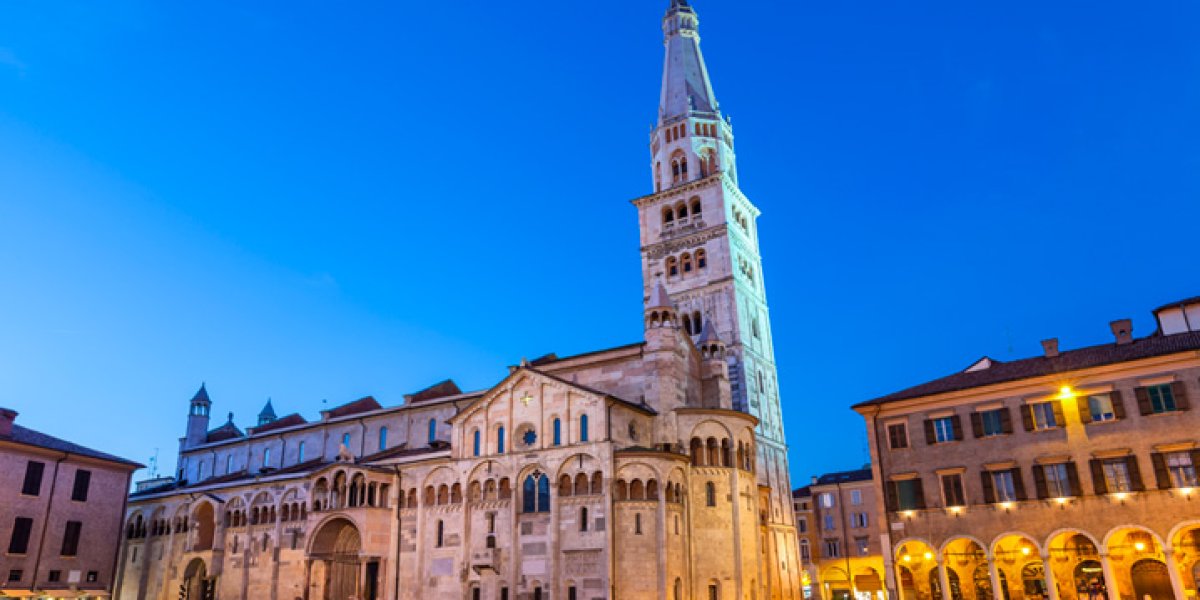
From Piazza Roma, slip south down Via Farini for four minutes — the Ghirlandina's pointed spike appears between the buildings before the square opens up. The Romanesque cathedral (1099, by Lanfranco) and the leaning bell tower form one of Italy's most complete UNESCO ensembles, with Wiligelmo's stone Genesis reliefs on the facade — some of the first narrative sculpture in medieval Europe. Walk a slow loop around the apse to see the cathedral and tower stack into a single silhouette from Piazza Torre.
Tip: The 'Pietra Ringadora' marble slab in front of the cathedral is where medieval debtors were forced to drop their trousers and publicly declare bankruptcy — locals still joke about it. Best photo angle is from Piazza Torre at the rear; the front facade is shaded by the cathedral itself until late morning, so 11:45-12:30 is when the reliefs actually catch direct light.
Open in Google Maps →13:00
Food
Exit Piazza Grande through the southern arcades — Mercato Albinelli's wrought-iron Liberty gate is two minutes away on Via Luigi Albinelli. The 1931 covered market still hums with fishmongers, salumieri and pasta nonne hand-rolling tortellini behind glass. Head upstairs to the gallery counters: a bowl of tortellini in brodo at Trattoria Pomposa runs about €9, a tigella stuffed with culatello and squacquerone at the salumeria stalls is €6, and a glass of cold Lambrusco di Sorbara is €3.
Tip: Order tortellini *in brodo* — never with cream. Modenese consider cream sauce a tourist crime; the broth is the entire point. Arrive at 13:00 sharp: morning shoppers have cleared, but the kitchens stay hot until the 14:30 closing bell. Cash moves the line twice as fast as card at the upstairs stalls.
Open in Google Maps →15:30
Landmark
From the market, walk southeast down Via San Vincenzo for ten minutes, past the medieval brickwork of Sant'Agostino — you arrive at an unassuming residential door at number 8. Upstairs in the family's 18th-century attic sits the *batteria*: a hundred-plus shrinking barrels of chestnut, cherry, oak, juniper and ash, where real Aceto Balsamico Tradizionale di Modena DOP slowly concentrates for 12, 25, sometimes 50 years. The tasting compares the 12-year, the 25-year Extra Vecchio, and a finger-dip of something even older — on a wooden spoon, on Parmigiano shavings, on a single strawberry.
Tip: Book a week ahead by email — drop-ins are politely refused. The only real *Tradizionale* comes in the Giugiaro-designed teardrop bottle with a gold or silver seal; the €5 supermarket 'balsamic glaze' is industrial caramel and wine vinegar, sharing no genetic material with the real thing. Never cook with it — three drops on Parmigiano is the local commandment.
Open in Google Maps →19:30
Food
From the acetaia, walk twelve minutes south down Via Vignolese — past the edge of the Giardini Ducali — to number 58, a low-key bistro with butcher-block tables. This is Massimo Bottura's casual sister to the three-Michelin-star Osteria Francescana, run by the same kitchen brain without the six-months-out booking lottery. Order the Tortellini Cacio e Pepe (€18) — Bottura's wink at Rome using Modenese pasta — and the Tagliata di Manzo finished with a thread of 25-year balsamic (€26); average bill lands around €55 with a glass of Lambrusco.
Tip: Reserve three to four days ahead for the 19:30 first seating — the kitchen is sharpest then, with the pasta freshly rolled. Pitfall warning: ignore the 'Osteria Francescana–style' tourist traps clustered along Via Stella that stick a Ferrari sticker in the window and charge €30 for a Lambrusco — the only two real Bottura kitchens are Francescana (booking-only, months out) and this one. Also: most serious Modenese trattorie close Mondays and Sunday evening, so verify the day before walking over.
Open in Google Maps →Zu Tag springen
09:00
Religious
Step into Piazza Duomo from Via Emilia — Modena's UNESCO core fits within 200 meters. Arrive just after the 8:30 mass, when locals slip out and tour groups haven't yet rolled up; morning light pours across Wiligelmo's 12th-century Genesis reliefs on the west facade. Descend to the crypt to stand beside the tomb of Saint Geminiano, the city's patron whose bones the cathedral was built around in 1099.
Tip: Don't rush past the south-side Porta Regia — the carved lions hold the column bases in their mouths, and Wiligelmo signed his work above the main door (the only Romanesque sculptor in Italy known to have done so). Visit before 11:00, or you'll share the nave with cruise-tour megaphones.
Open in Google Maps →10:30
Landmark
Exit the Duomo's north door — the 86-meter leaning bell tower rises straight above you, sharing the same UNESCO square. Climb the 200 narrow stone steps before noon, when haze hasn't dulled the view: the snow-capped Apennines line the south horizon, the Po Valley stretches infinitely north. The 'ghirlanda' (garland) name comes from the white marble railing crowning the spire, which appears to spin when you look up from Piazza Torre.
Tip: Buy the €6 combined ticket at the Acetaia Comunale entrance on Via Scudari — it includes the climb plus a free guided visit to the city's own balsamic batteries aging in the Palazzo Comunale attic (weekend afternoons only). Most visitors miss this — it's the best balsamic preview you'll get in the historic center.
Open in Google Maps →12:30
Food
From Piazza Grande, walk 200 meters south down Via Albinelli to the 1931 iron-and-glass market hall — Modena's belly. Eat standing at the counter of Rosticceria Giusti or Bar Schiavoni: gnocco fritto draped with prosciutto di Modena (€8), a paper plate of fresh tortellini (€10), a shaved wedge of Parmigiano Reggiano 36-month. This is how locals lunch — on their feet, in 30 minutes, paying half what the Via Emilia sit-down tourist places charge.
Tip: Buy a small jar of mostarda di Modena (mustard-spiced candied fruit, €6) from the central condiment stall — it pairs with cheese and survives the flight home. The fresh-tortellini counter to the left of the fountain is run by the Galloni family — ask for tortellini stuffed with mortadella, not the standard pork-prosciutto fill; it's a Modena variation few tourists know to request.
Open in Google Maps →14:30
Museum
Walk 5 minutes west along Via Emilia to Largo Sant'Agostino; the gallery occupies the top floor of Palazzo dei Musei. Afternoon is right — you've earned the indoor escape from midday glare, and the third floor empties after 14:00. Stand face-to-face with Velázquez's portrait of Duke Francesco I d'Este (one of only two royal portraits Velázquez painted outside Spain) and Bernini's marble bust of the same duke, displayed across from each other so you read two great artists describing one man.
Tip: Closed Mondays. Skip the Lapidary Museum on the ground floor — it's just Roman tombstones in dim light — and head straight up. Ask at the desk to see the Borso Bible in the Biblioteca Estense across the corridor: 1,200 hand-painted miniatures, one of the most beautiful manuscripts in Europe, free with the ticket but rarely signposted.
Open in Google Maps →17:00
Landmark
Walk 5 minutes back east along Via Emilia to Modena's beating heart. Late-afternoon golden light strikes the cathedral's south flank and turns the Palazzo Comunale's apricot arcades into theater; locals trickle out for aperitivo at the corner tables. Find the 'Preda Ringadora,' the worn red marble stone where medieval mayors swore their oaths to the people, and the small statue of 'La Bonissima' watching from the corner — the medieval symbol of Modena's honest grain weights.
Tip: Order a Lambrusco spritz (€6) at Caffè Concerto and sit at the marble tables under the cathedral's south wall — the only café in Modena with seating directly on the UNESCO piazza. Photograph the square at 17:30 from the corner of Via Castellaro: the leaning Ghirlandina, the cathedral apse, and the Palazzo all line up in one frame.
Open in Google Maps →19:30
Food
Walk 6 minutes north from Piazza Grande along Via Università to Largo Hannover. This neighborhood osteria, named after a 19th-century postal coach stop, is where Modenese in their fifties bring out-of-town friends — not where Instagram travelers go. Order tortellini in brodo (€18), zampone with lentils (€22), and a glass of Lambrusco di Sorbara secco, the dry, salmon-pink sparkling version that cuts pork fat like no other wine in Italy.
Tip: Book 3 days ahead online (they have 22 covers). Order the bollito misto cart if it's on — three meats sliced tableside with three mostardas. PITFALL WARNING: avoid the 'tortellino' restaurants along Via Emilia and around the bus station with English photo menus stuck to the sidewalk — they sell frozen industrial pasta at €18 a plate. Real Modenese osterias post a handwritten Italian-only menu inside the door and never advertise tortellini in five languages.
Open in Google Maps →09:00
Museum
Walk 15 minutes north from the historic center across Viale Crispi — the wave-shaped yellow aluminum roof, designed by Czech architect Jan Kaplický to echo a Ferrari engine bonnet, rises above the cypress trees on Via Paolo Ferrari. Be at the door for the 9:30 opening: the first hour you have the curved white gallery floor and its 25 prancing-horse Ferraris almost to yourself, before the Bologna school buses arrive. Enzo's actual birth-house, a small red-brick workshop, stands restored at the side as the second gallery.
Tip: The 18-minute panoramic film projected across the entire curved wall starts every 30 minutes — sit center-rear and watch the 11:00 screening for the fewest interruptions. Buy the combined ticket (€27) with the Museo Ferrari Maranello at the same desk if you plan to visit Maranello another day; it saves €5. Skip the gift-shop espresso — it's €4 and instant-pod quality.
Open in Google Maps →11:30
Food
Not walkable — grab a 15-minute taxi southeast to San Donnino di Modena (€18). Behind a 19th-century villa stretches a rooftop attic packed with 200 oak, chestnut, juniper, mulberry, and cherry barrels — the Bonini family has aged traditional balsamic here since 1891 and still supplies Bottura's Osteria Francescana. The tour ends in the tasting room: a 12-year extra vecchio next to a 25-year, served drop by drop on a small ceramic spoon so the tongue can read the leap between them.
Tip: Reserve the day before by WhatsApp — tours cap at 8 people and book up by morning. Buy a 100ml bottle of the 25-year 'extra vecchio' (€80) directly at the cellar; the identical bottle costs €170 at Bologna airport duty-free. Pack it as checked luggage in a sock inside a sock — the cork is wax-sealed and survives the flight.
Open in Google Maps →13:30
Food
Taxi 15 minutes back to the center; Aldina sits one floor up a narrow staircase across Via Albinelli from the market entrance. Run by the same family for 70 years, this lunch-only trattoria is where balsamic producers, Pavarotti's nephews, and Bottura's prep cooks eat their day-off meal — there is no sign in English, no menu online, no Instagram presence. Order tortellini in brodo (€12) and bollito misto with three mostardas (€16): the most honest version of Modenese cuisine you will ever eat.
Tip: Cash preferred — the card reader is moody. No reservations accepted: arrive at 12:45 with the early wave or after 13:30 (the locals' second seating). Closed Sunday and Monday. They stop serving when the brodo runs out, usually by 14:30 — and the brodo, simmered from capon since 6 a.m., is the whole point.
Open in Google Maps →15:30
Museum
Taxi 12 minutes east to Stradello Nava 8 (€15). This is Pavarotti's last home, kept exactly as he left it the morning of September 6, 2007 — the Steinway in the music salon is still tuned, his shaving brushes still on the bathroom shelf, his half-finished crossword still on the kitchen table. Walking through his bedroom lined with his Grammys, then his costume room hung with the actual robes he wore in La Bohème, Tosca, and Aida, is unexpectedly intimate — closer than any concert recording can be.
Tip: The free audioguide (English available at reception) plays Pavarotti's own recordings in each room — 'Nessun Dorma' triggers in the music salon and will silence the whole house. Skip the gift-shop coffee; walk 100 m down the road to Bar San Pancrazio, where the museum staff and Pavarotti's gardener still take their espresso (€1.20). Ask the taxi to wait — passing cabs out here are rare.
Open in Google Maps →17:30
Landmark
Taxi back to the center and step out at Piazza Roma. The vast Baroque facade of the Palazzo Ducale, built by the Este dukes in 1634 and now Italy's national Military Academy, glows apricot in the late golden hour — no museum queue, no tour group, no entrance — just locals cutting across the square on their commute. It is the grandest building in Modena, and yet far less touristed than Piazza Grande; on weekday evenings cadets in dress uniform exit at the 18:00 drill, sword-and-cap silhouettes against the warm stone.
Tip: You cannot enter the palazzo unless you book a Sunday-morning guided tour (weeks ahead, free, via the Modena tourist office on Piazza Grande) — the academy uses every room. Walk under the portico to the courtyard gate on the east side: from there you'll glimpse the inner courtyard's monumental staircase, the closest most travelers ever get to the interior.
Open in Google Maps →19:30
Food
Walk 10 minutes south from Piazza Roma along Via Carteria, then east on Via Vignolese to number 58. Massimo Bottura's casual sister to the three-Michelin-star Osteria Francescana — same kitchen brigade, same playful vision, one-fifth the price. Order the 4-course tasting menu (€55) with the Lambrusco pairing: the pasta course is always a Bottura riff on tortellini, and the dessert quotes 'Oops, I dropped the lemon tart' — his most famous Francescana dish — at half-scale.
Tip: Book online 2 weeks ahead. PITFALL WARNING: Osteria Francescana itself, three doors down at Via Stella 22, requires a €290-per-person deposit and 3 months' notice — Franceschetta is the smart traveler's Bottura experience. Avoid the 'artisanal tortellini' souvenir shops near Piazza Grande selling vacuum-packed frozen pasta at €25 a bag marketed as 'fresh' — real Modenese tortellini are made the morning you eat them and don't travel. The only legitimate pasta to take home is dried egg tagliatelle from Mercato Albinelli.
Open in Google Maps →
Trip builder
Plan this trip around Modena
Turn this guide into a bookable rail itinerary with FlipEarth.
Keep exploring
Related cities
More in the same country
FAQ
Frequently asked questions
How many days do you need in Modena?
Most travelers enjoy Modena in 1 days, with enough time for headline sights and a slower meal or museum stop.
What's the best time to visit Modena?
The easiest season for most travelers is Apr-Oct, especially if you want good weather and manageable crowds.
What's the daily budget for Modena?
A practical starting point is about €130 per person per day before hotels, then adjust based on museums, dining, and transport.
What are the must-see attractions in Modena?
A good first shortlist for Modena includes Museo Enzo Ferrari Modena (Exterior), Palazzo Ducale di Modena, Acetaia di Giorgio.