City Guide
Amalfi Coast
Italien · Best time to visit: May-Jun, Sep-Oct.
Day-by-day plan
Choose your pace
Reisedauer
09:00
Landmark
From the SITA bus stop on Via Cristoforo Colombo, descend the staircase streets through cascading pastel houses draped in bougainvillea — the most photographed coastal village in Europe unfolds below you step by step. At the bottom, the green-and-yellow majolica dome of Chiesa di Santa Maria Assunta rises above Spiaggia Grande, where fishing boats still line the dark volcanic sand. Stand on the beach and look back up at the full vertical sweep of colour — this is the image that made you book the trip.
Tip: The best elevated photo of the entire village is from the bend on Via Positanesi d'America, about 3 minutes uphill from the church — the houses fan out below with the sea behind. Arrive before 09:30 and you will have the staircases nearly to yourself; by 10:00 the first tour buses empty and the narrow lanes become a slow shuffle.
Open in Google Maps →11:45
Religious
Take the 11:15 ferry from Positano's beach pier (€10, 25 minutes) and walk straight through the harbour archway into Piazza del Duomo, where the cathedral's Arab-Norman striped facade towers above a dramatic 62-step staircase. The exterior is the spectacle: Moorish interlacing arches, Byzantine mosaics in the gable, and a bell tower tiled in the same majolica that echoes Positano's dome. Loop around Via Lorenzo d'Amalfi to glimpse the Chiostro del Paradiso arcade through the gate and browse artisan shops still selling handmade Amalfi paper.
Tip: The staircase faces roughly west, so morning light illuminates the facade beautifully — shoot from the bottom step with a wide angle. Skip the €5 interior ticket; the exterior and the free paper-making displays along Via Lorenzo d'Amalfi give you the full story with better light.
Open in Google Maps →13:00
Food
Step down from the cathedral staircase and turn left under the arcades — Pansa has occupied this corner of Piazza del Duomo since 1830. Order the delizia al limone (€5, a pillowy lemon sponge in limoncello cream) and a cuoppo di mare from the fried-seafood cart two doors down (€8, crispy calamari and baby shrimp in a paper cone) — eat standing at the bar or on a piazza bench to skip the €3-4 terrace cover. Budget €12-18 for a full coastal lunch in fifteen minutes.
Tip: The cuoppo vendors fry to order until mid-afternoon — ask for 'ben cotto' (well done) for extra crunch. Pansa's lemon granita is the best on the coast if you need cooling down; skip the gelato shops flanking the piazza, which charge tourist prices for industrial product.
Open in Google Maps →14:00
Neighborhood
Walk east from the piazza, exit Amalfi's harbour wall, and follow the Lungomare dei Cavalieri footpath carved into the cliff above turquoise water — a breathtaking 10-minute walk where the rock face rises on one side and the sea drops away on the other. You emerge into the smallest municipality in southern Italy: Piazza Umberto I wedged between the sea and a vertical wall of houses, with no souvenir shops and no tour groups. The arched tunnel from the piazza to Atrani's pocket beach frames the most photogenic shot of the day — stand inside looking out for a composition that contrasts dark stone with bright sea.
Tip: Catch the SITA bus to Ravello directly from the stop on the main road above the piazza (every 30 minutes, €1.30, 15 minutes of hairpin switchbacks climbing 350 m). Buy the ticket at the tabacchi on the piazza before heading up — the bus driver does not sell tickets.
Open in Google Maps →15:30
Landmark
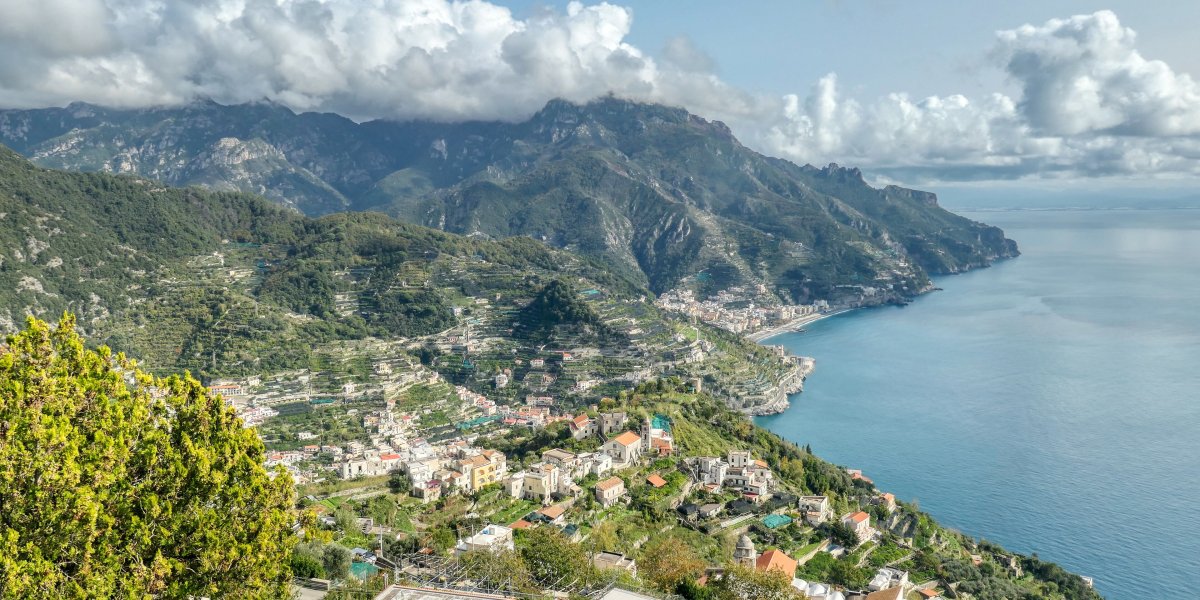
Step off the bus in Ravello's Piazza Duomo — after the coastal frenzy below, the hilltop silence hits you first. Villa Rufolo's 13th-century terraced gardens hang 350 metres above the sea; Wagner saw them in 1880 and composed parts of Parsifal on the spot, and when you reach the belvedere terrace and the full coastline unfolds — Amalfi, Atrani, Maiori, the sea dissolving into sky — you understand why. The lower Moorish garden, a cloister of pointed arches and tall palms, draws fewer visitors and frames the same view through centuries-old stone.
Tip: Afternoon light between 15:00 and 17:00 is ideal — the sun is behind you as you face the coast, giving saturated colours with no glare on the water. The lower terrace is less crowded and more photogenic than the main belvedere; most visitors never walk down.
Open in Google Maps →18:00
Food
Exit Villa Rufolo, turn right, and walk 2 minutes along Via Roma to this family trattoria that has fed Ravello since 1929 — checkered tablecloths, bottles of house wine on every table, and food that makes you forget you are in a tourist town. Order the mista di primi (€14, a parade of seven handmade pastas on one plate — scialatielli al limone, gnocchi alla sorrentina, ravioli capresi, and more) followed by the scaloppine al limone (€16). Budget €30-40 per person with house wine; the complimentary limoncello at the end is homemade and potent.
Tip: Arrive by 18:00 to walk in without waiting — by 19:30 every table is full and the queue stretches outside. No need to reserve; they seat walk-ins efficiently and the back room is quieter. Warning: the restaurants flanking Ravello's bus stop are tourist traps charging double for frozen-and-reheated food — walk 2 minutes past them to Via Roma where the locals actually eat.
Open in Google Maps →Zu Tag springen
09:00
Neighborhood
Take the SITA bus from Sorrento and step off at the Sponda stop — the moment Positano appears around the cliff bend, the entire bus falls silent. Stand at the roadside belvedere where the full village cascades below you in coral, terracotta, and cream, tumbling 200 meters to a turquoise cove. Then descend slowly through Via dei Mulini, past lemon-draped terraces, hand-painted ceramic workshops, and bougainvillea-covered archways — this walk is not a route to the destination, it is the destination.
Tip: Arrive at exactly 9:00 AM — the morning sun hits the eastern face of the village head-on, painting every building gold. By 11:00 the light flattens and the first tour buses unload. The single best photo position is the hairpin bend near Hotel Poseidon, where the dome of Santa Maria Assunta anchors the cascading houses in perfect composition.
Open in Google Maps →10:30
Religious
At the bottom of your descent through Via dei Mulini, the glittering majolica-tiled dome you have been staring at from above for the last hour is now directly overhead. Step inside to find a 13th-century Byzantine Black Madonna icon that, legend says, was aboard a Saracen ship becalmed offshore until a voice called 'Posa, posa' — put me down — and the town was named. The piazza in front is the social heart of Positano, where every path through the village converges.
Tip: The church is free; the small crypt museum below (€3) is worth five minutes for its Roman-era artifacts. For the best dome photo, stand on the church steps facing uphill — the tiled dome fills the frame against the cliff wall. Avoid the piazza between 11:00 and 12:00 when guided groups congregate and block every sightline.
Open in Google Maps →12:00
Food
Walk two minutes back uphill along Via Pasitea to this trattoria shaded by lemon trees — this is where Positano's shopkeepers eat lunch, not the beachfront places charging €25 for plain spaghetti. The scialatielli ai frutti di mare (handmade ribbon pasta with clams, mussels, and shrimp, ~€16) uses pasta rolled in-house that morning. Follow it with melanzane alla parmigiana (~€10) — layers of fried eggplant, mozzarella, and basil baked until the edges turn crisp and golden.
Tip: Arrive at noon sharp — by 12:30 the shaded terrace tables are claimed. No reservation needed for lunch. Order the house white (vino della casa, ~€4 per glass), a local Falanghina that pairs perfectly with seafood pasta. Ignore the tourist-menu signboards clustered near the beach — they mark the restaurants to avoid.
Open in Google Maps →13:30
Landmark
Walk five minutes downhill from the restaurant through the final stretch of boutiques and ceramic shops until the path opens onto Positano's main beach — the grey pebble crescent you have been gazing down at all morning is now beneath your feet. The water is clear enough to see the bottom at three meters. Rent a lounger from one of the operators on the left side, or lay a towel on the free public section near the pier and swim straight out for the view back at the painted cliff village — an angle impossible to capture from land.
Tip: The free public section is at the far left end facing the sea. Bring water shoes — the beach is smooth pebble, not sand, and barefoot walking is genuinely painful. Best swimming is before 15:00; after that the cliff shadow creeps across the western half. The boats at the pier hawk trips to the Li Galli islands (~€15) — the view from shore is just as good, save the money.
Open in Google Maps →15:30
Landmark
From the western end of Spiaggia Grande, a narrow cliffside path carved into the rock winds past the crumbling medieval watchtower of Torre Trasita — stop here for a photograph of Positano from an angle no postcard uses, the ruins framing the village. In eight minutes you reach Fornillo, Positano's quieter second beach: smaller, wilder, flanked by dramatic sea cliffs. The crowd is half the size. Italian families, a couple of low-key beach bars playing jazz, no hawkers — this is the Positano that locals actually use.
Tip: Da Ferdinando beach bar at Fornillo serves excellent fried calamari and cold Peroni right to your lounger — chairs here cost ~€10, half the price of Spiaggia Grande. The connecting cliffside path is narrow with no railing in parts; go slowly, especially if it has rained. The Torre Trasita viewpoint at the midpoint is worth a full stop — it is the most interesting perspective of Positano you will find.
Open in Google Maps →19:00
Food
Walk back along the coastal path and uphill on Via Pasitea for ten minutes to this family institution — three generations, proper linen tablecloths, and a terrace catching the last amber light. The grilled catch of the day (pesce del giorno alla griglia, ~€22) comes whole from the boats at the pier that morning, served with nothing but lemon and local olive oil. End with their signature delizia al limone (~€8) — a dome of lemon sponge filled with lemon cream made from the Amalfi lemons growing on the hillside behind the kitchen.
Tip: Reserve for 19:00 at least a day ahead in season — call directly, they do not use booking apps. Request the upper terrace. After dinner, walk down to Music on the Rocks (the nightclub built inside a sea cave below the cliff) for a drink — the setting alone is worth it. Warning: the beachfront restaurants flanking the pier, identifiable by aggressive hosts standing outside, charge double for mediocre reheated pasta targeting day-trippers. Walk ten minutes uphill to eat where Positano actually eats.
Open in Google Maps →09:00
Religious
Take the 8:00 SITA bus from Positano to Amalfi — 35 minutes along the coast road with sheer drops and blind curves; sit on the left side for the cliff views. From the bus stop at Piazza Flavio Gioia, walk two minutes to the foot of the cathedral's grand 62-step staircase. The Arab-Norman facade, shimmering in restored gold mosaic, catches the full morning sun. Inside, the Cloister of Paradise (Chiostro del Paradiso) is the hidden masterpiece — 120 slender white columns in interlocking pointed arches surrounding a silent garden, a 13th-century Moorish jewel that most visitors walk directly past.
Tip: The cathedral museum opens at 9:00 — arrive at opening to have the Cloister of Paradise nearly to yourself. By 10:30 the guided groups fill the space. The best facade photo is from the bottom of the staircase, using the steps as a leading line upward. The crypt below the altar holds the relics of Saint Andrew in an ornate Baroque chamber — worth two minutes even if relics are not your thing.
Open in Google Maps →10:15
Neighborhood
Exit the cathedral, turn right along Via Lorenzo d'Amalfi, and duck through the short pedestrian tunnel carved directly into the cliff face — in eight minutes you emerge into Atrani, a revelation. Italy's smallest municipality by area and the Amalfi Coast's best-kept secret: a tiny piazza opens onto a pocket beach, pastel houses stack up the ravine walls, and there is not a single souvenir shop in sight. The 10th-century Church of San Salvatore de' Birecto, where Amalfi's medieval doges were crowned, faces the square with a bronze door brought from Constantinople.
Tip: Walk to the small beach and face back toward the village for a photograph that never appears in guidebooks — Atrani compressed into a vertical composition of stacked houses, stone staircases, and church bells. The piazza is where Amalfi's locals drink their morning espresso at half the price of Piazza del Duomo, 200 meters away. This village is what the entire coast looked like before tourism arrived.
Open in Google Maps →12:00
Food
You are already standing on Atrani's piazza — pull up a chair under the medieval stone arches that give this family restaurant its name. The scialatielli allo scoglio (fresh pasta with clams, mussels, and prawns in white wine and cherry tomato, ~€14) is better than versions costing double in Amalfi. Order the frittura di paranza (crispy fried mixed small fish, ~€12) to share — the anchovies, tiny squid, and whitebait are caught in the bay that morning and arrive still glistening.
Tip: Sit outside on the piazza — the interior is cramped and dim. This is one of the rare Amalfi Coast restaurants where locals outnumber tourists at lunch, largely because most visitors never walk through the tunnel. No reservation needed before 13:00. A quartino of house white (~€5) and a table in the sun on this pocket piazza is one of those small travel moments you remember longer than any museum.
Open in Google Maps →14:00
Park
Walk back through the tunnel to Amalfi's Piazza Flavio Gioia and board the SITA bus to Ravello — 25 minutes of switchbacks climbing 350 meters above the sea; sit on the right side for the vertigo-inducing view straight down to the waves. From Ravello's Piazza Duomo, the entrance to Villa Rufolo is thirty seconds away. The terraced gardens hang directly over the coastline, and the panorama — an unbroken sweep from the Cilento coast to Capri — stopped Richard Wagner mid-conversation. He composed Parsifal's enchanted garden of Klingsor after standing on this exact terrace in 1880.
Tip: Walk straight to the main viewpoint terrace at the far end of the garden first — this is the shot everyone comes for, and you want it before the afternoon bus crowds arrive at 15:00. Then double back to explore the 13th-century Moorish tower and courtyard at your own pace. In July and August, the Ravello Festival stages evening concerts on a platform cantilevered over this terrace — if one aligns with your trip, buy a ticket and cancel dinner plans.
Open in Google Maps →16:00
Park
Exit Villa Rufolo and walk south through Ravello's quiet residential lanes — past artisan paper workshops, kitchen gardens behind stone walls, and cats stretched across warm steps. In fifteen unhurried minutes you reach Villa Cimbrone, and at its far end, the Terrace of Infinity (Terrazza dell'Infinito): a stone balustrade lined with 18th-century marble busts gazing out over a 300-meter vertical drop to the sea. Gore Vidal, who lived in Ravello for thirty years, called it the most beautiful view in the world. Stand at the railing and you will understand that he was not exaggerating.
Tip: Afternoon light between 16:00 and 17:30 is perfect — the sun is behind you to the west, fully illuminating the coastline and turning the sea electric blue. Walk to the far left end of the Terrace of Infinity for a profile shot of the marble busts against the infinite Mediterranean. The winding garden paths beyond the terrace — the Temple of Bacchus, the cloister, the rose garden — are deserted and deeply peaceful. This is your last great vista of the trip; do not rush it.
Open in Google Maps →19:00
Food
Walk back through Ravello's lanes to Via Roma, fifteen minutes of gentle downhill past closed-up ceramic shops and the scent of lemon groves. Cumpa' Cosimo has occupied this spot since 1929 — the legendary matriarch Netta Bottone served Humphrey Bogart, Jacqueline Kennedy, and Gore Vidal from this same kitchen. Order the piatto misto di pasta (~€16), a sharing plate of seven handmade pastas with seven different sauces — a Ravello tradition that exists nowhere else on the coast. The scaloppine al limone (~€18) uses lemons picked that day from the family's own grove on the hillside above.
Tip: Reserve for 19:00 — the restaurant is small and fills completely in season. After dinner, walk to the belvedere near Piazza Duomo to watch the coastline lights flicker on 350 meters below you — Ravello at night is pure magic. The last SITA bus to Amalfi departs around 22:00 (verify the seasonal schedule posted at the Ravello bus stop). Warning: the seafront restaurants flanking Amalfi's ferry terminal are the coast's worst tourist traps — aggressive hosts, frozen fish at fresh-catch prices, and portions designed for Instagram not appetites. If you are hungry on the coast, eat in Atrani or Ravello, never on the Amalfi waterfront promenade.
Open in Google Maps →
Trip builder
Plan this trip around Amalfi Coast
Turn this guide into a bookable rail itinerary with FlipEarth.
Keep exploring
Related cities
More in the same country




FAQ
Frequently asked questions
How many days do you need in Amalfi Coast?
Most travelers enjoy Amalfi Coast in 1 days, with enough time for headline sights and a slower meal or museum stop.
What's the best time to visit Amalfi Coast?
The easiest season for most travelers is May-Jun, Sep-Oct, especially if you want good weather and manageable crowds.
What's the daily budget for Amalfi Coast?
A practical starting point is about €90 per person per day before hotels, then adjust based on museums, dining, and transport.
What are the must-see attractions in Amalfi Coast?
A good first shortlist for Amalfi Coast includes Positano Village Walk to Spiaggia Grande, Villa Rufolo.