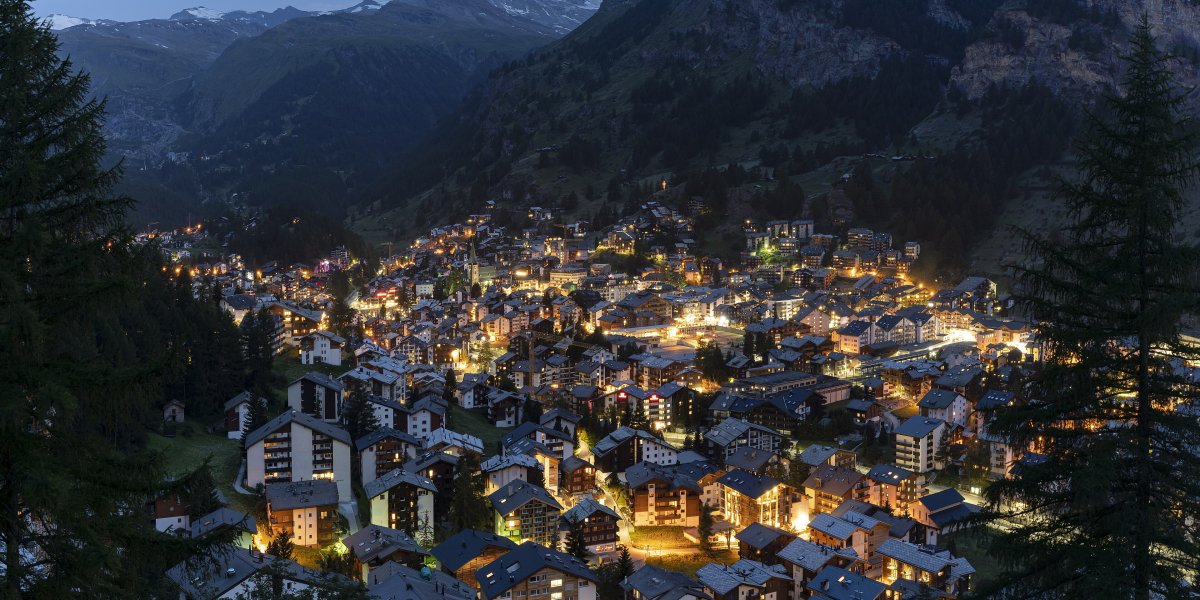
City Guide
Zermatt
Switzerland · Best time to visit: Jun-Sep, Dec-Mar.
Day-by-day plan
Choose your pace
Durée du voyage
07:00
Landmark
Walk two minutes east from Zermatt Bahnhof to the red cogwheel terminus of the Gornergrat Bahn — it is directly opposite the main station exit. The first train at 07:00 climbs 30 minutes through three tunnels to 3089 m just as the Matterhorn's east face catches the first golden light, and the summit terrace's coin telescope frames the full 4478 m pyramid across the Gorner Glacier. Ride one stop back down to Rotenboden and hike 90 minutes down the gravel trail past Riffelsee — the small tarn that holds the entire Matterhorn in its glass-still surface before the wind rises — continuing to Riffelberg to board the train back to Zermatt.
Tip: Buy the ticket online the evening before and take the 07:00 train, never the 08:00 — Riffelsee is only mirror-smooth before 10:00, after which the valley wind rises and breaks the reflection for the rest of the day. Sit on the right-hand side going up for Matterhorn views; switch to the left for the descent.
Open in Google Maps →11:30
Food
From the Gornergrat train's arrival platform, walk three minutes south along Bahnhofstrasse — Zermatt's only shopping street, lined with watch windows and ski boutiques — to the corner branch near Getwingstrasse. Fuchs is where mountain guides and lift operators grab breakfast before dawn: order the Walliser Roggenbrot sandwich with air-dried Valais beef (CHF 12) and a warm Apfelkuechli apple fritter (CHF 5), and eat standing at the counter so you stay on schedule. Grab a small bag of spiced Biber almond-honey cookies (CHF 3) — it's the only Valais pastry that survives an afternoon in the cable car.
Tip: Skip the Migros supermarket opposite and the sit-down cafés on the same block — both are double the price for a worse sandwich. Fuchs has two branches on Bahnhofstrasse; the southern one near the church is noticeably quicker at lunchtime. Contactless card saves 30 seconds versus cash.
Open in Google Maps →12:15
Neighborhood
Step out of Fuchs and walk 200 metres south to Kirchbrücke, the small wooden bridge over the glacier-fed Matter Vispa river — stand on the downstream railing for the single most-photographed composition in Switzerland: the Matterhorn framed directly above the torrent. Cross the bridge and turn left into Hinterdorf, a dense cluster of 16th-to-18th-century larchwood barns raised on flat stone staddle-discs to keep the rats out of the grain. Wander the three narrow lanes for 40 minutes — this is the one quarter of Zermatt that still looks exactly as it did when the first British climbers arrived in the 1850s.
Tip: Between 12:00 and 14:00 in summer the sun is overhead and the Matterhorn's north face is fully lit from Kirchbrücke — any later and the peak turns into a backlit silhouette. Photograph from the south end of the bridge, not the north: the north side has overhead tram cables that ruin the frame.
Open in Google Maps →13:45
Landmark
From Hinterdorf, walk 12 minutes south along the riverside path past the climbers' cemetery — where Edward Whymper's four lost partners from the 1865 first ascent are buried — to the Matterhorn Express valley station. Three cable cars in sequence lift you to 3883 m, Europe's highest cable-car station, where the 360-degree viewing platform reveals 38 four-thousanders including Mont Blanc on the horizon and the Glacier Palace ice tunnels sit a short staircase below. Allow 60 minutes at the top: 20 minutes on the summit platform for photographs, 30 minutes through the ice palace, 10 minutes for the Cinema Lounge window on the Matterhorn's south face.
Tip: Counter-intuitively, afternoon beats morning here — by 14:00 the tour groups descend for lunch and the Trockener Steg transfer queue drops from 30 minutes to under 5. Put on your warmest layer before boarding the second cable car, not at the top: there is no heating inside and the -10°C wind at 3883 m catches everyone in shorts out by surprise. Avoid the summit restaurant, it's a CHF 45 tourist menu for reheated rösti.
Open in Google Maps →17:30
Neighborhood
Exit the Matterhorn Express valley station and walk 15 minutes north along Bahnhofstrasse as the alpenglow begins — look back over your right shoulder every minute because the Matterhorn shifts from white to orange to deep rose to violet in the final 40 minutes before sunset. The shop windows of Bayard Sport and Slalom Sport glow with technical climbing gear that Reinhold Messner once endorsed; horse-drawn electric taxis clip past the old village fountain at the church square. End the walk in front of the dark-larchwood façade of Hotel Monte Rosa at Bahnhofstrasse 80, directly in time for dinner.
Tip: Stand at the Bahnhof end of Bahnhofstrasse looking south at 18:15 in July or 17:15 in October — the Matterhorn sits precisely at the street's vanishing point, the best free composition in the village. Every watch shop displays identical prices fixed by the Swiss distributor; bargaining is pointless and visibly offends the staff.
Open in Google Maps →19:00
Food
Step directly from the street into the low-beamed front Stube of Hotel Monte Rosa — this is the hotel from which Edward Whymper set out on 14 July 1865 for the first successful ascent of the Matterhorn, and the black-and-white photographs of the seven-man climbing party still line the wood-panelled walls. Order the cheese fondue moitié-moitié, half Gruyère and half Vacherin Fribourgeois (CHF 32 per person, two-person minimum), with a carafe of dry Fendant from the Valais; for a heavier main, the Cordon Bleu Whymper stuffed with Walliser raclette and air-dried beef (CHF 48) is the dish every guide in the village orders on their day off. Finish with a kirsch poured directly into the empty fondue pot — a local climbers' tradition.
Tip: Phone-reserve 2 days ahead on +41 27 966 03 66 — walk-ins are turned away after 19:30 in peak season. Ask for a table in the front Stube room, not the back dining hall: the front has the original 19th-century beams and the climbing photographs. Pitfall warning for the area: avoid the three restaurants at the south end of Bahnhofstrasse near the church with illuminated multilingual menu boards and touts at the doorway — they serve CHF 90 reheated rösti to one-night tourists, and every genuine local eats at Whymper-Stube, Walliserkanne, or Grampi's instead.
Open in Google Maps →Aller au jour
07:30
Landmark
From central Zermatt, a 5-minute walk east across Bahnhofplatz past the Catholic church brings you to the Gornergratbahn station directly opposite the main train station. Board the 07:24 first departure and sit on the right side of the carriage for the slow Matterhorn reveal as the cog railway climbs 1,469 m in 33 minutes, past the larch forest of Riffelalp and into the open alpine zone. The 3,089 m summit terrace places you eye-to-eye with 29 peaks above 4,000 m while the Matterhorn — lit front-on by the low eastern sun — still stands clear of the midday cloud collar that wraps it by 11:00.
Tip: The first two trains of the day are the only ones that reach the summit before the mountain's notorious cloud collar forms — book online the night before (gornergrat.ch) to guarantee the 07:24 seat, as the morning departures are often sold out 24 hours ahead in summer. Bring sunglasses: at 3,089 m with snow reflection, UV is brutal even in autumn.
Open in Google Maps →11:00
Landmark
On the Gornergratbahn descent, alight at Rotenboden (2,815 m) and follow the signed dirt track that drops west for 12 minutes, passing grazing black-nosed sheep in summer. Riffelsee is Zermatt's classic mirror — a shallow glacial tarn where on a windless morning the Matterhorn's reflection sits so still that the original image and the reflected one become indistinguishable. Walk clockwise to the south-shore boulder spur to line up the published photograph, then ride the next train from Rotenboden back to the village.
Tip: The reflection holds only before 12:00 — after that, thermal wind off the Gorner Glacier ripples the surface all afternoon. If the main lake is already stirred, the smaller twin tarn 80 m further downhill is more sheltered and gives you a second chance at a mirror shot.
Open in Google Maps →13:00
Food
From Zermatt station, a 3-minute walk south along Bahnhofstrasse brings you to the ochre façade of Hotel Monte Rosa, unchanged since 1839. The Whymper-Stube occupies the wood-panelled ground-floor parlour where Edward Whymper sat in July 1865 before the first Matterhorn ascent — the room is still the village's definitive fondue address. Order the fondue moitié-moitié (Gruyère and Vacherin Fribourgeois, CHF 32) with a glass of Fendant du Valais, and budget CHF 55-65 per person for a proper sit-down lunch.
Tip: Phone Hotel Monte Rosa the evening before for a window table — the Stube has only 12 tables and fills with returning skiers by 12:30 in season. Order the Trockenfleisch starter (Valais air-dried beef sliced paper-thin over rye bread, CHF 24) — it is the single dish most guests remember after the fondue is long forgotten.
Open in Google Maps →15:00
Museum
Exit Whymper-Stube and walk 150 m north on Bahnhofstrasse to the small church square — the circular glass cupola sunken into the lawn is the museum's subterranean entrance. Zermatlantis reconstructs an 1860s mountain village inside the crater, complete with stone chalets, a dairy, and a chapel, before climaxing in a dim alcove that holds the frayed hemp rope from Whymper's 1865 first-ascent disaster that killed four of seven men on the descent. Plan 90 minutes to read the surviving climber letters — the emotional arc from triumph to tragedy is why this museum exists.
Tip: Enter and bear left to follow the chronological narrative — bearing right dumps you at the epilogue and kills the dramatic reveal of the broken rope at the end. The rope itself looks unremarkable behind glass; read the caption beside it carefully, because that fraying is the reason the four men fell 1,200 m down the north face.
Open in Google Maps →17:00
Neighborhood
From the museum, walk 80 m east behind the church into Hinterdorf, the protected lane of 16th-century timber granaries (Stadel) raised on stone stilts topped with flat round discs that stopped rodents from climbing into the winter grain. Continue 400 m south along the Mattervispa to Kirchbrücke, the wooden footbridge that composes Zermatt's single most-photographed view: village rooftops, the spire of St. Mauritius, and the Matterhorn stacked into one frame. Time your crossing for 30 minutes before sunset — roughly 20:30 in summer, 16:30 in winter — when alpenglow turns the peak salmon pink for eight minutes.
Tip: Kirchbrücke draws a phone-wielding queue at golden hour — walk 50 m upstream to the smaller Riedbrücke for the identical composition without the scrum. Skip the horse-carriage rides touted along Bahnhofstrasse (CHF 40 for a route you can walk in 10 minutes) and ignore the Swiss-watch shops promising 'tax-free' prices — the same models run 10% cheaper in Zurich Airport.
Open in Google Maps →19:30
Food
From Kirchbrücke, walk 6 minutes south along Hofmattstrasse to Hotel Julen — the Schäferstube is the dark timber room on the ground floor, smelling of wood smoke the moment you open the door. The house specialty is Lammkarree vom Grill (rack of Zermatt Black-Nosed Sheep lamb, CHF 58) or Walliser Gitzi (spring goat, CHF 54), both from animals the Julen family raises themselves in the pastures above the village and grills over an open pit in the dining room. Budget CHF 95-115 per person with a glass of Dôle Valais red.
Tip: Reserve 24-48 hours ahead; the room has 40 seats and is fully booked every winter night from mid-December. Request a stool at the chef's counter beside the open grill — you watch the lamb turn on the spit while you eat, and the radiant heat is a genuine bonus after a day above 3,000 m.
Open in Google Maps →07:30
Landmark
From your hotel, a 12-minute walk south through the village along Kirchstrasse and Gryfelbodenweg reaches the Matterhorn Glacier Paradise cable-car base at the southern edge of town. Three cable-car stages in 45 minutes lift you to Europe's highest aerial station at 3,883 m, where the outdoor viewing platform stares straight down the Matterhorn's east face and across to Mont Blanc on clear mornings. Descend by internal lift into the Glacier Palace's ice tunnels — a carved chamber of blue-lit corridors and ice sculptures inside the glacier — before altitude fatigue catches up.
Tip: Take the 07:30 first cable car — the summit is typically cloud-free until 10:30, and by noon a line of 200+ forms at the base. Swallow an ibuprofen on the ascent if you are altitude-sensitive; the 3,000 m gain in 45 minutes gives most visitors a short headache at the top, and there is no pharmacy on the summit.
Open in Google Maps →12:30
Food
Descend by cable car to Zermatt, walk 8 minutes north to the Sunnegga underground funicular, and ride 4 minutes up to 2,288 m; from Sunnegga, follow the signed gravel path down through open alpine meadow for 20 minutes into Findeln hamlet. The sun-weathered wooden chalet with the south-facing terrace pointed directly at the Matterhorn is Chez Vrony, run by the same family for four generations, where local farmers still eat lunch in the corner booth. Order the hausgemachte Trockenfleischplatte (CHF 38) and the Vrony Burger with melted raclette (CHF 36); budget CHF 60-75 per person.
Tip: The terrace is first-come for walk-ins despite the reservation policy — arrive by 12:15 to claim a front-row table, or email reservation@chezvrony.ch two days ahead and specify terrasse. Skip the French Sancerre on the wine list in favour of the house Heida, a Valais white grown at 1,100 m in the village of Visperterminen that actually tastes of schist and sun.
Open in Google Maps →14:30
Landmark
From Chez Vrony, follow the Ob. Findeln trail 500 m uphill to the Fluhalp chairlift base, then ride one stage to Blauherd at 2,571 m — a 15-minute lift that covers the climb that would otherwise burn 90 minutes on foot. From Blauherd, walk 20 minutes east along the signed flat path to Stellisee, a wind-sheltered high-altitude tarn that holds the clearest Matterhorn reflection on the Sunnegga side. The window between 15:00 and 16:00 is optimal — the afternoon sun angle erases shadow from the north face and the wind has often dropped at this elevation.
Tip: Walk clockwise to the north-east shore — the commonly-photographed foreground rock sits there, though most visitors crowd the first viewpoint they hit on arrival. Do not dip your feet in (illegal, CHF 100 fine): Stellisee feeds the village drinking supply and is patrolled by rangers in July-August.
Open in Google Maps →16:00
Park
From Stellisee, pick up the signed 5-Seenweg (Five Lakes Trail) heading west — the 3.2 km route descends through Grindjisee (a moss-banked forest tarn that actually holds the best late-afternoon reflection of the five), Grünsee (a milky-green glacial pool), Moosjisee (industrial and skippable), and finishes at Leisee beside Sunnegga. Leisee is a shallow family lake with a wooden raft and a sandy beach where the Matterhorn is framed by pine forest — a softer, more complete composition than Stellisee. Walk 200 m uphill back to Sunnegga and ride the funicular down to Zermatt.
Tip: Grindjisee is the hidden gem of the five — its sheltered forest basin holds a mirror after 16:00 when the exposed lakes are already ruffled. Wear grippy shoes: the descent from Stellisee to Grindjisee crosses a 200 m band of loose schist where trail runners slip every week in summer.
Open in Google Maps →18:15
Religious
From Sunnegga funicular station, walk 7 minutes south on Bahnhofstrasse to the churchyard of St. Mauritius; pass through the main gate and continue to the smaller walled enclosure beyond the chapel — the Bergsteigerfriedhof (Mountaineers' Cemetery). Some 50 climbers rest here, including Michel Croz and the Reverend Charles Hudson — two of the four men who fell from Whymper's 1865 first-ascent team when the rope snapped (Lord Francis Douglas's body was never recovered; his plaque is on the far wall). After Day 1's museum and today's glacier, this is where the two-day arc closes in the soft evening light.
Tip: The large cemetery you enter first is the general village graveyard — walk through it to the smaller stone-walled section behind the chapel, where the climbers are grouped. Michel Croz's grave (1865) is the oldest and still receives a fresh edelweiss from anonymous climbers every July 14th, the anniversary of the first ascent.
Open in Google Maps →19:30
Food
A 4-minute walk south from the cemetery on Hofmattstrasse brings you to Le Mazot, a 28-seat Walliser stube built from a dismantled 18th-century grain barn, famous locally for its open fire-pit grill. The house plate is the Agneau Flambé à l'Absinthe (lamb flambéed tableside with Valais absinthe, CHF 52) or the Entrecôte de Cheval (horse ribeye, a traditional Valais meat, CHF 48), both served with hand-grated rösti; budget CHF 85-105 per person. The room fills with local mountain guides after their evening descent, which is the single strongest signal that the food is not a tourist performance.
Tip: Reserve 48 hours ahead by phone (+41 27 966 06 06) — the room has 28 covers and tourists routinely get turned away at 19:30. Ask for table 3 or 4 along the stone wall; heat from the grill reaches you but the smoke vents upward, unlike the draughty window tables. Beware the 'Swiss army knife' and 'cuckoo clock' shops clustered between Le Mazot and the station — they stock the same mass-produced souvenirs at triple the Geneva airport price.
Open in Google Maps →Aller au jour
07:00
Landmark
Board the red cog train directly across from the SBB station — 33 minutes of switchbacks through larch forest before the summit view explodes open at 3089 m. Catch the 07:00 departure: by 09:30 the platform fills with tour groups, and early light turns the Matterhorn's east face into a glowing spire. On the way down, get off at Rotenboden and walk 10 minutes to Riffelsee, where at this hour the tarn is dead calm and mirrors the peak perfectly.
Tip: Book seat 1-4 on the right side going up — that is the only side the Matterhorn appears on. After Rotenboden, walk the free 'Gourmet Path' down to Riffelberg instead of riding the train: zero crowds, one hour, and the peak is in your face the whole way.
Open in Google Maps →12:30
Food
Step off the cog train, cross Bahnhofplatz and walk 90 seconds south along Bahnhofstrasse to Hotel Monte Rosa — the 1855 inn where Edward Whymper stayed before his fatal first ascent. The cheese fondue moitié-moitié (CHF 32, half Vacherin Fribourgeois half Gruyère) is the benchmark in Zermatt; the Valais dry-aged beef carpaccio (CHF 28) is the quiet scene-stealer. Sit in the wood-panelled Stübli rather than the terrace — the 170-year-old room is the whole point.
Tip: Reserve the day before or arrive at 12:15 — the 12 interior tables fill by 12:45. Ask for a glass of Fendant du Valais (CHF 8) to cut the fondue; it works far better than the Chasselas most guidebooks recommend.
Open in Google Maps →14:30
Museum
From Monte Rosa walk 3 minutes south along Bahnhofstrasse to Kirchplatz, where a glass dome sinks you three metres underground into a reconstructed 19th-century Zermatt village. The centrepiece is the snapped rope from 14 July 1865 — the one that failed on Whymper's descent and killed four of his seven-man team. Pair that case with the final-room film on modern Matterhorn rescues to understand why this peak still kills climbers every summer.
Tip: Take the free English audio guide at the desk (90 min) — the written labels skim the 1865 drama, the audio doesn't. Come after Gornergrat, not before; the museum makes far more sense once you have seen the real mountain with your own eyes.
Open in Google Maps →17:00
Landmark
Leave the museum and cross Kirchplatz — the cemetery sits behind St. Mauritius Church, thirty steps away. Over 50 climbers are buried here, including three of Whymper's 1865 party, and the freshest headstones carry 2022 and 2023 dates — a quiet reminder that the peak you came to admire remains lethal. Read Jonathan Conville's (1979) and Donald Williams' (1975) inscriptions — the museum rope suddenly feels present, not historical.
Tip: Come after 16:30 when the sun drops behind the peak and backlights the wrought-iron crosses. Keep your voice down and fold any umbrella — this is still an active village churchyard used for funerals, not a tourist attraction.
Open in Google Maps →19:30
Food
Retrace west along Kirchstrasse and follow Riedstrasse south 5 minutes to Hotel Julen, whose basement Stube has served the family's own Valais blacknose lamb for four generations. Order the slow-roasted lamb shoulder (CHF 48) or the lamb entrecôte on hot-stone (CHF 58), paired with a Heida from Visperterminen — Europe's highest vineyard at 1150 m. The 36-seat room under blackened beams books out in high season, so reserve a week ahead.
Tip: Ask for table 4 or 5 against the far wall — the only seats with a clear view of the open hearth where the lamb is carved tableside. PITFALL WARNING: the pizzerias and 'Swiss' grills on Hotelplatz east of the station serve CHF 28 frozen raclette and add undisclosed 'music fees' to the bill — stick to the Kirchplatz-Riedstrasse side of the village for real kitchens.
Open in Google Maps →08:30
Landmark
From the village centre follow the Matter Vispa south 8 minutes to the Matterhorn Express base station — three cable cars and 45 minutes deliver you to Klein Matterhorn at 3883 m, Europe's highest cable-car station. Don't miss the Glacier Palace 15 m below the summit, a tunnel of carved ice chambers lit in cobalt and violet where you can touch 20-year-old glacier at –1 °C. Go early: by 11:00 the queue for the final cable car stretches past the ticket office, and clouds often swallow the peak by midday.
Tip: Buy the ticket online the night before at matterhornparadise.ch — saves CHF 5 and skips the 08:30 queue. Do the summit viewing platform FIRST before the altitude hits you, then the Glacier Palace, then the Cinema Lounge; doing it in reverse wastes the sharpest air on the least interesting room.
Open in Google Maps →13:00
Food
Ride the cable car back down to Furi, then follow the signed footpath through the larch forest 25 minutes to the hamlet of Zum See — seven 17th-century farmhouses around a single restaurant. Max and Greti Mennig have been cooking here since 1981; the duck confit with apple rösti (CHF 46) and the cream of carrot with ginger (CHF 16) are the two dishes regulars drive up from Geneva for. Sit on the south terrace — the Matterhorn stands directly over your plate.
Tip: Call from the cable car on the way down — only six outdoor tables open at 13:00 and regulars take them all. Ask for 'Greti's secret' rösti if she is in the kitchen; it is not on the menu and comes with local speck and sage butter.
Open in Google Maps →15:00
Landmark
From Zum See hamlet take the marked Gornerschlucht path west 20 minutes downhill through mossy pine. The gorge is 70 m deep, carved by the Gornera river through black serpentinite; wooden walkways bolted to the cliff drop you into a world without sky. Afternoon light angles into the upper walkway and turns the water emerald green — mornings see it black and flat.
Tip: Visit between 15:00 and 16:00 — after that the sun leaves the gorge and colour drains from the water. Bring a lens cloth: spray soaks cameras within 30 seconds on the middle bridge. Closed mid-October to late May; check the gate before walking 45 minutes uphill in shoulder season.
Open in Google Maps →17:00
Neighborhood
The gorge exit leads onto Furiweg; 12 minutes along the river brings you back to Bahnhofstrasse, Zermatt's 600 m pedestrian spine. Between 17:30 and 18:15 in summer (14:30 in winter) the Matterhorn's east face shifts from slate to gold to salmon pink, framed at the north end of the street between the gabled hotel roofs. Duck into Fuchs Bakery at no. 10 for a Matterhorn-shaped meringue (CHF 4.50) and eat it as you walk.
Tip: Stand directly in front of Hotel Monte Rosa at sundown — that is the only vanishing-point composition where the pedestrian street aligns perfectly with the peak. Skip the four chain 'Swiss chocolate' shops at the south end of the street; the real artisan chocolatier is Läderach at Bahnhofstrasse 61.
Open in Google Maps →19:30
Food
Continue 4 minutes south along Bahnhofstrasse past Kirchplatz — du Pont has stood on this corner since 1560, making it Zermatt's oldest restaurant by 120 years. The cheese rösti (CHF 26) with air-dried mountain beef and the Älplermagronen (CHF 24) — alpine pasta with onion, potato and apple sauce — are the plates locals still order. Take the second room on the right: warped pine floors, a single stuffed marmot, and Whymper's signature carved into a beam above the door.
Tip: No reservations — walk in at 19:00 sharp, not 19:30, or wait 40 minutes behind mountain guides just off shift. PITFALL WARNING: the 'cheese restaurants' lining Getwingstrasse pipe prerecorded yodelling into the dining room and charge CHF 42 for a single-person fondue pot — du Pont's CHF 26 rösti is twice the food for half the price.
Open in Google Maps →08:30
Park
From the main station cross east over the Matter Vispa — the Sunnegga Express base is 5 minutes on foot. The underground funicular climbs to 2288 m in 4 minutes; a chairlift and 20-minute walk bring you to Stellisee for a morning Matterhorn reflection, then you descend through Grindjisee, Grünsee, Moosjisee and Leisee. Total: 9.8 km of open Alpine meadow, dropping 500 m through larch and Arolla pine before the funicular returns you to the village.
Tip: Reach Stellisee before 10:30 — after that the breeze picks up and ripples kill the reflection. Reverse the trail (Leisee up to Stellisee) only if you want the Matterhorn facing you the entire climb; pack a swimsuit since Leisee is a marked swim lake with a sandy bottom and ~18 °C water in July.
Open in Google Maps →13:00
Food
Detour southwest from Leisee to the hamlet of Findeln — 25 minutes of descending meadow to 2130 m, where Chez Vrony sits among dark-timber farmhouses that have been in the Cotting family since 1900. The dry-aged côte de boeuf (CHF 72) and the Findeln burger with raclette and bacon (CHF 38) are the dishes Vogue and Condé Nast write about every summer. The south terrace opens a 180-degree arc of the Matterhorn — ask for tables 11 to 14 at the edge.
Tip: Book exactly 90 days out online — that is when the reservation window opens and mid-summer terrace tables vanish within 48 hours. Order the homemade thyme iced tea (CHF 8) instead of water; it is poured from copper jugs and refills come free without asking.
Open in Google Maps →15:30
Neighborhood
From Findeln take the Findelbach trail 50 minutes down to village level, then walk 3 minutes north along Steinmattstrasse into Hinterdorf — a cluster of 30 larchwood barns on stone stilts, Zermatt's last pre-1900 quarter. The flat stone disks ('Mäusesteine') on top of each stilt stopped rats from climbing into the grain stores, a detail unchanged for 500 years. Many barns still belong to the Aufdenblatten and Biner families whose ancestors built them.
Tip: Look for the carved dates on the door lintels — the oldest reads 1571. Photograph from Hinterdorfstrasse 20 around 16:30 when low sun rakes across the black timber and turns it gold; do NOT enter the courtyards even if the gate is open — these are private homes, not an open-air museum.
Open in Google Maps →17:00
Landmark
From Hinterdorf head south 4 minutes through the lanes to where Kirchstrasse meets the river — this small stone footbridge is the most photographed viewpoint in the Alps. Stand at the centre facing south: the Matter Vispa rushes under you and the Matterhorn rises dead-centre between the hotel roofs. In the final 4 minutes after sundown the summit flares pink — summer at ~21:10, winter at ~17:00 — and it is the closing image of the whole trip.
Tip: Arrive 15 minutes before sundown to claim the downstream rail — the only spot where river, village and peak line up without tripod heads intruding. Do NOT pay the man who sometimes sets up a camera and charges CHF 5 to photograph tourists here; he has no right to the bridge and the village has tried to move him on for years.
Open in Google Maps →19:30
Food
Cross back over the Kirchbrücke and follow Wiestistrasse 3 minutes — Heini's unmarked wooden door opens into a red-lit cave that has grilled a single dish, spit-roasted half-chicken, since 1966. The chicken (CHF 37) comes with crisp skin, rosemary potatoes and garlic butter; the only choices are a glass of Valais Pinot Noir or an apricot schnapps to finish. Eight counter seats face the open grill — this is theatre as much as dinner, and reservations are not accepted.
Tip: Arrive at 19:00 opening — all eight counter seats are gone by 19:20. The second seating at 20:45 is easier to get but the first chicken out of the rotisserie has crisper skin. FINAL PITFALL WARNING: anything on the Hotelplatz stretch east of the station with a menu printed in six languages at the door is a tourist-pricing trap; the hand-lettered chalkboards outside Heini, du Pont and Whymper-Stube are the three kitchens actual Zermatt villagers eat at.
Open in Google Maps →
Trip builder
Plan this trip around Zermatt
Turn this guide into a bookable rail itinerary with FlipEarth.
Keep exploring
Related cities
More in the same country
FAQ
Frequently asked questions
How many days do you need in Zermatt?
Most travelers enjoy Zermatt in 1 days, with enough time for headline sights and a slower meal or museum stop.
What's the best time to visit Zermatt?
The easiest season for most travelers is Jun-Sep, Dec-Mar, especially if you want good weather and manageable crowds.
What's the daily budget for Zermatt?
A practical starting point is about €350 per person per day before hotels, then adjust based on museums, dining, and transport.
What are the must-see attractions in Zermatt?
A good first shortlist for Zermatt includes Gornergrat Bahn and Riffelsee Reflection Hike, Matterhorn Glacier Paradise.