City Guide
Verona
Italie · Best time to visit: Apr-Jun, Sep-Oct.
Day-by-day plan
Choose your pace
Durée du voyage
09:00
Landmark
Start in an empty Piazza Bra: before 10:00 the cafés are still setting chairs and the 1st-century amphitheater stands alone against the sky. Circle the pink Veronese marble exterior and find the 'Ala' — a four-arch remnant of the original outer ring that an earthquake toppled in 1117. In April the morning side-light grazes the stone and turns it salmon-gold, the exact colour locals call 'rosa veronese.'
Tip: Unless opera season is running (Jun–Sep), the interior is just a bare oval not worth the €12 — shoot from Piazza Bra's northeast corner where the Ala frames the full curve. For a crowd-free Arena in frame, stand on the Liston pavement by 9:00 sharp; the street-sweepers finish their pass at 8:55 and the first tour buses arrive at 9:40.
Open in Google Maps →10:15
Landmark
From the Arena, cut west along Via Roma for 10 minutes — the pastel palazzi give way to the river just as the red-brick fortress appears. Skip the museum and walk onto Ponte Scaligero, the 14th-century fortified bridge, stopping at the middle arch: looking back, the swallowtail 'Ghibelline' merlons frame the castle and the green Adige in a single picture. Every brick you see was numbered, dredged from the river, and rebuilt after German sappers dynamited the bridge in April 1945.
Tip: The best shot of the bridge is NOT from the bridge — walk 2 minutes east along the south bank to the small pebble landing below the Arsenale, and you'll get all three arches mirrored in the water. Mid-morning the sun is behind you, so the bricks glow warm-red with no lens flare; a tripod isn't needed, the wall parapet is exactly camera height.
Open in Google Maps →12:30
Food
Back east on Corso Cavour for 8 minutes — you'll pass the Roman Arco dei Gavi, wedged awkwardly between two lanes of traffic, a reminder that Verona has layered itself on top of its own ruins for 2,000 years. At Corso Sant'Anastasia 41, a narrow marble-counter butcher has been curing its own porchetta since 1880. No seats, no printed menu, just glass cases of salumi and a blackboard of the day's panini — this is where Veronese office workers actually eat lunch.
Tip: Order the panino with porchetta and mostarda di Cremona (€7) with a small glass of Valpolicella Classico (€3), and eat standing at the marble shelf like locals, spilling out the doorway if it's sunny. Arrive by 12:30 sharp — by 13:10 the queue is out onto the street, and the porchetta sells out by 14:00 most days.
Open in Google Maps →13:30
Neighborhood
Three minutes south on Via Cappello you'll find a tunnel layered in love-letters from every country on earth — this is 'Juliet's house,' whose balcony was only bolted onto the façade in 1936 and whose bronze-breast ritual is a 1970s photo-op, so treat the courtyard as theatrical postcard, not pilgrimage. Slip through the archway into Piazza delle Erbe — Verona's real medieval heart, where a fruit market has set up under the frescoed palazzi since the Romans traded grain here. Drift into the adjoining Piazza dei Signori (Dante's statue, the Scaligeri tombs through the wrought-iron gate) and up Via delle Arche to feel the whole old town pivot on these three squares. Afternoon is the moment: fewer coach tours, golden-pink light raking the Torre dei Lamberti, and the aperitivo crowd starting to fill the cafés.
Tip: Skip the paid interior of Juliet's house — the free courtyard gives you the balcony and the letter-wall, which are the only real photo ops. For Piazza delle Erbe's best frame, stand beneath the Arco della Costa (the 'whale rib' arch) and shoot north-west toward the Torre dei Lamberti with the market umbrellas in the foreground; at 15:30-16:00 the tower catches direct sun while the square stays in cool shadow.
Open in Google Maps →16:30
Landmark
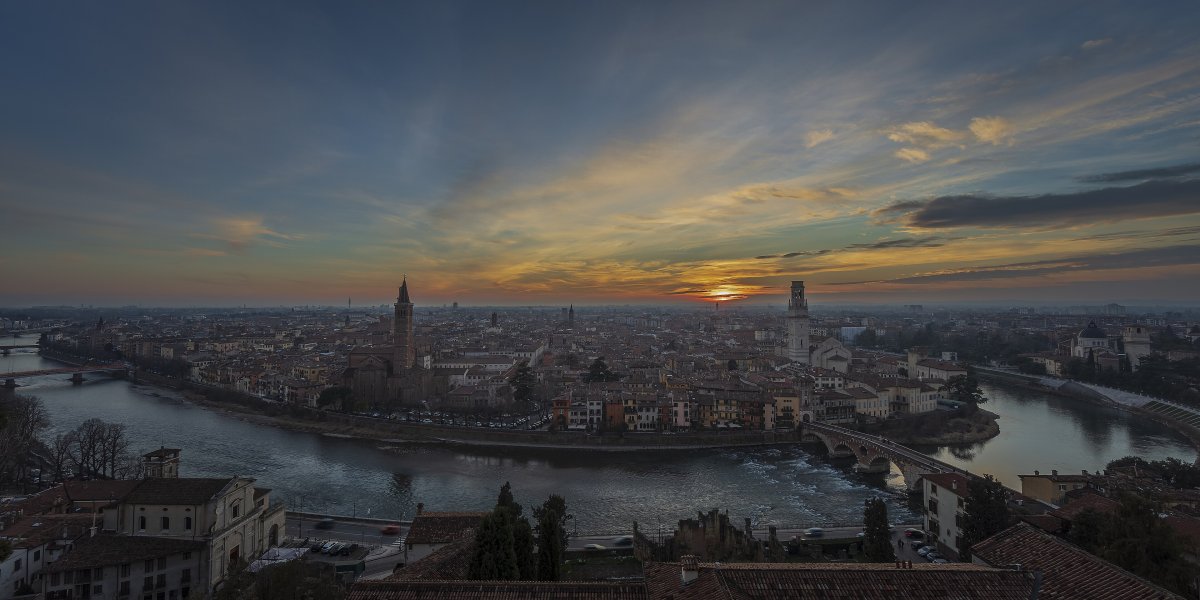
North from Piazza dei Signori, past the zebra-striped façade of the Duomo, to the Roman Ponte Pietra — the eastern half is original 1st-century BC stone; the western half was re-laid in 1959 with the same blocks fished from the Adige after Nazi sappers blew the bridge in 1945. Cross slowly, then turn right and climb the Scalinata Castel San Pietro — 100 brick steps through cypress and wisteria. The terrace at the top holds the single panorama every Veronese takes a date to: the river curving around the old town, terracotta roofs, the Duomo's bell tower, and a distant profile of the Arena, all stacked in one frame.
Tip: In April sunset is around 19:55 — be on the terrace by 18:45 for the golden hour that throws the Duomo bell tower's shadow across the river and lights the roof-tiles orange. If your legs are gone, the Funicolare (€2 one-way) runs from beside Ponte Pietra and shaves the climb to 90 seconds; still walk DOWN the stairs at dusk — watching the city's lights switch on beneath you is the memory you came for.
Open in Google Maps →20:00
Food
Down from the terrace, back across Ponte Pietra, then south on Via Sottoriva for 8 minutes — under the porticoes where medieval fishermen hung their nets to dry (the street name means 'under the bank'). This is one of the oldest osterias in the old town: dark wood, chalkboard wines, copper pots, and a covered outdoor row of tables directly beneath the arches. The kitchen cooks the three dishes Veronese grandmothers still argue about — pastissada de caval (slow-braised horse stew with polenta), bigoli con ragù d'anatra (hand-rolled duck pasta), and risotto all'Amarone — with a carafe of Valpolicella Classico for €12.
Tip: Order bigoli con ragù d'anatra (€14) — the duck pasta is Veneto's truest dish, and here the bigoli are still extruded through a hand-cranked 'torchio.' Book by 17:00 for a 20:00 table under the portico; arrive 19:55, not earlier, or you'll be parked inside. Pitfall warning for the whole day: every restaurant with a photo menu on Piazza Bra or Via Mazzini is a tourist trap — the identical pastissada is €32 there versus €18 here, service is rushed through three seatings, and the wine lists 'house Valpolicella' that is nothing of the sort.
Open in Google Maps →Aller au jour
09:00
Landmark
Start where Verona begins — on the pink-stone expanse of Piazza Bra, with the Roman amphitheater looming at its southern edge. Arrive at 9:00 sharp: ticket booths opened at 8:30 and for a golden twenty minutes you'll have a 2,000-year-old arena almost entirely to yourself, long before the tour buses arrive from Venice. Climb to the top tier where the limestone glows peach in the morning sun — this is the view locals pose against, and the angle that captures the full oval without cars in the frame.
Tip: Buy the Verona Card (€20, 24h) at the Arena ticket window — it covers 9 of today's and tomorrow's stops with skip-the-line, and pays for itself by activity three. If you visit in June–September, peek inside even if no opera is scheduled: the massive open-air stage sets for Aida or Nabucco are more theatrical than most museums.
Open in Google Maps →10:45
Landmark
Exit the Arena's north gate straight onto Via Mazzini — Verona's marble-paved shopping spine, lined with Baroque palazzi and local boutiques, a 10-minute saunter through the city at full social volume. Casa di Giulietta hides down an archway at number 23. The bronze Juliet is polished gold on her right breast where every visitor has touched her for luck; the famous balcony was actually bolted on in the 1930s (the building was a medieval inn), but the ivy-swallowed love letters pinned to every stone wall of the passageway are the real living ritual.
Tip: Skip the €6 house-museum ticket — everything worth seeing (the balcony, the statue, the love-letter passage) is in the free courtyard. Arrive before 11:30 and the courtyard is half-empty; by noon it's a phone-selfie scrum. For the iconic balcony shot, stand against the far-right wall of the courtyard, not the crowded center.
Open in Google Maps →12:00
Food
Walk two minutes northeast through the archway onto Via Arche Scaligere — a narrow stone lane said to have been Romeo's family home — where Osteria al Duca has occupied a Scaliger-era building since the 1200s. Order the bigoli con ragù d'anatra (thick hand-rolled pasta, slow duck ragù, €11) — a Veneto classic most tourist kitchens ruin — and a plate of pastissada de caval (horse slow-braised in Amarone with polenta, €15), which will either surprise or scandalize you, but is pure Verona. Budget €22–28 with a glass of Valpolicella.
Tip: No reservation needed at lunch — arrive 12:00–12:30 and you slide straight into a table, including the covered upstairs room. Ask for the casa Valpolicella Ripasso (€5/glass) — it's from a small producer in nearby Fumane and isn't on the printed wine list. Skip dessert here; gelato at Gelateria Ponte Pietra tomorrow is better.
Open in Google Maps →14:00
Landmark
Walk one minute west out of the osteria and you're on Piazza delle Erbe — Verona's outdoor living room, a Roman forum turned medieval market now selling fruit, flowers, and pink spritzes under a cluster of fresco-painted palazzi. Enter the Palazzo della Ragione courtyard on the south side for the 84-meter Torre dei Lamberti: take the elevator, then 40 stairs, for a panorama of red terracotta roofs, the Adige's green bend, and the Arena floating to the south. 14:00 is when the sun catches the Renaissance frescoes on Case Mazzanti directly opposite — the hour guidebooks schedule this place is wrong, they send you at noon when the façade is flat.
Tip: The beautiful-looking cafés on Piazza delle Erbe with waiters circling outside charge €8–12 for an Aperol spritz. Walk 50 meters west to Caffè Borsari (Corso Porta Borsari 15) for a €4 spritz at the counter — same neighborhood, one-third the price, and the real local crowd at 18:00.
Open in Google Maps →16:30
Landmark
Walk two minutes under the Arco della Costa — note the whale rib hanging from the archway, Verona's strangest legend — into Piazza dei Signori, the political heart of medieval Verona, quiet and symmetrical and presided over by a pensive Dante statue in its center. Slip through the side arch to the Arche Scaligere: five elaborate Gothic tombs of the della Scala lords, suspended in wrought-iron cages above the lane — among the finest funerary sculpture in Italy. Late-afternoon light slants through the spear-tipped ironwork and strips the tombs in gold; aim your camera up through the bars.
Tip: Stand directly under the Arco della Costa and look up — legend says the whale rib will fall on the first truly honest person to walk beneath it, and it has not fallen in 400 years. The Arche are free to see from the street through the iron fence; the €1 ticket only lets you step inside the cage and is purely optional. Visit the Dante statue 30 minutes before golden hour so he faces the sun.
Open in Google Maps →19:30
Food
Walk three minutes south down Vicolo Regina d'Ungheria to Trattoria Al Pompiere, a Verona institution since 1966, its walls plastered floor-to-ceiling with black-and-white photographs of the opera singers, politicians, and actors who have eaten here. Share the tagliere di salumi e formaggi (local cured meats and 12 aged cheeses, €22) — soprèssa veronese and Monte Veronese DOP are the stars — then risotto all'Amarone (€18), rice slow-cooked in the king of Verona's wines until each grain is stained purple. Budget €45–55 per person with wine.
Tip: Reserve two days ahead (+39 045 803 0537) — without a booking you will not get a Friday or Saturday table. Ask to be seated in the back 'sala degli affreschi' under the painted ceiling, not the front room. PITFALL WARNING — the streets right off Piazza delle Erbe are Verona's main tourist-price trap: restaurants with photo-menus outside, gelaterias displaying fluorescent-pistachio mountains (real pistachio is muted brown-green), the 'Casa di Romeo' plaque on Via delle Arche that leads to a private home you can't enter. Walk three minutes in any direction and prices drop by half.
Open in Google Maps →09:00
Religious
Walk five minutes north from Piazza Bra along Corso Porta Borsari — passing through a genuine 1st-century Roman city gate still framing the medieval street — onto Corso Sant'Anastasia, which opens dramatically onto the enormous brick façade of the Basilica di Sant'Anastasia. Enter at 9:00 sharp when the doors swing open: for thirty minutes the largest Gothic church in the Veneto is effectively yours. Go straight to the chapel on the right of the altar for Pisanello's 'St. George and the Princess' (1436) — one of the most celebrated late-Gothic frescoes in Europe. The early east-window light from the left is the only hour you can actually see the detail.
Tip: At the entrance, look down before you look up — the two holy-water fonts are held up by carved hunchback figures ('i gobbi'), and locals still touch their backs for luck as they enter. Your €4 ticket (included in Verona Card) also admits you to the Duomo and San Fermo — keep it in your pocket.
Open in Google Maps →10:15
Museum
Exit Sant'Anastasia and walk 12 minutes southwest along the riverside promenade Lungadige Riva Battello — green Adige on your right, red rooftops on your left, probably the prettiest stretch in Verona. You arrive straight at Castelvecchio, the della Scala family's 14th-century red-brick fortress, now home to Carlo Scarpa's 1960s museum renovation where the architecture itself is the exhibit: concrete, steel, and 600-year-old brick in conversation. Don't miss Pisanello's 'Madonna della Quaglia' and the equestrian statue of Cangrande I hung mid-air on a raw concrete shelf in the central courtyard. Then walk across Ponte Scaligero, the castle's private bridge — three crenelated arches stretching over the river to a view no other fortress in Italy offers.
Tip: Castelvecchio is CLOSED Monday morning (opens 13:30 Mon, 10:00 Tue–Sun). If you're here on a Monday, flip today's order: do Teatro Romano and Castel San Pietro in the morning, Castelvecchio in the afternoon. For the postcard Ponte Scaligero shot, cross to the far (north) bank of the Adige and shoot back — the crenelations silhouetted against the red castle walls is the iconic frame, impossible from the castle side itself.
Open in Google Maps →13:00
Food
Walk 10 minutes back east along Corso Cavour and duck into Via Sottoriva — a single medieval arcaded lane that looks unchanged since the 1300s, cool and cobblestoned even in August. Osteria Sottoriva holds the corner under the porticoes. Order the risotto al tastasal (rice with fresh-minced Veronese sausage, €14) — a dish genuinely made nowhere outside this province — and a glass of Soave Classico (€5) from the volcanic hills east of the city. Budget €25–35.
Tip: Reserve the day before for outdoor portico seating (+39 045 801 4323) — indoor is cramped and you'd miss the whole point of Sottoriva. Under €30 it's cash-only, so carry euros. Their house-bottled Valpolicella Superiore is €20 — half what the same producer charges at restaurants on the piazzas two minutes away.
Open in Google Maps →15:00
Religious
Walk six minutes north along Lungadige San Giorgio — the Adige bends sharply here, framing the Duomo's red-and-white-striped zebra bell tower ahead. Enter through the Romanesque porch guarded by twin griffin columns. Inside, head straight to the first chapel on the left for Titian's 'Assumption of the Virgin' (1535), a softer, earlier sister to his Venetian masterpiece, best viewed at 15:00 when west-facing window light floods the nave diagonally. Step next door into the 8th-century Baptistery of San Giovanni in Fonte — its octagonal monolithic font is the oldest in Italy, carved from a single block.
Tip: The Duomo is closed to tourists during Mass (usually 11:00 and 18:00) — 15:00 is the safe window. Walk around to the back cloister behind the church, which is free and almost always empty: you can see Roman mosaic floor visible under glass panels and the raw 6th-century apse of an earlier paleochristian basilica.
Open in Google Maps →16:30
Landmark
Walk four minutes across Ponte Pietra — Verona's oldest Roman bridge, painstakingly rebuilt stone by stone after the Germans blew it up in 1945 — and the Teatro Romano rises directly into the green hillside on the far bank. Climb through the 1st-century BC theater (still hosting Shakespeare in summer) up to the archaeological museum in the former convent on top. Then keep going — 200 stone steps, 10 minutes — up to Castel San Pietro. This is the view: all of Verona laid out below, Ponte Pietra's honey-colored arches, the Duomo tower, the Adige's silver bend, and the Arena in the distance. Arrive for 17:30 in April/October, 18:30 in summer — the sun sets behind the city from this east-bank vantage, and for twenty minutes the red roofs turn actually pink.
Tip: The funicular to Castel San Pietro (€2) stops running at 21:30 summer, 19:30 winter — take the stairs up while you have energy, funicular back down. Skip the café at the top viewpoint — it's sunset-premium priced (€8 for an espresso) and you don't need it: the terrace immediately left of the funicular exit is free and has the better angle. Teatro Romano is closed Mondays.
Open in Google Maps →20:00
Food
Walk eight minutes back across Ponte Pietra and down Via Duomo to Antica Osteria al Duomo — a tiny stone-walled room feeding locals since 1442, and they have the paperwork to prove it. If you skipped pastissada de caval yesterday, try it here; otherwise order the gnocchi di malga al pomodoro (€12) and Amarone-braised beef cheeks with polenta (€22). Honest house Valpolicella by the glass at €4. Portions are generous, the owner pours the wine himself, and the candlelight against the stone walls is what you came to Italy for. Budget €40–50 per person.
Tip: Reserve two days ahead (+39 045 800 4505) — only 8 tables, booked out nightly. PITFALL WARNING — avoid the restaurants clustered near Castel San Pietro and along the east bank of Ponte Pietra for dinner: they charge sunset-view premiums and the food rarely clears the bar. Also skip any gelateria advertising 'Juliet gelato' with neon-pink food coloring — real pistachio is muted brown-green, real stracciatella is ivory, and the radioactive colors are a dead giveaway for industrial paste. Gelateria Ponte Pietra on the west bank is the neighborhood's real one.
Open in Google Maps →
Trip builder
Plan this trip around Verona
Turn this guide into a bookable rail itinerary with FlipEarth.
Keep exploring
Related cities
More in the same country
FAQ
Frequently asked questions
How many days do you need in Verona?
Most travelers enjoy Verona in 1 days, with enough time for headline sights and a slower meal or museum stop.
What's the best time to visit Verona?
The easiest season for most travelers is Apr-Jun, Sep-Oct, especially if you want good weather and manageable crowds.
What's the daily budget for Verona?
A practical starting point is about €95 per person per day before hotels, then adjust based on museums, dining, and transport.
What are the must-see attractions in Verona?
A good first shortlist for Verona includes Arena di Verona, Castelvecchio & Ponte Scaligero, Ponte Pietra & Piazzale Castel San Pietro.