City Guide
Perugia
Italie · Best time to visit: Apr-Jun, Sep-Oct.
Day-by-day plan
Choose your pace
Durée du voyage
09:00
Religious
From the Minimetrò Pincetto station or the bus stop at Piazza Italia, take the escalator up and follow Corso Garibaldi north all the way to the city wall — a 20-minute walk through a residential medieval lane most tourists never see. Start here, at Perugia's northern tip: a 5th-century circular church built from recycled Roman temple columns, each one different. The morning light slants through the drum-shaped interior and the grass courtyard outside is empty of tour groups.
Tip: Walk a clockwise loop inside — the sixteen ancient columns are each from a different quarry, and you can see where the medieval masons shaved them down to match heights. Opens at 08:30; arrive by 09:00 and you will likely be the only visitor.
Open in Google Maps →10:15
Landmark
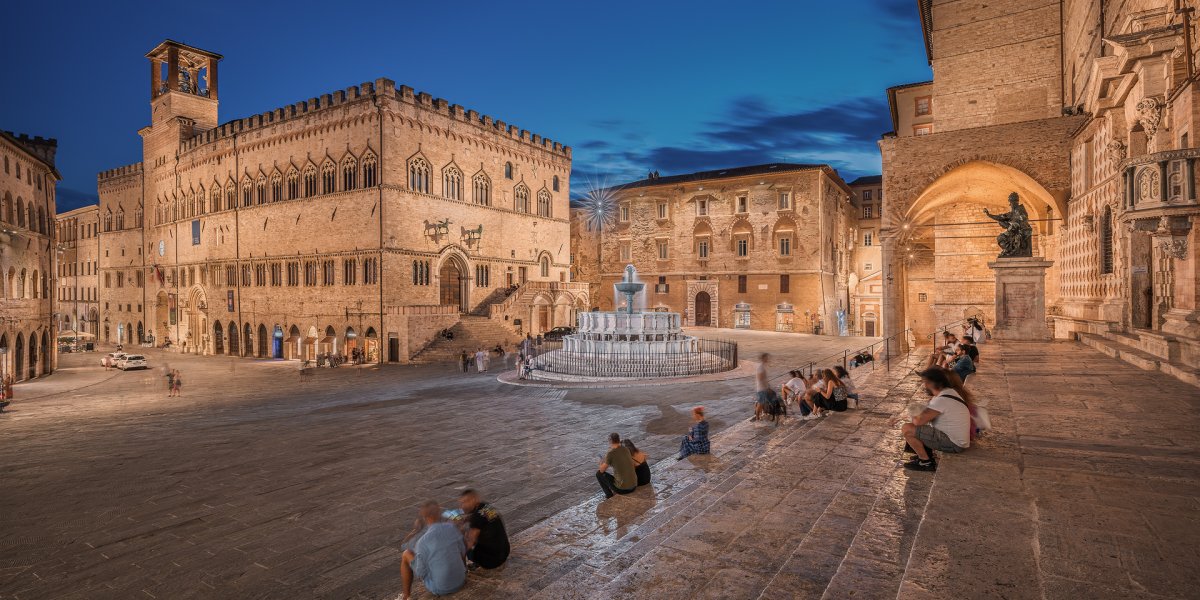
Walk back south down Corso Garibaldi, pass through the monumental Arco Etrusco (3rd century BC — the oldest gate of the city, pause here for a photo) and cut onto Via dell'Acquedotto, a raised medieval walkway built on top of a Roman aqueduct that floats above the streets below — a 15-minute secret route into the center. You emerge directly at Piazza IV Novembre, where the Fontana Maggiore by Nicola and Giovanni Pisano (1278) sits between the Duomo and the Palazzo dei Priori. Circle the fountain twice to read all fifty carved panels — zodiac, months, biblical scenes — then sit on the cathedral steps as locals do.
Tip: The best photo of the fountain is from the top of the Palazzo dei Priori staircase (the fan-shaped steps facing the piazza) — you get fountain, cathedral, and the entire medieval square in one frame. Before 11:30 the light is clean; after noon the duomo's shadow cuts across the fountain.
Open in Google Maps →12:30
Food
Thirty seconds off the piazza down Via Ulisse Rocchi — a tiny Umbrian street-food counter where locals queue for torta al testo, the region's flatbread cooked on a stone disk and stuffed hot. This is not tourist food; it's what Perugians actually eat for lunch. Eat standing at the marble counter or take it to the cathedral steps.
Tip: Order the torta al testo with salsiccia e erba (sausage and wild greens, €7) — the signature combo — and a glass of house Sagrantino (€3). Skip the prosciutto version; it's the sausage-and-greens that shows why this bread is Umbria's soul. Cash preferred.
Open in Google Maps →14:00
Neighborhood
From Mastro Giorgio, walk back to the piazza and follow Corso Vannucci south — Perugia's pedestrian spine, flagstone-paved, lined with palazzi and the evening passeggiata crowd. In 400 meters it opens into Piazza Italia and then, at the very southern edge of the old city, the Giardini Carducci: a balcony garden that drops away into a 180° view across the Umbrian valley to Assisi, Mount Subasio and the Apennines. The afternoon light here is why you come to Umbria.
Tip: Walk to the eastern end of the terrace (by the Carducci statue) — from there you can see the pink silhouette of Assisi on the hillside opposite on clear days. Come back here at golden hour if you have time; the whole valley turns amber around 18:00 in spring/autumn.
Open in Google Maps →16:30
Landmark
Walk 80 meters from the garden gate back to Piazza Italia — the entrance to the Rocca is the unmarked escalator descending from the piazza. What looks like a transit tunnel opens into a buried medieval neighborhood: Pope Paul III had an entire hilltop quarter entombed inside a fortress in 1540 as punishment for a revolt, and when the fortress was demolished the streets survived underground. You walk through actual medieval houses, archways and alleys in eerie half-light. Free, and one of the strangest sights in Italy.
Tip: Follow signs to 'Via Bagliona' — the main buried street — and look up: you can still see the stone doorframes and window ledges of houses that haven't seen daylight in five centuries. Pitfall warning for the evening ahead: avoid any restaurant on Corso Vannucci or Piazza IV Novembre with photo menus outside or staff calling you in — these are tourist traps charging €25 for mediocre pasta. Perugia's real restaurants are one street off the Corso, on side alleys like Via delle Streghe or Via del Forno.
Open in Google Maps →19:30
Food
Back up through the Rocca escalators to Corso Vannucci, then a 4-minute walk north and left onto Via delle Streghe — 'Witches' Alley', a narrow medieval lane — where La Taverna has been serving Umbrian cuisine in a candlelit stone cellar for decades. White tablecloths, chef Claudio greeting tables, Umbrian wine list deep enough to get lost in. The proper close to a hilltop day.
Tip: Reserve 2-3 days ahead (they book out, especially weekends — phone +39 075 572 4128). Order the strangozzi al tartufo nero (hand-rolled pasta with Umbrian black truffle, €22) and the piccione ripieno (stuffed squab, €26) — both are dishes Perugia does better than anywhere in Italy. Ask for a table in the lower cellar room, not the upstairs one.
Open in Google Maps →Aller au jour
09:00
Museum
From Piazza IV Novembre, cross under the striped arcade of the Palazzo dei Priori — the grand stone staircase on your right leads straight to the third-floor galleries. Inside, the rooms hold the soft Umbrian light of Perugino, Piero della Francesca's only work outside Tuscany, and a rarely-queued polyptych by Beato Angelico. Two hours is enough to focus on the 15th-century rooms, which are the real reason to come.
Tip: Arrive within 10 minutes of the 08:30 opening — the Perugino rooms are empty for about 45 minutes before the first coach tour arrives. The combined ticket (€13) includes the Nobile Collegio del Cambio next door, which most visitors skip but holds a fully intact Perugino fresco cycle.
Open in Google Maps →11:15
Landmark
Exit the Palazzo and the fountain stands twenty steps away in the center of the square. Carved in 1278 by Nicola and Giovanni Pisano, it is one of Italy's greatest medieval sculptures — fifty marble panels telling the months, the zodiac, Biblical figures, and the legendary founders of Perugia. Locals still meet 'al Fontana' for coffee, and by mid-morning the northern light catches the carvings at their sharpest.
Tip: Circle the fountain clockwise starting from the March panel on the north face — you will 'read' the twelve months in order as the medieval stonecutters intended. Most tourists photograph the south side, but the east face has the best-preserved zodiac figures.
Open in Google Maps →12:00
Religious
Thirty seconds across the piazza from the fountain — enter through the side door on Piazza IV Novembre, not the unfinished main façade on Piazza Danti. Inside, the Gothic space is plainer than Tuscan cathedrals but hides two treasures: the Virgin's wedding ring in the Cappella del Santo Anello, shown only a few times a year, and a Luca Signorelli altarpiece in the right transept. The stone is cooler than the outdoor sun at noon.
Tip: Look up at the pillars on the left aisle — the pinkish-white marble is salvaged from Roman ruins beneath the city. The cathedral took 300 years to build and they ran out of money before finishing the façade, which is why it still looks half-dressed.
Open in Google Maps →13:00
Food
Under the archway behind the Duomo, ninety seconds downhill onto Piazza Piccinino. Mediterranea is a wood-fired pizzeria loved by Perugian students and office workers — all brick vaults, no pretense, prices half of the restaurants ten meters uphill. Order torta al testo, Perugia's griddle flatbread, split and filled with prosciutto and pecorino the way the Umbrians have done it since Etruscan shepherds.
Tip: Skip the pizza menu and ask for 'torta al testo con salsiccia e spinaci' (€7) — the combination is not printed but is the owner's favorite. Pair with a glass of Grechetto bianco (€4); total lunch lands at €15-20 and leaves you walking, not waddling.
Open in Google Maps →15:30
Landmark
From Mediterranea, ten minutes down the full length of Corso Vannucci — Perugia's pedestrian spine, lined with pastry shops, palazzi, and the gilded Collegio del Cambio. At the far end, Piazza Italia opens to a panorama of the Umbrian valley. Inside the piazza, escalators drop you into buried medieval streets where Pope Paul III built his fortress in 1540 directly on top of an entire demolished neighborhood.
Tip: Enter from the Piazza Italia escalators, not the Via Marzia tunnel — the escalator descent reveals the buried houses gradually, and you exit at Via Baglioni with a ready walk back to center. It is always cool underground, so this is the ideal afternoon refuge in warm months.
Open in Google Maps →19:30
Food
Back up the escalator to Piazza Italia, then five minutes along Corso Vannucci during the evening passeggiata — turn right onto Via delle Streghe, a narrow medieval alley lit by iron lanterns. La Taverna occupies a 13th-century cellar: vaulted stone, handwritten menu, candles on every table, and a kitchen that is the benchmark for Umbrian fine dining in the city.
Tip: Order 'tagliolini al tartufo nero' (€24) — the black truffle is shaved at the table, not pre-grated. Avoid the open-terrace restaurants ringing Piazza IV Novembre with photo menus outside: they charge €25+ for the same pasta La Taverna serves for €14 one alley over. Reserve 48 hours ahead and request the cellar room downstairs.
Open in Google Maps →09:00
Landmark
From the historic center, head north down Via Ulisse Rocchi — the street pulls you gently downhill past stone palazzi and the University for Foreigners. At the bottom, the Arco Etrusco rises eleven meters of massive travertine blocks, cut by Etruscan engineers around 300 BC and still holding up 2,300 years of Roman, medieval, and Renaissance layers piled on top. The Latin inscription above was added by Augustus in 40 BC.
Tip: The lower seven meters of stone are original Etruscan — you can still see the cut marks from bronze tools. Morning eastern light until about 10:00 catches those lowest courses at their sharpest; after noon the arch falls into shade and the contrast vanishes.
Open in Google Maps →10:00
Landmark
Eight minutes back up Via Ulisse Rocchi through medieval alley to Piazza Danti, behind the Cathedral. A small door leads down into one of antiquity's engineering wonders: a 37-meter-deep Etruscan well, its shaft lined with the original travertine blocks, built around 300 BC to supply water to the entire hilltop city. The descent reveals the sheer scale block by block.
Tip: Arrive at 10:00 sharp when it opens — you will have the echo chamber to yourself for about ten minutes before the first groups. Look up from the bottom walkway: the circular opening frames the sky like a miniature Pantheon oculus, and that photo is the one people take home.
Open in Google Maps →11:30
Museum
From Piazza Danti, cut south down Corso Cavour — Perugia's quieter medieval spine — for about twelve minutes past crumbling palazzi and the Bishop's Palace. The museum sits inside the vast cloisters of San Domenico, Umbria's largest church. Inside, 1,500 years of Etruscan tombs, bronze mirrors, and carved cippi bring the civilization that built the arch and well vividly to life.
Tip: The Cippo di Perugia — the longest surviving Etruscan inscription — sits in the final room. Save it for the end because most visitors burn out by room three and miss it entirely. The cloister courtyard outside is free and makes a perfect ten-minute breather with no crowd.
Open in Google Maps →13:30
Food
From the museum, ten minutes back up Corso Cavour, then left onto Via dei Priori — a cobbled medieval lane sloping downhill through shaded stone. Osteria a Priori is a Slow Food-recognized room with twenty seats, sourced entirely within a 30-km radius of Perugia: truffle from Gubbio, pecorino from Norcia, wild boar from Monte Tezio. The walls are lined with the labels of small Umbrian vignerons.
Tip: Order 'strangozzi al tartufo nero' (€16) — hand-rolled pasta with fresh shaved black truffle, not paste. Start with the 'tagliere umbro' cured-meat and cheese board (€14) to share between two. Reservations essential for lunch — they turn walk-ins away after 13:00.
Open in Google Maps →16:00
Religious
From Via dei Priori, cut across Corso Vannucci to Piazza Italia, then descend Borgo XX Giugno through the Porta San Pietro gate — fifteen minutes downhill past olive trees and the Giardini del Frontone. The basilica's bell tower rises above a Benedictine complex founded in 966; inside, the nave holds a Perugino altarpiece and the apse preserves one of Umbria's most complete inlaid-wood choirs, carved cypress depicting 48 biblical scenes.
Tip: Ask the monk on duty to unlock the sacristy — inside hangs a small Perugino 'Pietà' that 90% of visitors miss because it is out of the main nave. The medicinal garden behind the cloister (free, open until 17:30) offers a sweeping view east over the valley where the Tiber cuts through Umbria.
Open in Google Maps →19:30
Food
Uphill from San Pietro — twenty minutes back up Corso Cavour through the evening lamplight, or a five-minute taxi for €8 if your calves are protesting. Il Cantinone occupies a 14th-century cellar fifty meters off Piazza IV Novembre: exposed stone, shared tables, an open hearth where cinghiale has been roasting since Etruscan shepherds first penned hogs on these hills. The wine list leans entirely Umbrian.
Tip: Order 'gnocchi al sagrantino con cinghiale' (€15) — the wine-reduced wild-boar ragù is the signature dish. Avoid any Perugia menu offering 'tartufo nero' pasta for under €15; it is almost certainly truffle paste or oil, not fresh shavings. Il Cantinone shaves the real truffle at your table — that is the tell of authentic tartufo.
Open in Google Maps →
Trip builder
Plan this trip around Perugia
Turn this guide into a bookable rail itinerary with FlipEarth.
Keep exploring
Related cities
More in the same country
FAQ
Frequently asked questions
How many days do you need in Perugia?
Most travelers enjoy Perugia in 1 days, with enough time for headline sights and a slower meal or museum stop.
What's the best time to visit Perugia?
The easiest season for most travelers is Apr-Jun, Sep-Oct, especially if you want good weather and manageable crowds.
What's the daily budget for Perugia?
A practical starting point is about €75 per person per day before hotels, then adjust based on museums, dining, and transport.
What are the must-see attractions in Perugia?
A good first shortlist for Perugia includes Piazza IV Novembre & Fontana Maggiore, Rocca Paolina.