City Guide
Palermo
Italie · Best time to visit: Apr-Jun, Sep-Oct.
Day-by-day plan
Choose your pace
Durée du voyage
09:00
Landmark
Begin at Piazza Verdi, where Italy's largest opera house fills the square with six Corinthian columns and the ceremonial staircase where The Godfather Part III's final scene was filmed. At nine in the morning, eastern sunlight warms the honey-colored stone and the piazza belongs to you — by ten, tour buses arrive and the magic breaks. The Italian inscription on the frieze translates to 'Art renews peoples and reveals their life,' and standing here, you believe it.
Tip: Climb to the top step and shoot back toward Via Maqueda for the classic symmetrical facade photo — this angle works best before 09:30 when the sun is low and directly behind you. The café kiosk on the left side of the piazza serves a quick espresso (€1.20) to fuel the walk south.
Open in Google Maps →10:15
Landmark
Walk south on Via Maqueda — a wide pedestrian boulevard of baroque balconies and vintage signage — for eight minutes until the street opens into a four-cornered baroque stage set: Quattro Canti, where each curved facade represents a season, a Spanish king, and a patron saint. Thirty meters south in Piazza Pretoria, a massive Florentine fountain packed with nude marble statues earned the nickname 'Fountain of Shame' from scandalized nuns in the convent next door. The morning sun is still low enough to light the eastern facades without harsh shadows, making this the ideal hour for the crossroads.
Tip: Stand in the exact center of the Quattro Canti intersection for the best shot — morning light catches both eastern facades simultaneously. Then step behind Piazza Pretoria into Piazza Bellini: the three red domes of Chiesa di San Cataldo are the most Instagrammed image in Palermo, and they are thirty seconds from the fountain. Three iconic shots in a fifty-meter triangle.
Open in Google Maps →11:30
Religious
Walk west along Corso Vittorio Emanuele for seven minutes — past iron-railed balconies draped with laundry — until the Cathedral of Palermo erupts into view. The exterior is a timeline carved in stone: Arab geometric arches, Norman crenellated towers, a Gothic portal, and a baroque dome layered across five centuries of conquest. Circle the full perimeter — each face tells a different chapter, and the southeast apse visible from Via Matteo Bonello is more extraordinary than the famous front.
Tip: Skip the crowded main entrance and walk around to the apse on Via Matteo Bonello — the interlocking Arab-Norman arches and geometric stone inlay are far more photogenic than the front facade, and you will likely have it to yourself. The full perimeter loop takes ten minutes and reveals how each conquering civilization added its own signature in stone.
Open in Google Maps →12:45
Food
Exit the Cathedral heading south, cross Corso Vittorio Emanuele, and within five minutes the roar of Ballarò Market engulfs you — vendors shouting in Sicilian, deep fryers hissing, pyramids of blood oranges stacked to the awnings. This thousand-year-old street market is your lunch counter: order a pane con panelle e crocchè (chickpea fritter and potato croquette sandwich, €2.50), a slice of sfincione (spongy onion-anchovy pizza, €2), and a hot arancina al ragù (fried rice ball, €2.50). Eat standing at the counter elbow-to-elbow with the neighborhood — this is how Palermo has lunched for centuries.
Tip: Walk into the middle of the market, not the edges facing main streets where tourist prices double. The best fry stalls are where the smoke is thickest and the queue deepest — follow the locals. Total lunch: €7-10 for a feast. Chase it with a fresh spremuta d'arancia (squeezed orange juice, €2) from any cart vendor.
Open in Google Maps →14:00
Landmark
Walk west from Ballarò through residential backstreets — past ceramic house numbers and cats sunning on parked Vespas — for eight minutes until Piazza del Parlamento opens and the Palazzo dei Normanni rises ahead. Built by Arab emirs in the 9th century, expanded by Norman kings into medieval Europe's most brilliant court, and still housing Sicily's parliament today — nine centuries of unbroken power in one building. The palm-shaded Villa Bonanno gardens in front offer benches and a kiosk where you can finally sit with a cold granita.
Tip: The best exterior photo is from the southeast corner of Villa Bonanno gardens, shooting northwest toward the medieval Norman tower rising above the later baroque additions. Grab a lemon or pistachio granita (€3) from the garden kiosk — you have earned the sit. The afternoon is yours: wander back east along pedestrianized Via Maqueda for shopping and gelato before dinner.
Open in Google Maps →19:00
Food
Walk east through the old city as evening light turns the limestone gold — twenty minutes along Corso Vittorio Emanuele, past the Cathedral now dramatically side-lit — until you reach Via dei Cassari. Gagini occupies a restored 16th-century sculptor's workshop with vaulted stone ceilings, serving contemporary Sicilian cuisine built around whatever the fishermen and farmers brought in that morning. Start with crudo di pesce (raw fish platter, €18) if the catch is local, then busiate al pesto trapanese (€14), paired with a glass of Nero d'Avola (€6) — Sicily's signature red.
Tip: Reserve at least a day ahead — Gagini fills by 20:00 most nights. Budget €35-50 per person with wine and cover. Final warning for the day: avoid every restaurant within 100 meters of Teatro Massimo and along Via Maqueda's tourist strip — laminated multilingual menus and barkers standing in doorways mean cruise-ship pasta at triple the fair price. If someone invites you in from the sidewalk, keep walking.
Open in Google Maps →Aller au jour
09:00
Landmark
The Cappella Palatina is where Byzantine gold mosaics, Arab muqarnas ceilings, and Norman arches converge in a single room — arguably the most beautiful chapel in Europe. Arrive at opening to experience the mosaics in near-solitude; by 10:30, tour groups flood the nave and the intimacy vanishes. Upstairs, the Sala di Ruggero's mosaic hunting scenes in the Royal Apartments are worth the extra ten minutes.
Tip: Enter through the Piazza del Parlamento courtyard — the queue moves faster than the Corso Vittorio Emanuele side. Look up: the wooden muqarnas ceiling is the finest surviving Islamic woodwork in Europe, and most visitors miss it entirely while staring at the wall mosaics.
Open in Google Maps →10:45
Landmark
Exit the palazzo and turn left — San Giovanni's five candy-red Arab domes appear above the garden wall after a 2-minute walk south along Via dei Benedettini. This deconsecrated Norman church built atop a mosque distills Palermo's layered identity into a single silhouette. The sparse interior matters less than the 13th-century cloister garden: twin columns, citrus trees, jasmine, and total stillness at this hour.
Tip: The best photograph is from the far end of the cloister path, shooting back toward the domes with palm fronds framing the sky — morning light makes the red pop against deep blue.
Open in Google Maps →11:45
Religious
Head east along Corso Vittorio Emanuele — baroque balconies and laundry lines frame the approach — and after 10 minutes the Cathedral's massive, mosque-influenced facade fills the street. Skip the comparatively plain nave and head straight to the rooftop walk for a 360-degree panorama across Palermo to Monte Pellegrino. Back inside, the royal tombs of Frederick II and Roger II in the south transept are a quiet encounter with the Norman kings who shaped this city.
Tip: Go to the rooftop first — the entrance is on the south side. Late-morning light is ideal for photos toward Monte Pellegrino. The rooftop closes in high winds; check at the ticket desk before queuing.
Open in Google Maps →13:00
Food
From the Cathedral, walk south on Via Bonello into the Albergheria quarter — you'll hear Ballarò's shouting vendors before you see them, an 8-minute walk. This is not a tourist market but the real daily market of Palermo, and its street food rivals any Asian night market: grab an arancina al ragù (€3) from the stall with the longest local queue, a panelle e crocchè sandwich (chickpea fritter and potato croquette in sesame bread, €2.50), and a slice of sfincione (Palermo's spongy street pizza, €2).
Tip: The best stalls cluster between Piazza del Carmine and Piazza Casa Professa — follow the queues of locals, not the menus in English. Keep your phone in a front pocket in the crowded alleys.
Open in Google Maps →14:15
Religious
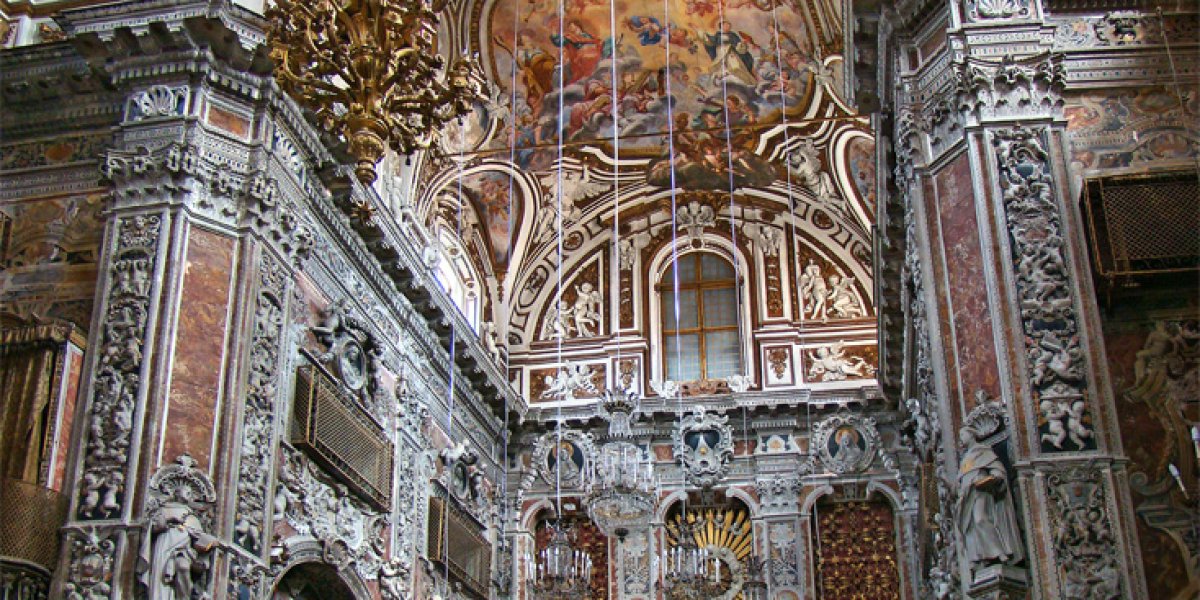
Walk 3 minutes north from the market's center to Piazza Casa Professa — the church's understated facade gives no warning of what waits inside. Every surface is encrusted with marble inlay, gilded stucco, and polychrome carvings in what may be Sicily's most extravagant Baroque interior, 200 years in the making by Jesuit artisans. The contrast with the raw market street you just left is the most Palermo moment of the entire trip.
Tip: The side chapels to the right of the nave have pietra dura panels — marble inlays so detailed they resemble oil paintings. Weekday afternoons offer near-total solitude; this church sees a fraction of the visitors it deserves.
Open in Google Maps →19:30
Food
From Casa Professa, head northwest through the Albergheria's residential streets — laundry lines overhead, Vespas threading past — toward the Capo quarter, a 15-minute evening walk. This no-frills trattoria hasn't changed its formula in decades: massive portions of traditional Palermitan cooking served to a dining room of neighborhood regulars. Order the pasta con le sarde (sardine pasta with wild fennel, pine nuts, and raisins, €10) and involtini di melanzane (eggplant rolls with breadcrumbs and capers, €8).
Tip: No reservations accepted — arrive by 19:30 or wait. The house wine is honest and cheap at €4 per quarter liter. Avoid the restaurants on Corso Vittorio Emanuele with laminated photo menus — they charge double for half the quality; the Capo and Albergheria backstreets are where Palermitans actually eat.
Open in Google Maps →09:00
Landmark
Europe's third-largest opera house dominates Piazza Verdi like a neoclassical temple — and served as the set for the final, devastating scene of The Godfather Part III. Take the 25-minute guided tour (English departures every half hour) to see the royal box, the frescoed ceiling, and the engineering marvel of its retractable stage floor. Clap once in the center of the stalls and listen to the acoustics carry the sound for a full three seconds.
Tip: First tours depart at 09:30 — arrive at 09:00 to buy tickets before the midday coach-tour crowds. The grand exterior staircase is THE Godfather photo: shoot from the bottom of the steps looking up, exactly as Coppola framed it.
Open in Google Maps →10:30
Landmark
Walk south along pedestrianized Via Maqueda — vintage shops and baroque balconies on both sides — and after 8 minutes the buildings open into the perfect octagonal intersection of Quattro Canti, Palermo's theatrical heart. One block east, the scandalously nude Fontana Pretoria earned the nickname 'Piazza of Shame' from outraged nuns next door. Cross to Piazza Bellini for Chiesa della Martorana, whose 12th-century Byzantine mosaics rival the Palatine Chapel in fineness with a fraction of the crowds.
Tip: Inside La Martorana, find the mosaic of Roger II crowned by Christ — the finest Norman mosaic outside the Palatine Chapel, and the pre-noon dome light makes it glow. Skip the gelato on Quattro Canti itself — tourist prices, mediocre product.
Open in Google Maps →12:15
Food
From Piazza Bellini, walk east along Via Vittorio Emanuele and turn right toward Piazza San Francesco — 6 minutes through narrow streets of artisan workshops and hidden courtyards. Operating since 1834, this is Palermo's most storied focacceria, with marble tables and cast-iron columns preserving the 19th-century atmosphere. Order the pane con la milza (spleen sandwich — rich, deeply savory, and a Palermo rite of passage, €5) or the focaccia with fresh ricotta and anchovy (€6).
Tip: Order at the counter on the left, pay at the register on the right — the system confuses every first-timer. Arriving at 12:15 beats the 13:00 rush by a wide margin.
Open in Google Maps →13:30
Museum
Walk southeast along Via Paternostro, turn left onto Via Alloro — La Kalsa's most elegant crumbling street — for a 5-minute stroll to this 15th-century Catalan-Gothic palace. Two masterpieces justify the visit alone: the wall-sized 'Triumph of Death,' an anonymous 15th-century fresco of skeletal Death on horseback mowing down the living, and Antonello da Messina's 'Virgin Annunciate' — a portrait of such serene intensity it stops every viewer mid-step. The rest of the small collection is manageable well within 90 minutes.
Tip: Head directly to Room 2 for the 'Triumph of Death' and Room 11 for the Antonello da Messina — give these two works unhurried time before browsing the rest. Closed Mondays; Tuesday–Friday afternoons are quietest.
Open in Google Maps →15:15
Park
Exit Palazzo Abatellis, continue south on Via Alloro, turn left onto Via Lincoln — bougainvillea spilling over courtyard walls marks the 7-minute walk. Founded in 1789, Palermo's Botanical Garden is a lush 10-hectare oasis where the Mediterranean meets the tropics. The Ficus macrophylla near the entrance, with its cathedral-like aerial roots, is one of the largest trees in Europe; at mid-afternoon the light filters through the canopy, school groups have left, and the garden feels like a private estate.
Tip: The most photogenic shot is the avenue of towering Ficus trees from the main gate — shoot toward the afternoon sun for dramatic shadows. Bring water; there is no café inside. The adjacent Villa Giulia park is free and extends the green walk.
Open in Google Maps →19:30
Food
Walk northwest through La Kalsa as the streets come alive with aperitivo energy at dusk — 12 minutes to the hidden Piazza Croce dei Vespri, tucked behind the palazzo where Visconti filmed The Leopard's ballroom scene. This refined restaurant serves creative Sicilian cuisine that honors tradition without being enslaved by it: the paccheri with red prawns and pistachio pesto (€18) is a signature, and the tonno rosso alla griglia (grilled Sicilian red tuna, €22) is extraordinary. Ask for a Nero d'Avola from Etna to close the trip properly.
Tip: Reserve at least two days ahead for an outdoor table on the piazza — one of the most romantic dinner settings in Palermo. Avoid the waterfront restaurants along Foro Italico and Via Cala: tourist-priced and forgettable. La Kalsa's backstreets are where Palermo eats best.
Open in Google Maps →
Trip builder
Plan this trip around Palermo
Turn this guide into a bookable rail itinerary with FlipEarth.
Keep exploring
Related cities
More in the same country
FAQ
Frequently asked questions
How many days do you need in Palermo?
Most travelers enjoy Palermo in 1 days, with enough time for headline sights and a slower meal or museum stop.
What's the best time to visit Palermo?
The easiest season for most travelers is Apr-Jun, Sep-Oct, especially if you want good weather and manageable crowds.
What's the daily budget for Palermo?
A practical starting point is about €75 per person per day before hotels, then adjust based on museums, dining, and transport.
What are the must-see attractions in Palermo?
A good first shortlist for Palermo includes Teatro Massimo Vittorio Emanuele, Quattro Canti & Fontana Pretoria, Norman Palace.