City Guide
Lecce
Italie · Best time to visit: Apr-Jun, Sep-Oct.
Day-by-day plan
Choose your pace
Durée du voyage
09:00
Landmark
Begin where every grand Lecce story starts — the triumphal arch of Porta Napoli, erected in 1548 to honor Charles V. This limestone gateway frames the entrance to the old town like a theater curtain about to rise. Stand on the northern side and look south through the arch: the entire old town stretches before you in honey-colored stone, bathed in morning gold.
Tip: Morning light hits the carved northern face before 10 AM, throwing the Habsburg coat of arms into sharp relief. Stand directly beneath the vault and shoot upward with a wide-angle lens — the imperial eagle overhead is the most overlooked detail and photographs beautifully from below. The small park outside the arch has a bench perfectly positioned for a framed gateway shot.
Open in Google Maps →09:30
Religious
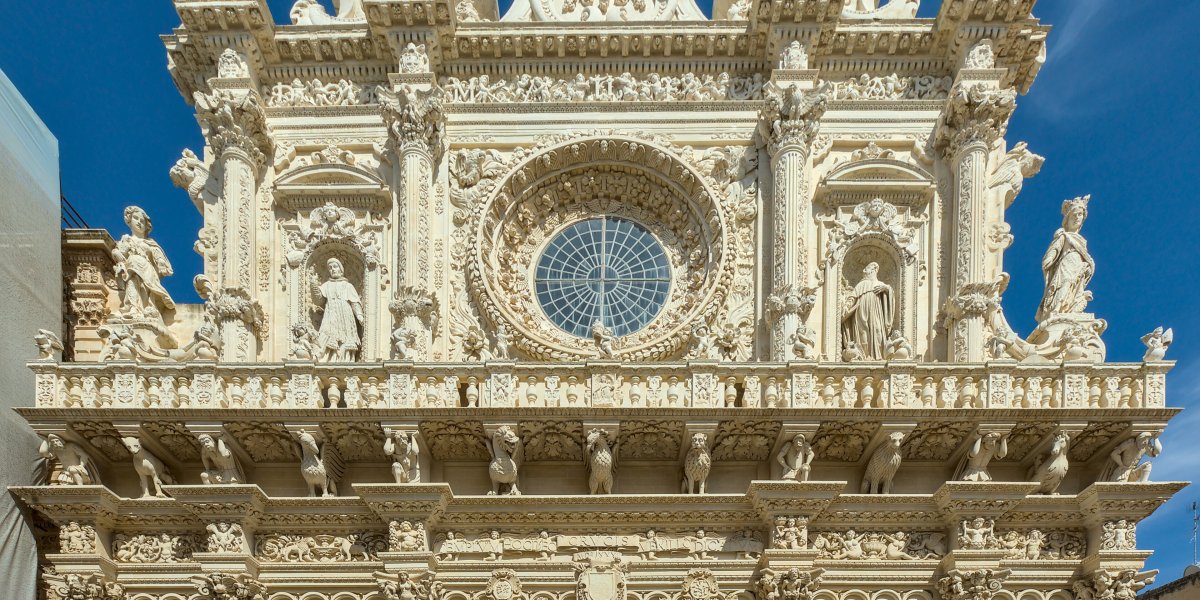
Walk three minutes south from the arch — the street narrows, balconies crowd overhead, and then the facade of the Basilica di Santa Croce hits you like a wave and you involuntarily stop walking. Two hundred years of Lecce's finest stone carvers poured their wildest imagination into this single wall: cherubs wrestling griffins, lions gripping shields, pomegranates splitting open, faces frozen mid-scream. This is the Sistine Chapel of Baroque stonework, except the medium is local pietra leccese — a soft limestone that hardens with age and turns more golden every century.
Tip: The upper rose window catches direct sun around 10 AM — the stone practically glows amber. Stand across the street at the Palazzo dei Celestini for the full facade, then cross and zoom into the lower columns: each grotesque face has a unique expression — find the one that looks profoundly annoyed. The adjacent Palazzo dei Celestini courtyard is visible through the entrance for free — step inside for an unexpected bonus of arched cloisters and quiet proportions.
Open in Google Maps →10:30
Landmark
Walk south along Via Libertini for seven minutes — this is Lecce's baroque runway, every palazzo competing for your attention — and turn left into a deceptively narrow entrance that suddenly explodes into an enormous enclosed square, the 68-meter bell tower soaring overhead. Piazza del Duomo is one of Italy's great architectural surprises: the Cathedral, Bishop's Palace, and Seminary wrap around you in a single unbroken wall of golden limestone, and the square has only one way in — making it feel like a private courtyard accidentally left unlocked.
Tip: The best photograph is from the narrow entrance passage itself — the bell tower framed between the flanking buildings creates a dramatic sense of discovery that a wide shot from the center of the square cannot match. The cathedral actually has two facades: the restrained main entrance facing the square, and a wildly ornate side facade on Via Libertini that most visitors walk right past — look for it on your way in. The square empties between guided-tour waves around 10:30 on weekdays.
Open in Google Maps →11:30
Food
Walk east from Piazza del Duomo along Via Augusto Imperatore for five minutes, ducking through quiet back streets until you emerge into the open buzz of Piazza Sant'Oronzo. Under the arched portico on the south side, Caffè Alvino has been feeding Lecce its two edible obsessions for generations — order a pasticciotto (warm shortcrust shell filled with silky vanilla custard, €1.50) and a caffè leccese (espresso shaken hard with ice and almond milk syrup, €3), and stand at the bar like the locals do.
Tip: The pasticciotto must be warm — if you feel heat through the napkin, you've timed it right. Alvino bakes in small batches all morning, so they're reliably fresh even at 11:30. Skip the cappuccino — caffè leccese is the only correct order, especially in warm weather. Standing at the bar costs €4-5 total; sitting at a table adds a €1-2 surcharge and gains you nothing but a wobbly chair.
Open in Google Maps →12:00
Landmark
Set down your coffee and turn around — a 2nd-century Roman amphitheatre is sitting in the middle of Piazza Sant'Oronzo as casually as a park bench. Only one-third of the original structure is visible; the rest sleeps beneath the surrounding buildings, unbothered. But the exposed tiered seating and arena floor convey the scale: this held 25,000 spectators watching gladiatorial combat where Italian grandmothers now eat gelato.
Tip: The midday sun pours directly into the open arena, eliminating shadows and giving you the clearest view of the stone tiers — this is the one sight that actually photographs best at noon. Walk to the far side for a shot capturing both the ancient tiers and the Column of Sant'Oronzo — the city's patron saint standing on a recycled Roman column originally from Brindisi. Peer through the glass doors of the 16th-century Sedile building on the north side of the square for a hidden frescoed interior.
Open in Google Maps →13:00
Food
Walk south from Piazza Sant'Oronzo along Via Leonardo Prato for five minutes — the tourist density drops sharply the moment you leave the square. Alle Due Corti is a Salentine grandmother's kitchen disguised as a restaurant: terracotta floors, hand-written specials on a chalkboard, and recipes unchanged in decades. Order ciceri e tria (hand-torn pasta, half boiled and half fried, tangled with chickpeas in a clay pot, €8) and a plate of pittule (crispy fried dough balls, €4), washed down with a half-liter of local Negroamaro house wine (€4).
Tip: No reservation needed — arrive by 13:00 and you'll get a table before the local office workers flood in at 13:30. Ciceri e tria is the dish Lecce is proudest of, and this is one of the last kitchens that still fries half the pasta in the traditional way. Ask for pane fatto in casa when you sit down — it arrives with a saucer of local olive oil that might quietly be the best thing you taste all day. Budget €15-20 per person with wine. Warning: the cluster of restaurants directly on Piazza Sant'Oronzo charge double for a far worse version of every dish on this menu — five minutes of walking is the difference between eating like a local and eating like a mark.
Open in Google Maps →Aller au jour
09:00
Religious
From Piazza Sant'Oronzo walk north along Via Umberto I for five minutes — stop at Pasticceria Natale on the way for a warm pasticciotto (€1.50), Lecce's sacred breakfast ritual. The facade of Santa Croce is the supreme expression of Lecce Baroque: every inch of golden pietra leccese writhes with cherubs, griffins, roses, and grotesque beasts, all glowing in the low morning sun that rakes across the relief at this hour. Inside, the coffered ceiling and the side-chapel altars reward a slow, contemplative circuit.
Tip: The adjacent Palazzo dei Celestini — now provincial government offices — shares the same facade line and its inner courtyard is free to enter. Step through the archway on the left for a serene Baroque cloister that 90% of visitors walk right past.
Open in Google Maps →10:45
Landmark
Exit Santa Croce and walk south along Via Umberto I, turn right onto Via Giuseppe Libertini past cartapesta workshops with open doors — a 6-minute stroll. Piazza del Duomo is an enclosed square with only one narrow entrance: the moment you step through the gap between buildings, the entire space detonates — the Cathedral with its ornate double facade, the 68-meter bell tower, the Bishop's Palace, and the Seminary with its exuberant Baroque well. Mid-morning light floods the square evenly across all four walls, ideal for the wide-angle photograph this piazza was designed for.
Tip: Walk through the door on the right side of the square into the Seminary courtyard — the Baroque well carved by Giuseppe Cino, dripping with sculpted fruit and mythological figures, is one of the finest decorative objects in Puglia. Almost no visitor pushes that door open.
Open in Google Maps →12:30
Food
Exit the piazza and turn left — a 3-minute walk down Via Vittorio Emanuele II. Le Zie is a no-frills cucina casareccia with handwritten daily menus and a dining room that feels like a Salentine grandmother's kitchen. Order the ciceri e tria (chickpea stew with partially fried pasta — the oldest recipe in Salento, €8) or the orecchiette con cime di rapa (€8), and start with a plate of pittule fritte (fried dough balls, €4). Budget €12-18 per person.
Tip: Arrive by 12:30 to beat the local office workers who fill every table by 13:00. No reservation needed — just walk in and sit. The ciceri e tria here uses a grandmother's ratio of fried to boiled pasta that no modern restaurant dares replicate.
Open in Google Maps →14:00
Landmark
Walk east along Via Vittorio Emanuele II toward Piazza Sant'Oronzo — a flat 5-minute stroll through the pedestrian shopping street. The 2nd-century Roman amphitheater rises from the center of the main square, half-buried beneath the modern city — only a third is visible, the rest sleeping under surrounding buildings. Walk down the stone steps into the arena floor where 25,000 spectators once watched gladiatorial combat, then look up at the Column of Sant'Oronzo and the elegant 16th-century Sedile with its frescoed ceiling.
Tip: After 14:00 the amphitheater walls cast deep shadows that create dramatic contrast for photographs — shoot from the southeast corner looking northwest toward the Column of Sant'Oronzo for the best composition. The panels inside mark which sections are Augustan-era versus later Hadrianic expansion.
Open in Google Maps →15:30
Landmark
Walk southeast from Piazza Sant'Oronzo along Viale Francesco Lo Re, past the public gardens — a 7-minute stroll. Charles V built this fortress in the 1530s to repel Ottoman raids along the Salento coast; the massive trapezoidal walls and arrow-slit bastions are pure military severity, a bracing contrast to the Baroque filigree of the morning. Inside, rotating exhibitions and a small museum of cartapesta reveal Lecce's extraordinary papier-mâché tradition — sacred statues built entirely from layered paper by artisans whose craft dates to the 17th century.
Tip: Visit between 15:30 and 17:00 when the castle empties out — morning tour groups are long gone. If the upper gallery is open, the view down into the geometric courtyard is the frame that captures Lecce's military chapter in a single shot.
Open in Google Maps →19:30
Food
Walk northwest from the castle back into the old town along Via Leonardo Prato — a 10-minute evening stroll as the pietra leccese catches the last light and the passeggiata fills the streets. Alle Due Corti is the temple of Salentine cooking, set in a converted 16th-century palazzo. Order the pezzetti di cavallo (horse meat slow-braised for hours in tomato sauce — the most unapologetically Salentine dish that exists, €12) and the fave e cicoria (silky fava bean purée with bitter wild chicory, €8), with a carafe of local Negroamaro. Budget €25-35.
Tip: Reserve at least a day ahead — locals compete with visitors for tables here. Ask for the inner courtyard if the weather is warm. Avoid the cluster of tourist-menu restaurants on Via Augusto Imperatore near the castle: triple the price, frozen ingredients, zero soul.
Open in Google Maps →09:00
Religious
Walk north from the center through Via Palmieri and out through Porta Napoli — the triumphal arch built in 1548 to honor Charles V, its carved imperial eagles worth a pause for photos. Continue 500 meters along a tree-lined avenue. Built by the Norman king Tancred in 1180, this church wears a 1716 Baroque facade grafted onto Romanesque bones — the collision of eight centuries on a single wall is extraordinary. Inside, ghostly fragments of 14th-century frescoes cling to the nave, and the adjacent cloister is hauntingly silent.
Tip: The church sits inside Lecce's monumental cemetery, which itself deserves a fifteen-minute walk — the funerary architecture ranges from Baroque tombs to Art Nouveau chapels. Arrive at 09:00 when the morning light cuts through the cloister arches at a low, cinematic angle.
Open in Google Maps →10:30
Museum
Walk back south through Porta Napoli, past the Basilica di Santa Croce in different morning light, and continue south — a 12-minute walk total. This 2nd-century Roman theater was discovered entirely by accident in 1929 during construction work, its 5,000 seats hidden beneath medieval and modern buildings for nearly two millennia. The attached Museo del Teatro Romano displays terracotta figurines, bronze coins, and marble fragments unearthed during excavation, placing Lecce firmly on the map of Roman Puglia.
Tip: The theater sits in a sunken pit surrounded by apartment buildings — residents literally have Roman ruins in their backyards. Look up at the laundry lines hanging over 2,000-year-old stone: that collision of ancient and everyday is the most uniquely Leccese photograph you will take on this trip.
Open in Google Maps →12:00
Food
Walk 5 minutes north to Piazza Sant'Oronzo. Founded in 1872, Caffè Alvino is where the rustico leccese was perfected — order one (puff pastry filled with tomato, mozzarella, and béchamel, €2.50) alongside a caffè leccese (espresso poured over ice with almond milk, €3), two inventions that belong to this city and this counter. Stand at the bar like a local; budget €8-12.
Tip: The rustico is best eaten warm straight from the oven — they come out in batches, so if the tray is empty, wait two minutes for the next round rather than taking a lukewarm one. Order two; one is never enough, and at €2.50 each you will not regret it.
Open in Google Maps →13:30
Neighborhood
Walk south from Piazza Sant'Oronzo along Via degli Acaya, then turn into the narrow lanes — 8 minutes into a neighborhood the Baroque crowds never reach. The Giudecca was Lecce's Jewish quarter from the medieval period until the 1541 expulsion; the streets are tighter, the buildings rougher, the atmosphere more intimate — look for the Star of David carved into a doorway on Via della Giudecca. Duck into the cartapesta workshops on Via dei Perroni, where artisans sculpt sacred statues from layered paper using 17th-century techniques.
Tip: The workshops with open doors and unpainted statues visible inside are the real working studios, not tourist shops. Watch how the artisan layers paper over a wire frame — the technique has not changed since the 1600s. Small handmade pieces start at €15 and are the only souvenir in Lecce worth carrying home.
Open in Google Maps →15:30
Religious
Continue south along Via dei Perroni for 2 minutes — the church appears at a bend in the street, its undulating facade catching you mid-stride. San Matteo is Lecce's answer to Borromini: the concave lower half and convex upper half create a rippling, almost liquid effect in golden stone, directly inspired by Rome's San Carlo alle Quattro Fontane. Late afternoon light hits the west-facing front at a warm, raking angle, turning the pietra leccese from gold to deep amber.
Tip: Stand directly across the narrow street to photograph the full facade — the tight space forces a dramatic upward perspective that amplifies the concave-convex wave. This is arguably the most architecturally daring church in Lecce, yet it appears in almost no English-language guidebook.
Open in Google Maps →19:00
Food
Walk north through Via dei Perroni and Via Paladini back toward the heart of the old town — a 7-minute stroll through streets that are golden and quiet at this hour. This osteria occupies a vaulted stone cellar in a 17th-century palazzo, candlelit and unhurried, with a menu that honors Salentine tradition through a lighter lens. Try the bombette pugliesi (pork rolls stuffed with caciocavallo cheese and herbs, €10) and the taieddha (a layered bake of rice, potatoes, and mussels that is pure Salento in one dish, €12). Local Primitivo by the glass, €5. Budget €25-35.
Tip: The vaulted cellar is the atmospheric choice; the courtyard upstairs is better in warm weather — ask when you arrive. For your last evening, steer clear of gelaterias near Piazza Sant'Oronzo with towering, fluorescent-colored displays — the garish hues signal artificial flavoring. Real artisan gelato is kept in covered metal pans with muted, natural tones.
Open in Google Maps →
Trip builder
Plan this trip around Lecce
Turn this guide into a bookable rail itinerary with FlipEarth.
Keep exploring
Related cities
More in the same country
FAQ
Frequently asked questions
How many days do you need in Lecce?
Most travelers enjoy Lecce in 1 days, with enough time for headline sights and a slower meal or museum stop.
What's the best time to visit Lecce?
The easiest season for most travelers is Apr-Jun, Sep-Oct, especially if you want good weather and manageable crowds.
What's the daily budget for Lecce?
A practical starting point is about €45 per person per day before hotels, then adjust based on museums, dining, and transport.
What are the must-see attractions in Lecce?
A good first shortlist for Lecce includes Porta Napoli, Piazza del Duomo, Roman Amphitheatre.