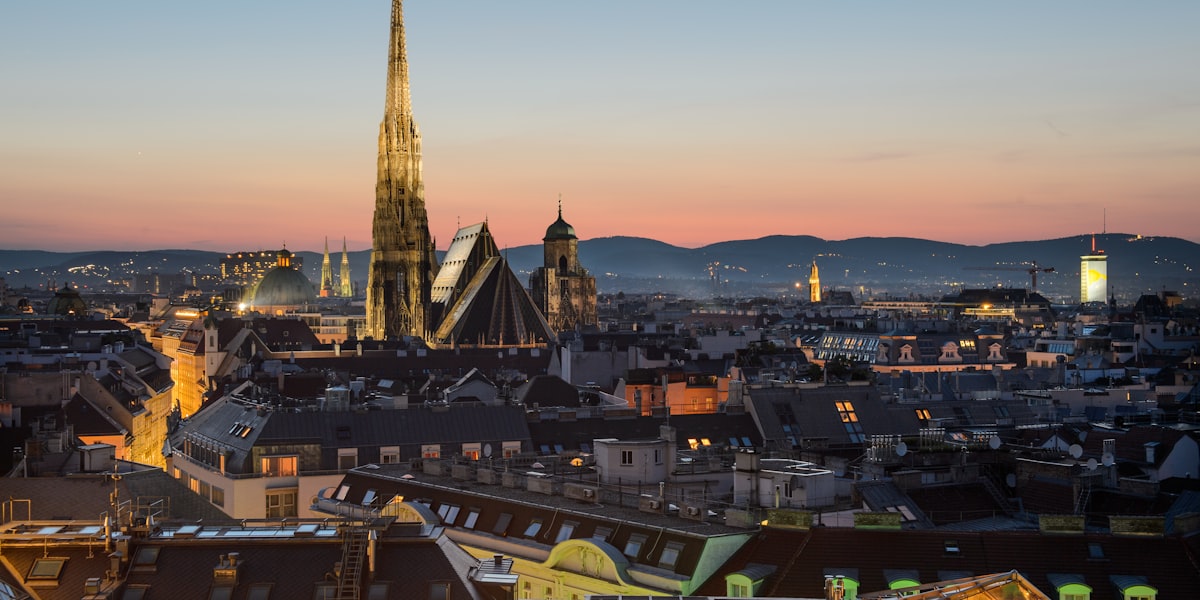
City Guide
Vienna
Austria · Best time to visit: Apr-Jun, Sep-Oct.
Day-by-day plan
Choose your pace
Duración del viaje
09:00
Landmark
Begin at Vienna's crown jewel while the morning sun lights up the baroque facade in warm gold — by 11:00, tour buses flood the courtyard, but at 9:00 you share the Great Parterre with joggers and gardeners. Walk the central axis past the Neptune Fountain, then climb the hill to the Gloriette — a 15-minute uphill hike rewarded with the single best panoramic photo in Vienna: the palace below, the city skyline beyond, the gardens laid out like an emperor's chessboard.
Tip: Shoot the palace facade from the Neptune Fountain — this is the postcard angle no one tells you about because it requires walking past the parterre. Skip the palace interior entirely: the queue eats 40+ minutes you don't have. The Gloriette café terrace offers the same panoramic view for the price of a melange (€5.50). Exit through the main gate and follow signs to U4 Schönbrunn station.
Open in Google Maps →12:00
Food
Take the U4 from Schönbrunn to Kettenbrückengasse (12 minutes) and surface into Vienna's legendary open-air food market — 120 stalls stretching 1.5 km between two grand Art Nouveau apartment rows. Walk the left side for the best food vendors. Grab a Käsekrainer (cheese-stuffed grilled sausage, €4.50) from any Würstelstand, or sit at Neni am Naschmarkt for a mezze plate with warm hummus and crispy halloumi (€12–14). Budget €10–15.
Tip: The best food stalls cluster in the eastern third near Kettenbrückengasse — don't walk the full length or you'll burn 20 minutes on tourist souvenirs at the flea-market end. The Turkish gözleme ladies on the left side (look for the hand-rolled flatbreads on a convex griddle) sell the crispiest stuffed flatbread in Vienna for €5. Eat standing like the locals do.
Open in Google Maps →13:15
Landmark
Walk east from Naschmarkt along Operngasse — in 8 minutes the Renaissance Revival facade of the Wiener Staatsoper rises ahead of you, framed by the Ringstrasse boulevard. This building took a direct bomb hit in 1945, was rebuilt stone by stone over a decade, and reopened in 1955 as Austria's declaration that its cultural soul was intact. Cross to the traffic island on Opernring for the unobstructed full-facade shot, then circle to the back on Philharmonikerstraße to see the stage door where the world's greatest singers slip in before curtain.
Tip: The best photo is from the raised median on Opernring directly opposite the main entrance — early afternoon light hits the facade evenly with no harsh shadows. Standing-room tickets for evening performances cost just €4–10 and go on sale 80 minutes before curtain at the side box office on Operngasse, but on a one-day blitz the exterior is the shot you came for.
Open in Google Maps →14:00
Landmark
Walk 5 minutes north through Albertinaplatz and pass under the Burgtor arch into Heldenplatz — the vast imperial square where Habsburg emperors reviewed their armies and where history turned dark in March 1938. Stand at the center for the full sweep: the curved Neue Burg wing to your left, the Leopoldine Wing straight ahead, the twin museum domes behind you. Then thread through the inner courtyards — In der Burg, the 16th-century Swiss Gate, and finally through the Michaelertor passage into Michaelerplatz, where you emerge under a soaring Baroque dome into sunlight. This 60-second architectural reveal is Vienna's most cinematic free experience.
Tip: Detour through the Volksgarten on the north side of the Hofburg — from April through October the rose garden is in spectacular bloom and nearly empty on weekday afternoons. When you reach the Michaelertor passage, slow down: you enter a dark echoing archway, round a bend, and the Baroque dome explodes above you. Pause and look up. Most tourists rush straight through and miss it entirely.
Open in Google Maps →16:00
Religious
Walk 10 minutes east from the Michaelerplatz exit through Kohlmarkt and Graben — Vienna's most elegant pedestrian boulevards, all marble facades, wrought-iron balconies, and Habsburg-era storefronts. The gilded Plague Column on Graben signals your arrival at Stephansplatz, where the cathedral's 136-meter south tower and dazzling chevron-patterned tile roof hit you all at once. Circle the entire building: the southeast corner reveals the full double-eagle mosaic on the roof, while the north side shows the deliberately unfinished second tower — a permanent reminder that perfection was never the point.
Tip: Late afternoon light after 16:00 makes the glazed roof tiles shimmer in blues and greens — this is when local photographers come. For an unexpected reflection shot, stand at the entrance of the Haas-Haus across the square: the curved glass facade mirrors the entire cathedral. After circling the cathedral, walk south down Kärntner Straße and duck into any traditional Kaffeehaus for a melange and Apfelstrudel (€12) — you've earned the rest before dinner.
Open in Google Maps →19:00
Food
Walk 3 minutes east from Stephansdom along Wollzeile to Vienna's most legendary schnitzel house, frying since 1905. This is not a tourist trap masquerading as tradition — it is a century-old institution where Viennese families celebrate birthdays. The schnitzels are pounded impossibly thin, hand-breaded, fried in clarified butter, and arrive hanging over the plate edge. One is a full meal. Pair it with their vinegary potato salad and a glass of Grüner Veltliner, and you will understand why Vienna has protected this place for over a hundred years.
Tip: Go to the Wollzeile 5 location — the original at Bäckerstraße 6 is a four-table alley with a permanent 45-minute queue. Order the Figlmüller Schnitzel (pork, €17.90), not the Wiener Schnitzel (veal, pricier, not better at this address). Do not order a starter — one schnitzel with potato salad defeats any appetite. Arrive by 19:00 sharp; by 19:30 the wait wraps around the block. Avoid every restaurant on Stephansplatz itself: they charge triple for reheated tourist-grade food and bank on the fact that you're too tired to walk two more minutes.
Open in Google Maps →Saltar al día
09:00
Landmark
Step out of the U1 Stephansplatz station and the cathedral's 136-meter Gothic spire fills the sky directly above you — you've arrived at the heart of Vienna. Climb the south tower's 343 narrow stone steps for the single best panorama in the city: terracotta rooftops, baroque church spires, and the distant Alps in every direction. Back at ground level, the baroque high altar glows in the morning light streaming through stained glass, and the bone-filled catacombs beneath add a shiver of Habsburg mortality to the morning.
Tip: Climb the South Tower at exactly 09:00 opening — by 10:30 the narrow spiral staircase becomes a slow single-file shuffle. Skip the North Tower (elevator, inferior view). From the top, face south for the best morning light across the city; the famous chevron-patterned roof tiles are best photographed from the northwest corner of the platform.
Open in Google Maps →10:45
Museum
Walk ten minutes down the Graben — Vienna's most elegant pedestrian boulevard, all baroque facades, gilded plague column, and street musicians — then turn right onto Kohlmarkt past Demel café until Michaelerplatz opens before you in a grand sweep. The Sisi Ticket covers the Imperial Apartments, Sisi Museum, and Silver Collection: the apartments are surprisingly intimate, from Franz Joseph's spartan military desk to Empress Elisabeth's private gymnasium with its rings and parallel bars. Focus your time on the Sisi Museum's personal artifacts — the Silver Collection impresses with its sheer excess but is skippable if energy runs low.
Tip: Enter through the Michaelertor — the grand curved entrance beneath the green dome is itself worth photographing. Rooms are quietest before 11:00, when bus tour groups start flooding in; you'll have the imperial bedchambers nearly to yourself. Head directly to the Sisi Museum wing first and use the included audio guide — it's surprisingly well-produced and transforms the visit.
Open in Google Maps →12:30
Food
Step back through the Michaelertor and duck into narrow Dorotheergasse — five minutes on foot to number 1, where a perpetual queue spills onto the sidewalk. Vienna's original standing-room sandwich bar since 1902: point at the tiny open-faced Brötchen behind the glass and order five or six varieties with a Pfiff, Vienna's smallest beer pour at a mere 125ml. Egg-and-anchovy, creamed herring, and paprika-liptauer are the signatures — you'll be perfectly fueled in twenty minutes flat.
Tip: Arrive before 12:30 — the lunch crowd from surrounding offices packs the tiny room by 12:45 and the queue doubles. The line looks daunting but moves fast; most people eat standing in under ten minutes. Each Brötchen is about €1.60; six plus a Pfiff runs you under €12. Don't overthink the order — point at whatever catches your eye; there's no wrong choice here.
Open in Google Maps →13:30
Museum
Continue south down Dorotheergasse to Augustinerstraße, then left to Albertinaplatz — an eight-minute walk through quiet side streets to the museum's grand staircase with the Soravia Wing jutting skyward. The permanent Batliner Collection covers Monet to Picasso to Rothko in twelve luminous rooms — substantial enough to satisfy any art appetite, compact enough to avoid museum fatigue. The Habsburg State Rooms upstairs are included with your ticket and nearly empty: gilded ceilings, parquet floors, and a terrace overlooking the Burggarten where you can finally exhale.
Tip: Go straight to the second-floor Batliner Collection — this is why you're here. Early afternoon is the museum's quietest window: morning school groups have left and the after-work crowd hasn't arrived yet. The terrace café has one of the best views in Vienna but charges accordingly — take the view, skip the overpriced coffee, and save your appetite for dinner.
Open in Google Maps →15:30
Landmark
Walk down the Albertina's front steps and you're looking directly at the Opera's Renaissance Revival facade — two minutes across the square, and you're standing before the most important building on the Ringstraße. The 40-minute guided tour reveals the grand staircase, Gustav Mahler's private salon, the Tea Salon with its Gobelin tapestries, and a 2,200-seat auditorium rebuilt stone by stone after a direct bomb hit in 1945 — the 1955 reconstruction is now more celebrated than the original. Pure theatrical grandeur from the city that gave the world Mozart, Strauss, and Mahler.
Tip: Check the tour schedule on the board at the Herbert von Karajan-Platz entrance (west side of the building) — afternoon tours at 14:00 and 15:00 are most common, but times shift with rehearsal schedules. If you happen to be here on a performance evening, standing-room tickets go on sale 80 minutes before curtain for just €4–15 — the best deal in classical music anywhere in the world.
Open in Google Maps →19:00
Food
Walk north up Kärntner Straße past the illuminated cathedral, then right onto Wollzeile — twelve minutes through the evening buzz of the inner city as Vienna shifts from daytime bustle to candlelit warmth. Prime boiled beef arrives at your table in a copper pot with bone marrow, broth, apple-horseradish cream, and chive sauce — a ritual perfected here since 1977, serving what was once Emperor Franz Joseph's daily meal. The dining room hums with well-dressed Viennese every night, which tells you everything you need to know about the quality.
Tip: Reserve online at least two days ahead — this place fills every single night. Order the Tafelspitz vom Weißen Scherzel (€32–38) for the most tender cut and pair it with a glass of Grüner Veltliner (€6). Budget €40–50 per person with wine. Avoid the string of restaurants on Kärntner Straße with multilingual sidewalk menus and touts — they charge double for reheated tourist-grade food, and no Viennese person has eaten at one in the last decade.
Open in Google Maps →09:00
Landmark
Take the U4 from Karlsplatz to Schönbrunn station — fifteen minutes door to door, and the palace's golden-yellow facade fills the frame the moment you exit the station. The Imperial Tour covers 22 rooms including the Great Gallery with its ceiling frescoes and crystal chandeliers, Maria Theresa's breakfast room decorated with Persian miniatures painted by her children, and the Hall of Mirrors where six-year-old Mozart performed for the empress and then jumped into her lap. This is where the Habsburg story transforms from textbook to something you can feel in the room — 300 years of power, taste, and eccentricity compressed into a single morning.
Tip: Book the Imperial Tour online the night before and select the 09:00 time slot — you'll walk through near-empty rooms while bus tour groups are still queuing at the ticket office outside. The Grand Tour adds 18 more rooms for €5 extra but the essential highlights are all covered in the Imperial Tour. Audio guide is included; enter through the right-side entrance and follow signs.
Open in Google Maps →11:15
Park
Exit the palace from the garden side and the full baroque landscape unfolds before you — start walking the central axis toward the Gloriette crowning the hill ahead, flanked by perfectly clipped hedgerows and splashing fountains. The climb takes fifteen minutes past the magnificent Neptune Fountain; at the top, the 1775 triumphal arch — built to commemorate Austria's victory over Prussia — frames Schönbrunn below in perfect symmetry with Vienna's skyline stretching to the horizon. This is the defining photograph of the city, and no trip is complete without standing here.
Tip: Take the left-side path up the hill for a more gradual slope — the central staircase is steeper and more crowded with selfie-takers. The Gloriette Café at the top does a perfectly decent Melange (Viennese coffee, ~€5) with the panorama included — worth a ten-minute stop to rest your legs. The viewing terrace is free. For the best photo of the palace, stand at the bottom of the Great Parterre and shoot upward with the Neptune Fountain in the foreground.
Open in Google Maps →12:30
Food
Walk back to Schönbrunn's U4 station and ride five stops to Kettenbrückengasse — ten minutes, and you emerge at the far end of Vienna's most famous open-air market, stretching 1.5 kilometers ahead of you between two grand Art Nouveau apartment rows. Over 120 stalls sell olives, spices, aged cheese, fresh oysters, Turkish gözleme, and falafel — don't sit at the first restaurant you see; walk the full length, scout what's good, and double back. The left side has prepared food and wine bars for eating; the right side has produce, spices, and deli counters for grazing.
Tip: Walk past the first cluster of restaurants near the Secession end — they're the most touristic, most expensive, and least interesting. The better stalls are deeper in, past the halfway mark. For a proper market lunch, try the fresh seafood counters (oysters and a glass of white wine standing up, around €15–18) or the Turkish-Middle Eastern stands (hand-rolled gözleme or lentil soup and börek, under €8). The market closes at 18:00 weekdays, 17:00 Saturdays, and is fully closed Sundays.
Open in Google Maps →14:00
Museum
Walk north from Naschmarkt, cross the Getreidemarkt, and enter the MuseumsQuartier through its grand archway — ten minutes to the white limestone cube at the center of the courtyard, one of the world's largest cultural complexes. The world's largest Egon Schiele collection lives here alongside Klimt, Kokoschka, and the Vienna Secession masters — Schiele's raw, contorted self-portraits feel shockingly modern for 1910, mesmerizing and deeply uncomfortable in equal measure. Klimt's monumental 'Death and Life' anchors the top floor with an equally unforgettable meditation on mortality and tenderness.
Tip: Start on Level 4 (top floor) with the permanent Klimt and Schiele collection — this is the crown jewel and the reason you're here. Look for Schiele's 'Self-Portrait with Chinese Lantern Plant' and Klimt's 'Death and Life' — both stop you in your tracks. The lower floors rotate temporary exhibitions of varying quality; skip them if time is short. After your visit, grab a seat on the colorful Enzis (curved outdoor furniture) in the MQ courtyard — Vienna's favorite open-air living room.
Open in Google Maps →16:00
Religious
Exit the MuseumsQuartier from the south gate and walk ten minutes down to Karlsplatz — the church's massive verdigris dome and twin triumphal columns modeled on Trajan's Column in Rome are unmistakable from across the reflecting pool. Take the panoramic elevator inside the dome to rise alongside Johann Michael Rottmayr's ceiling frescoes — close enough to see individual brushstrokes — with a vertigo-inducing view straight down into the nave from the top platform. Outside, the reflecting pool doubles the entire baroque facade in the warm late-afternoon light, creating one of Vienna's most photographed compositions.
Tip: Visit between 16:00 and 16:30 for the warmest afternoon light on the interior frescoes and the best reflecting pool photograph outside — at this hour the sun is behind you when you face the church from across the water. The dome elevator ride is included in the entry ticket, no separate booking needed. Take your time at the top; most visitors rush through, but the close-up view of the frescoes alone justifies the visit.
Open in Google Maps →19:30
Food
From Karlskirche, walk south on Wiedner Hauptstraße and turn right onto Pressgasse — a quiet eight-minute stroll into the residential Wieden district, where tourists vanish entirely and real neighborhood Vienna begins. A Beisl running since 1904 with dark wood panels, bentwood Thonet chairs, and a zinc bar that hasn't changed in a century: the Wiener Schnitzel is pounded impossibly thin and fried in clarified butter until the breading puffs into golden waves, arriving on a plate it hangs over the edges of. This is Vienna's comfort food at its most honest — the kind of farewell dinner that makes you start planning your return trip before you've asked for the check.
Tip: Order the Wiener Schnitzel (€18–22) and pair it with their cucumber-potato salad and a glass of Grüner Veltliner (€4–5). If the schnitzel feels like too much after market grazing, the Zwiebelrostbraten (roast beef with crispy fried onions, €20–24) is equally excellent. Budget €25–35 per person with wine. Skip the overpriced 'original Sachertorte' sold at tourist shops and hotel lobbies around the city center — if you must try it, Hotel Sacher on Philharmonikerstraße is the only authentic source at €9 per slice in their café.
Open in Google Maps →Saltar al día
09:00
Museum
From most central hotels, walk to Michaelerplatz — the grand curved facade of the Hofburg greets you in under 10 minutes. The doors open at 9:00; arriving right then means you walk through the imperial state rooms nearly alone. The route flows through the Silver Collection's 30-meter banquet table, Franz Joseph's spartan study, and Sisi's private gymnasium — the contrast between his discipline and her restlessness tells the entire Habsburg story.
Tip: Buy the Sisi Ticket online the night before — it covers all three collections and includes the audio guide. Start with the Silver Collection (most people rush through, but the imperial porcelain is extraordinary), then the Apartments, then the Sisi Museum. Budget 20 minutes, 40 minutes, and 50 minutes respectively.
Open in Google Maps →11:15
Landmark
Exit the Hofburg through Michaelertor, then walk straight along Kohlmarkt past Demel's bakery windows and through the Graben with its baroque Plague Column — a 10-minute stroll down Vienna's most elegant corridor. The cathedral interior is free; at this hour the south-facing windows pour light across the medieval nave. Climb the South Tower's 343 spiral steps for a 360° panorama where you can trace the 230,000 glazed roof tiles forming the Habsburg double-eagle pattern.
Tip: Climb the South Tower (Südturm, €6), not the North Tower elevator — the view is superior and the physical climb is part of the experience. Inside, find Anton Pilgram's stone pulpit: he carved his own face peering out from a window beneath the stairs, Gothic art's greatest inside joke. The cathedral closes to visitors during Sunday morning mass until around 12:00.
Open in Google Maps →13:00
Food
Exit the cathedral's west door and walk 3 minutes southeast to Wollzeile 5 — look for the narrow alley entrance. Since 1905, Figlmüller has served Vienna's defining dish: a Wiener Schnitzel (€17.90) pounded past the plate's edge, fried golden in clarified butter, served with warm potato salad dressed in pumpkin seed oil. Pair it with a Stiegl draft (€4.50).
Tip: Go to the Wollzeile 5 branch, not the Bäckerstraße 6 original — same kitchen, far shorter queue. Arrive by 12:45; by 13:15 the wait stretches to 30 minutes. No reservations at lunch. The signature schnitzel is pork, not veal — this is traditional to Figlmüller's recipe and gives the thinner, crispier result they're known for.
Open in Google Maps →14:30
Landmark
Walk south along Kärntner Straße, Vienna's main pedestrian boulevard — a 7-minute stroll delivers you to the Opera's grand entrance. The guided tour reveals the Tea Salon's Gobelins tapestries, the marble foyer, and the stage of one of the world's five great opera houses. The building was the first completed on the Ringstraße in 1869; its architects never lived to see the acclaim — one died and the other took his own life after critics called the design a 'sunken chest.'
Tip: Tour times vary daily (typically 13:00, 14:00, 15:00) — check wiener-staatsoper.at that morning, as tours are canceled on rehearsal days. After the tour, standing-room tickets go on sale 80 minutes before curtain at the Operngasse side entrance for €4–15: the best cultural deal in Europe. Use the gap before dinner to stroll back to Kohlmarkt and stop at Café Sacher (Philharmonikerstraße 4, behind the Opera) for the original Sachertorte (€8.90).
Open in Google Maps →19:00
Food
Walk north from the Graben through Naglergasse to Bognergasse 5 — a quiet 5-minute stroll as the shopping streets empty. This Art Nouveau institution has served since 1618: the front is a standing wine bar with legendary open-faced sandwiches (Brötchen, €4–7); the back dining room is where Vienna's professionals celebrate. Order the Tafelspitz — prime boiled beef with apple-horseradish cream and chive sauce (€29.50) — and a glass of Grüner Veltliner from the Wachau (€7).
Tip: Reserve the dining room 2 days ahead via beisl.kameel.at. If full, the standing bar is equally beloved — order 3–4 Brötchen and a glass of wine for a perfect light supper (€20). Avoid the illuminated 'MENU' boards on Stephansplatz and Kärntner Straße — those restaurants serve frozen schnitzel at triple the price and are Vienna's most reliable tourist trap.
Open in Google Maps →09:00
Shopping
Walk south from Karlsplatz past the Secession Building's golden laurel dome — the Naschmarkt's northern end begins 2 minutes beyond. Vienna's oldest market stretches 1.5 kilometers with over 120 stalls: Persian dried fruits, Balkan cheeses, fresh Austrian produce, and Turkish spice towers. At 9:00 the vendors are stocking and tasting; the tourist crowds don't arrive until after 11:00.
Tip: Enter from the Karlsplatz (north) end and walk south — the quality stalls and food stands are in the first half. Try a Käsekrainer sausage (€4.50) from one of the stand-up counters — a Viennese street-food icon filled with melted cheese. The Saturday flea market at the south end (from 06:30) is worth an early start if your visit falls on a Saturday. The market is closed Sundays.
Open in Google Maps →10:15
Museum
Walk north from the Naschmarkt through Karlsplatz and along Babenbergerstraße — a flat 10-minute stroll to Maria-Theresien-Platz. The KHM opens at 10:00; entering in the first 15 minutes means Room 10 — home to the world's largest Bruegel collection — is nearly empty. 'Hunters in the Snow' and 'Tower of Babel' exist only here; then find Vermeer's 'Art of Painting' in Room X and Raphael's 'Madonna of the Meadow' in Room 4 — three rooms worth crossing a continent for.
Tip: Head to the Bruegel room (Room 10, second floor) immediately — it gets crowded after 11:30. Download the free KHM app for better commentary than the audio guide. The museum is closed Mondays; on Thursdays it's open until 21:00 if you need to rearrange. The cupola café (Kuppelhalle) serves coffee beneath the dome — worth a pause for the architecture alone.
Open in Google Maps →12:45
Food
Exit the KHM from the west side and walk 8 minutes south along Getreidemarkt to Gumpendorfer Straße 11. Café Sperl has been the artists' and bohemians' coffeehouse since 1880 — less polished than Café Central, more authentic. Order the Viennese Gulasch (€14.90), rich and paprika-deep with a bread dumpling, then Topfenstrudel — warm curd strudel with vanilla sauce (€9.90) — and a Melange, Vienna's answer to the cappuccino.
Tip: Sit in the back room near the billiard table for the full 19th-century atmosphere — wooden reading racks still hold the day's newspapers on wooden holders, exactly as they did when Kubrick ate here while filming in Vienna. No reservations needed for lunch; the crowd is local. If you want to experience Viennese coffeehouse culture as UNESCO intended, this is the room.
Open in Google Maps →14:30
Religious
Walk east from Café Sperl toward Getreidemarkt and south to Karlsplatz — a flat 12-minute walk that brings you to the reflecting pool in front of the church. Vienna's finest baroque church was built by Fischer von Erlach in 1737; the twin columns modeled on Trajan's Column spiral with relief carvings of St. Charles Borromeo's life. Take the panoramic elevator inside the dome (€9.50) — it lifts you to ceiling height where Rottmayr's frescoes float at arm's length, painted for viewers 70 meters below.
Tip: Photograph the church from the south side of the reflecting pool — the full facade, pool, and sky create Vienna's classic postcard shot. The dome elevator is unique in Europe: you step onto a narrow platform entirely surrounded by painted saints and clouds, an experience no other church offers. After descending, spend 30 minutes in the MuseumsQuartier courtyard (5 minutes northwest) — locals sit on the colored 'Enzis' furniture with a Spritzer.
Open in Google Maps →19:00
Food
Walk south from Karlsplatz along Argentinierstraße and turn left on Pressgasse — a 10-minute walk into the residential 4th district, far from any tourist route. Gasthaus Ubl is a neighborhood Beisl from 1905: wood-paneled walls, paper tablecloths, the day's specials on a chalkboard. Order the Zwiebelrostbraten — roast beef smothered in crispy golden onions with Bratkartoffeln (€18.90) — and finish with Topfenknödel, warm curd dumplings in buttered breadcrumbs (€10.90).
Tip: No reservation needed on weeknights; weekends book a day ahead by phone. The wine list is short and all Austrian — ask for a Zweigelt from Burgenland (€4–5/glass). Beware 'Heurigen' wine taverns near Naschmarkt advertising authentic experiences — most are tourist operations with mass-produced wine. The real Heurigen are in the vineyard villages of Grinzing and Nussdorf, reachable by tram 38 if you have a free evening.
Open in Google Maps →09:00
Museum
Take the U4 from Karlsplatz directly to Schönbrunn — a 15-minute ride, trains every 4 minutes. Walk 5 minutes through the iron gates into the courtyard. The Grand Tour covers 40 rooms beginning with the Great Gallery — 40 meters of gilded rococo where the Congress of Vienna waltzed in 1815 — and ending in the Millions Room, its walls paneled in rosewood and 260 Indo-Persian miniature paintings. Book the 9:00 time slot online to enter before the bus groups arrive at 10:00.
Tip: Book the Grand Tour (40 rooms, €29), not the Imperial Tour (22 rooms) — the Millions Room and Chinese lacquer rooms are exclusive to the Grand Tour and are the palace's most extraordinary spaces. Audio guide is included. The palace sees 10,000+ visitors daily in peak season; at 9:00 you share the rooms with perhaps 50 people. By 10:30 the Great Gallery is elbow-to-elbow.
Open in Google Maps →11:15
Park
Exit the palace from the garden side into the Grand Parterre — the geometric French garden stretches 300 meters with the Gloriette crowning the hill beyond. Walk past the Neptune Fountain — the best photo angle is from beside the fountain looking back at the palace — then up the hillside path for 15 minutes to the Gloriette's arcaded terrace. From here, the palace, Vienna's skyline, and the Vienna Woods unfold in a single panorama — the view Maria Theresa saw every morning.
Tip: The Gloriette arcade is free to walk through; the upper viewing platform is €4.50 and worth it for an unobstructed photograph. Morning light falls on the palace's garden facade, making 11:00–12:00 the ideal photography window. On the way back down, take the small path east to the 'Schöner Brunnen' — the natural spring that gave the palace its name in 1612, tucked behind hedges and overlooked by 99% of visitors.
Open in Google Maps →13:15
Food
Walk back to Schönbrunn station and take the U4 east to Südtiroler Platz (12 minutes), then walk 8 minutes north along Rennweg to number 8 — directly across from the Belvedere entrance. Salm Bräu is a monastic-style brewpub that makes its own lager, wheat beer, and seasonal ales in copper kettles visible from the dining room. Order the Stelze — an enormous slow-roasted pork knuckle with crackling skin and a bread dumpling (€15.90) — with a half-liter of their house Märzen (€4.90).
Tip: Ask for the beer sampler (Bierprobe, €9.90 for 5 glasses) if you can't choose — the Böckchen dark bock is outstanding. The courtyard garden is open in warm months and feels like a monastery cloister. No reservation needed for lunch; the brewery crowd arrives after 17:00.
Open in Google Maps →14:30
Museum
Cross Rennweg from Salm Bräu and enter the Belvedere grounds through the south gate — the Upper Belvedere palace stands 2 minutes ahead across the formal garden. The crown jewel is Gustav Klimt's 'The Kiss' (1907–1908) in Room 1 on the upper floor — gold leaf on canvas, luminous and larger than you expect. Surrounding it: Klimt's 'Judith,' Schiele's raw self-portraits, and the largest collection of Austrian art from medieval altarpieces to the present, inside a baroque palace built for Prince Eugene of Savoy.
Tip: Go directly to the upper floor for Klimt and Schiele — these rooms fill after 15:00 when school groups arrive. 'The Kiss' is behind glass; photograph without flash from 2 meters back for the best result. After viewing the collection, walk through the palace to the north-facing terrace for the most photographed panorama in Vienna: the formal gardens, Lower Belvedere, and St. Stephen's Cathedral on the skyline.
Open in Google Maps →19:00
Food
From the Belvedere, walk north through Prinz-Eugen-Straße to Schwarzenbergplatz, then along the Ring past the Opera and Hofburg — a 25-minute farewell walk through the heart of everything you've seen. Café Landtmann sits on the Ringstraße beside the Burgtheater, where Freud held his regular table and politicians and artists have gathered since 1873. Order the Beef Tartare prepared tableside (€18.90) and finish with Kaiserschmarrn — torn golden pancake with plum compote (€16.90) — the dessert of emperors, literally.
Tip: Reserve via landtmann.at — window tables overlooking the illuminated Burgtheater are Vienna's most cinematic dinner setting. Ask for a Viennese Einspänner as a farewell drink (strong black coffee with whipped cream, €6.50) — it was designed so Fiaker carriage drivers could hold it in one hand. Skip the tourist Fiaker horse carriages at Heldenplatz — €110 for 20 minutes past sights you've already seen on foot.
Open in Google Maps →Saltar al día
09:00
Landmark
Begin at the cathedral that has anchored Vienna for eight centuries. At nine in the morning the nave is nearly empty — light pours through medieval glass onto the stone floor in amber and blue, a scene that vanishes by ten when the coach groups arrive. Climb the South Tower's 343 spiral steps for the panorama that defines Vienna: terracotta rooftops stretching to the Danube, and on clear mornings, Alpine foothills on the horizon.
Tip: Skip the North Tower — it has an elevator but a cramped, underwhelming platform. The South Tower's open-air balcony earns every one of those 343 steps. Do this climb first while your legs are fresh; it is the most demanding thing you will do all day.
Open in Google Maps →10:45
Museum
Exit Stephansdom onto Graben, Vienna's grandest pedestrian boulevard, and walk west past the gilded Plague Column through Kohlmarkt — ten minutes of streetscape so elegant it feels staged. The combined ticket takes you through the Imperial Apartments where Franz Joseph actually governed an empire, the Sisi Museum that tells Empress Elisabeth's real story — far darker and more fascinating than the fairy tale — and the Silver Collection where a banquet table set for 140 guests reveals the staggering scale of Habsburg daily life.
Tip: Start with the Silver Collection — most visitors skip it and rush to Sisi, but seeing how the Habsburgs dined puts every room that follows in context. The audioguide is included and genuinely excellent; do not skip it.
Open in Google Maps →13:00
Food
Leave through the Hofburg's In der Burg courtyard heading east on Habsburgergasse — in eight minutes you reach Kurrentgasse, a quiet lane one block from Stephansplatz that most tourists walk right past. Ofenloch has occupied this vaulted building since 1704, making it one of Vienna's oldest continuously operating restaurants. Order the Wiener Schnitzel (€18, pounded thin and fried in clarified butter exactly as it should be) or the Zwiebelrostbraten (€19, beef smothered in slow-caramelized onions).
Tip: Arrive by 13:00 — the office workers from surrounding law firms fill every table by 13:30. Ask for a table in the back vault, which is quieter and cooler in summer. Budget €18-25 per person with a drink.
Open in Google Maps →15:00
Landmark
Walk south from Kurrentgasse along Kärntner Straße, Vienna's central shopping promenade, for ten minutes until the neo-Renaissance facade of the Opera rises ahead. The guided tour takes you through the grand staircase, the Gustav Mahler salon, the Tea Salon with its Gobelin tapestries, and finally into the auditorium itself — 2,200 seats rising in horseshoe tiers draped in red velvet and gold, a space that has hosted Strauss premieres and Karajan's legendary tenure.
Tip: Tour times change daily based on rehearsal schedules — check wiener-staatsoper.at on the morning of your visit. After the tour, cross the street to Hotel Sacher for the original Sachertorte (€9) and a Melange — it fills the afternoon gap before dinner perfectly. If you prefer a live performance, standing-room tickets (€15) go on sale 80 minutes before curtain.
Open in Google Maps →19:30
Food
From the Opera, stroll northeast along the Ring past the illuminated Stadtpark entrance — a fifteen-minute walk that feels like a film sequence as the streetlights come on. Plachutta is the temple of Tafelspitz: prime beef simmered for hours in marrow broth, served bubbling in a copper pot with apple-horseradish and crispy hash potatoes. This is not a tourist recreation — the dining room is packed with Viennese families at nine on a Wednesday.
Tip: Reserve for 19:30 — walk-ins face a long wait. Order the classic Tafelspitz (€30) and start with the Markknödelsuppe (bone marrow dumpling soup, €8). Avoid the restaurants lining Kärntner Straße between here and the Opera — they survive on foot traffic and charge double for half the quality.
Open in Google Maps →10:00
Museum
The museum opens at ten — use the later start to sleep in or enjoy a slow hotel breakfast. Maria-Theresien-Platz is a pleasant fifteen-minute walk down the Ring from the center. Inside, 2.5 hours vanish: Vermeer's 'The Art of Painting,' the largest Bruegel collection on earth with its teeming peasant panoramas, Raphael, Caravaggio, and a Kunstkammer of curiosities that includes Cellini's famous golden salt cellar.
Tip: Head straight to the Bruegel room on the first floor — it fills up fastest and is worth the entire visit alone. The café under the central dome serves coffee in a room as lavish as the galleries; budget a fifteen-minute break there. Closed Mondays; Thursday stays open until 21:00 if your schedule shifts.
Open in Google Maps →12:45
Food
Exit the KHM from the south wing, cross the Getreidemarkt, and in five minutes you are standing at the eastern entrance of the Naschmarkt — Vienna's legendary open-air food market stretching half a kilometer along the Wienzeile. Head to Umar Fisch around stand 76, a family-run seafood counter where Viennese foodies queue for grilled whole branzino (€16) and the best calamari (€14) you will eat outside the Mediterranean.
Tip: Sit at the counter facing the grill and order the mixed seafood plate (€18) — it changes daily. After lunch, resist the souvenir shops at the market's western end; they are overpriced. The interesting stalls — olive merchants, Persian spice vendors, artisanal cheese caves — are in the eastern half where you are already sitting. Budget €12-20.
Open in Google Maps →14:30
Museum
Walk north from the Naschmarkt for three minutes to the corner of Friedrichstraße — the Secession's white cube crowned with its golden laurel-leaf dome is impossible to miss. The Viennese call it 'the golden cabbage.' Downstairs is the real reason you are here: Klimt's Beethoven Frieze, a 34-meter wall painting that wraps around the basement in gold, color, and raw emotion — meant to be temporary for a 1902 exhibition, it never left.
Tip: Go directly to the basement for the Beethoven Frieze — the ground-floor contemporary exhibitions rotate and vary widely in quality. The gift shop has the best Secession-era art prints in the city. Closed Mondays; plan accordingly if reshuffling days.
Open in Google Maps →16:00
Religious
Step outside the Secession and look southeast across the Resselpark reflecting pool — the baroque dome of Karlskirche rises between twin columns modeled on Trajan's Column in Rome, a sight that stuns every time. Inside, a panoramic elevator lifts you to a platform inches from the dome frescoes by Johann Michael Rottmayr — you see brushstrokes the painter assumed no human eye would ever examine this closely, a perspective that only exists because the restoration scaffold was converted into a permanent lift.
Tip: The elevator to the dome fresco is included in the €8 entry — the best value in the city. At 16:00 western light enters through the drum windows and ignites the gold leaf. On summer evenings the reflecting pool outside mirrors the entire facade — bring your camera on the way out. Skip the restaurants on Naschmarkt's south side with aggressive hawkers; they cater to tourists and price accordingly.
Open in Google Maps →19:30
Food
Walk south from Karlskirche through quiet residential streets — along Schönbrunner Straße the Gründerzeit facades and corner pharmacies make you feel you have stepped off the tourist map entirely, and in twelve minutes you have. Motto has been the creative class's living room since the 1980s: a dark, stylish bar-restaurant where artists and architects eat late. Order the beef tartare prepared tableside (€18) or the Schnitzel with a slight Asian inflection (€24) and settle in — nobody here is in a hurry.
Tip: Reserve for 19:30 — Motto fills from the bar outward. Ask for the booth seating along the wall. The cocktails here are serious; the Aperol Spritz tourist culture does not apply. Budget €25-35 per person.
Open in Google Maps →09:00
Museum
Take the U4 from Karlsplatz to Schönbrunn — twelve minutes — and walk five minutes through the grand forecourt. At nine you enter the Grand Tour's 40 rooms before the crowds thicken: the Hall of Mirrors where six-year-old Mozart played for Maria Theresa, the Millions Room paneled in rosewood and Persian miniatures, and the Great Gallery whose frescoed ceiling stretches the length of a football pitch. By the time you finish, the queue outside will explain why you came at opening.
Tip: Book the Grand Tour online in advance — it covers 40 rooms versus 22 in the cheaper Imperial Tour, and the best rooms (Millions Room, Great Gallery) are Grand Tour only. The audioguide is included and paces you perfectly for 2.5 hours.
Open in Google Maps →12:00
Food
Exit the palace through the main gate and turn left on Hietzinger Hauptstraße — in three minutes you reach Am Platz, the village square of Hietzing where locals sit under chestnut trees as if the 1,441-room palace next door were just background scenery. Brandauers is a brewery-restaurant in a handsome Gründerzeit building; the Wiener Schnitzel (€16) is crisp and no-nonsense, and the house-brewed lager is exactly what you need after a morning of gilded ceilings.
Tip: Sit on the terrace if weather permits — you will be facing the Hietzinger Pfarrkirche where the Habsburgs attended Sunday mass. The Rindsgulasch (€14) with a bread dumpling is the kitchen's quiet best dish. Budget €14-22.
Open in Google Maps →14:00
Park
Walk back through the palace gate into the formal gardens — the geometric parterre unfolds symmetrically before you, with the Neptune Fountain anchoring the middle distance and the Gloriette crowning the hilltop beyond. The walk up is a gentle twenty-minute climb through tree-lined paths, and the reward at the top is the most famous view in Vienna: the palace in the foreground, the entire city skyline behind it, and on clear afternoons the curve of the Alps along the horizon.
Tip: The Gloriette café serves a decent Melange with that view — budget €5 for the terrace. Afternoon light is ideal; by 15:00 the south-facing palace facade below glows warm gold. The gravel paths are uneven in places, so wear comfortable shoes for the climb.
Open in Google Maps →16:30
Landmark
Descend from the Gloriette through the western gardens, passing the hedge maze and the Roman Ruin folly — in fifteen minutes you reach the Palmenhaus, a magnificent iron-and-glass greenhouse built in 1882 that stretches 113 meters along the park's edge. Three climate zones house tropical orchids, 150-year-old palm trees, and a Mediterranean wing where citrus and olive trees grow as they did when they supplied the imperial kitchens.
Tip: The humid warmth inside is a welcome respite on cool days. The best photo angle is at the central junction where the three glass wings meet and the cupola rises to its highest point. Avoid the Schönbrunn souvenir shops near the palace exit — identical items cost half as much at any bookshop in the city center.
Open in Google Maps →19:30
Food
Take the U4 from Schönbrunn to Stadtpark — twenty minutes — and walk two minutes to the Ringstraße where Meissl & Schadn occupies the ground floor of the Grand Hotel Wien. This restaurant revives Vienna's legendary original, which was the Schnitzel capital of the empire before it closed in the 1950s. The reborn version serves what may be the finest Wiener Schnitzel in the city (€28): pounded impossibly thin, fried to a golden ripple, and wider than the plate.
Tip: Reserve two days ahead and request a window table facing the Ring — watching evening trams glide past the illuminated Opera across the street is the perfect end to your Schönbrunn day. Start with the beef tartare (€22) and do not skip the Kaiserschmarrn (€16) for dessert — the fluffiest in Vienna. Budget €28-40.
Open in Google Maps →09:30
Park
Cross the Danube Canal on the Marienbrücke and enter Leopoldstadt, the neighborhood where most Viennese live their actual lives far from the museum queues. The Augarten is the city's oldest baroque garden: geometrically clipped hedges, long gravel avenues under a chestnut canopy, and two colossal WWII flak towers that rise above the treetops like concrete monuments to a different century — too massive to demolish, too haunting to ignore.
Tip: Enter through the Obere Augartenstraße gate — at 09:30 you share the park with joggers and dog walkers, not tourists. The Vienna Boys' Choir rehearses in the Augarten Palais on weekday mornings; walk the eastern path and you may hear them through the open windows. The porcelain shop by the entrance sells handmade Augarten pieces you will not find elsewhere.
Open in Google Maps →12:00
Food
Exit Augarten heading south on Taborstraße through Leopoldstadt's residential core — notice the ornate apartment facades, the Turkish bakeries, and the secondhand bookshops that give this neighborhood its unhurried rhythm. In twelve minutes you reach Praterstraße and Café Ansari, a buzzing corner restaurant where the neighborhood's creative crowd gathers over thick Turkish coffee and plates that draw from the Middle East and Mediterranean. The shakshuka (€14) arrives in a cast-iron pan still bubbling; the lamb flatbread (€16) is the other thing to order.
Tip: Arrive right at noon — by 12:30 on weekends every table is taken and there is no reservation system. Grab the window seat for the Praterstraße people-watching; it is part of the meal. Budget €14-22.
Open in Google Maps →14:00
Museum
Continue east on Praterstraße and turn south on Untere Weißgerberstraße — ten minutes brings you to KunstHausWien, Friedensreich Hundertwasser's permanent museum in a building he redesigned to reject every straight line: undulating floors, trees growing through windows, and a facade of mismatched ceramic tiles. The permanent collection traces his obsessive, colorful philosophy from early paintings to architectural models — the closest you will get to walking through someone else's dream.
Tip: The uneven floors are intentional — wear flat shoes. The top-floor café has a hidden leafy courtyard that feels like a secret. After the museum, walk two minutes east to see the Hundertwasserhaus apartment building from the outside; residents still live there, so you can only admire the facade.
Open in Google Maps →16:00
Park
Walk north toward Praterstern — twelve minutes through Leopoldstadt's quieter streets — and enter the Hauptallee, a ruler-straight chestnut avenue that stretches four kilometers through the Prater's green heart. This is not the amusement park, which you can ignore entirely. Afternoon light filters through the old-growth canopy as joggers, cyclists, and horse riders pass in companionable silence; walk as far as you feel like and turn back whenever the city feels far enough away.
Tip: The café kiosk at the Konstantinhügel, about fifteen minutes in, has cold drinks and shade — a natural turning point. Stay in the pedestrian lane on the right; the cycle lane on the left is fast-moving and Viennese cyclists will ring their bells at you without mercy.
Open in Google Maps →19:00
Food
Walk back through the Prater's western edge and along the Danube Canal promenade — twenty minutes of street art murals and the occasional busker give the evening walk a festival feel. Skopik & Lohn sits on Leopoldsgasse flanking the Karmelitermarkt; step inside and look up — the ceiling is covered in a wild tangle of black scribbles by artist Otto Zitko, commissioned when the restaurant opened and never painted over. The fish of the day (€24-28) is always impeccable; the Wiener Schnitzel (€22) is the best version outside the tourist center.
Tip: Reserve for 19:00 — the neighborhood following is loyal and tables fill fast Thursday through Saturday. Ask for a seat under the densest part of the ceiling drawing. End with Marillenknödel (apricot dumplings, €12) if they are on the menu — this is your last Viennese dinner, make it count. Avoid the 'Viennese dinner show' packages sold in hotel lobbies; they are overpriced, performative, and the food is catering-grade.
Open in Google Maps →Saltar al día
09:00
Landmark
Take the U1 or U3 to Stephansplatz — as you surface from the station, the cathedral's 137-meter Gothic spire fills the sky directly above you, a disorienting, magnificent first impression. At nine in the morning the nave is flooded with eastern light through medieval stained glass, painting amber and sapphire on the stone floor — a scene that vanishes by ten when coach groups arrive. Climb the South Tower's 343 spiral steps for the panorama that defines Vienna: the chevron-tiled roof below, terracotta rooftops stretching to the Danube, and on clear mornings the Alpine foothills on the horizon.
Tip: Skip the North Tower entirely — it has an elevator but a cramped platform with plexiglass barriers. The South Tower's open-air balcony earns every one of those 343 steps and gives unobstructed 360-degree views. Do this climb first while your legs are fresh; it is the most physically demanding thing you will do all day.
Open in Google Maps →11:00
Museum
Walk west along Graben — Vienna's grandest pedestrian boulevard — past the gilded Plague Column, then through Kohlmarkt where the window displays alone are worth slowing down for. The Hofburg's Michaelertor gate appears through the arch after a ten-minute stroll. The combined ticket takes you through the Imperial Apartments where Franz Joseph governed an empire from a standing desk, the Sisi Museum that tells Empress Elisabeth's real story — her obsessive exercise routines, her poetry, her eventual withdrawal from court life — and the Silver Collection where a banquet table set for 140 guests reveals the staggering scale of Habsburg daily life.
Tip: Start with the Sisi Museum on the upper floor — most tour groups begin with the Silver Collection downstairs, so going against the flow gives you the most emotional exhibits in relative peace. The audioguide is included and genuinely excellent; it adds stories the wall texts omit. Budget two full hours — rushing through in one is the most common regret visitors report.
Open in Google Maps →13:15
Food
Exit the Hofburg through the In der Burg courtyard heading east on Habsburgergasse, then turn right through the narrow Wollzeile alley — Figlmüller's entrance hides behind an unassuming archway at Wollzeile 5. A ten-minute walk. This is the schnitzel against which all others are measured: pounded so thin it overhangs the plate by three inches on every side, fried to a golden bubble in clarified butter. Order the Wiener Schnitzel (€17.90) with the warm Erdäpfelsalat — potato salad dressed with beef broth and vinegar (€4.50) — and a glass of Grüner Veltliner from the Wachau (€5.50).
Tip: Arrive by 13:00 or book online — by 13:30 the queue snakes down the alley and the wait stretches past 30 minutes. The Bäckerstraße branch two streets away is the same kitchen with a larger dining room and almost never has a wait. Skip the salad greens and order only the potato salad — it is the traditional pairing and the one the kitchen actually cares about.
Open in Google Maps →14:45
Landmark
Walk south along Kärntner Straße — Vienna's central pedestrian promenade — for eight minutes until the neo-Renaissance facade of the Wiener Staatsoper rises at the Ringstrasse intersection. The 40-minute guided tour takes you through the grand staircase, the Gustav Mahler salon, the Tea Salon with its Gobelin tapestries, and finally into the auditorium — 2,200 seats in horseshoe tiers draped in red velvet and gold. Standing in that space, you understand why acoustics here are considered among the three finest in the world.
Tip: Tour times change daily based on rehearsal schedules — check the digital board by the side entrance or wiener-staatsoper.at on the morning of your visit. For an unforgettable evening, standing-room tickets go on sale 80 minutes before curtain at the Operngasse box office for €4–15 — the regulars queue from 17:00 and the atmosphere in the standing section is electric. This is something you can only do in Vienna.
Open in Google Maps →16:15
Food
Walk north through Herrengasse — twelve minutes from the Opera through the quiet government quarter — and duck into the Palais Ferstel arcade. The vaulted entrance leads directly into Café Central, where Trotsky plotted revolution over coffee and Peter Altenberg wrote entire novels at his regular table. Order a Wiener Melange (€6.50) — Vienna's answer to the cappuccino, with foamed milk poured tableside — and an Apfelstrudel (€7.80), baked in-house with dough so thin you can read a newspaper through it.
Tip: Weekday afternoons before 16:30 you can usually choose your table; weekends require a 20-minute wait. Ask for a window seat in the main hall — the arched ceilings and marble columns are the real atmosphere. Avoid the tourist-trap restaurants on Stephansplatz and Graben: if it has a photo menu displayed on the sidewalk, walk past it. The €25 schnitzels there are reheated and bear no resemblance to what you ate at Figlmüller.
Open in Google Maps →09:00
Museum
Walk down the Ring from your accommodation or take the U2 to Museumsquartier — the KHM's twin dome presides over Maria-Theresien-Platz, unmistakable. Three hours here is not indulgent, it is necessary. The world's largest Bruegel collection fills Room X with teeming peasant panoramas — The Tower of Babel alone justifies the trip to Vienna. Vermeer's The Art of Painting, Raphael's Madonna in the Meadow, Caravaggio's David with the Head of Goliath, and Cellini's golden salt cellar in the Kunstkammer are all within these walls. But look up: the building itself, with Klimt's early murals on the staircase spandrels, rivals the art it contains.
Tip: Go straight to Room X on the first floor — the Bruegel room fills fastest and is worth the entire visit alone. The café under the octagonal dome is the most beautiful museum café in Europe; budget a fifteen-minute coffee break there between floors. Closed Mondays; Thursday evening opening until 21:00 is a local secret with half the crowds.
Open in Google Maps →12:30
Food
Exit the KHM from the south wing, cross Maria-Theresien-Platz, and enter the MuseumsQuartier through the main archway. Glacis Beisl sits just outside the MQ complex to the left, its tree-shaded garden terrace sheltered by the old glacis wall. A five-minute walk. This is where museum staff and theater people eat — the Tafelspitz (prime boiled beef with apple-horseradish and chive sauce, €19.50) is the same preparation Emperor Franz Joseph ate daily. The warm potato salad alongside it is textbook.
Tip: The lunch menu (Mittagsmenü) between 11:30 and 14:30 offers two courses for around €14 — outstanding value for this quality. Sit on the garden terrace if the weather cooperates; the courtyard crowd of creatives is the real Vienna. No reservation needed for weekday lunch.
Open in Google Maps →14:00
Museum
Walk directly into the MuseumsQuartier courtyard — the Leopold Museum is the white limestone cube in the center, three minutes from Glacis Beisl. This museum holds the world's largest Egon Schiele collection: raw, contorted, uncomfortably honest self-portraits that are not something you see so much as feel. The top floor's Klimt paintings provide counterpoint — ornamental beauty versus Schiele's exposed nerves. Together they tell the story of Vienna at its creative peak, when beauty and darkness were inseparable.
Tip: The Schiele rooms on the second floor are the emotional core — go there first while your attention is sharpest. The MUMOK next door tempts with its basalt facade, but unless contemporary art is your primary interest, give the Leopold your full two hours. Rushing both means absorbing neither. The top-floor café has a terrace overlooking the MQ courtyard.
Open in Google Maps →16:30
Neighborhood
Exit the Leopold Museum through the MQ's western courtyard gate onto Museumsplatz, turn right up Stiftgasse, and in five minutes you are in the narrow cobblestone lanes of Spittelberg — a former artisan and red-light district, now Vienna's most charming neighborhood of Biedermeier-era houses, independent galleries, and wine bars. The streets are too narrow for tourist buses, so it stays authentically local. Wander Spittelbergasse and Gutenberggasse — the pastel facades, ironwork balconies, and candlelit wine-bar windows are peak Vienna without a single ticket booth.
Tip: In December, Spittelberg hosts Vienna's most intimate Christmas market — all handmade crafts and mulled wine, no mass-produced souvenirs. Year-round, the small galleries on Gutenberggasse show emerging Austrian artists and are free to enter. This is the kind of neighborhood that rewards slow walking with no agenda.
Open in Google Maps →19:00
Food
From Spittelbergasse, walk one block east to Stiftgasse 8 — Amerlingbeisl hides inside a Biedermeier courtyard behind a nondescript residential door. You are already here. This candlelit restaurant inside a historic apartment building is the kind of place you would never find without a local. Order the Zwiebelrostbraten — roast beef smothered in slow-caramelized onions with pan gravy (€18.50) — and a half-liter of Zweigelt house wine (€5.80). In summer, the vine-covered courtyard fills with warm light and quiet conversation.
Tip: Avoid the costumed Mozart ticket sellers on Kärntner Straße and Stephansplatz — they aggressively push overpriced tourist concerts (€60-90) in secondary venues with mediocre ensembles. For genuine classical music, book directly at the Musikverein or Konzerthaus box office, where standing tickets start at €6 and the orchestras are world-class.
Open in Google Maps →09:00
Shopping
Take the U4 to Kettenbrückengasse and surface into Vienna's 240-year-old open-air market — 120 stalls stretching half a kilometer between two grand Art Nouveau apartment rows designed by Otto Wagner. At nine on a Saturday, farmers from Lower Austria arrive with fresh produce and the market belongs to locals, not tourists. Walk the full length: taste brined olives at the Turkish stands, try a Käsekrainer (cheese-stuffed grilled sausage, €4.50) from the original stand, and pick up Styrian pumpkin seed oil and smoked paprika. This is not sightseeing — this is shopping like a Viennese.
Tip: The Saturday flea market (Flohmarkt) at the western Kettenbrückengasse end runs 06:30-15:00 and is a genuine treasure hunt — vintage kitchenware, vinyl records, Habsburg-era curiosities. Skip the first row of souvenir stands (overpriced tourist bait) and dig into the back rows. The Turkish gözleme ladies on the left side sell hand-rolled stuffed flatbread for €5 — the crispiest in Vienna.
Open in Google Maps →10:45
Museum
Walk east to the head of the Naschmarkt where Friedrichstraße meets Linke Wienzeile — the Secession's white cube crowned with its golden laurel-leaf dome appears in five minutes. The Viennese call it 'the golden cabbage.' Joseph Maria Olbrich designed it in 1898 as a manifesto: art must break free from academic tradition. But the real reason you are here is the basement — Klimt's Beethoven Frieze, a 34-meter panoramic painting that channels Beethoven's Ninth Symphony into visual form. The Poetry and Hostile Forces panels are Klimt at his most ambitious and strange.
Tip: Go directly to the basement — the Beethoven Frieze gallery has a separate entrance flow, and at 10:45 you will have the 34-meter painting nearly to yourself. Most visitors browse the ground-floor contemporary show first and crowd the frieze by midday. Closed Mondays.
Open in Google Maps →12:00
Food
Exit the Secession and walk straight back into the Naschmarkt along the left row of stalls — NENI's terrace is at the eastern entrance overlooking the market bustle, a four-minute walk. This Israeli-Viennese kitchen run by Haya Molcho and her four sons is where market vendors themselves eat lunch. Order the Sabich plate — fried eggplant, soft-boiled egg, hummus, and tangy amba sauce (€14.50) — a flavor combination that exists nowhere else outside this specific Tel Aviv-Vienna fusion. Add a glass of Austrian Grüner Veltliner (€5.50) and sit on the upper terrace for the best view over the market chaos below.
Tip: Reserve a terrace table for Saturday or Sunday lunch — the upper level fills by 12:30 and the indoor seating has none of the atmosphere. Weekday lunches need no reservation. The hummus here is made fresh each morning with market tahini; ask for extra pita if yours runs out before the hummus does.
Open in Google Maps →13:30
Religious
Walk east from NENI along the Naschmarkt edge and cross Karlsplatz — the baroque dome of Karlskirche rises between twin columns modeled on Trajan's Column in Rome, reflected in the shallow pool at its feet. A six-minute walk. Inside, a panoramic elevator lifts you to a platform inches from the dome frescoes by Johann Michael Rottmayr — you see individual brushstrokes the painter assumed no human eye would ever examine this closely, a perspective that only exists because the restoration scaffold was converted into a permanent lift.
Tip: The dome elevator is included in the €8 entry — the best value of any interior visit in Vienna. Afternoon light from the western windows illuminates the fresco far more dramatically than morning light does. Visit on a weekday around 14:00 and you may be the only person on the platform. The reflecting pool outside is the most photographed spot in the 4th district — shoot from the northern edge with the dome centered.
Open in Google Maps →19:00
Food
From Karlskirche walk southwest through quiet Wieden residential streets along Schlossgasse — twelve minutes through a neighborhood that feels like a village, not a capital. Silberwirt is a traditional Beisl on a corner that locals fiercely protect from guidebook fame. Order the Backhendl — Viennese fried chicken with parsley potato salad (€16.90) — shatteringly crisp outside, impossibly juicy inside. Follow it with the Marillenknödel (apricot dumpling rolled in buttered breadcrumbs, €9.80) — the best version in the district, served warm with a dusting of powdered sugar.
Tip: Arrive at 19:00 sharp — the dining room fills with regulars by 19:30 and there is no reservation system. The menu is handwritten on a board and the waiter has opinions about your order; listen to them. Avoid the restaurant clusters around Karlsplatz U-Bahn — most are chain-operated and microwaved. The real Viennese Beisl tradition lives in side streets like this, where the cook is also the owner.
Open in Google Maps →09:00
Landmark
Take the U4 from Karlsplatz to Schönbrunn — a twelve-minute ride. Exit the station and the golden-yellow baroque facade stretches across your entire field of vision, an opening shot no photograph prepares you for. The Grand Tour covers all 40 rooms and is the only way to see the Millions Room — its rosewood paneling inlaid with Indo-Persian miniatures is one of the most extravagant interiors in Europe. At nine, you walk the enfilade of state rooms in near solitude. The Hall of Mirrors, where six-year-old Mozart played for Empress Maria Theresa, still resonates with that story.
Tip: Book the Grand Tour online for the 09:00 slot — it covers 40 rooms versus 22 in the cheaper Imperial Tour, and the Millions Room and Great Gallery are Grand Tour exclusives. The audioguide is included and paces you perfectly. By 10:30 the first bus groups from Bratislava arrive and the crowd pressure in the narrow rooms becomes uncomfortable.
Open in Google Maps →12:00
Food
Exit Schönbrunn through the main gate, walk east along Hietzinger Hauptstraße through the elegant Hietzing residential quarter — fifteen minutes past embassy villas and chestnut trees — to Café Dommayer at the corner of Auhofstraße. Johann Strauss II premiered his very first waltz here in 1844, and the café has been a Hietzing institution ever since. Order the Kaiserschmarrn — shredded caramelized pancake with plum compote (€13.80) — theirs is light and airy, not the doughy version tourist restaurants serve. Coffee is excellent; the Einspänner (€6.20) is the traditional choice.
Tip: The garden terrace fills with Hietzing locals reading newspapers — sit outside and you are living a 150-year-old Viennese tradition that no inner-city café can replicate because the pace here is genuinely unhurried. If the weather turns, the interior Salon has wood paneling and the original Strauss-era atmosphere intact.
Open in Google Maps →13:30
Park
Walk back toward Schönbrunn and enter the palace gardens through the Hietzinger Tor on the western side — a ten-minute stroll. The formal Great Parterre stretches uphill past geometric hedgerows and the Neptune Fountain toward the tree line. Follow the central axis uphill for twenty minutes to the Gloriette, the neoclassical colonnade crowning the hilltop. The panoramic view from the top is the best in Vienna: the palace below, the entire city skyline beyond, and on clear afternoons the foothills of the Alps dissolving into haze. The afternoon light rakes across the gardens and turns the palace facade to gold.
Tip: The Privy Garden (Kronprinzengarten) near the Hietzinger Tor entrance is a hidden gem — a walled rose garden that most visitors walk right past, at its peak from May through June. For the best Gloriette photograph, position yourself at the Neptune Fountain and shoot uphill with a telephoto lens. The Gloriette café terrace charges €4.50 for the viewing platform, but the view from outside the railing is nearly identical and free.
Open in Google Maps →18:00
Food
Take the U4 from Hietzing directly to Heiligenstadt — a twenty-five-minute ride along the full length of the line. From the station, walk uphill along Probusgasse past Beethoven's former residence for ten minutes — the vineyards appear as the pavement gives way to village lanes. Beethoven composed parts of his Ninth Symphony in this very building; now it is one of Vienna's finest Heurigen, where wine from the family's own hillside vineyards is served alongside cold buffet platters. Order a Viertel (250ml) of their Wiener Gemischter Satz (€5.50) — a field blend from mixed grape varieties unique to Vienna — and a Brettljause platter of cured meats, Liptauer cheese spread, and fresh bread (€16).
Tip: The Wiener Gemischter Satz is available nowhere else in the world — it is a Vienna-only wine appellation made from multiple grape varieties grown in the same vineyard. Ask for a tasting flight of three wines (around €12) to understand the range. Sit in the garden as evening light fades over the vineyard hills. This is something you can genuinely only do in Vienna — do not skip it for a hotel dinner. Avoid 'Heurigen' in the inner city that serve industrial wine in costume; real Heurigen are in the vineyard villages.
Open in Google Maps →10:00
Museum
Take tram D from the Ring to Schloss Belvedere stop — enter through the upper gate on Prinz-Eugen-Straße and the palace appears across a formal reflecting pool, one of the most photographed compositions in Vienna. The Upper Belvedere holds Gustav Klimt's The Kiss — the painting that defines Vienna's golden age. Seeing it in person reveals what no reproduction can: the gold leaf actually shimmers, the canvas is larger than you expect, and the tenderness of the embrace stops you mid-step. The surrounding rooms hold Schiele's Death and the Maiden and a deep collection of Austrian art from medieval altarpieces to Baroque drama.
Tip: The Kiss is in the upper-floor gallery — head directly there at opening while the room is still quiet enough to stand in front of the painting without a phone screen between you and it. By 11:00 the crowd is three-deep. The garden between the Upper and Lower Belvedere offers the postcard view of the palace with the city skyline behind — photograph it on your way out when late-morning light is warm.
Open in Google Maps →12:30
Food
Walk downhill through the Belvedere gardens past the Lower Belvedere, exit at Rennweg, and continue north along Heumarkt to Stadtpark — Steirereck's modernist glass pavilion sits at the park's southeastern edge. A scenic twenty-minute walk through gardens the entire way. Two Michelin stars and consistently ranked among the world's best, yet Steirereck remains distinctly Viennese. The lunch menu (four courses from €65) showcases Austrian ingredients at their peak: char with beeswax, alpine dairy butter in fifteen varieties on the legendary bread trolley, and desserts built around Wachau apricots. This is your reservation-worthy meal — book two weeks ahead and request a terrace table overlooking the Wienfluss.
Tip: The bread trolley is complimentary and is the restaurant's signature moment — taste at least five of the fifteen varieties; the charcoal bread and the pumpkin seed roll are extraordinary. Ask your server for the Austrian wine pairing; the Wachau Riesling selections are world-class and far better value than choosing by the glass. Lunch is significantly more accessible than dinner in both price and availability.
Open in Google Maps →14:30
Park
Step out of Steirereck's terrace directly into the park — no transition needed, you are already surrounded by lime trees and curving paths along the Wienfluss. Vienna's most beloved park is a palate cleanser after a rich lunch. The gilded Johann Strauss monument — the most photographed statue in the city — stands in a small clearing to the north. Nearby, benches mark where Schubert composed and where Bruckner took his daily walk. This park is not grand like Schönbrunn; it is intimate, musical, and deeply Viennese.
Tip: The Strauss statue faces east — photograph it from the northeast side in the afternoon to catch the gold with sun on its face. The Kursalon concert hall on the park's northern edge hosts daily Strauss and Mozart performances that are more authentic than the costumed tourist shows marketed on the streets.
Open in Google Maps →15:30
Museum
Exit Stadtpark at the northwest gate onto Johannesgasse and walk west for five minutes through quiet Inner City streets. Haus der Musik is at Seilerstätte 30, a grand palace reimagined as an interactive sound museum. This is not a museum you walk through — it is a museum you play. The Virtual Conductor on the third floor lets you lead the Vienna Philharmonic: wave the baton too fast and the orchestra races ahead; too slow and they rebel and eventually walk off stage. The staircase between floors is a piano — each step a different key. Rooms dedicated to Haydn, Mozart, Beethoven, and Mahler reveal Vienna's musical DNA through experiences no concert hall can offer.
Tip: The Virtual Conductor on the third floor develops a queue after 16:00 — arriving at 15:30 means you can try conducting multiple pieces without waiting. The Mahler room on the top floor is the emotional peak: a darkened space where the Second Symphony's finale plays while you lie on the floor and listen. Most visitors skip it entirely. Do not.
Open in Google Maps →17:30
Food
Walk west along Kärntner Straße for six minutes — Café Sacher is on the left at Philharmonikerstraße 4, beside the Opera where your Vienna story began four days ago. End it where one of the city's sweetest chapters was written. The Original Sacher-Torte (€8.90) with a dollop of unsweetened whipped cream is denser and less sweet than every imitation — the thin apricot jam layer beneath the dark chocolate glaze is the secret that has survived since 1832. Order an Einspänner (€7.20) — strong black coffee crowned with whipped cream — to cut the richness. The red velvet interior has not changed since the hotel opened in 1876.
Tip: Use the café's own entrance on Philharmonikerstraße — the hotel lobby entrance always has a longer queue. Skip any Sachertorte sold in airport souvenir shops or train station kiosks — they are dry, overpriced, and nothing like the original. If you want to bring one home, buy a sealed wooden box from the Sacher take-away counter (from €32). One final warning: the restaurants between here and Stephansplatz with waiters standing outside are the city's most reliable tourist traps — you have eaten far better this week than they will ever serve.
Open in Google Maps →
Trip builder
Plan this trip around Vienna
Turn this guide into a bookable rail itinerary with FlipEarth.
Keep exploring
Related cities
Nearby cities
More in the same country
FAQ
Frequently asked questions
How many days do you need in Vienna?
Most travelers enjoy Vienna in 2 days, with enough time for headline sights and a slower meal or museum stop.
What's the best time to visit Vienna?
The easiest season for most travelers is Apr-Jun, Sep-Oct, especially if you want good weather and manageable crowds.
What's the daily budget for Vienna?
A practical starting point is about €110 per person per day before hotels, then adjust based on museums, dining, and transport.
What are the must-see attractions in Vienna?
A good first shortlist for Vienna includes St. Stephen's Cathedral, Vienna State Opera.