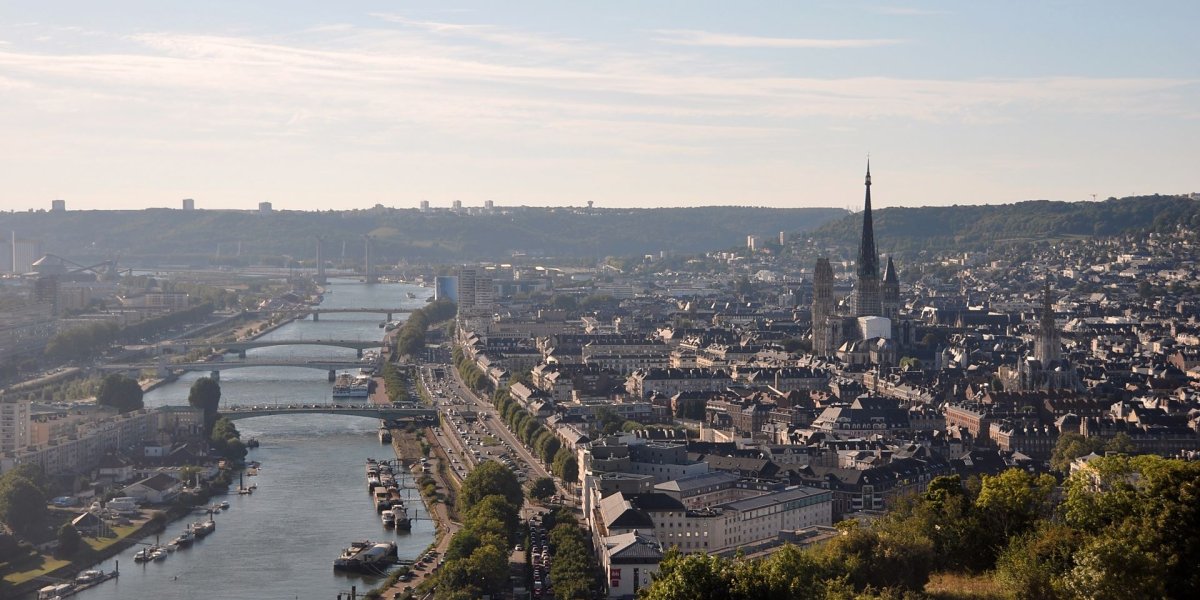
City Guide
Rouen
Francia · Best time to visit: May-Sep.
Day-by-day plan
Choose your pace
Duración del viaje
09:30
Religious
From Gare de Rouen-Rive-Droite, walk straight down Rue Jeanne d'Arc for twelve minutes — the whole city funnels you toward the square where she burned in 1431. A simple twenty-meter cross marks the exact spot; behind it rises a 1979 church shaped like an upturned Viking ship and a licking flame, its long stained-glass wall salvaged from a 16th-century church the Allies flattened in 1944. The leaning timber-framed houses ringing the square are the Rouen Joan herself would have recognized.
Tip: Stand with the cross directly in front of you and the church's green copper scale-roof behind it — that single frame tells the whole story in one photo. Avoid Tuesdays and Fridays when the covered market sprawls across the square and blocks the sightline.
Open in Google Maps →10:45
Landmark
Leave the square from its southeast corner and step straight onto Rue du Gros-Horloge — the pedestrian artery of the medieval city, lined the whole way with sagging timber facades painted ox-blood and cream. Three hundred meters in, a Renaissance archway lifts a single gilded clock face over your head: one hand, 24 hours, a silver sun rotating against deep blue enamel, untouched since 1529. Walk under the arch, turn around, and look back — the framing of cathedral spires beyond is the shot the postcards somehow never get.
Tip: Pass under the arch at exactly 12:00 — the whole medieval belfry chimes and the lunch-hour crowd has not yet arrived. Skip the paid belfry climb: the view from street level is the Monet-era one, and you will want your legs for the afternoon.
Open in Google Maps →12:30
Food
Continue east four minutes along Rue du Gros-Horloge until it becomes Rue Saint-Romain and the cathedral's south flank appears on your right — Dame Cakes is the pink-fronted tea room directly across. It occupies a restored 18th-century goldsmith's shop with a hidden garden terrace out back, and it is where Rouen grandmothers actually eat. Order the Norman tart with Neufchâtel cheese and cider-glazed apples (€14), finish with a caramelized apple tart and Calvados cream (€7.50), and drink a glass of dry Normandy cider instead of wine.
Tip: Walk straight past the front counter and ask for the garden terrace — 90% of visitors never realize it exists and the indoor salon fills by 12:45. No reservations; simply be there by 12:30 and you walk in.
Open in Google Maps →13:45
Religious
Step out of Dame Cakes and cross forty meters to Place de la Cathédrale — you are now standing where Monet set up his easel in the second-floor window of the old Au Caprice shop and painted this facade thirty times in every light. At two in the afternoon the sun pivots to the southwest and floods the entire west front, turning the limestone from gray to apricot to gold in real time as you watch. The tallest spire in France at 151 meters is cast iron, not stone — a 19th-century repair after lightning that Monet himself considered a scar.
Tip: The Monet vantage point is marked by a small bronze plaque on the pavement in front of the Office de Tourisme, the building directly opposite the facade — stand on the plaque for the exact painter's angle. Arrive by 14:00: one hour later the tourist office's own roof shadow begins clipping the lower portal and the magic breaks.
Open in Google Maps →15:30
Landmark
From the cathedral's south transept, cut east along Rue Saint-Romain past the flamboyant Église Saint-Maclou, then slip through the low passage at 186 Rue Martainville into a square courtyard that stops most visitors mid-step. This is a 16th-century plague cemetery — the oak beams of all four surrounding galleries are carved with skulls, crossed bones, gravediggers' tools, and dancing skeletons, blackened by five centuries of Norman weather. Restored in 2020, it is now a fine-arts school; students sketch under the same death's-head capitals where Black Death victims were once stacked to the roofline.
Tip: Enter through the main wooden door on Rue Martainville, not the side gate on Rue Géricault — the first sightline across the courtyard, with all four galleries of memento mori carvings converging toward you, is the only angle that captures the full macabre impact. Free entry, closes sharp at 18:00.
Open in Google Maps →19:00
Food
Leave the Aître and walk six minutes north on Rue Martainville, then right onto Rue Eau-de-Robec — a narrow street with a tiny stream still running down its center and rows of the most leaning, most painted timber houses in the city, once the dyers' and wool-fullers' quarter. Le P'tit Bec sits halfway along the row behind a crooked 15th-century facade. This is unpretentious Norman home cooking: order the gratin de poulet à la normande with Camembert and cider cream (€18), finish with teurgoule, Normandy's cinnamon rice pudding slow-baked six hours in a clay pot (€7). Two courses and a glass of cider come in under €35.
Tip: Phone ahead for the 19:00 seating — they rotate tables and the 20:30 turn often sells out by mid-afternoon. Do not eat on Place du Vieux-Marché or Place de la Cathédrale: those terraces exist purely for day-trippers, charge Paris prices for microwaved cassoulet, and the photogenic timber facades hide kitchens that buy everything frozen. Rouen's real food lives one street back, and Rue Eau-de-Robec is its heart.
Open in Google Maps →
Trip builder
Plan this trip around Rouen
Turn this guide into a bookable rail itinerary with FlipEarth.
Keep exploring
Related cities
More in the same country
FAQ
Frequently asked questions
How many days do you need in Rouen?
Most travelers enjoy Rouen in 1 days, with enough time for headline sights and a slower meal or museum stop.
What's the best time to visit Rouen?
The easiest season for most travelers is May-Sep, especially if you want good weather and manageable crowds.
What's the daily budget for Rouen?
A practical starting point is about €85 per person per day before hotels, then adjust based on museums, dining, and transport.
What are the must-see attractions in Rouen?
A good first shortlist for Rouen includes Gros-Horloge, Aître Saint-Maclou.